
BuddhistCatholicContemplativeEvangelicalGeneral ChristianHinduJewishLatter-day SaintMuslimNew VisionsProgressive Christian
Beliefs
- Buddhist
- Catholic
- Contemplative
- Evangelical
- General Christian
- Hindu
- Jewish
- Latter-day Saint
- More Voices
- Muslim
- New Visions
- Pagan
- Progressive Christian
Topics
- Religion News
- Food and Religion
- Sports and Religion
- Religious Art
- Religious Music and Entertainment
- Religious Events
- History and Religion
- Style and Religion
- Politics and Religion
- Women in Religion
- Recreation Outdoors and Religion
- Business Finance and Religion
- Careers Workplace and Religion
- Education and Religion
- Family Parenting and Religion
- Health Fitness and Religion
- Home and Religion
- Relationships and Religion
- Technology and Religion
- Travel and Religion
Columnists
- Buddhist Columnists
- Business Finance and Religion Columnists
- Careers Workplace and Religion Columnists
- Catholic Columnists
- Contemplative Columnists
- Education and Religion Columnists
- Evangelists Columnists
- Family Parenting and Religion Columnists
- General Christian Columnists
- Health Fitness and Religion Columnists
- Hindu Columnists
- History and Religion Columnists
- Home and Religion Columnists
- Jewish Columnists
- More Voices Columnists
- Latter Day Columnists
- Muslim Columnists
- New Visions Columnists
- Nonreligious Columnists
- Pagan Columnists
- Politics and Religion Columnists
- Progressive Columnists
- Recreation Outdoors and Religion Columnists
- Relationships and Religion Columnists
- Religion News Columnists
- Religious Art Columnists
- Religious Events Columnists
- Religious Music and Entertainment Columnists
- Sports and Religion Columnists
- Style and Religion Columnists
- Technology and Religion Columnists
- Travel and Religion Columnists
- Women in Religion Columnists
Resource Library
- 2026 Calendar
- Library of World Religions
- The 100 Most Holy Places on Earth
- Patheos Answers
- Podcasts
- Videos
- Faith Leaders Database
- Anglican Episcopalian
- Bahai
- Baptist
- Buddhism
- Christianity
- Confucianism
- Eastern Orthodoxy
- Hinduism
- Holiness and Pentecostal
- ISKCON
- Islam
- Judaism
- Lutheran
- Methodist
- The Church of Jesus Christ of Latter-day Saints
- New Age
- Paganism
- Presbytarian and Reformed
- Protestantism
- Religion Behind the Scenes
- Roman Catholic
- Scientology
- Shia Islam
- Sikhism
- Sufism
- Sunni Islam
- Taoism
- Zen
- See all religions
Research Tools
 Ad-Free & Subscriber Log-In Subscription Support
Follow Patheos 

- Trending:
- Advent
- |
- Forgiveness
- |
- Thanksgiving
- |
- Election
- |
- Seasonal Holidays
- |
- Marriage
 Jesus Creed
- Home
- Evangelical
- Reviewing Pete Enns: Is the Bible Just Humans Updating God as it Goes?
Reviewing Pete Enns: Is the Bible Just Humans Updating God as it Goes?
Last updated on: August 14, 2019 at 10:53 am by Scot McKnight
Reviewing Pete Enns: Is the Bible Just Humans Updating God as it Goes? 2019-08-14T10:53:43-05:00 Scot McKnight
Patheos Explore the world's faith through different perspectives on religion and spirituality! Patheos has the views of the prevalent religions and spiritualities of the world.
Part 1: On Wisdom By Geoff Holsclaw, a pastor and professor. See his free How Did We Get the Bible?
At some point in my childhood I remember hearing the story in the Bible of King Solomon’s asking God for wisdom (1 Kings 3). I really wanted wisdom—but probably not for the right reasons. God comes to Solomon in a dream and says that he can ask for whatever he wants and God will do it. Because he is a young and inexperienced king, Solomon asks for a wise and discerning heart. God was so pleased with this humble request that God also granted him riches and honor. For years after hearing this story I remember praying every night for wisdom, asking God to give me a wise and discerning heart, just like Solomon. Early on I’m sure this was more pragmatic than pious. I really just wanted the riches and the honor, and thought wisdom would be the divine shortcut. But by my teenage years I started to realize the value of wisdom, and how it didn’t always make life easier. In fact, wisdom sometimes makes life harder. Peter Enns’ new book, How the Bible Actually Works, at its best seeks to place us on the hard, but rewarding, path of wisdom. Enns seeks to grow us in maturity so that we might take up wisdom as our “sacred responsibility.”
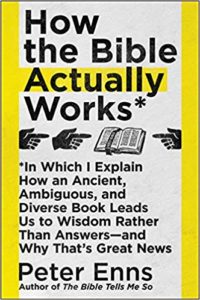
But in the end, it is unclear whether it is God’s path of wisdom or our own that Enns is leading us on. In this two part review of his book I want to start with what I appreciate about Enns’ approach the Bible (and there is much appreciation). In the next post I’ll raise my criticisms (about equal to my appreciation).
A Diverse Book of Wisdom
Enns is writing for the barely or formerly Christian who are trying to hang on to some semblance of faith in God and trying their hardest to give the Bible a second chance. By writing a popular book, rather than an academic treatise, Enns seeks to pastor those who feel duped by a church that preached a simplistic understanding of the Bible. Enns starts from two foundational assumptions. The first is that God is not a helicopter parent, micro-managing our lives. Instead, God is like a wise parent who wants us to grow in maturity and gain the skills necessary for life. God is not hovering over us offering moment by moment direction and meting out real time punishments for infractions. Rather, for Enns, God is like a wise parent who gives freedom and responsibility so that we can learn to handle life like “mature, well-functioning adults” (13). The second assumption—based on the first—is that the Bible is not a rulebook or instruction manual for life. A helicopter parent would spell everything thing out in detail and make sure nothing goes wrong. And a helicopter God would give us a sacred book “full of clear, consistent, unambiguous information” to follow (14). But God didn’t give us a Bible like this. The way the Bible actually works, according to Enns, is that it “leads us to wisdom rather than answers” (to quote the book’s subtitle). And it does this leaving by ample room for pondering, debating, and thinking amid its ancient, ambiguous, and diverse covers.
Don’t Answer A Fool, Except When You Should
Enns turns to the book of Proverbs—the wisdom book par excellence—as a guide for understanding the whole Bible. Near the end of the book is one of my favorite pair of proverbs. Do not answer a fool according to his folly, or you will be a fool yourself. Answer a fool according to his folly, or he will be wise in his own eyes. (Prov. 26:4-5) In back to back proverbs we get contradictory rules. If we read Proverbs like a clear cut rule book, then which one of these do we follow? Knowing which rule to follow requiring understanding the situation (Should I correct that foolish answer or ignore it). And understanding a situation and knowing how to response properly is what wisdom is all about. That’s why the book of Proverbs placed these right next to each other, so that we would start learning how to discern different situations and learn how to responded to them. Reading individual proverbs as if they were just rules to be followed would ruin your life. But instead of rules they are more like building blocks—the raw materials—from which we build wise lives. And this isn’t just how the book of Proverb help us become wise. Enns claims that this is how the entire Bible works. The whole Bible cultivates wisdom in us by offering diverse situations and different perspectives on God, humanity, and the world.
What About the 10 Commandments?
It might be objected, however, that there are plenty of rules in the Bible. And rather than cultivating wisdom, these rules demand obedience. There are the big ten commandments, for instance. But Enns notes that severals of these commandments are not really that straightforward. What does it really mean not to have any other gods “before” Yahweh. Does that mean none at all? Or just make sure Yahweh is first? And how do you know when you’ve taken God’s name in vain and when you haven’t? Jesus ran afoul of those who thought he wasn’t keeping the Sabbath holy in the right way. And what about honoring your father and mother? How do you really know when you’ve do it or not? Not stealing and not murdering seem easy enough to understand. But how do you know when you’ve cross the line from admiring to coveting? Enns claims these laws are ambiguous because their goal is to cultivate wisdom in us, the ability to know how to apply them creatively in the complex situations that come up in our complicated lives. And in this I think Enns is on to something. If we just think of the Bible as full of rules and answers then we are going to be disappointed and disillusioned. But if we see the Bible as the long and complicated story of a relational God interacting wisely with humanity, and longing for humanity to gain the wisdom that leads to life, then the twists and turns of the Bible become an opportunity to grow in our love and knowledge of God—and ourselves.
Updating For A New Context
For Enns, it’s not just that our lives require wisdom because they are complex. But wisdom is required because our lives are complex, and they are changing. Because of this we need to exercise wisdom in updating faith for new circumstances. The Bible, for Enns, models this kind of updating, adapting, or “reimagining” as he most often calls it (I’m not sure why Enns didn’t call it contextualizing, which is the term that would have clearer I think—perhaps he thought it too jargon for a popular book).
Exodus and Deuteronomy
One example of reimagine God’s laws are found in Exodus and Deuteronomy. The book of Exodus talks about the treatment and release of slaves. But the book of Deuteronomy has more humane laws concerning slaves. Another example concerns the rules about Passover. In Exodus the lamb is to be roasted, not boiled. And the Israelites prepare the lamb in their own homes. In Deuteronomy the lamb can be roasted or boiled. And the celebration must be in Jerusalem. In this and many other ways Enns claims that “Deuteronomy reimagines God for a new time and place. Deuteronomy is, in other words, an act of wisdom. For the past to have any spiritual vitality in the present, it had to be reshaped for the present” (87).
Samuel/Kings and Chronicles
Enns also turns the two long histories of the Old Testament of 1-2 Samuel and 1-2 Kings, and 1-2 Chronicles. Why two histories that retell much of the same material? What is going on here? Enns sees Samuel-Kings as written just before or during the Babylonian exile as an attempt to answer the question, “How did we get into this mess? What did we do to deserve exile?” (108). The answer is that the kings and leaders had led Israel astray into idolatry. Israel is being punished because of the sins of the kings, which is why it spends so much time telling the stories of the various kings, and whether they were evil or not. The history in Chronicles, written well after the return from exile, is not answering the question of why the Exile, but the question, “Is God still with us?” (108). Enns points out that rather than pinning the exile on sinful leaders, that the Chronicler places responsibility on all the people—it is much more collective in handing out blame. The moral of the story is that God is with Israel to the degree that the entire people stay faithful to God. This retelling of Israel’s history is “nothing less than one big act of reimagining God, of accepting the sacred responsibility to creatively retell the past in order to bridge that past to a difficult present” (109).
For, or Against, Nineveh?
Lastly, is God’s word, delivered by the prophets, a word of condemnation or compassion? The prophet Nahum received a message of condemnation. Speaking of Nineveh, Nahum 3 begins with “Woe to you city of blood…” (v. 1) and ends with “Nothing can heal you; your wound is fatal” (v. 19), and everything in between is destruction. But the prophet Jonah, who seems to concur with Nahum, is forced to watch God show compassion to Nineveh amid their mass repentance (Jonah 4). On the one hand, God is punishing those who punish Israel, making God especially concerned about Israel (Nahum). On the other hand, God seems concerned about extending mercy and compassion to all people, if they would only repent (Jonah). The presence of both Nahum and Jonah in the Bible forces us to wrestle with who God really is and to grow in wisdom about how to live accordingly.
Cultivating Wisdom, and Love
In the next post I will critically engage with Enns’ idea of the Bible update, adapting, or reimagining God as it goes along. But for now I want to express appreciation that Enns connects wisdom, maturity, and the Bible. Any careful reader of the New Testament knows that maturity is the goal of discipleship, of being conformed to the image of Christ. This is the reason that diverse gifts are given to the church, “so that the body of Christ may be built up until we all reach unity in the faith and in the knowledge of the Son of God and become mature, attaining to the whole measure of the fullness of Christ” (Eph. 4:12-15). Indeed, this maturity comes through the wisdom of God in Christ, the “one we proclaim, admonishing and teaching everyone with all wisdom, so that we may present everyone fully mature in Christ. To this end I strenuously contend with all the energy Christ so powerfully works in me” (Col. 1:28-29). This wisdom that works maturity in us the wisdom of God hidden in Christ (1 Cor. 2:6-7). This wisdom and maturity comes not through the Bible not as a rule book, but as something that cultivates wisdom in us as we grapple with its meaning. Enns is aligned with the ancient wisdom of Augustine who claimed that “the Bible was composed in such a way that as beginners mature, its meaning grows with them.” (Confession, 3.1). The difficulties in the text are there to turn our pride into humility as our hearts and minds are trained in wisdom. Augustine puts it even more strongly. For him, reading the Bible is no longer necessary once God had fully cultivated faith, hope, and love in us (On Christian Doctrine, 1.39). In other words, once we are mature in Christ, the Bible is no longer necessary. In this way, the difficulties in this ancient text are not first off problems to be solved, but opportunities to grow. Likewise, Enns invites us into a biblical complexity that cultivate wisdom, a complexity that is both more honest that we get from literal, fundamentalist approaches, and more helpful.
Next Time
In the next post I’ll engage with Enns’ larger claim that the “entire history of the Christian church is defined by moments of reimagining God to speak here and now…Reimagining the God of the Bible is what Christians do” (156). My concern is that this reimagining of God all too focused on humanity—how humanity thinks, feels, imagines God to be—and leaves almost no room for how God has revealGod to be. Indeed, Enns seems to have turned the Bible into what humans reimagine God to be, and has totally lefts aside whether the Bible reveals God in anyway. But that is for next time.
And for why I think we should still read the ancient document called the Bible, check out my free—and brief—ebook on How Did We Get the Bible?
Previous Post

August 5, 2019
Yet Again: Gun Violence. Yet Again: Time for Change?
Next Post
August 6, 2019 Inerrant or Trustworthy? (RJS)
Browse Our Archives
Select a Category Acts of the Apostles Adam Advent Anabaptism Angels Anglican Apologetics Atonement Baptism BCP Prayers Bible Biblical Studies Birds Blogging Bloglossary Bonhoeffer Books Calvinism Christianity Church Church History Coffee Colossians Commentary Recs Conversion Creation Creeds Culture Death Ecclesiastes Economics Education Embracing Grace Emergent Emerging Movement Eschatology Essays Ethics Eucharist Evangelicalism Family Fasting Fathers Fellowship of Differents Footsteps Tour Fun and Whimsical Gospel Grace Happiness Heaven Hell Holy Spirit Irenaeus James Jesus Jesus Creed Job Justification Kingdom of God Law Lectures Lent Liberalism Love and Marriage Mabanteneni Manhood Mary Miracles Missio Alliance MissioLife Missional Missional Jesus Movies and Film New Perspective Northern Seminary OneLife Origins Project Orthodox Parables Pastor's Spouse Pastoring and Leading Pastoring and Preaching Patristics Paul Paul-John Tour Pharisees Pietism Political Theology Prayer and Formation Preaching Problems for Faith Psalm 119 Psalms Public Issues Purgatory Religions Resurrection Revelation Romans Rule of JCreed Science and Faith Sermon on the Mount Sports Ten Commandments Theology Third Way Top Ten Lists Translations Uncategorized Universalism University Ministry Way Out Weekly Meanderings Wisdom Women and Ministry Work Worship Writing & Blogging Youth Ministry
Select a Month July 2021 January 2020 December 2019 November 2019 October 2019 September 2019 August 2019 July 2019 June 2019 May 2019 April 2019 March 2019 February 2019 January 2019 December 2018 November 2018 October 2018 September 2018 August 2018 July 2018 June 2018 May 2018 April 2018 March 2018 February 2018 January 2018 December 2017 November 2017 October 2017 September 2017 August 2017 July 2017 June 2017 May 2017 April 2017 March 2017 February 2017 January 2017 December 2016 November 2016 October 2016 September 2016 August 2016 July 2016 June 2016 May 2016 April 2016 March 2016 February 2016 January 2016 December 2015 November 2015 October 2015 September 2015 August 2015 July 2015 June 2015 May 2015 April 2015 March 2015 February 2015 January 2015 December 2014 November 2014 October 2014 September 2014 August 2014 July 2014 June 2014 May 2014 April 2014 March 2014 February 2014 January 2014 December 2013 November 2013 October 2013 September 2013 August 2013 July 2013 June 2013 May 2013 April 2013 March 2013 February 2013 January 2013 December 2012 November 2012 October 2012 September 2012 August 2012 July 2012 June 2012 May 2012 April 2012 March 2012 February 2012 January 2012 December 2011 November 2011 October 2011 September 2011 August 2011 July 2011 June 2011 May 2011 April 2011 March 2011 February 2011 January 2011 December 2010 November 2010 October 2010 September 2010 August 2010 July 2010 June 2010 May 2010 April 2010 March 2010 February 2010 January 2010 December 2009 November 2009 October 2009 September 2009 August 2009 July 2009 June 2009 May 2009 April 2009 March 2009 February 2009 January 2009 December 2008 November 2008 October 2008 September 2008 August 2008 July 2008 June 2008 May 2008 April 2008 March 2008 February 2008 January 2008 December 2007 November 2007 October 2007 September 2007 August 2007 July 2007 June 2007 May 2007 April 2007 March 2007 February 2007 January 2007 December 2006 November 2006 October 2006 September 2006 August 2006 July 2006 June 2006 May 2006 April 2006 March 2006 February 2006 January 2006 December 2005 November 2005 October 2005 September 2005 August 2005 July 2005 June 2005 May 2005 April 2005 0000
Follow Us!
TAKE THE
Religious Wisdom Quiz
How many chapters are in the Book of Romans?
Select your answer to see how you score.
14 16 12 18
Related posts from Jesus Creed


The Gospel of With Us and Through Us

Northern Seminary Announces: Nijay Gupta Joins Faculty

The Gundrys and Me: Ruth Tucker
TRENDING AT PATHEOS Evangelical

When you hear the word riches, what comes to mind? For most...

Don’t Miss the Parents: A Creative Christmas Meditation
As we enter the Advent Season, I see many people trying to...

Making Stones Into Bread: Choosing the “Right” Work
I was on my online arts ministry Zoom meeting with the International...

Ukraine’s exhausted Christians face fifth winter of war
By Julian Lukins The full-scale war in Ukraine is taking “a serious...

Russell Brand's Conviction is not anti-Christian Persecution
How do we shed the reputation that the Church is OK with...

Have you ever caught yourself saying, “I’ll do it tomorrow,” or “Now...
view all Evangelical blogs
Ad-Free & Subscriber Log-In Subscription Support
- About Us
- 2026 Calendar
- Videos
- Podcasts
- Library of World Religions
- Faith In Media Tracker
- Advertise With Us
- Write for Us
- Privacy Policy
- Terms of Service
- Do Not Sell My Data
- Contact Us
- Radiant Digital
- Manage Newsletter Subscriptions
- Unsubscribe From Notifications
- Sitemap
Copyright 2008-2026, Patheos, part of the Radiant Digital network of media brands. All rights reserved.
Subscription Support Ad-Free & Subscriber Log-In
Follow Patheos