
BuddhistCatholicContemplativeEvangelicalGeneral ChristianHinduJewishLatter-day SaintMuslimNew VisionsProgressive Christian
Beliefs
- Buddhist
- Catholic
- Contemplative
- Evangelical
- General Christian
- Hindu
- Jewish
- Latter-day Saint
- More Voices
- Muslim
- New Visions
- Pagan
- Progressive Christian
Topics
- Religion News
- Food and Religion
- Sports and Religion
- Religious Art
- Religious Music and Entertainment
- Religious Events
- History and Religion
- Style and Religion
- Politics and Religion
- Women in Religion
- Recreation Outdoors and Religion
- Business Finance and Religion
- Careers Workplace and Religion
- Education and Religion
- Family Parenting and Religion
- Health Fitness and Religion
- Home and Religion
- Relationships and Religion
- Technology and Religion
- Travel and Religion
Columnists
- Buddhist Columnists
- Business Finance and Religion Columnists
- Careers Workplace and Religion Columnists
- Catholic Columnists
- Contemplative Columnists
- Education and Religion Columnists
- Evangelists Columnists
- Family Parenting and Religion Columnists
- General Christian Columnists
- Health Fitness and Religion Columnists
- Hindu Columnists
- History and Religion Columnists
- Home and Religion Columnists
- Jewish Columnists
- More Voices Columnists
- Latter Day Columnists
- Muslim Columnists
- New Visions Columnists
- Nonreligious Columnists
- Pagan Columnists
- Politics and Religion Columnists
- Progressive Columnists
- Recreation Outdoors and Religion Columnists
- Relationships and Religion Columnists
- Religion News Columnists
- Religious Art Columnists
- Religious Events Columnists
- Religious Music and Entertainment Columnists
- Sports and Religion Columnists
- Style and Religion Columnists
- Technology and Religion Columnists
- Travel and Religion Columnists
- Women in Religion Columnists
Resource Library
- 2026 Calendar
- Library of World Religions
- The 100 Most Holy Places on Earth
- Patheos Answers
- Podcasts
- Videos
- Faith Leaders Database
- Anglican Episcopalian
- Bahai
- Baptist
- Buddhism
- Christianity
- Confucianism
- Eastern Orthodoxy
- Hinduism
- Holiness and Pentecostal
- ISKCON
- Islam
- Judaism
- Lutheran
- Methodist
- The Church of Jesus Christ of Latter-day Saints
- New Age
- Paganism
- Presbytarian and Reformed
- Protestantism
- Religion Behind the Scenes
- Roman Catholic
- Scientology
- Shia Islam
- Sikhism
- Sufism
- Sunni Islam
- Taoism
- Zen
- See all religions
Research Tools
 Ad-Free & Subscriber Log-In Subscription Support
Ad-Free & Subscriber Log-In Subscription Support
Follow Patheos 

- Trending:
- Forgiveness
- |
- Marriage
- |
- Consciousness
- |
- Death Penalty
- |
- Election
- |
- Halloween
 Jesus Creed
- Home
- Evangelical
- Ex Nihilo! (RJS)
Ex Nihilo! (RJS)
Last updated on: March 5, 2019 at 4:57 am by RJS
Ex Nihilo! (RJS) 2019-03-04T21:44:26-06:00 RJS
Patheos Explore the world's faith through different perspectives on religion and spirituality! Patheos has the views of the prevalent religions and spiritualities of the world.
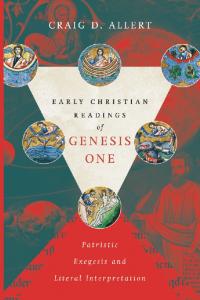 In Chapter 5 of Understanding Scientific Theories of Origins John Walton argued at length that in the opening chapter of Genesis God is ordering the cosmos and creating sacred space. It does not describe creation ex nihilo – out of nothing. In fact, Walton argues that it does not really describe material creation at all. Whether this is accurate or not, it is clear that both creation from nothing and an interpretation of Genesis 1 in the context of creation from nothing has a long history in the Christian church. In Chapter 5 of Early Christian Readings of Genesis One Craig Allert describes the importance of creation from nothing in the writings of the early church fathers.
In the beginning God created the heavens and the earth. Now the earth was formless and empty, darkness was over the surface of the deep, and the Spirit of God was hovering over the waters.
The interpretation of Genesis 1:1-2 to support the doctrine of creation from nothing was important to many of the early church fathers. The Greeks held several different views of creation with two major schools of thought. Lucretius provides an example of one school with a cosmos described as an accident with matter-in-motion explanations, infinite universe, transient cosmos, flat earth, and an evolution of process within the cosmos. He is explicit in his denial of divine agency and divine purpose. Plato and Aristotle provide examples of the other school where the cosmos has is unique, has purpose, is finite and either eternal or repeating with a spherical earth and often an immaterial soul. (summarized from p. 209) If the earth is thought to be created by a god or gods, it was produced from and constrained by preexisting matter.
This means that Plato’s creator is not really free, because he was limited to matter that possessed certain properties and dictated the way in which he could use it. The substance with which the creator worked did not have a starting point and thus the creator did not give the world its existence in the full ontological sense. Not only was Plato’s creator limited by preexistent matter, he was also limited by the space in which the matter existed. This space possessed movement and expansion and thus change. (pp. 211-212)
Neither of these options were acceptable in the early church any more than they would be today. Given this background we can see the importance of the opening line of the Apostles’ Creed “I believe in God, the Father Almighty, Creator of heaven and earth” expanded in the Nicene Creed: “We believe in one God, the Father almighty, maker of heaven and earth, of all things visible and invisible.” To acknowledge God as creator of everything was and is an important element of Christian belief.
Craig Allert looks at Theophilus of Antioch, Ephrem of Syria, and Basil of Caesarea to explore creation ex nihilo in the early church. Theophilus is the earliest of the three (died ca. 183-185 AD). A brief summary from Allert’s chapter:
Theophilus of Antioch is of special importance because he is usually identified as the first post-New Testament Christian writer to unambiguously argue for creatio ex nihilo in the ontological sense. One can see that the doctrine is clearly set in opposition to the previously mentioned ideas concerning the eternality of matter. (pp. 214-215)
Theophilus puts forth this argument for creation out of nothing for three reasons: First, if matter is preexistent (and therefore uncreated), this places matter on the same level as God, and he can no longer be thought of as the Creator of everything; second, since God is uncreated he is, therefore, immutable (similarly, if matter was uncreated it would also be immutable); third, God creating out of preexistent matter is no different than a human craftsman fashioning something out of a given material. Because God creates out of nothing and fashions “whatever he wished in whatever way he wished,” he can, unlike human craftsmen, create a being that is rational, breathing, and capable of sensation. In other words, for Theophilus creation out of nothing must be seen in parallel with the conferring of life. (p. 220)
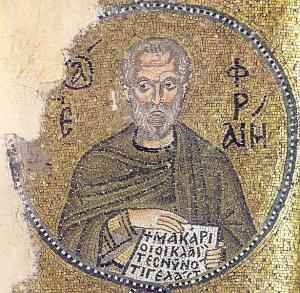 Ephrem the Syrian (ca. 306 – 373 AD) and Basil of Caesarea (ca. 329-379 AD) represent a more completely developed doctrine of creation out of nothing. Ephrem looks to Moses as the author of Genesis 1 to refute errant cosmologies of his day, particularly a cosmology proposed by Bardasian a century or so earlier. Ephraim is particularly concerned to defend the sovereignty of God as creator of everything that exists. Whereas Bardasian held that God ordered preexisting matter, for Ephraim this was heretical and he argued at length for creation ex nihilo. Allert quotes from Ephrem’s commentary on Genesis:
Therefore, it is evident that heaven and earth came to be from nothing because neither water nor wind had yet been created, nor had fire, light or darkness been given their nature. for they were younger than heaven and earth. These things were created things that came after heaven and earth and they were not self-subsistent beings for they did not exist before [heaven and earth] (p. 224)
God created heaven and earth from nothing and before anything else existed.
Basil argued something similar although he isn’t quite as explicit. God is the creator at all with the cosmos having both a beginning (no preexisting matter) and an end in the age to come. Allert summarizes Basil:
But with the opening words of Genesis, Moses immediately posits God as Creator. As Basil states, “How beautiful an arrangement! He placed first ‘the beginning,’ that no one might believe that it was without a beginning. Then he added the word ‘created,’ that it might be shown that what was made required a very small part of the power of the creator.” It was by his will alone that the Creator brought the material world into existence. Thus, we should not imagine a world without beginning and without end. This first statement in the “divinely inspired teaching” of Genesis is “the preliminary proclamation of the doctrine concerning the end and the changing of the world.” (p. 227)
Allert summarizes the views in the early church:
The doctrine of creatio ex nihilo in the early church was established in direct opposition to certain philosophical and scientific views that encroached on God’s providence, sovereignty, and eternality. … In the Fathers discussed in this book, creation out of nothing was well accepted and seen as a necessary counter to certain philosophical and scientific views of God. (p. 228)
Whether Genesis 1 actually teaches creation from nothing or not, it was clearly interpreted and used in the early church and down through the ages as teaching such a view. In many respects it doesn’t matter if their use of Genesis 1 was appropriate. Creation from nothing is a Christian doctrine that can be defended from Scripture independent of the original intent of the author of Genesis 1 – whose culture may well have had different challenges and questions that needed to be addressed. In particular it can be defended from Colossians 1:15-17 and John 1:1-4. We say with the church Fathers that We believe in one God, the Father almighty, maker of heaven and earth, of all things visible and invisible.
If you wish to contact me directly you may do so at rjs4mail[at]att.net.
If interested you can subscribe to a full text feed of my posts at Musings on Science and Theology.
Previous Post

March 5, 2019
Can A Paycheck Bring Purpose? On Workism
Next Post

March 5, 2019 Nancy Beach's Wise Words
Browse Our Archives
Select a Category Acts of the Apostles Adam Advent Anabaptism Angels Anglican Apologetics Atonement Baptism BCP Prayers Bible Biblical Studies Birds Blogging Bloglossary Bonhoeffer Books Calvinism Christianity Church Church History Coffee Colossians Commentary Recs Conversion Creation Creeds Culture Death Ecclesiastes Economics Education Embracing Grace Emergent Emerging Movement Eschatology Essays Ethics Eucharist Evangelicalism Family Fasting Fathers Fellowship of Differents Footsteps Tour Fun and Whimsical Gospel Grace Happiness Heaven Hell Holy Spirit Irenaeus James Jesus Jesus Creed Job Justification Kingdom of God Law Lectures Lent Liberalism Love and Marriage Mabanteneni Manhood Mary Miracles Missio Alliance MissioLife Missional Missional Jesus Movies and Film New Perspective Northern Seminary OneLife Origins Project Orthodox Parables Pastor's Spouse Pastoring and Leading Pastoring and Preaching Patristics Paul Paul-John Tour Pharisees Pietism Political Theology Prayer and Formation Preaching Problems for Faith Psalm 119 Psalms Public Issues Purgatory Religions Resurrection Revelation Romans Rule of JCreed Science and Faith Sermon on the Mount Sports Ten Commandments Theology Third Way Top Ten Lists Translations Uncategorized Universalism University Ministry Way Out Weekly Meanderings Wisdom Women and Ministry Work Worship Writing & Blogging Youth Ministry
Select a Month July 2021 January 2020 December 2019 November 2019 October 2019 September 2019 August 2019 July 2019 June 2019 May 2019 April 2019 March 2019 February 2019 January 2019 December 2018 November 2018 October 2018 September 2018 August 2018 July 2018 June 2018 May 2018 April 2018 March 2018 February 2018 January 2018 December 2017 November 2017 October 2017 September 2017 August 2017 July 2017 June 2017 May 2017 April 2017 March 2017 February 2017 January 2017 December 2016 November 2016 October 2016 September 2016 August 2016 July 2016 June 2016 May 2016 April 2016 March 2016 February 2016 January 2016 December 2015 November 2015 October 2015 September 2015 August 2015 July 2015 June 2015 May 2015 April 2015 March 2015 February 2015 January 2015 December 2014 November 2014 October 2014 September 2014 August 2014 July 2014 June 2014 May 2014 April 2014 March 2014 February 2014 January 2014 December 2013 November 2013 October 2013 September 2013 August 2013 July 2013 June 2013 May 2013 April 2013 March 2013 February 2013 January 2013 December 2012 November 2012 October 2012 September 2012 August 2012 July 2012 June 2012 May 2012 April 2012 March 2012 February 2012 January 2012 December 2011 November 2011 October 2011 September 2011 August 2011 July 2011 June 2011 May 2011 April 2011 March 2011 February 2011 January 2011 December 2010 November 2010 October 2010 September 2010 August 2010 July 2010 June 2010 May 2010 April 2010 March 2010 February 2010 January 2010 December 2009 November 2009 October 2009 September 2009 August 2009 July 2009 June 2009 May 2009 April 2009 March 2009 February 2009 January 2009 December 2008 November 2008 October 2008 September 2008 August 2008 July 2008 June 2008 May 2008 April 2008 March 2008 February 2008 January 2008 December 2007 November 2007 October 2007 September 2007 August 2007 July 2007 June 2007 May 2007 April 2007 March 2007 February 2007 January 2007 December 2006 November 2006 October 2006 September 2006 August 2006 July 2006 June 2006 May 2006 April 2006 March 2006 February 2006 January 2006 December 2005 November 2005 October 2005 September 2005 August 2005 July 2005 June 2005 May 2005 April 2005 0000
Follow Us!
TAKE THE
Religious Wisdom Quiz
What does "Tabernacle" mean?
Select your answer to see how you score.
Dwelling place Cupboard Holy altar Sacrifice
Related posts from Jesus Creed


The Gospel of With Us and Through Us

Northern Seminary Announces: Nijay Gupta Joins Faculty

The Gundrys and Me: Ruth Tucker
TRENDING AT PATHEOS Evangelical

How the author of the world's best hymn...
I've been working with John Newton for a while now. This makes...

Long before this Lectio Divina, Psalm 130 - the song - started...

What About the Trees? Another Living Parable
After I finished writing the last article about falling leaves as a...

Why Classical Education Is a Conversation, Not a...
Come and Read: Joy in Classical Education When I was a little...

Falling Leaves: A Living Parable on Letting Go
I’ve spent the vast majority of my life in the southeast corner...

Cornell University has received a great deal of negative publicity and intense...
view all Evangelical blogs
Ad-Free & Subscriber Log-In Subscription Support
- About Us
- 2026 Calendar
- Videos
- Podcasts
- Library of World Religions
- Faith In Media Tracker
- Advertise With Us
- Write for Us
- Privacy Policy
- Terms of Service
- Do Not Sell My Data
- Contact Us
- Radiant Digital
- Manage Newsletter Subscriptions
- Unsubscribe From Notifications
- Sitemap
Copyright 2008-2026, Patheos. All rights reserved.
Subscription Support Ad-Free & Subscriber Log-In
Follow Patheos