
BuddhistCatholicContemplativeEvangelicalGeneral ChristianHinduJewishLatter-day SaintMuslimNew VisionsProgressive Christian
Beliefs
- Buddhist
- Catholic
- Contemplative
- Evangelical
- General Christian
- Hindu
- Jewish
- Latter-day Saint
- More Voices
- Muslim
- New Visions
- Pagan
- Progressive Christian
Topics
- Religion News
- Food and Religion
- Sports and Religion
- Religious Art
- Religious Music and Entertainment
- Religious Events
- History and Religion
- Style and Religion
- Politics and Religion
- Women in Religion
- Recreation Outdoors and Religion
- Business Finance and Religion
- Careers Workplace and Religion
- Education and Religion
- Family Parenting and Religion
- Health Fitness and Religion
- Home and Religion
- Relationships and Religion
- Technology and Religion
- Travel and Religion
Columnists
- Buddhist Columnists
- Business Finance and Religion Columnists
- Careers Workplace and Religion Columnists
- Catholic Columnists
- Contemplative Columnists
- Education and Religion Columnists
- Evangelists Columnists
- Family Parenting and Religion Columnists
- General Christian Columnists
- Health Fitness and Religion Columnists
- Hindu Columnists
- History and Religion Columnists
- Home and Religion Columnists
- Jewish Columnists
- More Voices Columnists
- Latter Day Columnists
- Muslim Columnists
- New Visions Columnists
- Nonreligious Columnists
- Pagan Columnists
- Politics and Religion Columnists
- Progressive Columnists
- Recreation Outdoors and Religion Columnists
- Relationships and Religion Columnists
- Religion News Columnists
- Religious Art Columnists
- Religious Events Columnists
- Religious Music and Entertainment Columnists
- Sports and Religion Columnists
- Style and Religion Columnists
- Technology and Religion Columnists
- Travel and Religion Columnists
- Women in Religion Columnists
Resource Library
- 2026 Calendar
- Library of World Religions
- The 100 Most Holy Places on Earth
- Patheos Answers
- Podcasts
- Videos
- Faith Leaders Database
- Anglican Episcopalian
- Bahai
- Baptist
- Buddhism
- Christianity
- Confucianism
- Eastern Orthodoxy
- Hinduism
- Holiness and Pentecostal
- ISKCON
- Islam
- Judaism
- Lutheran
- Methodist
- The Church of Jesus Christ of Latter-day Saints
- New Age
- Paganism
- Presbytarian and Reformed
- Protestantism
- Religion Behind the Scenes
- Roman Catholic
- Scientology
- Shia Islam
- Sikhism
- Sufism
- Sunni Islam
- Taoism
- Zen
- See all religions
Research Tools
 Ad-Free & Subscriber Log-In Subscription Support
Ad-Free & Subscriber Log-In Subscription Support
Follow Patheos 

- Trending:
- Forgiveness
- |
- Marriage
- |
- Consciousness
- |
- Death Penalty
- |
- Election
- |
- Halloween
 Jesus Creed
- Home
- Evangelical
- Miracles As Experienced Reality
Miracles As Experienced Reality
Last updated on: October 23, 2018 at 12:05 am by Scot McKnight
Miracles As Experienced Reality 2018-10-21T11:00:47-05:00 Scot McKnight
Patheos Explore the world's faith through different perspectives on religion and spirituality! Patheos has the views of the prevalent religions and spiritualities of the world.
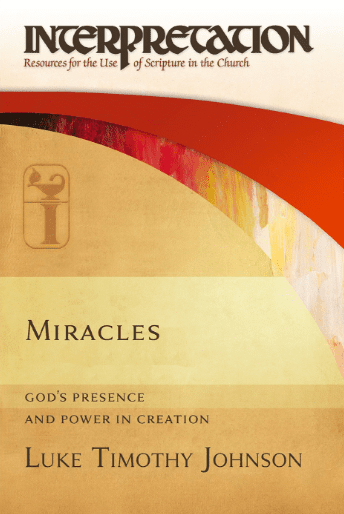 Luke Timothy Johnson, unlike any author I know, connects miracles to experience, not to dismiss an empirical reality but to focus on the life-in-connection-to-supernatural that is characteristic of earliest Christianity.
We are talking here about his book Miracles: God’s Presence and Power in Creation.
While the Gospels are known for their miracles and signs, there is a lack of attention to the overwhelming belief in the power of God at work in what is said in the letters.
Similarly, in the narratives of the Gospels (and Acts), which recount events of the past, miracles are attached to characters in the story, above all to Jesus and the apostles, as acts that they perform. In the Epistles, written in response to current circumstances, the presence and power of God is the implicit premise of all discourse.
The whole NT is a witness to an experienced reality, not just facts that happened.
If the character of the New Testament writings is properly to be appreciated, then they ought to be approached as a set of witnesses to a range of experiences and convictions concerning the presence and power of God made possible through the ministry, death, and resurrection of Jesus Christ.
We forget this: what did Jesus and the apostles and early church offer to the world? Redemption as a new reality in which they actually lived.
The Christian movement did not offer the world then (or now) a comprehensive interpretation of the world more logical or verifiable than that offered by its competitors; it did not present then (or now) a moral vision that was purer or saner than that found in other schools and other philosophies. It certainly did not then (or now) contain a vision for the ordering of society, the management of economy, the deployment of resources, or the education of the young, as its rivals sometimes did.
What the nascent Christian movement did offer (and sometimes now still offers) are claims to having experienced, within the context of ordinary human existence, the extraordinary presence and power of God. The New Testament s enduring ability to compel attention owes much to the way in which it shows how such extraordinary claims to the miraculous intersect with, and complicate, the mundane lives of those making those claims.
Miracle then is not an adjunct to the Christian faith; it is its only reality.
If we want to understand and appreciate discourse concerning miracles in the pages of the New Testament, then from the start we must grasp that the miraculous is not an incidental or disposable component of the Christian religion; it is rather the heart and the entire point of the Christian religion.
Johnson explores the claims of the earliest Christians:
Believers claim to play a pivotal role in the worlds present and future. They participate in the reconciliation of the world with God (Rom. 5:10; 2 Cor. 5:19), and they anticipate the rebirth of the entire cosmos into liberty (Rom. 8:20-22). … They spoke, for example, of having been released from the cosmic forces that, in the perceptions of that age, otherwise dominated human existence: they were no longer subject to such “powers and principalities” (Rom. 8:38; 1 Cor. 2:6-10; Eph. 2:1-10; Col. 1:13; 1 Pet. 3:22) or to the “elemental spirits of the universe” (Gal. 4:3, 9; Col. 2:8, 20), or to the repressive systems of law that those forces had used to keep humans in bondage (Rom. 6:15-23; 2 Cor. 3:6-18; Gal. 3:23-4:7; Col. 2:8-23).
How to explain this? Johnson says the word is “power.”
When we scan the language expressing these experiential realities, we quickly become aware of how frequently, even consistently, such speech intersects language about power. The fundamental Christian claim was to have been touched by an awesome force that had given them new and unexpected power, a particularly paradoxical claim given their worldly circumstances.
In a potent paragraph, Johnson points to this experienced reality, this miracle-experienced reality, through the word “now.”
The distinctive experiential basis for the existence and success of the Christian movement can be shown by tracing the use of the simple word “now” throughout the writings of the New Testament. In Paul’s Letter to the Romans, Paul writes that now Gods righteousness is being revealed (3:21, 26), now they have been made righteous (5:9), now they have been reconciled to God (5:11), now they are freed from sin (6:22), now they are discharged from the law (7:6), now there is no condemnation for God’s people (8:1), and now the mystery of God is being revealed (16:26). Paul says in another place, “See, now is the acceptable time; see, now is the day of salvation!” (2 Cor. 6:2, emphasis added; see also Gal. 4:9; Eph. 2:2; 3:5; Col. 1:22, 26; 2 Tim. 1:10; Heb. 9:26; 1 Pet. 1:12; 2:25; 3:21; 1 John 3:2).
No “now” and no miracle apart from the resurrection of Jesus as something also experienced by the early Christians:
The resurrection experience, I argue, is the fundamental miracle that brings Christianity into existence and provides the basis for all the claims made by the first believers. A full grasp of this thesis, however, requires making a distinction between (1) narrative accounts, which place an emphasis on the resurrection as something that happened to Jesus, and (2) the discourse of epistolary literature, which places an emphasis on the resurrection as something that happens to believers through the power of the Holy Spirit. The neglect or denial of either sort of witness threatens to distort the full truth of Christianity’s original and most provocative proclamation.
The experience of Jesus’ powerful presence was possible because he was alive and caused it. We can define the resurrection experience that gave birth to Christianity as the experience of the continuing presence of a personal, transcendent, and transforming power within the community.
No Christianity apart from this miracle-experienced reality. None.
Indeed, of all the distortions of the gospel that Christianity has accomplished over the centuries, and there have been more than a few, none is greater than the shift that made the resurrection into an event of the past that could be celebrated liturgically once a year at Easter, rather than the existential truth concerning the present that forms the basis of all proclamation and Christian practice (Johnson 1994).
Previous Post

October 22, 2018
Eugene Peterson, We'll Miss You
Next Post
October 23, 2018 CT, The 81%, and John Hawthorne
Browse Our Archives
Select a Category Acts of the Apostles Adam Advent Anabaptism Angels Anglican Apologetics Atonement Baptism BCP Prayers Bible Biblical Studies Birds Blogging Bloglossary Bonhoeffer Books Calvinism Christianity Church Church History Coffee Colossians Commentary Recs Conversion Creation Creeds Culture Death Ecclesiastes Economics Education Embracing Grace Emergent Emerging Movement Eschatology Essays Ethics Eucharist Evangelicalism Family Fasting Fathers Fellowship of Differents Footsteps Tour Fun and Whimsical Gospel Grace Happiness Heaven Hell Holy Spirit Irenaeus James Jesus Jesus Creed Job Justification Kingdom of God Law Lectures Lent Liberalism Love and Marriage Mabanteneni Manhood Mary Miracles Missio Alliance MissioLife Missional Missional Jesus Movies and Film New Perspective Northern Seminary OneLife Origins Project Orthodox Parables Pastor's Spouse Pastoring and Leading Pastoring and Preaching Patristics Paul Paul-John Tour Pharisees Pietism Political Theology Prayer and Formation Preaching Problems for Faith Psalm 119 Psalms Public Issues Purgatory Religions Resurrection Revelation Romans Rule of JCreed Science and Faith Sermon on the Mount Sports Ten Commandments Theology Third Way Top Ten Lists Translations Uncategorized Universalism University Ministry Way Out Weekly Meanderings Wisdom Women and Ministry Work Worship Writing & Blogging Youth Ministry
Select a Month July 2021 January 2020 December 2019 November 2019 October 2019 September 2019 August 2019 July 2019 June 2019 May 2019 April 2019 March 2019 February 2019 January 2019 December 2018 November 2018 October 2018 September 2018 August 2018 July 2018 June 2018 May 2018 April 2018 March 2018 February 2018 January 2018 December 2017 November 2017 October 2017 September 2017 August 2017 July 2017 June 2017 May 2017 April 2017 March 2017 February 2017 January 2017 December 2016 November 2016 October 2016 September 2016 August 2016 July 2016 June 2016 May 2016 April 2016 March 2016 February 2016 January 2016 December 2015 November 2015 October 2015 September 2015 August 2015 July 2015 June 2015 May 2015 April 2015 March 2015 February 2015 January 2015 December 2014 November 2014 October 2014 September 2014 August 2014 July 2014 June 2014 May 2014 April 2014 March 2014 February 2014 January 2014 December 2013 November 2013 October 2013 September 2013 August 2013 July 2013 June 2013 May 2013 April 2013 March 2013 February 2013 January 2013 December 2012 November 2012 October 2012 September 2012 August 2012 July 2012 June 2012 May 2012 April 2012 March 2012 February 2012 January 2012 December 2011 November 2011 October 2011 September 2011 August 2011 July 2011 June 2011 May 2011 April 2011 March 2011 February 2011 January 2011 December 2010 November 2010 October 2010 September 2010 August 2010 July 2010 June 2010 May 2010 April 2010 March 2010 February 2010 January 2010 December 2009 November 2009 October 2009 September 2009 August 2009 July 2009 June 2009 May 2009 April 2009 March 2009 February 2009 January 2009 December 2008 November 2008 October 2008 September 2008 August 2008 July 2008 June 2008 May 2008 April 2008 March 2008 February 2008 January 2008 December 2007 November 2007 October 2007 September 2007 August 2007 July 2007 June 2007 May 2007 April 2007 March 2007 February 2007 January 2007 December 2006 November 2006 October 2006 September 2006 August 2006 July 2006 June 2006 May 2006 April 2006 March 2006 February 2006 January 2006 December 2005 November 2005 October 2005 September 2005 August 2005 July 2005 June 2005 May 2005 April 2005 0000
Follow Us!
TAKE THE
Religious Wisdom Quiz
Which king was famous for his wisdom and built the first temple in Jerusalem?
Select your answer to see how you score.
Saul David Rehoboam Solomon
Related posts from Jesus Creed
How Important Are Miracles For Christian Faith?



TRENDING AT PATHEOS Evangelical

How the author of the world's best hymn...
I've been working with John Newton for a while now. This makes...

Long before this Lectio Divina, Psalm 130 - the song - started...

What About the Trees? Another Living Parable
After I finished writing the last article about falling leaves as a...

Why Classical Education Is a Conversation, Not a...
Come and Read: Joy in Classical Education When I was a little...

Falling Leaves: A Living Parable on Letting Go
I’ve spent the vast majority of my life in the southeast corner...

Cornell University has received a great deal of negative publicity and intense...
view all Evangelical blogs
Ad-Free & Subscriber Log-In Subscription Support
- About Us
- 2026 Calendar
- Videos
- Podcasts
- Library of World Religions
- Faith In Media Tracker
- Advertise With Us
- Write for Us
- Privacy Policy
- Terms of Service
- Do Not Sell My Data
- Contact Us
- Radiant Digital
- Manage Newsletter Subscriptions
- Unsubscribe From Notifications
- Sitemap
Copyright 2008-2026, Patheos. All rights reserved.
Subscription Support Ad-Free & Subscriber Log-In
Follow Patheos