
BuddhistCatholicContemplativeEvangelicalGeneral ChristianHinduJewishLatter-day SaintMuslimNew VisionsProgressive Christian
Beliefs
- Buddhist
- Catholic
- Contemplative
- Evangelical
- General Christian
- Hindu
- Jewish
- Latter-day Saint
- More Voices
- Muslim
- New Visions
- Pagan
- Progressive Christian
Topics
- Religion News
- Food and Religion
- Sports and Religion
- Religious Art
- Religious Music and Entertainment
- Religious Events
- History and Religion
- Style and Religion
- Politics and Religion
- Women in Religion
- Recreation Outdoors and Religion
- Business Finance and Religion
- Careers Workplace and Religion
- Education and Religion
- Family Parenting and Religion
- Health Fitness and Religion
- Home and Religion
- Relationships and Religion
- Technology and Religion
- Travel and Religion
Columnists
- Buddhist Columnists
- Business Finance and Religion Columnists
- Careers Workplace and Religion Columnists
- Catholic Columnists
- Contemplative Columnists
- Education and Religion Columnists
- Evangelists Columnists
- Family Parenting and Religion Columnists
- General Christian Columnists
- Health Fitness and Religion Columnists
- Hindu Columnists
- History and Religion Columnists
- Home and Religion Columnists
- Jewish Columnists
- More Voices Columnists
- Latter Day Columnists
- Muslim Columnists
- New Visions Columnists
- Nonreligious Columnists
- Pagan Columnists
- Politics and Religion Columnists
- Progressive Columnists
- Recreation Outdoors and Religion Columnists
- Relationships and Religion Columnists
- Religion News Columnists
- Religious Art Columnists
- Religious Events Columnists
- Religious Music and Entertainment Columnists
- Sports and Religion Columnists
- Style and Religion Columnists
- Technology and Religion Columnists
- Travel and Religion Columnists
- Women in Religion Columnists
Resource Library
- 2026 Calendar
- Library of World Religions
- The 100 Most Holy Places on Earth
- Patheos Answers
- Podcasts
- Videos
- Faith Leaders Database
- Anglican Episcopalian
- Bahai
- Baptist
- Buddhism
- Christianity
- Confucianism
- Eastern Orthodoxy
- Hinduism
- Holiness and Pentecostal
- ISKCON
- Islam
- Judaism
- Lutheran
- Methodist
- The Church of Jesus Christ of Latter-day Saints
- New Age
- Paganism
- Presbytarian and Reformed
- Protestantism
- Religion Behind the Scenes
- Roman Catholic
- Scientology
- Shia Islam
- Sikhism
- Sufism
- Sunni Islam
- Taoism
- Zen
- See all religions
Research Tools
 Ad-Free & Subscriber Log-In Subscription Support
Follow Patheos 

- Trending:
- Advent
- |
- Forgiveness
- |
- Thanksgiving
- |
- Election
- |
- Seasonal Holidays
- |
- Marriage
 Jesus Creed
- Home
- Evangelical
- Religious Scientists? (RJS)
Religious Scientists? (RJS)
Last updated on: January 30, 2018 at 7:17 am by RJS
Religious Scientists? (RJS) 2018-01-30T07:17:52-06:00 RJS
Patheos Explore the world's faith through different perspectives on religion and spirituality! Patheos has the views of the prevalent religions and spiritualities of the world.
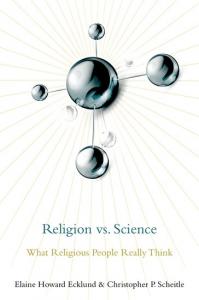 Chapter 4 of the new book, Religion vs. Science: What Religious People Really Think, by Elaine Howard Ecklund and Christopher P. Scheitle looks Christians active in the sciences. Elaine Ecklund’s earlier book Science vs. Religion: What Scientists Really Think focused on scientists at elite universities. It is clear that this population is far less religious than the general US population. It is not clear that the primary reason for this is conflict between science and religion. We can consider several different reasons:
Education removes the reason for God. If God is simply an explanation for gaps in understanding this is a plausible explanation and should influence scientists at all levels.
Education introduces a dissonance, a conflict, between the evidence and the faith. Young earth, evolution, and old testament studies are all places where this comes into play. Again, this will influence scientists in many walks of life, not only elite universities.
The University environment may be hostile to faith. There can be pressure, both overt and subtle leave the faith. To lose the respect of one’s peers is a severe and real possibility. Peer pressure at the university – this will vary across institutions and vocations. This leads to another reason.
The group may be self-selected. Perhaps pursuit of graduate education itself doesn’t cause loss of faith – rather people of faith tend to pursue other career paths.
The sometimes hostile environment may lead to other career choices. I have spoken with a number of Christian graduate students for whom this was true – while originally interested in academic careers, they didn’t want to step into this hornet’s nest. In Religion vs. Science Ecklund and Scheitle note that when it comes to religious belief the disparity between elite University professors and the general population isn’t confined to the sciences. It is true across disciplines.
In Science vs. Religion Ecklund reports that many of those who came from a religious tradition noted that religion was not very important in their families as children. Those from families where religion was important are much more likely to retain faith as adults. For one specific sample group of young scientists Eckland notes that it appears that ~85% retain faith. This is a substantial percentage. However, this is a small portion of the total sample surveyed. Perhaps those from strong religious backgrounds self-select out of careers at elite universities. Given the commitment of time and effort involved and the fact that religious people may devalue the workaholic approach to life, this is a real possibility.
Education doesn’t cause loss of faith – rather loss of faith precedes education. Ekclund relates stories by several scientists who comment on bad experiences growing up in the church. No place for honest, inquisitive, hard questions and a real or perceived hypocrisy led to loss of faith for all three here – science was involved only peripherally. It was not the facts, it was the attitude.
What about scientists in general? In the present book Ecklund and Scheitle look at a much broader range of scientists in careers outside of academia. Something like 3 to 4% of Christians are what they call rank-and-file scientists (see the book for their definitions and classifications). This is true of evangelicals, mainline protestants, and Catholics. A higher percentage of Jews, those from non-Western religions, and the unaffiliated are rank-and-file scientists. However, when adjusted for other factors such as region of residence, race, education, and income the differences vanish. “These differences are mostly a result of other social and demographic differences between the groups, especially discrepancies in education.” (p. 60) Overall rank-and-file scientists look very much like the general population.
In their survey and interviews Ecklund and Scheitle found that like their colleagues at elite universities, religious rank-and-file scientists feel a squeeze between the expectation at work that scientists are not (supposed to be) religious and the perception at church that Christians in the sciences are dangerous and suspect. (No one can love two masters.) They also find that “evangelical rank-and-file scientists are … significantly more likely than their evangelical peers to think that scientists are hostile to religion.” (p. 65) Ecklund and Scheitle suggest (and I agree) that this is because they are more likely to have heard informal negative comments.
 Lessons for the church. The best approach to dispel the atmosphere of conflict is to bring scientists in the church to the conversation. The scientists in the pews, known to the congregation will generally have the biggest impact. It can be useful to bring in “big names” for special lectures or presentations, but engage the locals in the conversation as experts in their fields. In the process, however, it is important to have a well-defined approach for dealing with potentially divisive issues. Ecklund describes a Scientists in Congregations program at her church – where many scientists in the congregation were initially quite wary – but overall convinced by the end that the program was a success for them personally as well as for the congregation at large. Although we have not had a formal program at our church, I have found the same to be true. To be engaged in open conversation is good for me and for my fellow Christians.
Do you know any Christians working and highly educated in scientific positions?
How do they think about the “conflict” between science and faith?
If you wish to contact me directly you may do so at rjs4mail[at]att.net.
If interested you can subscribe to a full text feed of my posts at Musings on Science and Theology.
Previous Post

January 30, 2018
"For Our Sins"
Next Post
January 31, 2018 Defending A Christian Worldview
Browse Our Archives
Select a Category Acts of the Apostles Adam Advent Anabaptism Angels Anglican Apologetics Atonement Baptism BCP Prayers Bible Biblical Studies Birds Blogging Bloglossary Bonhoeffer Books Calvinism Christianity Church Church History Coffee Colossians Commentary Recs Conversion Creation Creeds Culture Death Ecclesiastes Economics Education Embracing Grace Emergent Emerging Movement Eschatology Essays Ethics Eucharist Evangelicalism Family Fasting Fathers Fellowship of Differents Footsteps Tour Fun and Whimsical Gospel Grace Happiness Heaven Hell Holy Spirit Irenaeus James Jesus Jesus Creed Job Justification Kingdom of God Law Lectures Lent Liberalism Love and Marriage Mabanteneni Manhood Mary Miracles Missio Alliance MissioLife Missional Missional Jesus Movies and Film New Perspective Northern Seminary OneLife Origins Project Orthodox Parables Pastor's Spouse Pastoring and Leading Pastoring and Preaching Patristics Paul Paul-John Tour Pharisees Pietism Political Theology Prayer and Formation Preaching Problems for Faith Psalm 119 Psalms Public Issues Purgatory Religions Resurrection Revelation Romans Rule of JCreed Science and Faith Sermon on the Mount Sports Ten Commandments Theology Third Way Top Ten Lists Translations Uncategorized Universalism University Ministry Way Out Weekly Meanderings Wisdom Women and Ministry Work Worship Writing & Blogging Youth Ministry
Select a Month July 2021 January 2020 December 2019 November 2019 October 2019 September 2019 August 2019 July 2019 June 2019 May 2019 April 2019 March 2019 February 2019 January 2019 December 2018 November 2018 October 2018 September 2018 August 2018 July 2018 June 2018 May 2018 April 2018 March 2018 February 2018 January 2018 December 2017 November 2017 October 2017 September 2017 August 2017 July 2017 June 2017 May 2017 April 2017 March 2017 February 2017 January 2017 December 2016 November 2016 October 2016 September 2016 August 2016 July 2016 June 2016 May 2016 April 2016 March 2016 February 2016 January 2016 December 2015 November 2015 October 2015 September 2015 August 2015 July 2015 June 2015 May 2015 April 2015 March 2015 February 2015 January 2015 December 2014 November 2014 October 2014 September 2014 August 2014 July 2014 June 2014 May 2014 April 2014 March 2014 February 2014 January 2014 December 2013 November 2013 October 2013 September 2013 August 2013 July 2013 June 2013 May 2013 April 2013 March 2013 February 2013 January 2013 December 2012 November 2012 October 2012 September 2012 August 2012 July 2012 June 2012 May 2012 April 2012 March 2012 February 2012 January 2012 December 2011 November 2011 October 2011 September 2011 August 2011 July 2011 June 2011 May 2011 April 2011 March 2011 February 2011 January 2011 December 2010 November 2010 October 2010 September 2010 August 2010 July 2010 June 2010 May 2010 April 2010 March 2010 February 2010 January 2010 December 2009 November 2009 October 2009 September 2009 August 2009 July 2009 June 2009 May 2009 April 2009 March 2009 February 2009 January 2009 December 2008 November 2008 October 2008 September 2008 August 2008 July 2008 June 2008 May 2008 April 2008 March 2008 February 2008 January 2008 December 2007 November 2007 October 2007 September 2007 August 2007 July 2007 June 2007 May 2007 April 2007 March 2007 February 2007 January 2007 December 2006 November 2006 October 2006 September 2006 August 2006 July 2006 June 2006 May 2006 April 2006 March 2006 February 2006 January 2006 December 2005 November 2005 October 2005 September 2005 August 2005 July 2005 June 2005 May 2005 April 2005 0000
Follow Us!
TAKE THE
Religious Wisdom Quiz
What was the first miracle Jesus performed according to John's Gospel?
Select your answer to see how you score.
Turning water into wine Raising Lazarus Feeding the 5000 Walking on water
Related posts from Jesus Creed


The Gospel of With Us and Through Us

Northern Seminary Announces: Nijay Gupta Joins Faculty

The Gundrys and Me: Ruth Tucker
TRENDING AT PATHEOS Evangelical

When you hear the word riches, what comes to mind? For most...

Don’t Miss the Parents: A Creative Christmas Meditation
As we enter the Advent Season, I see many people trying to...

Making Stones Into Bread: Choosing the “Right” Work
I was on my online arts ministry Zoom meeting with the International...

Ukraine’s exhausted Christians face fifth winter of war
By Julian Lukins The full-scale war in Ukraine is taking “a serious...

Russell Brand's Conviction is not anti-Christian Persecution
How do we shed the reputation that the Church is OK with...

Have you ever caught yourself saying, “I’ll do it tomorrow,” or “Now...
view all Evangelical blogs
Ad-Free & Subscriber Log-In Subscription Support
- About Us
- 2026 Calendar
- Videos
- Podcasts
- Library of World Religions
- Faith In Media Tracker
- Advertise With Us
- Write for Us
- Privacy Policy
- Terms of Service
- Do Not Sell My Data
- Contact Us
- Radiant Digital
- Manage Newsletter Subscriptions
- Unsubscribe From Notifications
- Sitemap
Copyright 2008-2026, Patheos, part of the Radiant Digital network of media brands. All rights reserved.
Subscription Support Ad-Free & Subscriber Log-In
Follow Patheos