
BuddhistCatholicContemplativeEvangelicalGeneral ChristianHinduJewishLatter-day SaintMuslimNew VisionsProgressive Christian
Beliefs
- Buddhist
- Catholic
- Contemplative
- Evangelical
- General Christian
- Hindu
- Jewish
- Latter-day Saint
- More Voices
- Muslim
- New Visions
- Pagan
- Progressive Christian
Topics
- Religion News
- Food and Religion
- Sports and Religion
- Religious Art
- Religious Music and Entertainment
- Religious Events
- History and Religion
- Style and Religion
- Politics and Religion
- Women in Religion
- Recreation Outdoors and Religion
- Business Finance and Religion
- Careers Workplace and Religion
- Education and Religion
- Family Parenting and Religion
- Health Fitness and Religion
- Home and Religion
- Relationships and Religion
- Technology and Religion
- Travel and Religion
Columnists
- Buddhist Columnists
- Business Finance and Religion Columnists
- Careers Workplace and Religion Columnists
- Catholic Columnists
- Contemplative Columnists
- Education and Religion Columnists
- Evangelists Columnists
- Family Parenting and Religion Columnists
- General Christian Columnists
- Health Fitness and Religion Columnists
- Hindu Columnists
- History and Religion Columnists
- Home and Religion Columnists
- Jewish Columnists
- More Voices Columnists
- Latter Day Columnists
- Muslim Columnists
- New Visions Columnists
- Nonreligious Columnists
- Pagan Columnists
- Politics and Religion Columnists
- Progressive Columnists
- Recreation Outdoors and Religion Columnists
- Relationships and Religion Columnists
- Religion News Columnists
- Religious Art Columnists
- Religious Events Columnists
- Religious Music and Entertainment Columnists
- Sports and Religion Columnists
- Style and Religion Columnists
- Technology and Religion Columnists
- Travel and Religion Columnists
- Women in Religion Columnists
Resource Library
- 2026 Calendar
- Library of World Religions
- The 100 Most Holy Places on Earth
- Patheos Answers
- Podcasts
- Videos
- Faith Leaders Database
- Anglican Episcopalian
- Bahai
- Baptist
- Buddhism
- Christianity
- Confucianism
- Eastern Orthodoxy
- Hinduism
- Holiness and Pentecostal
- ISKCON
- Islam
- Judaism
- Lutheran
- Methodist
- The Church of Jesus Christ of Latter-day Saints
- New Age
- Paganism
- Presbytarian and Reformed
- Protestantism
- Religion Behind the Scenes
- Roman Catholic
- Scientology
- Shia Islam
- Sikhism
- Sufism
- Sunni Islam
- Taoism
- Zen
- See all religions
Research Tools
 Ad-Free & Subscriber Log-In Subscription Support
Ad-Free & Subscriber Log-In Subscription Support
Follow Patheos 

- Trending:
- Forgiveness
- |
- Marriage
- |
- Consciousness
- |
- Death Penalty
- |
- Election
- |
- Halloween
 Jesus Creed
- Home
- Evangelical
- The Incarnation Grounds the Christian Faith (RJS)
The Incarnation Grounds the Christian Faith (RJS)
Last updated on: December 26, 2017 at 5:36 am by RJS
The Incarnation Grounds the Christian Faith (RJS) 2017-12-25T21:55:17-06:00 RJS
Patheos Explore the world's faith through different perspectives on religion and spirituality! Patheos has the views of the prevalent religions and spiritualities of the world.
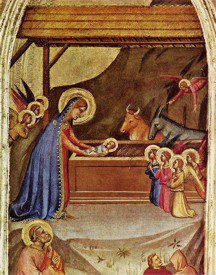 The book of essays by Dorothy Sayers Christian Letters to a Post-Christian World reprinted as The Whimsical Christian contains an essay entitled “A Vote of Thanks to Cyrus.” In this essay Sayers reflects on the way we classify different kinds of literature – in particular the implicit, even unconscious, distinctions we make between the bible, classics, and history.
I owe a certain debt to Cyrus the Persian. I made his acquaintance fairly early, for he lived between the pages of a children’s magazine, in a series entitled Tales from Herodotus, or something of that kind. … Cyrus was pigeon-holed in my mind with the Greeks and the Romans.
So for a long time he remained. And then, one day, I realized with a shock as of sacrilege, that on that famous expedition he had marched clear out of Herodotus and slap into the Bible. Mene, mene, tekel upharsin – the palace wall had blazed with the exploits of Cyrus, and Belshazzar’s feast had broken up under the stern and warning eye of the prophet Daniel. (p. 49)
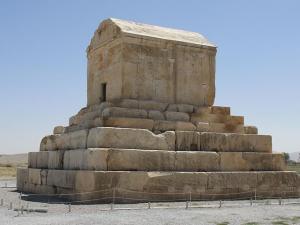 The image to the left, obtained from wikipedia where you can find it with better resolution, is the purported tomb of Cyrus located in modern day Iran. For Sayers the connection between history and the Bible resulted in a reordering in thinking about scripture and the nature of the Bible in the text we have. It became a real book not a magic book separated from real life.
The book of Esther and the identification of King Ahasuerus with Xerxes provided another example where Sayers that she could not neatly separate “Bible” from “classics.” The Bible is not something special and separate. History is all of a piece and the Bible is grounded in the same soil as the classics. This is not to eliminate God from the picture by any means – but to realize that God interacted with the real world, their world and our world.
Most children, I suppose, begin by keeping different bits of history in watertight compartments, of which “Bible” is the tightest and most impenetrable. But some people never seem to grow out of this habit – possibly because of having never having really met Cyrus and Ahasuerus (or Xerxes). Bible critics in particular appear to be persons of very leisurely mental growth. Take, for example, the notorious dispute about the Gospel according to St. John. (pp. 50-51)
Sayers continues on to describe an approach to the Gospel of John and how those who practice Biblical criticism have taken an approach long since rejected in the study of other literature from the classical period. She pokes fun at some of the arguments and what she sees as their shortcomings and forays into the irrational. Biblical criticism was, she found, still locked into dismantling and distrusting the text long after other areas of study had emerged from the fad. This seems no less true today than it was some sixty years ago when Sayers wrote.
When it came to the Bible, the spirit of destruction was the more gleefully iconoclastic because of the conservative extravagances of the “verbal inspiration” theory. But the root of the trouble is to be found, I suspect (as usual), in the collapse of dogma. Christ, even for Christians, is not quite “really” real – not altogether human – and the taint of unreality has spread to His disciples and friends and to His biographers; they are not “real” writers, but just “Bible” writers. (p. 53)
Christ for Christians should be real, very down to earth real. The message of scripture and the power of the incarnation is in the real humanity of Christ, the notion that God became man, that God speaks to us in scripture and through the Spirit in a fashion that is grounded in everyday reality. The celebration of the birth of Christ at Christmas is a time to reflect on the earthy groundedness of Christian faith. Immanuel, God with us, is not some abstract ethereal concept separate in some fashion from real life, but a flesh and blood child at a particular time and place in history, for a purpose. The Gospel writers placed Jesus in a very real and down to earth context, from his birth to his death. Jesus is God’s Messiah, of the house and lineage of David.
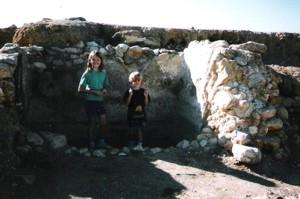 We don’t have a picture of Bethlehem (well actually we do, but only of the modern streets, the Church of the Nativity, and something like a “Santa” type parade), but the picture to the right shows my kids, about a week before Christmas 2001, in one of the houses at Tel Be’er Sheva.
Real places, real people, real history, real relationship, God with us.
“Altogether man, with a rational mind and a human body -.” It is just as well that from time to time Cyrus should march out of Herodotus into the Bible, for the synthesis of history and the confutation of heresy. (p. 54)
If you wish to contact me directly you may do so at rjs4mail[at]att.net
If interested you can subscribe to a full text feed of my posts at Musings on Science and Theology.
A repost – appropriate for the season.
Previous Post

December 26, 2017
Donald Trump And The Jerusalem Embassy
Next Post
December 27, 2017 An Affair to Remember
Browse Our Archives
Select a Category Acts of the Apostles Adam Advent Anabaptism Angels Anglican Apologetics Atonement Baptism BCP Prayers Bible Biblical Studies Birds Blogging Bloglossary Bonhoeffer Books Calvinism Christianity Church Church History Coffee Colossians Commentary Recs Conversion Creation Creeds Culture Death Ecclesiastes Economics Education Embracing Grace Emergent Emerging Movement Eschatology Essays Ethics Eucharist Evangelicalism Family Fasting Fathers Fellowship of Differents Footsteps Tour Fun and Whimsical Gospel Grace Happiness Heaven Hell Holy Spirit Irenaeus James Jesus Jesus Creed Job Justification Kingdom of God Law Lectures Lent Liberalism Love and Marriage Mabanteneni Manhood Mary Miracles Missio Alliance MissioLife Missional Missional Jesus Movies and Film New Perspective Northern Seminary OneLife Origins Project Orthodox Parables Pastor's Spouse Pastoring and Leading Pastoring and Preaching Patristics Paul Paul-John Tour Pharisees Pietism Political Theology Prayer and Formation Preaching Problems for Faith Psalm 119 Psalms Public Issues Purgatory Religions Resurrection Revelation Romans Rule of JCreed Science and Faith Sermon on the Mount Sports Ten Commandments Theology Third Way Top Ten Lists Translations Uncategorized Universalism University Ministry Way Out Weekly Meanderings Wisdom Women and Ministry Work Worship Writing & Blogging Youth Ministry
Select a Month July 2021 January 2020 December 2019 November 2019 October 2019 September 2019 August 2019 July 2019 June 2019 May 2019 April 2019 March 2019 February 2019 January 2019 December 2018 November 2018 October 2018 September 2018 August 2018 July 2018 June 2018 May 2018 April 2018 March 2018 February 2018 January 2018 December 2017 November 2017 October 2017 September 2017 August 2017 July 2017 June 2017 May 2017 April 2017 March 2017 February 2017 January 2017 December 2016 November 2016 October 2016 September 2016 August 2016 July 2016 June 2016 May 2016 April 2016 March 2016 February 2016 January 2016 December 2015 November 2015 October 2015 September 2015 August 2015 July 2015 June 2015 May 2015 April 2015 March 2015 February 2015 January 2015 December 2014 November 2014 October 2014 September 2014 August 2014 July 2014 June 2014 May 2014 April 2014 March 2014 February 2014 January 2014 December 2013 November 2013 October 2013 September 2013 August 2013 July 2013 June 2013 May 2013 April 2013 March 2013 February 2013 January 2013 December 2012 November 2012 October 2012 September 2012 August 2012 July 2012 June 2012 May 2012 April 2012 March 2012 February 2012 January 2012 December 2011 November 2011 October 2011 September 2011 August 2011 July 2011 June 2011 May 2011 April 2011 March 2011 February 2011 January 2011 December 2010 November 2010 October 2010 September 2010 August 2010 July 2010 June 2010 May 2010 April 2010 March 2010 February 2010 January 2010 December 2009 November 2009 October 2009 September 2009 August 2009 July 2009 June 2009 May 2009 April 2009 March 2009 February 2009 January 2009 December 2008 November 2008 October 2008 September 2008 August 2008 July 2008 June 2008 May 2008 April 2008 March 2008 February 2008 January 2008 December 2007 November 2007 October 2007 September 2007 August 2007 July 2007 June 2007 May 2007 April 2007 March 2007 February 2007 January 2007 December 2006 November 2006 October 2006 September 2006 August 2006 July 2006 June 2006 May 2006 April 2006 March 2006 February 2006 January 2006 December 2005 November 2005 October 2005 September 2005 August 2005 July 2005 June 2005 May 2005 April 2005 0000
Follow Us!
TAKE THE
Religious Wisdom Quiz
What does Proverbs 23:4-5 warn against pursuing too much?
Select your answer to see how you score.
Status Wealth Knowledge Power
Related posts from Jesus Creed


The Gospel of With Us and Through Us

Northern Seminary Announces: Nijay Gupta Joins Faculty

The Gundrys and Me: Ruth Tucker
TRENDING AT PATHEOS Evangelical

The REST of Your Life: A Creative Wrestles...
This week I had a conversation with a good friend from church....

How the author of the world's best hymn...
I've been working with John Newton for a while now. This makes...

Long before this Lectio Divina, Psalm 130 - the song - started...

What About the Trees? Another Living Parable
After I finished writing the last article about falling leaves as a...

Why Classical Education Is a Conversation, Not a...
Come and Read: Joy in Classical Education When I was a little...

Cornell University has received a great deal of negative publicity and intense...
view all Evangelical blogs
Ad-Free & Subscriber Log-In Subscription Support
- About Us
- 2026 Calendar
- Videos
- Podcasts
- Library of World Religions
- Faith In Media Tracker
- Advertise With Us
- Write for Us
- Privacy Policy
- Terms of Service
- Do Not Sell My Data
- Contact Us
- Radiant Digital
- Manage Newsletter Subscriptions
- Unsubscribe From Notifications
- Sitemap
Copyright 2008-2026, Patheos. All rights reserved.
Subscription Support Ad-Free & Subscriber Log-In
Follow Patheos