
BuddhistCatholicContemplativeEvangelicalGeneral ChristianHinduJewishLatter-day SaintMuslimNew VisionsProgressive Christian
Beliefs
- Buddhist
- Catholic
- Contemplative
- Evangelical
- General Christian
- Hindu
- Jewish
- Latter-day Saint
- More Voices
- Muslim
- New Visions
- Pagan
- Progressive Christian
Topics
- Religion News
- Food and Religion
- Sports and Religion
- Religious Art
- Religious Music and Entertainment
- Religious Events
- History and Religion
- Style and Religion
- Politics and Religion
- Women in Religion
- Recreation Outdoors and Religion
- Business Finance and Religion
- Careers Workplace and Religion
- Education and Religion
- Family Parenting and Religion
- Health Fitness and Religion
- Home and Religion
- Relationships and Religion
- Technology and Religion
- Travel and Religion
Columnists
- Buddhist Columnists
- Business Finance and Religion Columnists
- Careers Workplace and Religion Columnists
- Catholic Columnists
- Contemplative Columnists
- Education and Religion Columnists
- Evangelists Columnists
- Family Parenting and Religion Columnists
- General Christian Columnists
- Health Fitness and Religion Columnists
- Hindu Columnists
- History and Religion Columnists
- Home and Religion Columnists
- Jewish Columnists
- More Voices Columnists
- Latter Day Columnists
- Muslim Columnists
- New Visions Columnists
- Nonreligious Columnists
- Pagan Columnists
- Politics and Religion Columnists
- Progressive Columnists
- Recreation Outdoors and Religion Columnists
- Relationships and Religion Columnists
- Religion News Columnists
- Religious Art Columnists
- Religious Events Columnists
- Religious Music and Entertainment Columnists
- Sports and Religion Columnists
- Style and Religion Columnists
- Technology and Religion Columnists
- Travel and Religion Columnists
- Women in Religion Columnists
Resource Library
- 2026 Calendar
- Library of World Religions
- The 100 Most Holy Places on Earth
- Patheos Answers
- Podcasts
- Videos
- Faith Leaders Database
- Anglican Episcopalian
- Bahai
- Baptist
- Buddhism
- Christianity
- Confucianism
- Eastern Orthodoxy
- Hinduism
- Holiness and Pentecostal
- ISKCON
- Islam
- Judaism
- Lutheran
- Methodist
- The Church of Jesus Christ of Latter-day Saints
- New Age
- Paganism
- Presbytarian and Reformed
- Protestantism
- Religion Behind the Scenes
- Roman Catholic
- Scientology
- Shia Islam
- Sikhism
- Sufism
- Sunni Islam
- Taoism
- Zen
- See all religions
Research Tools
 Ad-Free & Subscriber Log-In Subscription Support
Follow Patheos 

- Trending:
- Advent
- |
- Forgiveness
- |
- Thanksgiving
- |
- Election
- |
- Seasonal Holidays
- |
- Marriage
 Jesus Creed
- Home
- Evangelical
- What Religious People Really Think (RJS)
What Religious People Really Think (RJS)
Last updated on: December 21, 2017 at 1:23 pm by RJS
What Religious People Really Think (RJS) 2017-12-21T13:23:33-06:00 RJS
Patheos Explore the world's faith through different perspectives on religion and spirituality! Patheos has the views of the prevalent religions and spiritualities of the world.
 Are all scientists sharks out to eat religious people for lunch? Do many religious people really believe this? Are religious Americans scientifically ignorant, uninterested or or hostile toward science?
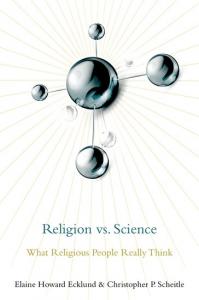
Several years ago I read and posted on a fascinating book by Elaine Howard Ecklund, Science vs. Religion: What Scientists Really Think. Elaine Ecklund is sociologist at Rice University. The work reported in this book drew on an extensive survey of nearly 1700 professors at twenty one “elite” universities, in seven core disciplines (chemistry, physics, biology, sociology, economics, political science, and psychology), augmented by detailed interviews with 275 of them. I have spent all but three of the last 36 years, as graduate student, postdoc, and professor, at Universities included in Ecklund’s study. This book hit the target. I found nothing surprising, but much that provoked thought. Now Elaine, with coauthor Christopher P. Scheitle (Sociology, West Virginia University) has a new book looking at the other side of the equation: Religion vs. Science: What Religious People Really Think. Like the first book, this one draws on extensive survey and interview data to analyze the range of views among Christians, Jews, and Muslims and fleshes out the dry data with personal stories and anecdotes. As in the first book, I find nothing especially surprising – but much that provokes thought, and should stimulate some good conversation.
From the introduction:
The way religious Americans approach science is shaped by two fundamental questions. First, what does science mean for the existence and activity of God? Second, what does science mean for the sacredness of humanity? How these questions – questions with profound moral implications – play out as individual believers think about science both challenge stereotypes and highlight the real tensions between religion and science. (p. 2, emphasis added)
Ecklund and Scheitle hit the nail on the head here. For some the issue is Biblical authority, or the impact on some favored theological construction but the most significant questions on this blog over the years, and I’ve been at this for ten years now, have dealt with human uniqueness – what does it mean to say humans are created in the image of God – and room for divine action (miracles anyone?). This means that evolution and common descent raise significant questions that must be addressed. It also means that moral questions surrounding life and death – abortion, euthanasia, stem cell research, genetic manipulation, cloning – are significant. A religious worldview does impact our views on some significant “scientific” questions.
On the other hand, religious outlook has very little to do with a person’s impression of climate change and global warming.
Our survey data show that even among those who hold the view that “God created the universe, the Earth, and all of life withing the past 10,000 years,” more than 72% acknowledge that the climate is changing and human activity has made at least some contribution to that change. Political conservatism and a lack of trust in the scientific community are much stronger direct predictors of climate-change denial than is religious identity. (p. 8)
 It is true that many white evangelicals are politically conservative and thus a correlation between white evangelicals and climate-change denial may exist – but correlation is not the same as causation. Climate-change denial does not seem to be a position rooted in religious belief. On the other hand, religious belief does help shape an approach toward environmental concerns.
We do find, however, that some religious Americans, particularly evangelicals, are uncomfortable when they feel environmental concerns elevate the earth above God or deny God’s ability to intervene in the world. (p. 8)
Humans are called to stewardship – but the Christian belief holds that the Earth was created for human occupation. The love of other humans created in the image of God works against some extreme forms of environmentalism. What appears to be earth worship is regarded as another form of idolatry.
Myths We Believe … In her earlier book Elaine Ecklund looked at myths about science vs. religion. It is a myth that many if not most scientists are deeply hostile, actively working against religion. Only ~2% of the cohort of elite scientists interviewed for Science vs. Religion were actively hostile. Another myth is that there are no religious scientists, especially at our elite Universities. Yet Ecklund found that 18% of the scientists attended religious services at least once a month. About 7% are conservative to moderate Protestants or Catholics, about 17% are liberal Protestants or Catholics.
In the current book Ecklund and Scheitle address myths about religious people. Myths like religious people do not like science or scientists, religious people are not scientists, religious people are all young-earth creationists and/or climate change deniers, religious people are against scientific technology.The last is interesting – Ecklund and Scheitle dig into some serious issues: reproductive genetic technologies, in vitro fertilization, and human embryonic stem cell research. Here the biblical understanding of the sanctity of life plays a large role for many Christians. It isn’t science denial, but the need for morally grounded oversight. Not everything that can be done should be done.
We need to move beyond the myths and understand why people hold the views they hold – especially when it impacts something we value.
Our message to scientists is this: Myths are a problem for the scientific enterprise. The majority of American people are religious. This means religious people pay taxes and vote. … It is important for us to move beyond stereotypes to know exactly why some religious Americans reject evolution if we hope to help them accept what science teaches about the origin and development of life on earth. (p. 3)
Our message to people of faith is this: Myths are a problem for faith communities. Science is incredibly influential in our world, and if religious leaders want to see their communities not just survive but thrive, they must learn how to incorporate science and scientists into their faith communities. (p. 3)
The conflict motif drives some Christians away from faith and prevents many non-Christians from even considering Christian faith as a viable option. This is not a healthy place for the church. The conflict motif also takes Christians away from the table when many significant moral issues are discussed, including such topics as genetic technologies and stem cell research. We need to be in the conversation.
In future posts we will work through some of the findings reported by Ecklund and Scheitle – I look forward to the conversation.
What does science mean for the existence and activity of God?
What does science mean for the sacredness of humanity?
Do you agree that these are the two most significant questions? What might you add?
If you wish to contact me directly you may do so at rjs4mail[at]att.net.
If interested you can subscribe to a full text feed of my posts at Musings on Science and Theology.
Previous Post

December 21, 2017
Reasons To Leave Evangelicalism
Next Post
December 21, 2017 Shame, Shame On Apple!
Browse Our Archives
Select a Category Acts of the Apostles Adam Advent Anabaptism Angels Anglican Apologetics Atonement Baptism BCP Prayers Bible Biblical Studies Birds Blogging Bloglossary Bonhoeffer Books Calvinism Christianity Church Church History Coffee Colossians Commentary Recs Conversion Creation Creeds Culture Death Ecclesiastes Economics Education Embracing Grace Emergent Emerging Movement Eschatology Essays Ethics Eucharist Evangelicalism Family Fasting Fathers Fellowship of Differents Footsteps Tour Fun and Whimsical Gospel Grace Happiness Heaven Hell Holy Spirit Irenaeus James Jesus Jesus Creed Job Justification Kingdom of God Law Lectures Lent Liberalism Love and Marriage Mabanteneni Manhood Mary Miracles Missio Alliance MissioLife Missional Missional Jesus Movies and Film New Perspective Northern Seminary OneLife Origins Project Orthodox Parables Pastor's Spouse Pastoring and Leading Pastoring and Preaching Patristics Paul Paul-John Tour Pharisees Pietism Political Theology Prayer and Formation Preaching Problems for Faith Psalm 119 Psalms Public Issues Purgatory Religions Resurrection Revelation Romans Rule of JCreed Science and Faith Sermon on the Mount Sports Ten Commandments Theology Third Way Top Ten Lists Translations Uncategorized Universalism University Ministry Way Out Weekly Meanderings Wisdom Women and Ministry Work Worship Writing & Blogging Youth Ministry
Select a Month July 2021 January 2020 December 2019 November 2019 October 2019 September 2019 August 2019 July 2019 June 2019 May 2019 April 2019 March 2019 February 2019 January 2019 December 2018 November 2018 October 2018 September 2018 August 2018 July 2018 June 2018 May 2018 April 2018 March 2018 February 2018 January 2018 December 2017 November 2017 October 2017 September 2017 August 2017 July 2017 June 2017 May 2017 April 2017 March 2017 February 2017 January 2017 December 2016 November 2016 October 2016 September 2016 August 2016 July 2016 June 2016 May 2016 April 2016 March 2016 February 2016 January 2016 December 2015 November 2015 October 2015 September 2015 August 2015 July 2015 June 2015 May 2015 April 2015 March 2015 February 2015 January 2015 December 2014 November 2014 October 2014 September 2014 August 2014 July 2014 June 2014 May 2014 April 2014 March 2014 February 2014 January 2014 December 2013 November 2013 October 2013 September 2013 August 2013 July 2013 June 2013 May 2013 April 2013 March 2013 February 2013 January 2013 December 2012 November 2012 October 2012 September 2012 August 2012 July 2012 June 2012 May 2012 April 2012 March 2012 February 2012 January 2012 December 2011 November 2011 October 2011 September 2011 August 2011 July 2011 June 2011 May 2011 April 2011 March 2011 February 2011 January 2011 December 2010 November 2010 October 2010 September 2010 August 2010 July 2010 June 2010 May 2010 April 2010 March 2010 February 2010 January 2010 December 2009 November 2009 October 2009 September 2009 August 2009 July 2009 June 2009 May 2009 April 2009 March 2009 February 2009 January 2009 December 2008 November 2008 October 2008 September 2008 August 2008 July 2008 June 2008 May 2008 April 2008 March 2008 February 2008 January 2008 December 2007 November 2007 October 2007 September 2007 August 2007 July 2007 June 2007 May 2007 April 2007 March 2007 February 2007 January 2007 December 2006 November 2006 October 2006 September 2006 August 2006 July 2006 June 2006 May 2006 April 2006 March 2006 February 2006 January 2006 December 2005 November 2005 October 2005 September 2005 August 2005 July 2005 June 2005 May 2005 April 2005 0000
Follow Us!
TAKE THE
Religious Wisdom Quiz
What does "Beersheba" mean?
Select your answer to see how you score.
House of the King Blessed Field Well of the Oath Valley of Water
Related posts from Jesus Creed


The Gospel of With Us and Through Us

Northern Seminary Announces: Nijay Gupta Joins Faculty

The Gundrys and Me: Ruth Tucker
TRENDING AT PATHEOS Evangelical

When you hear the word riches, what comes to mind? For most...

Don’t Miss the Parents: A Creative Christmas Meditation
As we enter the Advent Season, I see many people trying to...

Making Stones Into Bread: Choosing the “Right” Work
I was on my online arts ministry Zoom meeting with the International...

Ukraine’s exhausted Christians face fifth winter of war
By Julian Lukins The full-scale war in Ukraine is taking “a serious...

Russell Brand's Conviction is not anti-Christian Persecution
How do we shed the reputation that the Church is OK with...

Have you ever caught yourself saying, “I’ll do it tomorrow,” or “Now...
view all Evangelical blogs
Ad-Free & Subscriber Log-In Subscription Support
- About Us
- 2026 Calendar
- Videos
- Podcasts
- Library of World Religions
- Faith In Media Tracker
- Advertise With Us
- Write for Us
- Privacy Policy
- Terms of Service
- Do Not Sell My Data
- Contact Us
- Radiant Digital
- Manage Newsletter Subscriptions
- Unsubscribe From Notifications
- Sitemap
Copyright 2008-2026, Patheos, part of the Radiant Digital network of media brands. All rights reserved.
Subscription Support Ad-Free & Subscriber Log-In
Follow Patheos