
BuddhistCatholicContemplativeEvangelicalGeneral ChristianHinduJewishLatter-day SaintMuslimNew VisionsProgressive Christian
Beliefs
- Buddhist
- Catholic
- Contemplative
- Evangelical
- General Christian
- Hindu
- Jewish
- Latter-day Saint
- More Voices
- Muslim
- New Visions
- Pagan
- Progressive Christian
Topics
- Religion News
- Food and Religion
- Sports and Religion
- Religious Art
- Religious Music and Entertainment
- Religious Events
- History and Religion
- Style and Religion
- Politics and Religion
- Women in Religion
- Recreation Outdoors and Religion
- Business Finance and Religion
- Careers Workplace and Religion
- Education and Religion
- Family Parenting and Religion
- Health Fitness and Religion
- Home and Religion
- Relationships and Religion
- Technology and Religion
- Travel and Religion
Columnists
- Buddhist Columnists
- Business Finance and Religion Columnists
- Careers Workplace and Religion Columnists
- Catholic Columnists
- Contemplative Columnists
- Education and Religion Columnists
- Evangelists Columnists
- Family Parenting and Religion Columnists
- General Christian Columnists
- Health Fitness and Religion Columnists
- Hindu Columnists
- History and Religion Columnists
- Home and Religion Columnists
- Jewish Columnists
- More Voices Columnists
- Latter Day Columnists
- Muslim Columnists
- New Visions Columnists
- Nonreligious Columnists
- Pagan Columnists
- Politics and Religion Columnists
- Progressive Columnists
- Recreation Outdoors and Religion Columnists
- Relationships and Religion Columnists
- Religion News Columnists
- Religious Art Columnists
- Religious Events Columnists
- Religious Music and Entertainment Columnists
- Sports and Religion Columnists
- Style and Religion Columnists
- Technology and Religion Columnists
- Travel and Religion Columnists
- Women in Religion Columnists
Resource Library
- 2026 Calendar
- Library of World Religions
- The 100 Most Holy Places on Earth
- Patheos Answers
- Podcasts
- Videos
- Faith Leaders Database
- Anglican Episcopalian
- Bahai
- Baptist
- Buddhism
- Christianity
- Confucianism
- Eastern Orthodoxy
- Hinduism
- Holiness and Pentecostal
- ISKCON
- Islam
- Judaism
- Lutheran
- Methodist
- The Church of Jesus Christ of Latter-day Saints
- New Age
- Paganism
- Presbytarian and Reformed
- Protestantism
- Religion Behind the Scenes
- Roman Catholic
- Scientology
- Shia Islam
- Sikhism
- Sufism
- Sunni Islam
- Taoism
- Zen
- See all religions
Research Tools
 Ad-Free & Subscriber Log-In Subscription Support
Follow Patheos 

- Trending:
- Advent
- |
- Forgiveness
- |
- Thanksgiving
- |
- Election
- |
- Seasonal Holidays
- |
- Marriage
 Jesus Creed
- Home
- Evangelical
- Luther The Catholic Misreading Augustine
Luther The Catholic Misreading Augustine
Last updated on: November 16, 2017 at 12:06 am by Scot McKnight
Luther The Catholic Misreading Augustine 2017-11-14T17:46:27-06:00 Scot McKnight
Patheos Explore the world's faith through different perspectives on religion and spirituality! Patheos has the views of the prevalent religions and spiritualities of the world.
A reduced story of Luther looks like this: Luther was miserable and suffering under the law’s condemnation but in reading Romans and Galatians he discovered grace, justification by faith alone and imputation of Christ’s righteousness. Hence, from misery to joy.
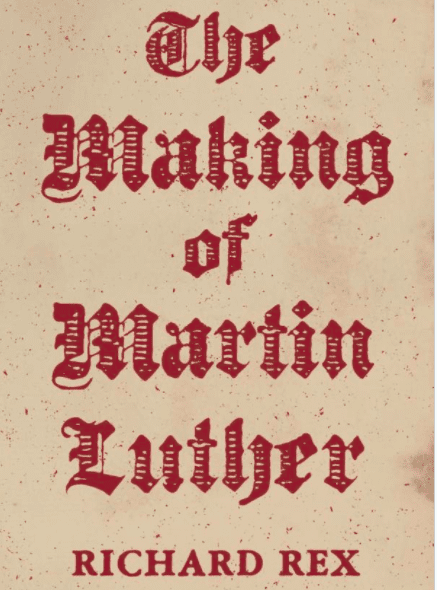 Not so fast says Richard Rex in his fine (and very readable book), The Making of Martin Luther. Luther’s story was more gradual.
A few observations:
First, prior to Luther’s “conversion” he was reading and studying and commenting on and teaching the Bible, including both Psalms and Romans. He did so as a Catholic in the Ockhamist tradition and in tension somewhat with the Aristotelian tradition.
Second, as a Catholic Luther was obsessed with justice and justification, though he clearly was not yet Lutheran in his understanding. His approach was more along the line of obedience.
Luther’s overwhelming concern, however, arising from the very first psalm, was with the central theological issue of justice. It was to the understanding and explanation of justice and justification that he returned throughout the commentary—and it is this focus that has led some scholars to conclude that, because the words are there, his later and very distinctive understandings of justice and justification are also already present.
But, his views were not yet “Lutheran.” They were thoroughly Catholic:
Thus the mere passing comment that “we are co-workers with God” demonstrates that Luther was still well within the boundaries of medieval Catholicism.8 The concept of “cooperative grace” implicit in the claim that the faithful are co-workers (cooperatores) is worlds away from the strictly passive or instrumental role ascribed to human action and even volition in Luthers later understanding of salvation. Faith, grace, and justice (three pretty much interchangeable terms) are “given”—data — not (as much later) “imputed.” Justifl cation is continuous and progressive, not instantaneous. His understanding of salvation is entirely traditional: “The first root of all good is to put one’s will into the law of the Lord.” Far from believing in “justification by faith alone,” Luther’s first reference to faith in this commentary is his quotation from the Epistle of James: “Faith without works is dead.” Indeed, he censures the “stupid confidence” of those who think that they are saved because they are members of the people of God, because they are baptized believers, without any good works. Faith was a prerequisite for everything. But it was not everything. Christian justice came through faith in Christ, but it was still about works of justice. Christians, unlike Jews, “work towards God and fulfil the works of the Law before God.” Salvation for the early Luther, as for the late medieval Church, was ultimately about imitating Christ. The deeds of Christ, and of his saints, done in humility, poverty, and affliction, were examples set before the faithful for emulation.
Third, as a Catholic and not unlike others, Luther was virulently anti-Semitic. While Rex does not drudge up the mud by constant citation of the worst of his statements, Luther’s own notes on the Psalms clearly evidenced anti-Semitism.
The most striking feature of the commentary, at least to the modern eye, is its stridently anti-Jewish tone. Although there was then a clear Christian consensus that, at the time of Christ, the Jews had (with some exceptions) willfully and culpably rejected his Messianic claims and brought about his crucifixion, calling down upon themselves and their descendants the chastisement of divine providence, and although this consensus underpinned a general hostility towards Jews that ranged from a reluctant and grudging (though highly discriminatory) toleration by way of moral panic to sporadic mob violence and, ultimately, the option of forced conversion or expulsion, antiJewish rhetoric did not usually run right through Christian theological reflection. … In Luther’s commentaries, anti-Jewish rhetoric is well-nigh omnipresent, surfacing in almost every psalm, indeed on almost every page. Anti-Jewish ideas are not only endemic, but are systemically integral to the text, in that Luther construes the Jews and their interpretation of the “law” (i.e., the Old Testament scriptures, the Hebrew Bible) as the wrong end of a stark polarity between true and false justice. The Jews and their theology embody a complete inversion of the divine justice that is, for Luther, the crucial theme of the book of Psalms. They seek to justify themselves.
The suggestion, sometimes made, that it was only later that Luther became anti-Semitic then is unjustified. He needs to be understood as someone who exaggerated a tradition at work in his Catholic tradition.
Fourth, when Luther turned to teaching Romans and making notes in his copy of Romans, his theology began to take on anti-Aristotelian polemics and pro-Augustinian theology. This occurs in the middle of the 1510s. The key to this shift in Luther — this gradual awakening — was discovery of the many anti-Pelagian writings of Augustine, and they gave to Luther his opportunity of characteristic exaggeration, paradox and dichotomy.
He begins to suspect free will and human efforts and affirms the primacy of grace. He turns from polemics against Judaism to polemics against some in the church, and in particular, he sees the same problem in Catholics than he saw in Judaism. (This was a feature of E.P. Sanders in some ways.)
Fifth, Luther mistranslated something in Augustine and his mistranslation shaped Luther’s own theology in important ways.
Luther sees in Augustine, which he mistranslates, both a forgiveness of sin in baptism as well as sin’s continuance (he calls this concupiscense) after baptism though it is not considered sin after baptism. Augustine did not teach this; Luther thought he did.
But Saint Augustine put it excellently, saying that “the sin concupiscence is remitted in baptism not so that it does not exist, but so that it is not imputed.”
[Now to Rex’s footnote:] In this citation, Luther misplaced the word “peccatum.” Augustine’s words were: “concupiscentiam in baptismate remitti non ut non sit, sed ut non imputetur in peccatum,” namely, “concupiscence is remitted in baptism not so that it does not exist but so that it is not reckoned as sin.” Luther’s formulation here—”peccatum concupiscentiam in baptismate remitti, non ut non sit, sed ut non imputetur”—was the nearest he ever got to citing the text accurately. In countless later references, doubtless working from memory, he omitted the word “concupiscence” and spoke only of “sin.” Thus, for Luther, “sin” (rather than “concupiscence”) was what was said by Augustine to be forgiven but not entirely removed in baptism. This erroneous recollection was probably responsible for Luther’s original adoption of this idiosyncratic position, though he later argued that his position was justified from the words of Paul alone. Augustine always insisted that the concupiscence of the flesh was not sin in the baptized, because baptism took away all sin.
All of this emphasis on grace led him further from Aristotle and Aquinas and back to Augustine, though almost all of his contemporaries were Augustinian as well.
By the time Luther had finished with Romans, he had finished with Aristotle, and with the medieval theology that blended Aristotelianism with Christianity. This was openly proclaimed in an event he staged in Wittenberg at the end of summer 1517, the “Disputation against Scholastic Theology.” … The truth is that the human being, corrupted to the root, can neither desire nor perform anything but evil. … Almost all of Aristotle’s Ethics is completely opposed to grace.
The emphasis in popular preaching on the Aristotelian virtues and vices obscured from Christians the true reality of sin, which Luther now envisaged in a deeply Augustinian way as an endemic undercurrent of even the holiest life. Indeed, his understanding of sin was already “hyper-Augustinian,” in that his misreading of Augustine s conception of the “concupiscence of the flesh” took the debate onto a new level. Moreover, his antipathy to scholastic theology was leading him to misrepresent it. The understanding of justice and justification among scholastic theologians was for the most part formulated with careful attention to the teachings of Augustine, to whom almost all medieval Catholic theologians looked back as supreme among the “Fathers” of the Church. Luther, careless as ever of subtle distinctions, bundled them all together in a box, labelled it “Pelagians” and henceforth paid them even less attention.
And off he went.
Previous Post

November 15, 2017
Teach The Whole Bible At Once
Next Post
November 16, 2017 She Leads, She Preaches, Emboldened
Browse Our Archives
Select a Category Acts of the Apostles Adam Advent Anabaptism Angels Anglican Apologetics Atonement Baptism BCP Prayers Bible Biblical Studies Birds Blogging Bloglossary Bonhoeffer Books Calvinism Christianity Church Church History Coffee Colossians Commentary Recs Conversion Creation Creeds Culture Death Ecclesiastes Economics Education Embracing Grace Emergent Emerging Movement Eschatology Essays Ethics Eucharist Evangelicalism Family Fasting Fathers Fellowship of Differents Footsteps Tour Fun and Whimsical Gospel Grace Happiness Heaven Hell Holy Spirit Irenaeus James Jesus Jesus Creed Job Justification Kingdom of God Law Lectures Lent Liberalism Love and Marriage Mabanteneni Manhood Mary Miracles Missio Alliance MissioLife Missional Missional Jesus Movies and Film New Perspective Northern Seminary OneLife Origins Project Orthodox Parables Pastor's Spouse Pastoring and Leading Pastoring and Preaching Patristics Paul Paul-John Tour Pharisees Pietism Political Theology Prayer and Formation Preaching Problems for Faith Psalm 119 Psalms Public Issues Purgatory Religions Resurrection Revelation Romans Rule of JCreed Science and Faith Sermon on the Mount Sports Ten Commandments Theology Third Way Top Ten Lists Translations Uncategorized Universalism University Ministry Way Out Weekly Meanderings Wisdom Women and Ministry Work Worship Writing & Blogging Youth Ministry
Select a Month July 2021 January 2020 December 2019 November 2019 October 2019 September 2019 August 2019 July 2019 June 2019 May 2019 April 2019 March 2019 February 2019 January 2019 December 2018 November 2018 October 2018 September 2018 August 2018 July 2018 June 2018 May 2018 April 2018 March 2018 February 2018 January 2018 December 2017 November 2017 October 2017 September 2017 August 2017 July 2017 June 2017 May 2017 April 2017 March 2017 February 2017 January 2017 December 2016 November 2016 October 2016 September 2016 August 2016 July 2016 June 2016 May 2016 April 2016 March 2016 February 2016 January 2016 December 2015 November 2015 October 2015 September 2015 August 2015 July 2015 June 2015 May 2015 April 2015 March 2015 February 2015 January 2015 December 2014 November 2014 October 2014 September 2014 August 2014 July 2014 June 2014 May 2014 April 2014 March 2014 February 2014 January 2014 December 2013 November 2013 October 2013 September 2013 August 2013 July 2013 June 2013 May 2013 April 2013 March 2013 February 2013 January 2013 December 2012 November 2012 October 2012 September 2012 August 2012 July 2012 June 2012 May 2012 April 2012 March 2012 February 2012 January 2012 December 2011 November 2011 October 2011 September 2011 August 2011 July 2011 June 2011 May 2011 April 2011 March 2011 February 2011 January 2011 December 2010 November 2010 October 2010 September 2010 August 2010 July 2010 June 2010 May 2010 April 2010 March 2010 February 2010 January 2010 December 2009 November 2009 October 2009 September 2009 August 2009 July 2009 June 2009 May 2009 April 2009 March 2009 February 2009 January 2009 December 2008 November 2008 October 2008 September 2008 August 2008 July 2008 June 2008 May 2008 April 2008 March 2008 February 2008 January 2008 December 2007 November 2007 October 2007 September 2007 August 2007 July 2007 June 2007 May 2007 April 2007 March 2007 February 2007 January 2007 December 2006 November 2006 October 2006 September 2006 August 2006 July 2006 June 2006 May 2006 April 2006 March 2006 February 2006 January 2006 December 2005 November 2005 October 2005 September 2005 August 2005 July 2005 June 2005 May 2005 April 2005 0000
Follow Us!
TAKE THE
Religious Wisdom Quiz
Who was the scribe and priest that led a second group back to Jerusalem?
Select your answer to see how you score.
Zerubbabel Nehemiah Ezra Mordecai
Related posts from Jesus Creed


The Gospel of With Us and Through Us

Northern Seminary Announces: Nijay Gupta Joins Faculty

The Gundrys and Me: Ruth Tucker
TRENDING AT PATHEOS Evangelical

When you hear the word riches, what comes to mind? For most...

Don’t Miss the Parents: A Creative Christmas Meditation
As we enter the Advent Season, I see many people trying to...

Making Stones Into Bread: Choosing the “Right” Work
I was on my online arts ministry Zoom meeting with the International...

Ukraine’s exhausted Christians face fifth winter of war
By Julian Lukins The full-scale war in Ukraine is taking “a serious...

Russell Brand's Conviction is not anti-Christian Persecution
How do we shed the reputation that the Church is OK with...

Have you ever caught yourself saying, “I’ll do it tomorrow,” or “Now...
view all Evangelical blogs
Ad-Free & Subscriber Log-In Subscription Support
- About Us
- 2026 Calendar
- Videos
- Podcasts
- Library of World Religions
- Faith In Media Tracker
- Advertise With Us
- Write for Us
- Privacy Policy
- Terms of Service
- Do Not Sell My Data
- Contact Us
- Radiant Digital
- Manage Newsletter Subscriptions
- Unsubscribe From Notifications
- Sitemap
Copyright 2008-2026, Patheos, part of the Radiant Digital network of media brands. All rights reserved.
Subscription Support Ad-Free & Subscriber Log-In
Follow Patheos