
BuddhistCatholicContemplativeEvangelicalGeneral ChristianHinduJewishLatter-day SaintMuslimNew VisionsProgressive Christian
Beliefs
- Buddhist
- Catholic
- Contemplative
- Evangelical
- General Christian
- Hindu
- Jewish
- Latter-day Saint
- More Voices
- Muslim
- New Visions
- Pagan
- Progressive Christian
Topics
- Religion News
- Food and Religion
- Sports and Religion
- Religious Art
- Religious Music and Entertainment
- Religious Events
- History and Religion
- Style and Religion
- Politics and Religion
- Women in Religion
- Recreation Outdoors and Religion
- Business Finance and Religion
- Careers Workplace and Religion
- Education and Religion
- Family Parenting and Religion
- Health Fitness and Religion
- Home and Religion
- Relationships and Religion
- Technology and Religion
- Travel and Religion
Columnists
- Buddhist Columnists
- Business Finance and Religion Columnists
- Careers Workplace and Religion Columnists
- Catholic Columnists
- Contemplative Columnists
- Education and Religion Columnists
- Evangelists Columnists
- Family Parenting and Religion Columnists
- General Christian Columnists
- Health Fitness and Religion Columnists
- Hindu Columnists
- History and Religion Columnists
- Home and Religion Columnists
- Jewish Columnists
- More Voices Columnists
- Latter Day Columnists
- Muslim Columnists
- New Visions Columnists
- Nonreligious Columnists
- Pagan Columnists
- Politics and Religion Columnists
- Progressive Columnists
- Recreation Outdoors and Religion Columnists
- Relationships and Religion Columnists
- Religion News Columnists
- Religious Art Columnists
- Religious Events Columnists
- Religious Music and Entertainment Columnists
- Sports and Religion Columnists
- Style and Religion Columnists
- Technology and Religion Columnists
- Travel and Religion Columnists
- Women in Religion Columnists
Resource Library
- 2026 Calendar
- Library of World Religions
- The 100 Most Holy Places on Earth
- Patheos Answers
- Podcasts
- Videos
- Faith Leaders Database
- Anglican Episcopalian
- Bahai
- Baptist
- Buddhism
- Christianity
- Confucianism
- Eastern Orthodoxy
- Hinduism
- Holiness and Pentecostal
- ISKCON
- Islam
- Judaism
- Lutheran
- Methodist
- The Church of Jesus Christ of Latter-day Saints
- New Age
- Paganism
- Presbytarian and Reformed
- Protestantism
- Religion Behind the Scenes
- Roman Catholic
- Scientology
- Shia Islam
- Sikhism
- Sufism
- Sunni Islam
- Taoism
- Zen
- See all religions
Research Tools
 Ad-Free & Subscriber Log-In Subscription Support
Follow Patheos 

- Trending:
- Advent
- |
- Forgiveness
- |
- Thanksgiving
- |
- Election
- |
- Seasonal Holidays
- |
- Marriage
 Jesus Creed
- Home
- Evangelical
- Preposterous Or Not Preposterous?
Preposterous Or Not Preposterous?
Last updated on: November 10, 2017 at 12:05 am by Scot McKnight
Preposterous Or Not Preposterous? 2017-11-09T19:12:27-06:00 Scot McKnight
Patheos Explore the world's faith through different perspectives on religion and spirituality! Patheos has the views of the prevalent religions and spiritualities of the world.
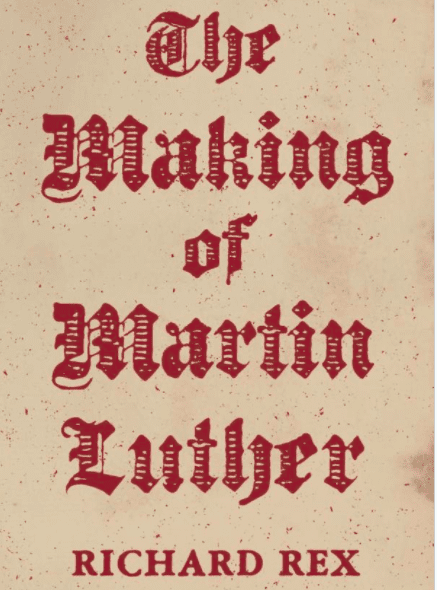 His claim is that Luther’s doctrine of justification by faith is a species of indulgences and is, in fact, the most extreme form of indulgence. Everything for nothing. Salvation for doing nothing. So Richard Rex in his new book, The Making of Martin Luther.
I’m no fan of faux-Alte Schrift design for letters on Reformation books, but I suppose one gets an ancient feel from the Alte Schrift. In part it is because I learned to read Alte Schrift and considered it a mark of distinction to read old German books. Anyways, as a friend of mine used to say, who cares?! Or as another says, It is what it is.
On to Luther and indulgences and Rex’s (seemingly) preposterous claim.
Here’s how Rex works out his theory of Luther’s indulgences-on-steroids:
Yet the most interesting feature of his [Luther’s] original critique of indulgences is the vast gap it reveals between his theological standpoint in autumn 1517 and his new position in spring 1518. For, within a year, he was offering Christians salvation on the cheapest terms ever.
When Luther first began he had not yet worked out his theory of justification by faith alone — grace alone. So, Rex has made here an important point. His original theory against indulgences had more to do with the minimalistic approach: all they had to do was get the indulgence, largely through donations, and not attend to repentance and obedience.
Rex, however, and he admits this is not a cheap shot, and his book proves he’s not taking cheap shots. But his point is nonetheless a zinger and stinger. Rex contends there is a direct correlation between indulgences and justification by faith.
From one point of view, the doctrine of justification by faith alone was simply the proclamation of a universal, plenary indulgence, available at absolutely no cost or effort. This is no mere cheap shot. For a start, Luther himself was perfectly clear about the parallel. He himself announced that the only indulgence of any value to Christians was the one issued by God.
In his day Luther was criticized for just this point. He required nothing but faith.
The critique of moral hazard which he had been willing to deploy against the traditional doctrine of indulgences was therefore, inevitably, deployed still more readily against his new doctrine by his opponents. Luther’s superindulgence required absolutely nothing of its beneficiaries, not even a token donation or a perfunctory prayer, let alone the inconvenience and embarrassment of confession to an all too human priest (though Luther left plenty of room for such confession, which he continued to regard as a salutary moral discipline, if conducted in the right way). The very slogan “faith without works” said it all.
I have not read the whole book but it seems to me as I read this that this might be the precise point of Luther: no one got an indulgence for doing nothing but believing. Justification was had for nothing but faith in Christ alone. It is not, then, anything like an indulgence. (Perhaps I misunderstand.)
Luther’s problem was the impact of his theology on the morality of those in his churches. Were they changed? Were they transformed?
Luther sought to mitigate the risk by insisting that those people who were genuinely justified by faith necessarily and almost naturally brought forth the fruit of good works in their lovingly Christian lives. But the moral hazard was undeniable, and is evidenced in the extent to which Protestant Reformers throughout the sixteenth century felt the need to counter the intellectual challenge posed by what they described as “antinomianism” or “libertinism.”
So Rex poses the irony of Luther creating justification by faith, superindulgence theory, as a contrast to indulgences, but his theory ended up being a kind of indulgence.
It is not merely that there is an ironic coincidence between Luther’s doctrine of justification and the scholastic doctrine of the indulgence. It is not even that there is an adventitious historical connection between the doctrine of the indulgence and the origins of his new doctrine. [Shown above.]
Rex contends that Luther’s justification by faith was formed because indulgences were a viable theological category in the air.
It is on reflection plain that Luther s doctrine of justification could not have been conceived, could not have been imagined, could not have been developed if the scholastic doctrine of the indulgence had not previously been worked out by the theologians of the Middle Ages. By a much deeper irony, Luther’s understanding of justification is conditioned by the scholastic theory of indulgences.
Even more.
It might almost be regarded as the logical consequence of that theory, and can certainly be seen as its most extreme formulation. The conception of the infinite superabundance of Christ’s merits which underpinned the theory of indulgences was fundamental to the rhetoric of the “passion and merits” of Christ that ran through sixteenth-century Protestant preaching and devotion.
Rex pushes harder in his rhetoric.
Luther’s doctrine of justification was not so much a reaction against the theory of indulgences as its culmination. This may be why Luther did not formulate his own theology of justification until, thanks to the furore over indulgences, he had not only started, unknown to himself, to cut his ties with the authority of the Church, but had somehow loosed his imagination from the constraints of medieval understandings of how Christian salvation worked.
Here is Rex’s strongest stinger.
He had at first thought that the doctrine of indulgences went too far. What he realized later was that it did not go far enough.
I contend that in going farther than indulgences, Luther abandoned indulgence theology to create a different kind of theology: one rooted in faith alone, grace alone, in Christ alone.
The issue, of course, is if Paul too offered this so-called ironic superindulgence.
Is this theory of Rex preposterous or not?
Previous Post

November 9, 2017
The Church And Bible Reading: Podcast Q & A
Next Post
November 10, 2017 To Build A Fire
Browse Our Archives
Select a Category Acts of the Apostles Adam Advent Anabaptism Angels Anglican Apologetics Atonement Baptism BCP Prayers Bible Biblical Studies Birds Blogging Bloglossary Bonhoeffer Books Calvinism Christianity Church Church History Coffee Colossians Commentary Recs Conversion Creation Creeds Culture Death Ecclesiastes Economics Education Embracing Grace Emergent Emerging Movement Eschatology Essays Ethics Eucharist Evangelicalism Family Fasting Fathers Fellowship of Differents Footsteps Tour Fun and Whimsical Gospel Grace Happiness Heaven Hell Holy Spirit Irenaeus James Jesus Jesus Creed Job Justification Kingdom of God Law Lectures Lent Liberalism Love and Marriage Mabanteneni Manhood Mary Miracles Missio Alliance MissioLife Missional Missional Jesus Movies and Film New Perspective Northern Seminary OneLife Origins Project Orthodox Parables Pastor's Spouse Pastoring and Leading Pastoring and Preaching Patristics Paul Paul-John Tour Pharisees Pietism Political Theology Prayer and Formation Preaching Problems for Faith Psalm 119 Psalms Public Issues Purgatory Religions Resurrection Revelation Romans Rule of JCreed Science and Faith Sermon on the Mount Sports Ten Commandments Theology Third Way Top Ten Lists Translations Uncategorized Universalism University Ministry Way Out Weekly Meanderings Wisdom Women and Ministry Work Worship Writing & Blogging Youth Ministry
Select a Month July 2021 January 2020 December 2019 November 2019 October 2019 September 2019 August 2019 July 2019 June 2019 May 2019 April 2019 March 2019 February 2019 January 2019 December 2018 November 2018 October 2018 September 2018 August 2018 July 2018 June 2018 May 2018 April 2018 March 2018 February 2018 January 2018 December 2017 November 2017 October 2017 September 2017 August 2017 July 2017 June 2017 May 2017 April 2017 March 2017 February 2017 January 2017 December 2016 November 2016 October 2016 September 2016 August 2016 July 2016 June 2016 May 2016 April 2016 March 2016 February 2016 January 2016 December 2015 November 2015 October 2015 September 2015 August 2015 July 2015 June 2015 May 2015 April 2015 March 2015 February 2015 January 2015 December 2014 November 2014 October 2014 September 2014 August 2014 July 2014 June 2014 May 2014 April 2014 March 2014 February 2014 January 2014 December 2013 November 2013 October 2013 September 2013 August 2013 July 2013 June 2013 May 2013 April 2013 March 2013 February 2013 January 2013 December 2012 November 2012 October 2012 September 2012 August 2012 July 2012 June 2012 May 2012 April 2012 March 2012 February 2012 January 2012 December 2011 November 2011 October 2011 September 2011 August 2011 July 2011 June 2011 May 2011 April 2011 March 2011 February 2011 January 2011 December 2010 November 2010 October 2010 September 2010 August 2010 July 2010 June 2010 May 2010 April 2010 March 2010 February 2010 January 2010 December 2009 November 2009 October 2009 September 2009 August 2009 July 2009 June 2009 May 2009 April 2009 March 2009 February 2009 January 2009 December 2008 November 2008 October 2008 September 2008 August 2008 July 2008 June 2008 May 2008 April 2008 March 2008 February 2008 January 2008 December 2007 November 2007 October 2007 September 2007 August 2007 July 2007 June 2007 May 2007 April 2007 March 2007 February 2007 January 2007 December 2006 November 2006 October 2006 September 2006 August 2006 July 2006 June 2006 May 2006 April 2006 March 2006 February 2006 January 2006 December 2005 November 2005 October 2005 September 2005 August 2005 July 2005 June 2005 May 2005 April 2005 0000
Follow Us!
TAKE THE
Religious Wisdom Quiz
Who came to Jesus at night to ask about being born again?
Select your answer to see how you score.
Cornelius Nicodemus Simon Zacchaeus
Related posts from Jesus Creed


The Gospel of With Us and Through Us

Northern Seminary Announces: Nijay Gupta Joins Faculty

The Gundrys and Me: Ruth Tucker
TRENDING AT PATHEOS Evangelical

When you hear the word riches, what comes to mind? For most...

Don’t Miss the Parents: A Creative Christmas Meditation
As we enter the Advent Season, I see many people trying to...

Making Stones Into Bread: Choosing the “Right” Work
I was on my online arts ministry Zoom meeting with the International...

Ukraine’s exhausted Christians face fifth winter of war
By Julian Lukins The full-scale war in Ukraine is taking “a serious...

Russell Brand's Conviction is not anti-Christian Persecution
How do we shed the reputation that the Church is OK with...

Have you ever caught yourself saying, “I’ll do it tomorrow,” or “Now...
view all Evangelical blogs
Ad-Free & Subscriber Log-In Subscription Support
- About Us
- 2026 Calendar
- Videos
- Podcasts
- Library of World Religions
- Faith In Media Tracker
- Advertise With Us
- Write for Us
- Privacy Policy
- Terms of Service
- Do Not Sell My Data
- Contact Us
- Radiant Digital
- Manage Newsletter Subscriptions
- Unsubscribe From Notifications
- Sitemap
Copyright 2008-2026, Patheos, part of the Radiant Digital network of media brands. All rights reserved.
Subscription Support Ad-Free & Subscriber Log-In
Follow Patheos