
BuddhistCatholicContemplativeEvangelicalGeneral ChristianHinduJewishLatter-day SaintMuslimNew VisionsProgressive Christian
Beliefs
- Buddhist
- Catholic
- Contemplative
- Evangelical
- General Christian
- Hindu
- Jewish
- Latter-day Saint
- More Voices
- Muslim
- New Visions
- Pagan
- Progressive Christian
Topics
- Religion News
- Food and Religion
- Sports and Religion
- Religious Art
- Religious Music and Entertainment
- Religious Events
- History and Religion
- Style and Religion
- Politics and Religion
- Women in Religion
- Recreation Outdoors and Religion
- Business Finance and Religion
- Careers Workplace and Religion
- Education and Religion
- Family Parenting and Religion
- Health Fitness and Religion
- Home and Religion
- Relationships and Religion
- Technology and Religion
- Travel and Religion
Columnists
- Buddhist Columnists
- Business Finance and Religion Columnists
- Careers Workplace and Religion Columnists
- Catholic Columnists
- Contemplative Columnists
- Education and Religion Columnists
- Evangelists Columnists
- Family Parenting and Religion Columnists
- General Christian Columnists
- Health Fitness and Religion Columnists
- Hindu Columnists
- History and Religion Columnists
- Home and Religion Columnists
- Jewish Columnists
- More Voices Columnists
- Latter Day Columnists
- Muslim Columnists
- New Visions Columnists
- Nonreligious Columnists
- Pagan Columnists
- Politics and Religion Columnists
- Progressive Columnists
- Recreation Outdoors and Religion Columnists
- Relationships and Religion Columnists
- Religion News Columnists
- Religious Art Columnists
- Religious Events Columnists
- Religious Music and Entertainment Columnists
- Sports and Religion Columnists
- Style and Religion Columnists
- Technology and Religion Columnists
- Travel and Religion Columnists
- Women in Religion Columnists
Resource Library
- 2026 Calendar
- Library of World Religions
- The 100 Most Holy Places on Earth
- Patheos Answers
- Podcasts
- Videos
- Faith Leaders Database
- Anglican Episcopalian
- Bahai
- Baptist
- Buddhism
- Christianity
- Confucianism
- Eastern Orthodoxy
- Hinduism
- Holiness and Pentecostal
- ISKCON
- Islam
- Judaism
- Lutheran
- Methodist
- The Church of Jesus Christ of Latter-day Saints
- New Age
- Paganism
- Presbytarian and Reformed
- Protestantism
- Religion Behind the Scenes
- Roman Catholic
- Scientology
- Shia Islam
- Sikhism
- Sufism
- Sunni Islam
- Taoism
- Zen
- See all religions
Research Tools
 Ad-Free & Subscriber Log-In Subscription Support
Ad-Free & Subscriber Log-In Subscription Support
Follow Patheos 

- Trending:
- Forgiveness
- |
- Marriage
- |
- Consciousness
- |
- Death Penalty
- |
- Election
- |
- Halloween
 Jesus Creed
- Home
- Evangelical
- In The Beginning: Eyewitnesses Talking Jesus
In The Beginning: Eyewitnesses Talking Jesus
Last updated on: October 25, 2017 at 12:06 am by Scot McKnight
In The Beginning: Eyewitnesses Talking Jesus 2017-10-23T08:13:43-05:00 Scot McKnight
Patheos Explore the world's faith through different perspectives on religion and spirituality! Patheos has the views of the prevalent religions and spiritualities of the world.
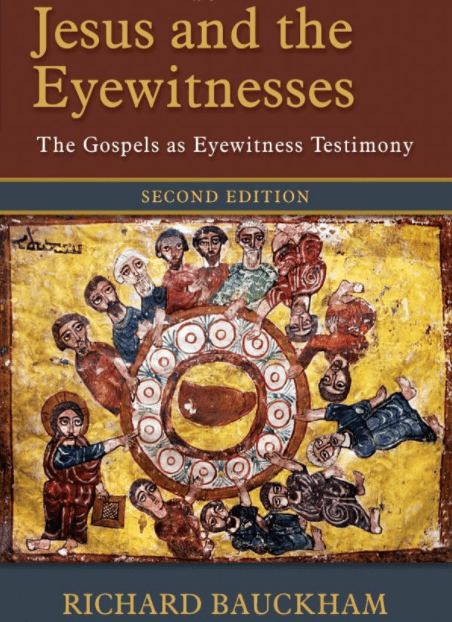 It is Richard Bauckham’s intent to dismantle a major element of classical (German-rooted) form criticism. In particular, this feature: the sayings and deeds of Jesus were incorporated into an oral tradition at an early date but then were passed on by anonymous Tradents (passers on of traditions) who adjusted the forms to fit into early church needs and who adjusted the sayings and deeds to fit into the forms themselves. In other words, there was no inspection, no guarantee that the sayings or deeds were reliably passed on.
Any student of the Gospels; any student of Jesus (historical Jesus studies); any apologist — each of these needs to read this book carefully. And absorb it. Agree or disagree, but know it first.
Bauckham’s theory is that there were eyewitnesses and that what the earliest writers wanted most was not a reliable tradition but eyewitness testimony. This is all worked out extensively in his book Jesus and the Eyewitnesses: The Gospels as Eyewitness Testimony.
Gospel students know the significance of Papias in this discussion, and I remember now during my early years as a professor reading Josef Kürzinger’s extensive monograph on Papias, a monograph so far as I know has never been translated from German into English. Bauckham translates the famous words of Eusebius citing Papias:
I shall not hesitate also to put into properly ordered form for you [singular] everything I learned carefully in the past from the elders and noted down well, for the truth of which I vouch. For unlike most people I did not enjoy those who have a great deal to say, but those who teach the truth. Nor did I enjoy those who recall someone else’s commandments, but those who remember the commandments given by the Lord to the faith and proceeding from the truth itself. And if by chance anyone who had been in attendance on (parekolouthekostis) the elders should come my way, I inquired about the words of the elders — [that is,] what [according to the elders] Andrew or Peter said (eipen), or Philip, or Thomas or James, or John or Matthew or any other of the Lord’s disciples, and whatever Aristion and the elder John, the Lord’s disciples, were saying (legousin). For I did not think that information from books would profit me as much as information from a living and surviving voice (Eusebius, Hist. Eccl. 3-39-3-4). [The change of tense indicates Papias’ own context: he had access to what Aristion and the Elder John were saying but not to the apostles.]
Who was Papias? Bishop of Hierapolis (not far from Laodicea and Colosse) at the end of the 1st Century and beginning of 2d. The big issue is that he was in touch with eyewitnesses as Hierapolis was a major cross road:
Papias belonged, roughly speaking, to the third Christian generation, and therefore to a generation that had been in touch with the first Christian generation, the generation of the apostles. He was personally acquainted with the daughters of Philip the evangelist, the Philip who was one of the Seven (though later writers assimilated him with the Philip who was one of the Twelve). This Philip spent the last years of his life in Hierapolis, and two of his daughters, who were well known as prophets (Acts 21:8-9), also lived out the rest of their lives there, unmarried. Perhaps Papias knew Philip himself in his childhood, but it was from Philip’s daughters that he learned some stories about the apostles (Eusebius, Hist. Eccl. 3.39.9).
Papias is alive and ministering when Matthew, Luke and John were coming into publication and their reputation:
This makes this particular passage from Papias very precious evidence of the way in which Gospel traditions were understood to be related to the eyewitnesses at the very time when three of our canonical Gospels were being written.
Some observations, then, of Papias famous saying quoted above:
First, his statement is modest and not a self-serving claim of authority:
There is no reason at all to regard Papias’s claims in this passage as apologetic exaggeration, for they are strikingly modest. To traditions from members of the Twelve he claims at best to have had access only at second hand, while, as we have seen, he probably did not even claim to have heard Aristion and John the Elder himself but only to have received their teaching, during their lifetimes, from those who did hear them. We may therefore trust the most significant implication of what Papias says: that oral traditions of the words and deeds of Jesus were attached to specific named eyewitnesses.
Second, Papias prefers eyewitness to researching written sources, and what he means by “living and surviving voice” is not oral tradition as understood by some in form criticism.
Papias’s denial that “information from books would profit me as much as information from a living and surviving voice” has been often remarked and much misunderstood. Many have taken it to mean that he preferred oral tradition in general to books in general. Such a prejudice against books and in favor of the spoken word would make the fact that Papias recorded in writing the Gospel traditions he collected, as well as the fact that he himself later wrote a book that bore some relationship to these traditions, paradoxical to say the least. We also know that by the time he was writing his own book Papias knew written Gospels, at least those of Mark and Matthew, and, even though he seems conscious of some deficiencies in these two Gospels, by no means disparages them.
Third, Bauckham convincingly demonstrates (with others) that “living voice” refers to eyewitnesses and to oral history and not to anonymous oral traditions passed on and on and on. The expression “living voice” then refers to finding and discussing with and relying upon eyewitnesses. This, he shows, was the favorable method of historians in that time. This conclusion by Bauckham challenges much of what has been said about how the Gospel sayings and deeds were passed on, and it makes me rethink my own ways of discussing the Gospels and the apostolic gospel traditions. As this book moves on I will want to see if he gives enough space for source criticism, or the use of written sources by the Gospel writers.
Against a historiographic background, what Papias thinks preferable to books is not oral tradition as such but access, while they are still alive, to those who were direct participants in the historical events — in this case “disciples of the Lord.”
Fourth, Papias is at the threshold of the dying off of the eyewitnesses. He did not know the apostles (“disciples”) but he heard from the “elders” via those who heard the elders. But he does know Aristion and the Elder John, so he can vouch for what is being said about Jesus, though it is not clear that he heard those two himself. But he heard from those who had heard their voices.
The presence, then, of eyewitnesses is both a guarantee of the reliability of sayings and deeds of Jesus and a preservative force of those who were saying things or writing things about Jesus. The eyewitnesses, to swipe something from CS Lewis, I don’t know where, were around to blow the gaff if someone got out of hand. This is Bauckham’s big polemic: the form critics are not in line with the eyewitness theme at work in ancient history and the Gospels.
Previous Post

October 24, 2017
The World's Most Powerful Force
Next Post
October 25, 2017 After That (Houston) Storm
Browse Our Archives
Select a Category Acts of the Apostles Adam Advent Anabaptism Angels Anglican Apologetics Atonement Baptism BCP Prayers Bible Biblical Studies Birds Blogging Bloglossary Bonhoeffer Books Calvinism Christianity Church Church History Coffee Colossians Commentary Recs Conversion Creation Creeds Culture Death Ecclesiastes Economics Education Embracing Grace Emergent Emerging Movement Eschatology Essays Ethics Eucharist Evangelicalism Family Fasting Fathers Fellowship of Differents Footsteps Tour Fun and Whimsical Gospel Grace Happiness Heaven Hell Holy Spirit Irenaeus James Jesus Jesus Creed Job Justification Kingdom of God Law Lectures Lent Liberalism Love and Marriage Mabanteneni Manhood Mary Miracles Missio Alliance MissioLife Missional Missional Jesus Movies and Film New Perspective Northern Seminary OneLife Origins Project Orthodox Parables Pastor's Spouse Pastoring and Leading Pastoring and Preaching Patristics Paul Paul-John Tour Pharisees Pietism Political Theology Prayer and Formation Preaching Problems for Faith Psalm 119 Psalms Public Issues Purgatory Religions Resurrection Revelation Romans Rule of JCreed Science and Faith Sermon on the Mount Sports Ten Commandments Theology Third Way Top Ten Lists Translations Uncategorized Universalism University Ministry Way Out Weekly Meanderings Wisdom Women and Ministry Work Worship Writing & Blogging Youth Ministry
Select a Month July 2021 January 2020 December 2019 November 2019 October 2019 September 2019 August 2019 July 2019 June 2019 May 2019 April 2019 March 2019 February 2019 January 2019 December 2018 November 2018 October 2018 September 2018 August 2018 July 2018 June 2018 May 2018 April 2018 March 2018 February 2018 January 2018 December 2017 November 2017 October 2017 September 2017 August 2017 July 2017 June 2017 May 2017 April 2017 March 2017 February 2017 January 2017 December 2016 November 2016 October 2016 September 2016 August 2016 July 2016 June 2016 May 2016 April 2016 March 2016 February 2016 January 2016 December 2015 November 2015 October 2015 September 2015 August 2015 July 2015 June 2015 May 2015 April 2015 March 2015 February 2015 January 2015 December 2014 November 2014 October 2014 September 2014 August 2014 July 2014 June 2014 May 2014 April 2014 March 2014 February 2014 January 2014 December 2013 November 2013 October 2013 September 2013 August 2013 July 2013 June 2013 May 2013 April 2013 March 2013 February 2013 January 2013 December 2012 November 2012 October 2012 September 2012 August 2012 July 2012 June 2012 May 2012 April 2012 March 2012 February 2012 January 2012 December 2011 November 2011 October 2011 September 2011 August 2011 July 2011 June 2011 May 2011 April 2011 March 2011 February 2011 January 2011 December 2010 November 2010 October 2010 September 2010 August 2010 July 2010 June 2010 May 2010 April 2010 March 2010 February 2010 January 2010 December 2009 November 2009 October 2009 September 2009 August 2009 July 2009 June 2009 May 2009 April 2009 March 2009 February 2009 January 2009 December 2008 November 2008 October 2008 September 2008 August 2008 July 2008 June 2008 May 2008 April 2008 March 2008 February 2008 January 2008 December 2007 November 2007 October 2007 September 2007 August 2007 July 2007 June 2007 May 2007 April 2007 March 2007 February 2007 January 2007 December 2006 November 2006 October 2006 September 2006 August 2006 July 2006 June 2006 May 2006 April 2006 March 2006 February 2006 January 2006 December 2005 November 2005 October 2005 September 2005 August 2005 July 2005 June 2005 May 2005 April 2005 0000
Follow Us!
TAKE THE
Religious Wisdom Quiz
How many books are named after prophets in the Old Testament?
Select your answer to see how you score.
5 17 12 21
Related posts from Jesus Creed


The Gospel of With Us and Through Us

Northern Seminary Announces: Nijay Gupta Joins Faculty

The Gundrys and Me: Ruth Tucker
TRENDING AT PATHEOS Evangelical

How the author of the world's best hymn...
I've been working with John Newton for a while now. This makes...

Long before this Lectio Divina, Psalm 130 - the song - started...

What About the Trees? Another Living Parable
After I finished writing the last article about falling leaves as a...

Why Classical Education Is a Conversation, Not a...
Come and Read: Joy in Classical Education When I was a little...

Falling Leaves: A Living Parable on Letting Go
I’ve spent the vast majority of my life in the southeast corner...

Cornell University has received a great deal of negative publicity and intense...
view all Evangelical blogs
Ad-Free & Subscriber Log-In Subscription Support
- About Us
- 2026 Calendar
- Videos
- Podcasts
- Library of World Religions
- Faith In Media Tracker
- Advertise With Us
- Write for Us
- Privacy Policy
- Terms of Service
- Do Not Sell My Data
- Contact Us
- Radiant Digital
- Manage Newsletter Subscriptions
- Unsubscribe From Notifications
- Sitemap
Copyright 2008-2026, Patheos. All rights reserved.
Subscription Support Ad-Free & Subscriber Log-In
Follow Patheos