
BuddhistCatholicContemplativeEvangelicalGeneral ChristianHinduJewishLatter-day SaintMuslimNew VisionsProgressive Christian
Beliefs
- Buddhist
- Catholic
- Contemplative
- Evangelical
- General Christian
- Hindu
- Jewish
- Latter-day Saint
- More Voices
- Muslim
- New Visions
- Pagan
- Progressive Christian
Topics
- Religion News
- Food and Religion
- Sports and Religion
- Religious Art
- Religious Music and Entertainment
- Religious Events
- History and Religion
- Style and Religion
- Politics and Religion
- Women in Religion
- Recreation Outdoors and Religion
- Business Finance and Religion
- Careers Workplace and Religion
- Education and Religion
- Family Parenting and Religion
- Health Fitness and Religion
- Home and Religion
- Relationships and Religion
- Technology and Religion
- Travel and Religion
Columnists
- Buddhist Columnists
- Business Finance and Religion Columnists
- Careers Workplace and Religion Columnists
- Catholic Columnists
- Contemplative Columnists
- Education and Religion Columnists
- Evangelists Columnists
- Family Parenting and Religion Columnists
- General Christian Columnists
- Health Fitness and Religion Columnists
- Hindu Columnists
- History and Religion Columnists
- Home and Religion Columnists
- Jewish Columnists
- More Voices Columnists
- Latter Day Columnists
- Muslim Columnists
- New Visions Columnists
- Nonreligious Columnists
- Pagan Columnists
- Politics and Religion Columnists
- Progressive Columnists
- Recreation Outdoors and Religion Columnists
- Relationships and Religion Columnists
- Religion News Columnists
- Religious Art Columnists
- Religious Events Columnists
- Religious Music and Entertainment Columnists
- Sports and Religion Columnists
- Style and Religion Columnists
- Technology and Religion Columnists
- Travel and Religion Columnists
- Women in Religion Columnists
Resource Library
- 2026 Calendar
- Library of World Religions
- The 100 Most Holy Places on Earth
- Patheos Answers
- Podcasts
- Videos
- Faith Leaders Database
- Anglican Episcopalian
- Bahai
- Baptist
- Buddhism
- Christianity
- Confucianism
- Eastern Orthodoxy
- Hinduism
- Holiness and Pentecostal
- ISKCON
- Islam
- Judaism
- Lutheran
- Methodist
- The Church of Jesus Christ of Latter-day Saints
- New Age
- Paganism
- Presbytarian and Reformed
- Protestantism
- Religion Behind the Scenes
- Roman Catholic
- Scientology
- Shia Islam
- Sikhism
- Sufism
- Sunni Islam
- Taoism
- Zen
- See all religions
Research Tools
 Ad-Free & Subscriber Log-In Subscription Support
Ad-Free & Subscriber Log-In Subscription Support
Follow Patheos 

- Trending:
- Forgiveness
- |
- Marriage
- |
- Consciousness
- |
- Death Penalty
- |
- Election
- |
- Halloween
 Jesus Creed
- Home
- Evangelical
- New Birth Transcending Atonement Theories
New Birth Transcending Atonement Theories
Last updated on: October 20, 2017 at 8:51 am by Scot McKnight
New Birth Transcending Atonement Theories 2017-10-20T08:51:15-05:00 Scot McKnight
Patheos Explore the world's faith through different perspectives on religion and spirituality! Patheos has the views of the prevalent religions and spiritualities of the world.
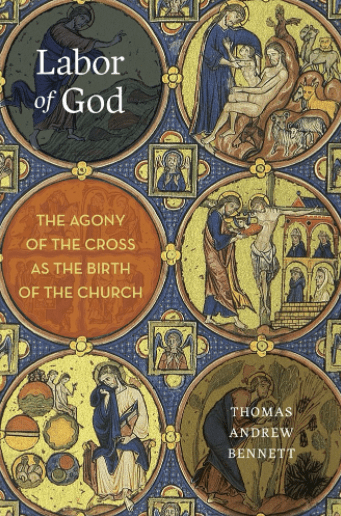 Yes, that’s the claim by Thomas Andrew Bennett, Labor of God: The Agony of the Cross as the Birth of the Church. At the heart of all atonement theories is a problem — a theodicy, sin, need for salvation, guilt, estrangement — and each atonement theory resolves that problem.
Bennett contends forcefully, though not too boldly or over-confidently, that previous models are insufficient. Here’s how he states it, and one of his major themes is that most theories are conglomerations of metaphors and systems of thought:
In order to make penal substitution work conceptually—so that it does not appear as absurd as our story about the child executed in a murderers stead—Christian doctrine conflates the narrative of penal substitution with the practice of sacrifice. … What is doubly strange about this intertwining—leaving aside its bizarre entangling of separate systems found in the Old Testament—is that it egregiously lets the condemned get away with murder, offers no account of whether the child’s sacrifice will change the criminal’s character in any way, and puts an innocent to death for no reason at all.
In “offers no account of whether the child’s sacrifice will change the criminal’s character in any way” Bennett makes a major claim: that an atonement theory must be and account for the personal transformation of the one who benefits from the atonement. Still, he thinks the combination of ideas makes no sense:
The logic of sacrifice rescues the logic of penal substitution from collapsing in on itself but has the unfortunate corollary of creating a bizarre, piecemeal metaphorical universe, one that bears little resemblance to the biblical worlds from which it has been fashioned.
The objective approaches are systems of exchange:
This for that, him for us, they present the death of Jesus as “for us” in the sense that his life buys ours, or he is taken hostage that we might be released, or he endures punishment meant for us, or he satisfies God’s honor or justice or righteousness on our behalf.
He disputes subjective models too, though he gives them scant attention — I agree that subjective accounts are not acts that accomplish something:
Unfortunately, models that explicitly eschew economies of exchange—that is, subjective accounts—have a hard time making sense of the cross.
Atonement as a coherent doctrine appears to be on the horns: either it is objective, and therefore involved in an economy of exchange that deconstructs conceptually, or it is subjective, and God does not act through the cross except to inform and inspire.
He proposes — by now clear to all readers of this blog series — “labor of God” as his model.
as the God-born, the spiritual children birthed at the cross possess a divine nature and the potential and propensity to live and act as God lives and acts. Moreover, as children embedded into the divine family that constitutes the church, the God-born are formed and nurtured in such a way as to bring this potential to its fruition. By all accounts, the cross as the labor of God generates an objective model of atonement m which real, God-authored change takes place in people.
Where to begin? We can all agree on this: atonement is a gift.
What is gift? This has been a very intense conversation for a century, beginning with Nietzsche and then on into Derrida and then to Ricoeur. The problem they bring to the table is that when gift is turned into obligation and reciprocity, gift is no longer gift but instead a kind of exchange. When it is exchange it is not gift. Bennett:
What is wanted, then, is an account of Scripture that does justice to the language of giftedness while nevertheless testifying to a model of atonement that is not mired in an economy of exchange.
[So he contends gift is transformed out of exchange when it is God’s gift.] That is, giftedness, if as a concept it truly describes something that has happened between God and human beings in and through the cross, will see its meaning altered in accordance with the weight of glory, as it were.
Here he becomes bold in criticism of ruling models of atonement:
Atonement theology has, therefore, made a tremendous category mistake. By applying a credit/debt notion of giftedness to the cross and invoking economies of exchange in order to explain what Jesus’ death did, our objective atonement models commit two equally egregious sins. Firstly, they fail exegetically, treating Pauls language of the gift as though he were speaking of an exchange among friends and not the terrible majesty of a crucified God. … Secondly, atonement theology’s models have inscribed an eternal recurrence—to plunder Nietzsche’s rhetoric—of debt into a transhistorical event that was meant to break indebtedness once and for all.
In other words, if it is a gift, it must be a gift and not something from an economy of exchange. He appeals to Wright’s translation of Romans 5:17 where the emphasis is grace/gift, covenant, and an economy of life. Here is Bennett’s summary conclusion: “rod, in Christ at the cross, has remedied the widespread disorder of sin. Creation, individual hearts, infected systems—all that are part and parcel of the covenant community have been rescued, fixed, healed, from the inside out” (85). The ringer: “This is the “free gift’ of Romans 5. It is not, the reader will also notice, an exchange” (85).
God is not “granting justification” or “inspiring sanctification” so much as beginning the end of a world dominated by just these sorts of mundane, pedestrian, and wholly powers-owned economic practices. Rather than a pardon or a mercy—however extensive such pronouncements may be—the gift of the cross is better understood as a new creation, a cosmological event instantiated in what theologians call ecclesiology. A new people, the God-born, gathered in a new family, the church, established as a landmark, a monument, signifying to the economies of the powers that another economy entirely already rules in the highest heavens and will one day do so always and everywhere. This is the divine “gift, and it is unserved by atonement models that denigrate it, reducing it to the tit-for-tat of favors asked and granted and returned. This is, of course, why ecclesiology must be sourced in labor and atonement, in the notion that the church is, fundamentally, the family of God, sharing God’s character and proclivities by birth, rather than as something extrinsic to nature. The family inculcates and nurtures and reinforces a way of being-in-the-world that is mostly unrecognizable to the world, saturated as it is by what we may now deem the disease of reciprocity (86).
Those are not necessarily false dichotomies but he will need to explain the other side of the negation and not just the affirmation on the near side. He will have to explain Why death? Why labor? Not just What is the purpose but What is the cause of all this work of grace?
What is needed is for the machine of exchange itself to be sabotaged, and sabotaged in such a way as to eliminate the very problems the machine was invented to solve. In this case, namely, the problem is sin in all of its distorting, corrupting, ruining ignominy. If only there were something, some kind of gift-that-was-not-a-gift, a way out of exchange altogether, something that defenestrated sin and exposed it and transformed people from what they are into what they ought to be. As we gaze at the labor of God, birthing spiritual children out of the cycles of exchange, perhaps we can cry out with Paul in Romans 7:24-25 (NRSV), “Wretched man that I am! Who will rescue me from this body of death? Thanks be to God through Jesus Christ our Lord!’
One more chapter to read, but one question I’m not asking is if Bennett’s proposal does not need to interact with John Barclay’s understanding of gift/grace.
Previous Post

October 18, 2017
Are Americans Leaving Faith Because of Universities?
Next Post
October 19, 2017 Job 38 Updated for Today (RJS)
Browse Our Archives
Select a Category Acts of the Apostles Adam Advent Anabaptism Angels Anglican Apologetics Atonement Baptism BCP Prayers Bible Biblical Studies Birds Blogging Bloglossary Bonhoeffer Books Calvinism Christianity Church Church History Coffee Colossians Commentary Recs Conversion Creation Creeds Culture Death Ecclesiastes Economics Education Embracing Grace Emergent Emerging Movement Eschatology Essays Ethics Eucharist Evangelicalism Family Fasting Fathers Fellowship of Differents Footsteps Tour Fun and Whimsical Gospel Grace Happiness Heaven Hell Holy Spirit Irenaeus James Jesus Jesus Creed Job Justification Kingdom of God Law Lectures Lent Liberalism Love and Marriage Mabanteneni Manhood Mary Miracles Missio Alliance MissioLife Missional Missional Jesus Movies and Film New Perspective Northern Seminary OneLife Origins Project Orthodox Parables Pastor's Spouse Pastoring and Leading Pastoring and Preaching Patristics Paul Paul-John Tour Pharisees Pietism Political Theology Prayer and Formation Preaching Problems for Faith Psalm 119 Psalms Public Issues Purgatory Religions Resurrection Revelation Romans Rule of JCreed Science and Faith Sermon on the Mount Sports Ten Commandments Theology Third Way Top Ten Lists Translations Uncategorized Universalism University Ministry Way Out Weekly Meanderings Wisdom Women and Ministry Work Worship Writing & Blogging Youth Ministry
Select a Month July 2021 January 2020 December 2019 November 2019 October 2019 September 2019 August 2019 July 2019 June 2019 May 2019 April 2019 March 2019 February 2019 January 2019 December 2018 November 2018 October 2018 September 2018 August 2018 July 2018 June 2018 May 2018 April 2018 March 2018 February 2018 January 2018 December 2017 November 2017 October 2017 September 2017 August 2017 July 2017 June 2017 May 2017 April 2017 March 2017 February 2017 January 2017 December 2016 November 2016 October 2016 September 2016 August 2016 July 2016 June 2016 May 2016 April 2016 March 2016 February 2016 January 2016 December 2015 November 2015 October 2015 September 2015 August 2015 July 2015 June 2015 May 2015 April 2015 March 2015 February 2015 January 2015 December 2014 November 2014 October 2014 September 2014 August 2014 July 2014 June 2014 May 2014 April 2014 March 2014 February 2014 January 2014 December 2013 November 2013 October 2013 September 2013 August 2013 July 2013 June 2013 May 2013 April 2013 March 2013 February 2013 January 2013 December 2012 November 2012 October 2012 September 2012 August 2012 July 2012 June 2012 May 2012 April 2012 March 2012 February 2012 January 2012 December 2011 November 2011 October 2011 September 2011 August 2011 July 2011 June 2011 May 2011 April 2011 March 2011 February 2011 January 2011 December 2010 November 2010 October 2010 September 2010 August 2010 July 2010 June 2010 May 2010 April 2010 March 2010 February 2010 January 2010 December 2009 November 2009 October 2009 September 2009 August 2009 July 2009 June 2009 May 2009 April 2009 March 2009 February 2009 January 2009 December 2008 November 2008 October 2008 September 2008 August 2008 July 2008 June 2008 May 2008 April 2008 March 2008 February 2008 January 2008 December 2007 November 2007 October 2007 September 2007 August 2007 July 2007 June 2007 May 2007 April 2007 March 2007 February 2007 January 2007 December 2006 November 2006 October 2006 September 2006 August 2006 July 2006 June 2006 May 2006 April 2006 March 2006 February 2006 January 2006 December 2005 November 2005 October 2005 September 2005 August 2005 July 2005 June 2005 May 2005 April 2005 0000
Follow Us!
TAKE THE
Religious Wisdom Quiz
Which prophet had a vision of God standing beside a destroyed altar?
Select your answer to see how you score.
Amos Micah Ezekiel Joel
Related posts from Jesus Creed

The Biggest Problem For Atonement Theories?
"God In Labor" in Christian Theology
Passovering Your Atonement Theory
TRENDING AT PATHEOS Evangelical

How the author of the world's best hymn...
I've been working with John Newton for a while now. This makes...

Long before this Lectio Divina, Psalm 130 - the song - started...

What About the Trees? Another Living Parable
After I finished writing the last article about falling leaves as a...

Why Classical Education Is a Conversation, Not a...
Come and Read: Joy in Classical Education When I was a little...

Falling Leaves: A Living Parable on Letting Go
I’ve spent the vast majority of my life in the southeast corner...

Cornell University has received a great deal of negative publicity and intense...
view all Evangelical blogs
Ad-Free & Subscriber Log-In Subscription Support
- About Us
- 2026 Calendar
- Videos
- Podcasts
- Library of World Religions
- Faith In Media Tracker
- Advertise With Us
- Write for Us
- Privacy Policy
- Terms of Service
- Do Not Sell My Data
- Contact Us
- Radiant Digital
- Manage Newsletter Subscriptions
- Unsubscribe From Notifications
- Sitemap
Copyright 2008-2026, Patheos. All rights reserved.
Subscription Support Ad-Free & Subscriber Log-In
Follow Patheos