
BuddhistCatholicContemplativeEvangelicalGeneral ChristianHinduJewishLatter-day SaintMuslimNew VisionsProgressive Christian
Beliefs
- Buddhist
- Catholic
- Contemplative
- Evangelical
- General Christian
- Hindu
- Jewish
- Latter-day Saint
- More Voices
- Muslim
- New Visions
- Pagan
- Progressive Christian
Topics
- Religion News
- Food and Religion
- Sports and Religion
- Religious Art
- Religious Music and Entertainment
- Religious Events
- History and Religion
- Style and Religion
- Politics and Religion
- Women in Religion
- Recreation Outdoors and Religion
- Business Finance and Religion
- Careers Workplace and Religion
- Education and Religion
- Family Parenting and Religion
- Health Fitness and Religion
- Home and Religion
- Relationships and Religion
- Technology and Religion
- Travel and Religion
Columnists
- Buddhist Columnists
- Business Finance and Religion Columnists
- Careers Workplace and Religion Columnists
- Catholic Columnists
- Contemplative Columnists
- Education and Religion Columnists
- Evangelists Columnists
- Family Parenting and Religion Columnists
- General Christian Columnists
- Health Fitness and Religion Columnists
- Hindu Columnists
- History and Religion Columnists
- Home and Religion Columnists
- Jewish Columnists
- More Voices Columnists
- Latter Day Columnists
- Muslim Columnists
- New Visions Columnists
- Nonreligious Columnists
- Pagan Columnists
- Politics and Religion Columnists
- Progressive Columnists
- Recreation Outdoors and Religion Columnists
- Relationships and Religion Columnists
- Religion News Columnists
- Religious Art Columnists
- Religious Events Columnists
- Religious Music and Entertainment Columnists
- Sports and Religion Columnists
- Style and Religion Columnists
- Technology and Religion Columnists
- Travel and Religion Columnists
- Women in Religion Columnists
Resource Library
- 2026 Calendar
- Library of World Religions
- The 100 Most Holy Places on Earth
- Patheos Answers
- Podcasts
- Videos
- Faith Leaders Database
- Anglican Episcopalian
- Bahai
- Baptist
- Buddhism
- Christianity
- Confucianism
- Eastern Orthodoxy
- Hinduism
- Holiness and Pentecostal
- ISKCON
- Islam
- Judaism
- Lutheran
- Methodist
- The Church of Jesus Christ of Latter-day Saints
- New Age
- Paganism
- Presbytarian and Reformed
- Protestantism
- Religion Behind the Scenes
- Roman Catholic
- Scientology
- Shia Islam
- Sikhism
- Sufism
- Sunni Islam
- Taoism
- Zen
- See all religions
Research Tools
 Ad-Free & Subscriber Log-In Subscription Support
Ad-Free & Subscriber Log-In Subscription Support
Follow Patheos 

- Trending:
- Forgiveness
- |
- Marriage
- |
- Consciousness
- |
- Death Penalty
- |
- Election
- |
- Halloween
 Jesus Creed
- Home
- Evangelical
- Richard Bauckham: Historian, Apologist
Richard Bauckham: Historian, Apologist
Last updated on: October 18, 2017 at 12:09 am by Scot McKnight
Richard Bauckham: Historian, Apologist 2017-10-15T12:52:08-05:00 Scot McKnight
Patheos Explore the world's faith through different perspectives on religion and spirituality! Patheos has the views of the prevalent religions and spiritualities of the world.
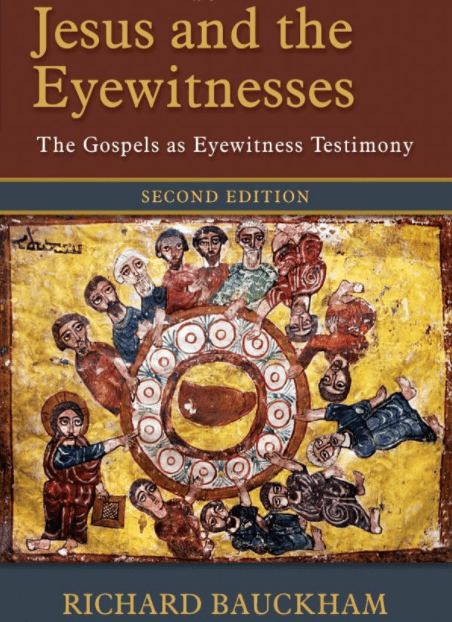 One of the most significant books in the last two decades is Richard Bauckham’s Jesus and the Eyewitnesses: The Gospels as Eyewitness Testimony [=JE], and a new second edition only reveals how significant the book is.
Speaking of eyewitness, when I was a PhD student at Nottingham, Jimmy Dunn and I drove together down to Cambridge for a Tyndale Lectureship. One of the lecturers was Richard Bauckham — of whom I had not heard but of whom Jimmy Dunn said he was an up and coming young scholar. Bauckham’s paper, or at least the bit I remember most (this was 1982), was that the destruction of Jerusalem was far less of a crisis for the early church than the death of apostles as eyewitnesses.
In 2006 the first edition of JE appeared and now a decade later he has updated and expanded that first edition. Reading the first edition is fine; but it is unwise to avoid all the new stuff in this second edition.
One issue that emerges from Bauckham’s book is how to classify this work: is it history or is it apologetics or is it both? Time and discussion will adjudicate this one. I will also wonder if testimony will ultimately satisfy the historians and historiographers. What he writes probably will not matter one bit to the apocalyptic crowd. Conservative evangelicals will trumpet the book but I suspect at times for the wrong reasons. But let’s begin this long series by looking at what I think is an introduction that pins his theses to the Historical Jesus Scholar’s Wittenberg Door.
He begins with observations about what is going on with the Historical Jesus Scholarship, and what he says here is so importantly accurate though many simply pass these nuances off as unimportant. They are (important) so mark his words (my italics):
From the beginning of the quest the whole enterprise of attempting to reconstruct the historical figure of Jesus in a way that is allegedly purely historical, free of the concerns of faith and dogma, has been highly problematic for Christian faith and theology.
Precisely: historical Jesus scholarship is out to reconstruct Jesus and to do so “free of the concerns of faith and dogma.” So, what is the historical Jesus? He delineates three possible meanings: the earthly Jesus, the canonical Jesus and the historical (or historian’s) Jesus:
What, after all, does the phrase “the historical Jesus” mean? It is a seriously ambiguous phrase, with at least three meanings. It could mean Jesus as he really was in his earthly life, in that sense distinguishing the earthly Jesus from the Jesus who, according to Christian faith, now lives and reigns exalted in heaven and will come to bring history to its end. In that sense the historical Jesus is by no means all of the Jesus Christians know and worship, but as a usage that distinguishes Jesus in his earthly life from the exalted Christ the phrase could be unproblematic.
However, the full reality of Jesus as he historically was is not, of course, accessible to us. The world itself could not contain the books that would be needed to record even all that was empirically observable about Jesus, as the closing verse of the Gospel of John puts it.
Now to the canonical Jesus:
We could therefore use the phrase “the historical Jesus” to mean, not all that Jesus was, but Jesus insofar as his historical reality is accessible to us. But here we reach the crucial methodological problem. For Christian faith this Jesus, the earthly Jesus as we can know him, is the Jesus of the canonical Gospels, Jesus as Matthew, Mark, Luke, and John recount and portray him.
And on to the historical Jesus (my italics throughout):
Yet everything changes when historians suspect that these texts may be hiding the real Jesus from us, at best because they give us the historical Jesus filtered through the spectacles of early Christian faith, at worst because much of what they tell us is a Jesus constructed by the needs and interests of various groups in the early church. Then that phrase “the historical Jesus” comes to mean, not the Jesus of the Gospels, but the allegedly real Jesus behind the Gospels, the Jesus the historian must reconstruct by subjecting the Gospels to ruthlessly objective (so it is claimed) scrutiny. It is essential to realize that this is not just treating the Gospels as historical evidence. It is the application of a methodological skepticism that must test every aspect of the evidence so that what the historian establishes is not believable because the Gospels tell us it is, but because the historian has independently verified it. The result of such work is inevitably not one historical Jesus, but many.
A Jesus apart from theology or meaning is impossible to find because there was no such person and no historian will provide us with one? Why?
All history — meaning all that historians write, all historiography — is an inextricable combination of fact and interpretation, the empirically observable and the intuited or constructed meaning. In the Gospels we have, of course, unambiguously such a combination, and it is this above all that motivates the quest for the Jesus one might find if one could leave aside all the meaning that inheres in each Gospel’s story of Jesus. One might, of course, acquire from a skeptical study of the Gospels a meager collection of extremely probable but mere facts that would be of very little interest. That Jesus was crucified may be indubitable but in itself it is of no more significance than the fact that undoubtedly so were thousands of others in his time. The historical Jesus of any of the scholars of the quest is no mere collection of facts, but a figure of significance. Why? If the enterprise is really about going back behind the Evangelists’ and the early church’s interpretation of Jesus, where does a different interpretation come from?
Bauckham is right in what follows in answer to that question:
It comes not merely from deconstructing the Gospels but also from reconstructing a Jesus who, as a portrayal of who Jesus really was, can rival the Jesus of the Gospels. We should be under no illusions that, however minimal a Jesus results from the quest, such a historical Jesus is no less a construction than the Jesus of each of the Gospels. Historical work, by its very nature, is always putting two and two together and making five — or twelve or seventeen.
He gets to the real issue: the historical Jesus scholar attempts to reconstruct an alternative Jesus. To what end?
From the perspective of Christian faith and theology we must ask whether the enterprise of reconstructing a historical Jesus behind the Gospels, as it has been pursued through all phases of the quest, can ever substitute for the Gospels themselves as a way of access to the reality of Jesus the man who lived in first-century Palestine.
Of course, there’s value in historical work, and I agree with this, but the issue again is To what end?
We need not question that historical study can be relevant to our understanding of Jesus in significant ways. What is in question is whether the reconstruction of a Jesus other than the Jesus of the Gospels, the attempt, in other words, to do all over again what the Evangelists did, though with different methods, critical historical methods, can ever provide the kind of access to the reality of Jesus that Christian faith and theology have always trusted we have in the Gospels. By comparison with the Gospels, any Jesus reconstructed by the quest cannot fail to be reductionist from the perspective of Christian faith and theology.
So Bauckham has a theory, a proposal, a counter, an alternative methodological angle:
I suggest that we need to recover the sense in which the Gospels are testimony! This does not mean that they are testimony rather than history. It means that the kind of historiography they are is testimony. An irreducible feature of testimony as a form of human utterance is that it asks to be trusted. This need not mean that it asks to be trusted uncritically, but it does mean that testimony should not be treated as credible only to the extent that it can be independently verified. There can be good reasons for trusting or distrusting a witness, but these are precisely reasons for trusting or distrusting. Trusting testimony is not an irrational act of faith that leaves critical rationality aside; it is, on the contrary, the rationally appropriate way of responding to authentic testimony. Gospels understood as testimony are the entirely appropriate means of access to the historical reality of Jesus.
We need to recognize that, historically speaking, testimony is a unique and uniquely valuable means of access to historical reality.
Testimony offers us, I wish to suggest, both a reputable historiographic category for reading the Gospels as history, and also a theological model for understanding the Gospels as the entirely appropriate means of access to the historical reality of Jesus.
OK, fine, this is valuable to the core. But the issue is how reliable is that testimony? Can we ever escape the historian’s question and the historian’s end? In other words, what if one concludes the testimony is not reliable on something minor (did Peter find a coin in the fish’s mouth?) or on something major (did Jesus do the miracles?) or something that interprets the actions for us (did Jesus say I am the Way or not? Did he solicit a Messianic confession or not? Did Jesus speaks of the cross as saving or not?)? Does testimony escape reliability? These are my questions as I read Bauckham with you.
In general, I shall be arguing in this book that the Gospel texts are much closer to the form in which the eyewitnesses told their stories or passed on their traditions than is commonly envisaged in current scholarship. This is what gives the Gospels their character as testimony.
Part of my intention in this book is to present evidence, much of it not hitherto noticed at all, that makes the “personal link of the Jesus tradition with particular tradents,” throughout the period of the transmission of the tradition down to the writing of the Gospels, if not “historically undeniable,” then at least historically very probable.
If, as I shall argue in this book, the period between the “historical” Jesus and the Gospels was actually spanned, not by anonymous community transmission, but by the continuing presence and testimony of the eyewitnesses, who remained the authoritative sources of their traditions until their deaths, then the usual ways of thinking of oral tradition are not appropriate at all.
Oral testimony was preferable to written sources, and witnesses who could contribute the insider perspective only available from those who had participated in the events were preferred to detached observers.
Previous Post

October 17, 2017
Announcement: Our Next Webinar
Next Post
October 18, 2017 After the (Houston) Storm
Browse Our Archives
Select a Category Acts of the Apostles Adam Advent Anabaptism Angels Anglican Apologetics Atonement Baptism BCP Prayers Bible Biblical Studies Birds Blogging Bloglossary Bonhoeffer Books Calvinism Christianity Church Church History Coffee Colossians Commentary Recs Conversion Creation Creeds Culture Death Ecclesiastes Economics Education Embracing Grace Emergent Emerging Movement Eschatology Essays Ethics Eucharist Evangelicalism Family Fasting Fathers Fellowship of Differents Footsteps Tour Fun and Whimsical Gospel Grace Happiness Heaven Hell Holy Spirit Irenaeus James Jesus Jesus Creed Job Justification Kingdom of God Law Lectures Lent Liberalism Love and Marriage Mabanteneni Manhood Mary Miracles Missio Alliance MissioLife Missional Missional Jesus Movies and Film New Perspective Northern Seminary OneLife Origins Project Orthodox Parables Pastor's Spouse Pastoring and Leading Pastoring and Preaching Patristics Paul Paul-John Tour Pharisees Pietism Political Theology Prayer and Formation Preaching Problems for Faith Psalm 119 Psalms Public Issues Purgatory Religions Resurrection Revelation Romans Rule of JCreed Science and Faith Sermon on the Mount Sports Ten Commandments Theology Third Way Top Ten Lists Translations Uncategorized Universalism University Ministry Way Out Weekly Meanderings Wisdom Women and Ministry Work Worship Writing & Blogging Youth Ministry
Select a Month July 2021 January 2020 December 2019 November 2019 October 2019 September 2019 August 2019 July 2019 June 2019 May 2019 April 2019 March 2019 February 2019 January 2019 December 2018 November 2018 October 2018 September 2018 August 2018 July 2018 June 2018 May 2018 April 2018 March 2018 February 2018 January 2018 December 2017 November 2017 October 2017 September 2017 August 2017 July 2017 June 2017 May 2017 April 2017 March 2017 February 2017 January 2017 December 2016 November 2016 October 2016 September 2016 August 2016 July 2016 June 2016 May 2016 April 2016 March 2016 February 2016 January 2016 December 2015 November 2015 October 2015 September 2015 August 2015 July 2015 June 2015 May 2015 April 2015 March 2015 February 2015 January 2015 December 2014 November 2014 October 2014 September 2014 August 2014 July 2014 June 2014 May 2014 April 2014 March 2014 February 2014 January 2014 December 2013 November 2013 October 2013 September 2013 August 2013 July 2013 June 2013 May 2013 April 2013 March 2013 February 2013 January 2013 December 2012 November 2012 October 2012 September 2012 August 2012 July 2012 June 2012 May 2012 April 2012 March 2012 February 2012 January 2012 December 2011 November 2011 October 2011 September 2011 August 2011 July 2011 June 2011 May 2011 April 2011 March 2011 February 2011 January 2011 December 2010 November 2010 October 2010 September 2010 August 2010 July 2010 June 2010 May 2010 April 2010 March 2010 February 2010 January 2010 December 2009 November 2009 October 2009 September 2009 August 2009 July 2009 June 2009 May 2009 April 2009 March 2009 February 2009 January 2009 December 2008 November 2008 October 2008 September 2008 August 2008 July 2008 June 2008 May 2008 April 2008 March 2008 February 2008 January 2008 December 2007 November 2007 October 2007 September 2007 August 2007 July 2007 June 2007 May 2007 April 2007 March 2007 February 2007 January 2007 December 2006 November 2006 October 2006 September 2006 August 2006 July 2006 June 2006 May 2006 April 2006 March 2006 February 2006 January 2006 December 2005 November 2005 October 2005 September 2005 August 2005 July 2005 June 2005 May 2005 April 2005 0000
Follow Us!
TAKE THE
Religious Wisdom Quiz
What day did God rest during creation?
Select your answer to see how you score.
The sixth day The seventh day The third day The first day
Related posts from Jesus Creed


The Gospel of With Us and Through Us

Northern Seminary Announces: Nijay Gupta Joins Faculty

The Gundrys and Me: Ruth Tucker
TRENDING AT PATHEOS Evangelical

The REST of Your Life: A Creative Wrestles...
This week I had a conversation with a good friend from church....

How the author of the world's best hymn...
I've been working with John Newton for a while now. This makes...

Long before this Lectio Divina, Psalm 130 - the song - started...

What About the Trees? Another Living Parable
After I finished writing the last article about falling leaves as a...

Why Classical Education Is a Conversation, Not a...
Come and Read: Joy in Classical Education When I was a little...

Cornell University has received a great deal of negative publicity and intense...
view all Evangelical blogs
Ad-Free & Subscriber Log-In Subscription Support
- About Us
- 2026 Calendar
- Videos
- Podcasts
- Library of World Religions
- Faith In Media Tracker
- Advertise With Us
- Write for Us
- Privacy Policy
- Terms of Service
- Do Not Sell My Data
- Contact Us
- Radiant Digital
- Manage Newsletter Subscriptions
- Unsubscribe From Notifications
- Sitemap
Copyright 2008-2026, Patheos. All rights reserved.
Subscription Support Ad-Free & Subscriber Log-In
Follow Patheos