
BuddhistCatholicContemplativeEvangelicalGeneral ChristianHinduJewishLatter-day SaintMuslimNew VisionsProgressive Christian
Beliefs
- Buddhist
- Catholic
- Contemplative
- Evangelical
- General Christian
- Hindu
- Jewish
- Latter-day Saint
- More Voices
- Muslim
- New Visions
- Pagan
- Progressive Christian
Topics
- Religion News
- Food and Religion
- Sports and Religion
- Religious Art
- Religious Music and Entertainment
- Religious Events
- History and Religion
- Style and Religion
- Politics and Religion
- Women in Religion
- Recreation Outdoors and Religion
- Business Finance and Religion
- Careers Workplace and Religion
- Education and Religion
- Family Parenting and Religion
- Health Fitness and Religion
- Home and Religion
- Relationships and Religion
- Technology and Religion
- Travel and Religion
Columnists
- Buddhist Columnists
- Business Finance and Religion Columnists
- Careers Workplace and Religion Columnists
- Catholic Columnists
- Contemplative Columnists
- Education and Religion Columnists
- Evangelists Columnists
- Family Parenting and Religion Columnists
- General Christian Columnists
- Health Fitness and Religion Columnists
- Hindu Columnists
- History and Religion Columnists
- Home and Religion Columnists
- Jewish Columnists
- More Voices Columnists
- Latter Day Columnists
- Muslim Columnists
- New Visions Columnists
- Nonreligious Columnists
- Pagan Columnists
- Politics and Religion Columnists
- Progressive Columnists
- Recreation Outdoors and Religion Columnists
- Relationships and Religion Columnists
- Religion News Columnists
- Religious Art Columnists
- Religious Events Columnists
- Religious Music and Entertainment Columnists
- Sports and Religion Columnists
- Style and Religion Columnists
- Technology and Religion Columnists
- Travel and Religion Columnists
- Women in Religion Columnists
Resource Library
- 2026 Calendar
- Library of World Religions
- The 100 Most Holy Places on Earth
- Patheos Answers
- Podcasts
- Videos
- Faith Leaders Database
- Anglican Episcopalian
- Bahai
- Baptist
- Buddhism
- Christianity
- Confucianism
- Eastern Orthodoxy
- Hinduism
- Holiness and Pentecostal
- ISKCON
- Islam
- Judaism
- Lutheran
- Methodist
- The Church of Jesus Christ of Latter-day Saints
- New Age
- Paganism
- Presbytarian and Reformed
- Protestantism
- Religion Behind the Scenes
- Roman Catholic
- Scientology
- Shia Islam
- Sikhism
- Sufism
- Sunni Islam
- Taoism
- Zen
- See all religions
Research Tools
 Ad-Free & Subscriber Log-In Subscription Support
Follow Patheos 

- Trending:
- Advent
- |
- Forgiveness
- |
- Thanksgiving
- |
- Election
- |
- Seasonal Holidays
- |
- Marriage
 Jesus Creed
- Home
- Evangelical
- David Bentley Hart’s New Testament
David Bentley Hart’s New Testament
Last updated on: October 9, 2017 at 12:09 am by Scot McKnight
David Bentley Hart’s New Testament 2017-10-08T15:05:53-05:00 Scot McKnight
Patheos Explore the world's faith through different perspectives on religion and spirituality! Patheos has the views of the prevalent religions and spiritualities of the world.
 What depresses me about Bible translation debates today is tribalism. Some have raised the bar of this conversation to such heights that variation is tantamount to heresy. Translations can also be a window to our heart and theology and preferences. Not only can be, they are.
So here goes with a sketch of tribalist translation tendencies. Each of these is partially true but not wholly true, so let’s not reify but have a little fun…
NRSV for traditional mainliners;
CEB for ready-to-change mainliners;
ESV for Reformed complementarian Baptists;
HCSB for LifeWay store buying Southern Baptists;
NIV for complementarian evangelicals;
TNIV for egalitarians;
NIV 2011 for, well, both complementarians and egalitarians;
NASB for those who want straight Bible, forget the English;
NLT for generic brand evangelicals;
Amplified for folks who have no idea what translation is but know that if you try enough words one of them will hit pay dirt;
NKJV and KJV for Byzantine manuscript-tree huggers;
The Message for evangelicals looking for a breath of fresh air and seeker sensitive, never-read-a-commentary evangelists who find Peterson’s prose so catchy.
I put David Bentley Hart in the category of a one-of-a-kind.
Sometimes it sounds like Christian culture wars because it is.
The problem is that these translations in taking sides betray what the New Testament actually is, and David Bentley Hart gets this right when he speaks freshly and boldly of what these writings are actually like:
They are not beguiling exercises in suasive rhetoric or feats of literary virtuosity; rather, they are chiefly the devout and urgent attempts of often rather ordinary persons to communicate something “seen” and “heard” that transcends any language, but that nevertheless demands to be spoken, now, here, in whatever words one can marshal. This is the special amphibology of Christian scripture. Whereas the Jewish Bible represents the concentrated literary genius of an ancient and amazingly rich culture—mythic, epic, lyric, historical, and visionary, in texts assembled over many centuries and then judiciously synthesized, redacted, and polished—the Christian New Testament is a somewhat unsystematically compiled and pragmatically edited compendium of “important documentation”: writings from the first generations of witnesses to the new faith, the oldest ambassadors to us from the apostolic and early postapostolic ages, consisting in quickly limned stories, theological discourses, and even a bit of historically impenetrable occasional writing. As such it draws one in by the intensity, purity, and perhaps frequent naivete of its language, not by the exquisite sheen of its belletristic graces (The New Testament: A Translation., xxii).
Claims of superiority in translation is a fail from the get-go because these translations are blendings of the language that lather them up into an acceptable product; they are designed for popular consumption; they fail to respect oddities and differences and stylistic crudities. These translations are all reliable but they are not the real thing itself.
Modern translations play nice and make nice. They claim more than they are.
So to an important point: the authority is the original text, not the translation. The original texts are in Hebrew and Aramaic (Old Testament) and Greek (New Testament). The authoritative text is not in English, regardless of how accurate the translation. No matter which translation you prefer, it is not the authoritative text for determining which translation is best. Yes, we need more to devote more time to study of the original languages.
The sweeping conclusion is this: unless you can read the original languages, you should avoid making public pronouncements about which translation is best. Instead, here’s my suggestion: if you don’t know the languages and can’t read them well enough to translate accurately on your own but you want to tell your congregation or your listeners which translate is best, you need to admit it by saying something like this: “On the basis of people I trust to make this decision, the ESV or the TNIV or the NRSV or the NLT is a reliable translation.”
We could get into the “intent” of translation, but that’s another post. Our intent is simple: to press upon everyone that there is a distinction between the text and a translation of the text. The authority is with the former; those who know that text are informed enough to decide about translations.
Another point being made in dustups about translations has to do with translation theory. I hear it like this all the time: I prefer “dynamic equivalence” (functional equivalence) or I prefer “formal equivalence.” Sometimes it gets expressed by such words as “paraphrase” or “literal” and sometimes by “bad” and “good.” Or “loose” and “tight.” Most words are translated in all Bible translations with formal equivalence while some words are translated more or less in a dynamic, or functional way.
In spite of trumpet blowing and the tooting of horns by the ESV crowd, there isn’t really a radical commitment to theory or by dynamic equivalence — as if one can find some better way in English to the original languages “and” or “but” or “the” or “God.” Nor is there a radical commitment to “formal equivalence,” as if the Greek word order can be maintained in English and make sense, though at times the NASB gave that a try (much to the consternation of English readers). No one translates “God’s nostrils got bigger” (formal equivalence) but we translate “God became angry.” There are some expressions that can’t be translated woodenly unless one prefers not to be understood. (See Dan Wallace.)
The result of this is that all translations are on a spectrum of more or less formal and more ore less dynamic. Now one more complication: each translation will vary for individual words or phrases or clauses.
The most important book to read (so far as I know) for translation theory is the old book by Eugene Nida, The Theory and Practice of Translation, and I used to teach this book every year. The issue here is clear: there is an original text and there is a “receptor” language (English). It is the translator’s intent to take the original text and make it the receptor language in a way that is as “equivalent” as possible. The issue has to do with which one gains prominence when decision time comes? Everyone strives for “equivalence.” The TNIV people don’t think they are paraphrasing; they are translating the original text accurately into modern English.
Formal equivalence tends to move in the direction of “identity” — the idea that one can translate as simply as possible in a way that is as close to “identical” as one language can be to another. “And” becomes “and” and “gird up the loins of your mind” becomes “gird up the loins of your mind.” The more dynamic approach is as concerned with a modern reader being provoked to the same response as the original language provoked in the original writer/listener/reader. So, the spectrum moves from identical text to receptor’s response/understanding. The focus moves from “text in its original context” to “text in its modern context.” In one the emphasis is on rendering a text in as identical fashion as possible while the other is on rendering a text so that obstacles are removed to understanding. And another point: preachers and teachers, whether they like the formal or not, always explain the text in dynamic ways. All of this is connected to purpose of both translator and reader. It’s not simple and it’s not either-or.
It is not to be forgotten that the NT authors more often than not quote the Old Testament (Hebrew Bible) from its Greek translations (called Septuagint), and those translations were as dynamic at times as we see in modern dynamic translations — making it fairly obvious that use of dynamic translation is already at work in the New Testament we are now reading.
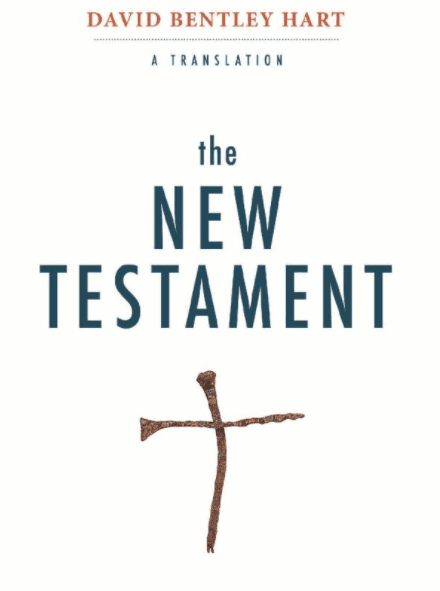 Which leads me to David Bentley Hart’s The New Testament: A Translation. It’s neither dynamic nor formal, but both, and something else, too, but clearly more formal than anything else. A few general observations today:
First, he says “I have elected to produce an almost pitiless literal translation” (xvii). As such, Hart will give his readers a closer feel to the Greek of the NT than any translation available today. Even more than the NASB.
Hart has a desire to make the reader as uncomfortable as he can and that is because he thinks the NT itself — those early Christians and their view of wealth — were extremists, which aligns rather well with Hart’s extremist approach to translation.
On this Hart is himself just lopsided, delightfully so at times, but lopsided nonetheless. An introduction that dives as deeply into the theme of wealth and poverty in the New Testament, mostly by neglecting other themes (and there are plenty others to consider), is itself extreme.
Hart’s fascination with the radical edge tells us more about himself than the New Testament itself. Hart is by nature a contrarian; so is this translation. This will be to our good and our disagreement.
Second, I doubt this New Testament will work as a Sunday morning worship service Bible reading Bible. It won’t do for lectionary churches. But, with a little practice and a good reader, Hart can be used at times.
Third, he’s gone his own way on terms like Christos and made it “Anointed” (not Christ, not King, not Messiah); diabolos is “Slanderer” and ekklesia is “assembly” and not “church.” He says he’s not been entirely consistent, which makes for some oddities and questions. He’s tried, however, to render the same word in the same way throughout.
Fourth, he means to provoke the attention of readers so sometimes he has odd translations. He does this well.
“In the long twilight struggle between felicity and fidelity, the latter should always win out in the end” (xxi).
Fifth, Hart is not being nice and is not playing nice, and for that reason no issues that concern us today will show up: no inclusiveness for instance. When someone says what he says about translations, then I can respect that.
Sixth, Hart translates from the Critical as well as the Majority Text, which is more or less what the Orthodox Church uses today. So, he’s made his own decisions on which Greek Text to translate. I’m not even sure what he means by the “Critical” Text unless he means Nestle-Aland.
What I like most about Hart’s translation is that this a man who knows his Greek well enough to know the style of authors and to render those styles in approximate English that gives us a feel for their style. Translations today have decided in advance that the way to make the Bible read well is to make it sound like 21st Century American English. OK, but that decision obscures the individual vitality of the writers of the Bible itself! For that reason alone I will keep this translation nearby (and gripe about it as well):
Most of the authors of the New Testament did not write particularly well, even by the forgiving standards of the koine—that is, “common”—Greek in which they worked. The unknown author of the Letter to the Hebrews commanded a fairly distinguished and erudite style, and was obviously an accomplished native speaker of the tongue; and Luke, the author of both the third Gospel and the Acts of the Apostles, wrote in an urbane, unspectacular, but mostly graceful prose; the author of the first letter attributed to Peter was clearly an educated person whose primary language was a fairly refined form of Greek, while the author of the second letter wrote in a somewhat bombastic style, of the kind classically called Asiatic Greek; but the language of most of the canon is anything but extraordinary. Paul’s letters possess an elemental power born out of the passion of his faith and the marvel of what he believes has been revealed to him, and his prose occasionally flowers into a plain but startling lyricism; but his Greek is generally rough, sometimes inept, and occasionally incoherent. The Gospel of Mark contains obvious solecisms and is awkwardly written throughout. The prose of the Gospel of Matthew is rarely better than ponderous. Even the Gospel of John, perhaps the most structurally and symbolically sophisticated religious text to have come down to us from late antiquity, is written in a Greek that is grammatically correct but syntactically almost childish (or perhaps I should say, “remarkably limpid”), and—unless its author was some late first-century precursor of Gertrude Stein—its stylistic limitations suggest an author whose command of the language did not exceed mere functional competence. Then, of course, the book of Revelation, the last New Testament text to be accepted into the canon—it was not firmly established there throughout the Christian world until the early fifth century—is, if judged purely by the normal standards of literary style and good taste, almost unremittingly atrocious. And, in the most refined pagan critics of the new faith in late antiquity, the stylistic coarseness of Christian literature often provoked the purest kind of patrician contempt (xxi-xxii).
If you want to feel these differences, read Hart. If you’d like to feel better about your Bible, read the NIV or the ESV or the NLT or the NRSV or the CEB.
I’ll do more posts on Hart’s translation, but I want to say this here: big mistake not to have chapters at the top of each page. It’s how we all find our way in the Bible.
Previous Post

October 8, 2017
A Prayer for Las Vegas
Next Post

October 9, 2017 The Biggest Problem For Atonement Theories?
Browse Our Archives
Select a Category Acts of the Apostles Adam Advent Anabaptism Angels Anglican Apologetics Atonement Baptism BCP Prayers Bible Biblical Studies Birds Blogging Bloglossary Bonhoeffer Books Calvinism Christianity Church Church History Coffee Colossians Commentary Recs Conversion Creation Creeds Culture Death Ecclesiastes Economics Education Embracing Grace Emergent Emerging Movement Eschatology Essays Ethics Eucharist Evangelicalism Family Fasting Fathers Fellowship of Differents Footsteps Tour Fun and Whimsical Gospel Grace Happiness Heaven Hell Holy Spirit Irenaeus James Jesus Jesus Creed Job Justification Kingdom of God Law Lectures Lent Liberalism Love and Marriage Mabanteneni Manhood Mary Miracles Missio Alliance MissioLife Missional Missional Jesus Movies and Film New Perspective Northern Seminary OneLife Origins Project Orthodox Parables Pastor's Spouse Pastoring and Leading Pastoring and Preaching Patristics Paul Paul-John Tour Pharisees Pietism Political Theology Prayer and Formation Preaching Problems for Faith Psalm 119 Psalms Public Issues Purgatory Religions Resurrection Revelation Romans Rule of JCreed Science and Faith Sermon on the Mount Sports Ten Commandments Theology Third Way Top Ten Lists Translations Uncategorized Universalism University Ministry Way Out Weekly Meanderings Wisdom Women and Ministry Work Worship Writing & Blogging Youth Ministry
Select a Month July 2021 January 2020 December 2019 November 2019 October 2019 September 2019 August 2019 July 2019 June 2019 May 2019 April 2019 March 2019 February 2019 January 2019 December 2018 November 2018 October 2018 September 2018 August 2018 July 2018 June 2018 May 2018 April 2018 March 2018 February 2018 January 2018 December 2017 November 2017 October 2017 September 2017 August 2017 July 2017 June 2017 May 2017 April 2017 March 2017 February 2017 January 2017 December 2016 November 2016 October 2016 September 2016 August 2016 July 2016 June 2016 May 2016 April 2016 March 2016 February 2016 January 2016 December 2015 November 2015 October 2015 September 2015 August 2015 July 2015 June 2015 May 2015 April 2015 March 2015 February 2015 January 2015 December 2014 November 2014 October 2014 September 2014 August 2014 July 2014 June 2014 May 2014 April 2014 March 2014 February 2014 January 2014 December 2013 November 2013 October 2013 September 2013 August 2013 July 2013 June 2013 May 2013 April 2013 March 2013 February 2013 January 2013 December 2012 November 2012 October 2012 September 2012 August 2012 July 2012 June 2012 May 2012 April 2012 March 2012 February 2012 January 2012 December 2011 November 2011 October 2011 September 2011 August 2011 July 2011 June 2011 May 2011 April 2011 March 2011 February 2011 January 2011 December 2010 November 2010 October 2010 September 2010 August 2010 July 2010 June 2010 May 2010 April 2010 March 2010 February 2010 January 2010 December 2009 November 2009 October 2009 September 2009 August 2009 July 2009 June 2009 May 2009 April 2009 March 2009 February 2009 January 2009 December 2008 November 2008 October 2008 September 2008 August 2008 July 2008 June 2008 May 2008 April 2008 March 2008 February 2008 January 2008 December 2007 November 2007 October 2007 September 2007 August 2007 July 2007 June 2007 May 2007 April 2007 March 2007 February 2007 January 2007 December 2006 November 2006 October 2006 September 2006 August 2006 July 2006 June 2006 May 2006 April 2006 March 2006 February 2006 January 2006 December 2005 November 2005 October 2005 September 2005 August 2005 July 2005 June 2005 May 2005 April 2005 0000
Follow Us!
TAKE THE
Religious Wisdom Quiz
What four things does the Pale Horse in Revelations bring upon the earth?
Select your answer to see how you score.
Silence, fire, blood, and pestilence Storms, earthquakes, floods, and darkness Wrath, power, redemption, and judgment Sword, famine, plague, and wild beasts
Related posts from Jesus Creed


The Gospel of With Us and Through Us

Northern Seminary Announces: Nijay Gupta Joins Faculty

The Gundrys and Me: Ruth Tucker
TRENDING AT PATHEOS Evangelical

When you hear the word riches, what comes to mind? For most...

Don’t Miss the Parents: A Creative Christmas Meditation
As we enter the Advent Season, I see many people trying to...

Making Stones Into Bread: Choosing the “Right” Work
I was on my online arts ministry Zoom meeting with the International...

Ukraine’s exhausted Christians face fifth winter of war
By Julian Lukins The full-scale war in Ukraine is taking “a serious...

Russell Brand's Conviction is not anti-Christian Persecution
How do we shed the reputation that the Church is OK with...

Have you ever caught yourself saying, “I’ll do it tomorrow,” or “Now...
view all Evangelical blogs
Ad-Free & Subscriber Log-In Subscription Support
- About Us
- 2026 Calendar
- Videos
- Podcasts
- Library of World Religions
- Faith In Media Tracker
- Advertise With Us
- Write for Us
- Privacy Policy
- Terms of Service
- Do Not Sell My Data
- Contact Us
- Radiant Digital
- Manage Newsletter Subscriptions
- Unsubscribe From Notifications
- Sitemap
Copyright 2008-2026, Patheos, part of the Radiant Digital network of media brands. All rights reserved.
Subscription Support Ad-Free & Subscriber Log-In
Follow Patheos