
BuddhistCatholicContemplativeEvangelicalGeneral ChristianHinduJewishLatter-day SaintMuslimNew VisionsProgressive Christian
Beliefs
- Buddhist
- Catholic
- Contemplative
- Evangelical
- General Christian
- Hindu
- Jewish
- Latter-day Saint
- More Voices
- Muslim
- New Visions
- Pagan
- Progressive Christian
Topics
- Religion News
- Food and Religion
- Sports and Religion
- Religious Art
- Religious Music and Entertainment
- Religious Events
- History and Religion
- Style and Religion
- Politics and Religion
- Women in Religion
- Recreation Outdoors and Religion
- Business Finance and Religion
- Careers Workplace and Religion
- Education and Religion
- Family Parenting and Religion
- Health Fitness and Religion
- Home and Religion
- Relationships and Religion
- Technology and Religion
- Travel and Religion
Columnists
- Buddhist Columnists
- Business Finance and Religion Columnists
- Careers Workplace and Religion Columnists
- Catholic Columnists
- Contemplative Columnists
- Education and Religion Columnists
- Evangelists Columnists
- Family Parenting and Religion Columnists
- General Christian Columnists
- Health Fitness and Religion Columnists
- Hindu Columnists
- History and Religion Columnists
- Home and Religion Columnists
- Jewish Columnists
- More Voices Columnists
- Latter Day Columnists
- Muslim Columnists
- New Visions Columnists
- Nonreligious Columnists
- Pagan Columnists
- Politics and Religion Columnists
- Progressive Columnists
- Recreation Outdoors and Religion Columnists
- Relationships and Religion Columnists
- Religion News Columnists
- Religious Art Columnists
- Religious Events Columnists
- Religious Music and Entertainment Columnists
- Sports and Religion Columnists
- Style and Religion Columnists
- Technology and Religion Columnists
- Travel and Religion Columnists
- Women in Religion Columnists
Resource Library
- 2026 Calendar
- Library of World Religions
- The 100 Most Holy Places on Earth
- Patheos Answers
- Podcasts
- Videos
- Faith Leaders Database
- Anglican Episcopalian
- Bahai
- Baptist
- Buddhism
- Christianity
- Confucianism
- Eastern Orthodoxy
- Hinduism
- Holiness and Pentecostal
- ISKCON
- Islam
- Judaism
- Lutheran
- Methodist
- The Church of Jesus Christ of Latter-day Saints
- New Age
- Paganism
- Presbytarian and Reformed
- Protestantism
- Religion Behind the Scenes
- Roman Catholic
- Scientology
- Shia Islam
- Sikhism
- Sufism
- Sunni Islam
- Taoism
- Zen
- See all religions
Research Tools
 Ad-Free & Subscriber Log-In Subscription Support
Follow Patheos 

- Trending:
- Advent
- |
- Forgiveness
- |
- Thanksgiving
- |
- Election
- |
- Seasonal Holidays
- |
- Marriage
 Jesus Creed
- Home
- Evangelical
- A Literary Adam (RJS)
A Literary Adam (RJS)
Last updated on: October 3, 2017 at 6:27 am by RJS
A Literary Adam (RJS) 2017-10-03T06:27:16-05:00 RJS
Patheos Explore the world's faith through different perspectives on religion and spirituality! Patheos has the views of the prevalent religions and spiritualities of the world.
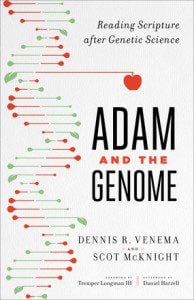 The final chapter of the new book Adam and the Genome by Dennis Venema and Scot McKnight looks carefully at the the way at Paul uses Adam in Romans 5 and 1 Corinthians 15. As this is really the core issue for many Christians. We looked at Scot’s first two theses concerning Paul’s use of Adam in the last post on the book (Paul’s Adam) and will look at the final three today. In what follows I summarize key parts of Scot’s arguments (read the whole book – it is well worth the time), but also throw in some of my own thinking. It warrants deep thought and civil conversation as we work through the issues.
Thesis Three: The Adam of Paul is the archetypal, moral Adam who is the archetype for both Israel and all humanity. Paul’s uses Adam as the reverse image or negative of Christ. The importance is in the comparison, where Adam’s sin is contrasted with Christ’s faithfulness. Salvation is tied not to Adam’s sinfulness, but to Christ’s faithfulness. “Paul uses Adam to bolster his Christology and to magnify the accomplishments of Christ.” (p. 181) Christ is the second Adam and the finally faithful Israelite. In Paul’s usage, Adam isn’t the prototype (primeval) man, but the archetype for mankind – the one representing all. (See Walton’s chapter in The Historical Adam pp. 89-118 for a more complete discussion of “archetype.”) This doesn’t address whether Adam lived as a unique human being, it merely addresses the role that Adam plays in Paul’s development of his Christology.
Thesis Four: Adam and all his descendants are connected, but original sin understood as original guilt and damnation for all humans by birth is not found in Paul. In Jewish fashion, Paul points his accusing finger at humans for their sins. How there is continuity between Adam, all his descendants, their sins and death is not stated by Paul. (p. 183) In good Jewish fashion, Adam is a literary figure who is put to theological use in Paul’s development of his Christology.
Romans 5:12 is a key but complex verse. “Therefore, just as sin entered the world through one man, and death through sin, and in this way death came to all people, because all sinned” (NIV) The ESV and NASB also have “because all sinned,” The CEB has “since everyone has sinned.” I could give other examples, but this is key. All may have sinned because Adam introduced sin into the world, but all people sin as individuals. There is no “original guilt” implied in Paul’s development.
Scot writes:
What needs to be observed and repeated for a generation with emphasis is what Paul is here saying: he is not saying that all have sinned in Adam and therefore die but instead that each person, like Adam, sins and therefore dies because of that sinning. Humans somehow inherit something from Adam, but they die not because of that inheritance but because they sin. (p. 185)
There is a corporate sense in Paul – as humans we stand together. This is part of his argument in Romans 5:18-19, but unless you are a universalist, original guilt really doesn’t seem to stand up in Paul’s theology and Christology (and I don’t see Paul as a universalist). Consequently, just as one trespass resulted in condemnation for all people, so also one righteous act resulted in justification and life for all people. For just as through the disobedience of the one man the many were made sinners, so also through the obedience of the one man the many will be made righteous. We live in a fallen world, among rebellious and imperfect people. Reading Paul – from Romans through Philemon – unless we act and believe in God and his Messiah, Jesus the Christ, we remain in condemnation for our sins (not for Adam’s sin).
Scot sums up:
We have now come to a crucial moment in this section of the book. What kind of Adam is found in Romans 5 (and 1 Cor. 15)? The answer is clear: Paul’s Adam is the literary Adam of Genesis filtered through the Jewish tradition of interpreting Adam as the archetypal, moral, and exemplary Adam who both unleashes sin into the world by his own sin and at the same time forms a model for each human being: each human being stands before God as a sinner because each human being sins as did Adam (and Eve). Adam is the precise counterpoint to Christ – what Adam did Christ undid; what Adam did not do Christ did. Hence, Paul cannot blame Adam; he blames each person for sinning like Adam. (p. 187)
Thesis Five: The Adam of Paul was not the historical Adam. To understand this statement we have to understand what Scot means by the historical Adam. It is a logical argument that I will shorten and paraphrase: (1) two actual persons lived. (2) Those two persons have a biological relationship to all that (3) passed on their DNA and (4,5) having fallen, passed on their sin nature to all. (6) Without this biological passing on of a sin nature, not all would need salvation. Therefore, (7) if one denies the historical Adam one denies the gospel of salvation. Adam is the lynchpin to the story. Without him it falls apart. This is not Paul’s Adam.
Paul may have believed that Adam and Eve existed as unique individuals. He likely believed in the genealogical Adam (Genesis 5, 1 Chronicles 1). However, we shouldn’t push too hard, as ancient thinkers were not gullible – they thought deeply, recognized inconsistencies, and worked with the text. Also, Paul dealt with questions at hand in his letters, not with every possible question or issue. Paul certainly believed that humans were created in the image of God, that they chose to disobey, that this brought death into the world for all; that all sin; that Christ, through his faithful life and death, and through his resurrection brings justification and life for all. Paul doesn’t address the eternal fate of those who died young or unable to comprehend (infants, disabled, etc.). Concerning the rest of us he is clear.
Daniel Harrell, a Pastor and a friend, writes in the Afterword to Adam and the Genome.
I’ve always appreciated that while Adam and Jesus are the two sides of Paul’s salvation equation, they are not equal historically. Adam was known to Paul only through hundreds of years of religious and cultural transmission as a figure of Jewish theology and archetypal significance. But Jesus and his resurrection were recent realities and a personal experience for Paul, occurring in Jerusalem only twenty-five years or so before he wrote the Letter to the Romans. (p. 198)
Paul is writing about Christ, using Adam. Adam is not the center of Paul’s gospel. Adam is not the starting point for Paul’s gospel. Adam is not the foundation for Paul’s gospel. Now, brothers and sisters, I want to remind you of the gospel I preached to you, … that Christ died for our sins according to the Scriptures, that he was buried, that he was raised on the third day according to the Scriptures, that he appeared (to many of his followers and lastly to Paul). (1 Cor. 15:1-8) Christ is center, starting point, and foundation of Paul’s gospel. Christ is also the center of Romans 5. Adam is used as the original sinner, not the origin of sin or the one from whom we inherit original guilt.
So what? Now me, not Scot (he may or may not agree). When we as a church focus on the historical Adam and on original guilt, we develop and preach a construct that can undermine our witness to the world around us. We start to do silly things – like set up science and scientists as a tool of Satan. We push the conflict view, pitting faith and science against each other. Because Adam is not the focal point of Paul’s gospel, of the Gospel’s or even of the Old Testament, we put up unnecessary stumbling blocks. Hold it with an open hand. Let chips fall where they fall – perhaps future work in science will turn around and support a more literal interpretation of the Genesis creation account, perhaps it won’t (I lean toward the latter, but it doesn’t matter). Paul’s Christology didn’t depend on Adam and our faith doesn’t depend on Adam.
How does Paul use Adam?
What is Paul’s goal?
If you wish to contact me directly you may do so at rjs4mail[at]att.net.
If interested you can subscribe to a full text feed of my posts at Musings on Science and Theology.
Previous Post

October 3, 2017
Overcoming Religious Tribalism: An Example
Next Post
October 3, 2017 Life On Earth: 3.95 Billion Years Ago
Browse Our Archives
Select a Category Acts of the Apostles Adam Advent Anabaptism Angels Anglican Apologetics Atonement Baptism BCP Prayers Bible Biblical Studies Birds Blogging Bloglossary Bonhoeffer Books Calvinism Christianity Church Church History Coffee Colossians Commentary Recs Conversion Creation Creeds Culture Death Ecclesiastes Economics Education Embracing Grace Emergent Emerging Movement Eschatology Essays Ethics Eucharist Evangelicalism Family Fasting Fathers Fellowship of Differents Footsteps Tour Fun and Whimsical Gospel Grace Happiness Heaven Hell Holy Spirit Irenaeus James Jesus Jesus Creed Job Justification Kingdom of God Law Lectures Lent Liberalism Love and Marriage Mabanteneni Manhood Mary Miracles Missio Alliance MissioLife Missional Missional Jesus Movies and Film New Perspective Northern Seminary OneLife Origins Project Orthodox Parables Pastor's Spouse Pastoring and Leading Pastoring and Preaching Patristics Paul Paul-John Tour Pharisees Pietism Political Theology Prayer and Formation Preaching Problems for Faith Psalm 119 Psalms Public Issues Purgatory Religions Resurrection Revelation Romans Rule of JCreed Science and Faith Sermon on the Mount Sports Ten Commandments Theology Third Way Top Ten Lists Translations Uncategorized Universalism University Ministry Way Out Weekly Meanderings Wisdom Women and Ministry Work Worship Writing & Blogging Youth Ministry
Select a Month July 2021 January 2020 December 2019 November 2019 October 2019 September 2019 August 2019 July 2019 June 2019 May 2019 April 2019 March 2019 February 2019 January 2019 December 2018 November 2018 October 2018 September 2018 August 2018 July 2018 June 2018 May 2018 April 2018 March 2018 February 2018 January 2018 December 2017 November 2017 October 2017 September 2017 August 2017 July 2017 June 2017 May 2017 April 2017 March 2017 February 2017 January 2017 December 2016 November 2016 October 2016 September 2016 August 2016 July 2016 June 2016 May 2016 April 2016 March 2016 February 2016 January 2016 December 2015 November 2015 October 2015 September 2015 August 2015 July 2015 June 2015 May 2015 April 2015 March 2015 February 2015 January 2015 December 2014 November 2014 October 2014 September 2014 August 2014 July 2014 June 2014 May 2014 April 2014 March 2014 February 2014 January 2014 December 2013 November 2013 October 2013 September 2013 August 2013 July 2013 June 2013 May 2013 April 2013 March 2013 February 2013 January 2013 December 2012 November 2012 October 2012 September 2012 August 2012 July 2012 June 2012 May 2012 April 2012 March 2012 February 2012 January 2012 December 2011 November 2011 October 2011 September 2011 August 2011 July 2011 June 2011 May 2011 April 2011 March 2011 February 2011 January 2011 December 2010 November 2010 October 2010 September 2010 August 2010 July 2010 June 2010 May 2010 April 2010 March 2010 February 2010 January 2010 December 2009 November 2009 October 2009 September 2009 August 2009 July 2009 June 2009 May 2009 April 2009 March 2009 February 2009 January 2009 December 2008 November 2008 October 2008 September 2008 August 2008 July 2008 June 2008 May 2008 April 2008 March 2008 February 2008 January 2008 December 2007 November 2007 October 2007 September 2007 August 2007 July 2007 June 2007 May 2007 April 2007 March 2007 February 2007 January 2007 December 2006 November 2006 October 2006 September 2006 August 2006 July 2006 June 2006 May 2006 April 2006 March 2006 February 2006 January 2006 December 2005 November 2005 October 2005 September 2005 August 2005 July 2005 June 2005 May 2005 April 2005 0000
Follow Us!
TAKE THE
Religious Wisdom Quiz
What does "Beersheba" mean?
Select your answer to see how you score.
House of the King Blessed Field Well of the Oath Valley of Water
Related posts from Jesus Creed


The Gospel of With Us and Through Us

Northern Seminary Announces: Nijay Gupta Joins Faculty

The Gundrys and Me: Ruth Tucker
TRENDING AT PATHEOS Evangelical

When you hear the word riches, what comes to mind? For most...

Don’t Miss the Parents: A Creative Christmas Meditation
As we enter the Advent Season, I see many people trying to...

Making Stones Into Bread: Choosing the “Right” Work
I was on my online arts ministry Zoom meeting with the International...

Ukraine’s exhausted Christians face fifth winter of war
By Julian Lukins The full-scale war in Ukraine is taking “a serious...

Russell Brand's Conviction is not anti-Christian Persecution
How do we shed the reputation that the Church is OK with...

Have you ever caught yourself saying, “I’ll do it tomorrow,” or “Now...
view all Evangelical blogs
Ad-Free & Subscriber Log-In Subscription Support
- About Us
- 2026 Calendar
- Videos
- Podcasts
- Library of World Religions
- Faith In Media Tracker
- Advertise With Us
- Write for Us
- Privacy Policy
- Terms of Service
- Do Not Sell My Data
- Contact Us
- Radiant Digital
- Manage Newsletter Subscriptions
- Unsubscribe From Notifications
- Sitemap
Copyright 2008-2026, Patheos, part of the Radiant Digital network of media brands. All rights reserved.
Subscription Support Ad-Free & Subscriber Log-In
Follow Patheos