
BuddhistCatholicContemplativeEvangelicalGeneral ChristianHinduJewishLatter-day SaintMuslimNew VisionsProgressive Christian
Beliefs
- Buddhist
- Catholic
- Contemplative
- Evangelical
- General Christian
- Hindu
- Jewish
- Latter-day Saint
- More Voices
- Muslim
- New Visions
- Pagan
- Progressive Christian
Topics
- Religion News
- Food and Religion
- Sports and Religion
- Religious Art
- Religious Music and Entertainment
- Religious Events
- History and Religion
- Style and Religion
- Politics and Religion
- Women in Religion
- Recreation Outdoors and Religion
- Business Finance and Religion
- Careers Workplace and Religion
- Education and Religion
- Family Parenting and Religion
- Health Fitness and Religion
- Home and Religion
- Relationships and Religion
- Technology and Religion
- Travel and Religion
Columnists
- Buddhist Columnists
- Business Finance and Religion Columnists
- Careers Workplace and Religion Columnists
- Catholic Columnists
- Contemplative Columnists
- Education and Religion Columnists
- Evangelists Columnists
- Family Parenting and Religion Columnists
- General Christian Columnists
- Health Fitness and Religion Columnists
- Hindu Columnists
- History and Religion Columnists
- Home and Religion Columnists
- Jewish Columnists
- More Voices Columnists
- Latter Day Columnists
- Muslim Columnists
- New Visions Columnists
- Nonreligious Columnists
- Pagan Columnists
- Politics and Religion Columnists
- Progressive Columnists
- Recreation Outdoors and Religion Columnists
- Relationships and Religion Columnists
- Religion News Columnists
- Religious Art Columnists
- Religious Events Columnists
- Religious Music and Entertainment Columnists
- Sports and Religion Columnists
- Style and Religion Columnists
- Technology and Religion Columnists
- Travel and Religion Columnists
- Women in Religion Columnists
Resource Library
- 2026 Calendar
- Library of World Religions
- The 100 Most Holy Places on Earth
- Patheos Answers
- Podcasts
- Videos
- Faith Leaders Database
- Anglican Episcopalian
- Bahai
- Baptist
- Buddhism
- Christianity
- Confucianism
- Eastern Orthodoxy
- Hinduism
- Holiness and Pentecostal
- ISKCON
- Islam
- Judaism
- Lutheran
- Methodist
- The Church of Jesus Christ of Latter-day Saints
- New Age
- Paganism
- Presbytarian and Reformed
- Protestantism
- Religion Behind the Scenes
- Roman Catholic
- Scientology
- Shia Islam
- Sikhism
- Sufism
- Sunni Islam
- Taoism
- Zen
- See all religions
Research Tools
 Ad-Free & Subscriber Log-In Subscription Support
Follow Patheos 

- Trending:
- Advent
- |
- Forgiveness
- |
- Thanksgiving
- |
- Election
- |
- Seasonal Holidays
- |
- Marriage
 Jesus Creed
- Home
- Evangelical
- Paul’s Adam (RJS)
Paul’s Adam (RJS)
Last updated on: September 19, 2017 at 1:22 pm by RJS
Paul’s Adam (RJS) 2017-09-19T13:22:26-05:00 RJS
Patheos Explore the world's faith through different perspectives on religion and spirituality! Patheos has the views of the prevalent religions and spiritualities of the world.
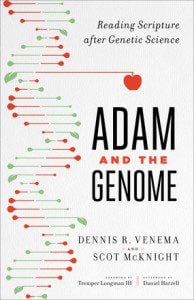 The final chapter of the new book Adam and the Genome by Dennis Venema and Scot McKnight looks carefully at the the way at Paul uses Adam in Romans 5 and 1 Corinthians 15. As this is really the core issue for many Christians, we will spread the discussion out over two posts.
Scot starts the chapter with a brief discussion of the role that Science, particularly evolutionary biology, can play in loss of faith. If a person has tightly connected faith with a particular biblical teaching on Genesis and on original sin it can appear that the only two options are (1) dismiss evolutionary biology and much of modern science as a misguided fraud or (2) dismiss orthodox Christian faith as a misguided fraud. Scot provides the example of a man named Kenneth who “chose science because the understanding of the Bible was in his view demonstrably wrong.” (p. 173) In fact, he was “disturbed by the flippant disregard and disdain on the part of many creationists for the patient investigation and analysis that have led most scientists in the past century to accept evolution.” (p. 172)
If the Bible clearly teaches a young earth creation, global flood, woman from side of man and Augustinian Original Sin, then we must make this hard choice, and in my opinion Kenneth made the right one. This particular teaching and interpretation of scripture is demonstrably inconsistent with observations of the world around us. The imaginative extrapolations required to make observations fit the interpretation are mind-blowing. Joel Duff, a professor of biology at Akron, does an excellent job of digging into these on his blog Naturalis Historia.
However, it is not at all clear that the young earth interpretation is the only faithful interpretation of Scripture. Thus, the science compels us to dig deeper into Scripture and into the context within which it was written. This isn’t a new situation. As Kyle Greenwood described in his book Scripture and Cosmology, we walk in the footsteps of those who came before us. The earth is a spheroid with people populating most of the surface, the solar system is sun-centered, not earth centered, neither of which represent the most “literal” interpretation of Scripture. It is also not clear that the interpretation of Adam as the sole male progenitor of the entire human race some 6000 years ago is the only faithful interpretation of Scripture.
If there are alternative interpretations and approaches consistent both with Scripture and with conclusions of modern science, then we should be open to these interpretations. All truth is God’s truth. To fail to do so is to give people an easy excuse to avoid even considering the deeper claims of Christianity embodied in the life, death, and resurrection of Jesus the Christ. Paul, after all, was not intent on teaching about Adam, rather he was preaching and teaching the gospel of Jesus Christ as experienced in his life, in the lives of the other apostles, and in the explosion of the early church.
This brings us to the first two of Scot’s five theses concerning Paul’s use of Adam. The following is a sketch – read the book to flesh out details. Scot starts by outlining Romans 5:12-21 following N. T. Wright (The Letter to the Romans, NIB). The passage is complex in part because the argument is interspersed with explanatory asides. The primary argument couples verse 12 with 18: Therefore, just as sin entered the world through one man, and death through sin, and in this way death came to all people, because all sinned— … Consequently, just as one trespass resulted in condemnation for all people, so also one righteous act resulted in justification and life for all people. And a triumphant conclusion (v. 21): so that, just as sin reigned in death, so also grace might reign through righteousness to bring eternal life through Jesus Christ our Lord.
Thesis 1: The Adam of Paul is the literary, genealogical, image-of-God Adam found in Genesis. (p. 176) Paul didn’t have any extraordinary or supernatural knowledge about Adam. Paul knew about Adam from the Bible. One thing this means is that we shouldn’t impose later (Augustinian for example) understandings back on to Paul. Rather we should consider whether these ideas are or are not consistent with Paul’s intent, based on the Adam of Genesis.
Thesis 2: The Adam of Paul is the Adam of the Bible filtered through – both in agreement and in disagreement with – the Jewish interpretive tradition about Adam. (p. 177) Paul’s use of Adam shows distinct similarities to the Wisdom of Solomon, a first century work included in the Apocrypha or Deuterocanonical books. It has been valued by the church, although not included in the Protestant canon. In particular Romans 1 and Wisdom 13:1-19 show distinct similarities.
This chapter in the Wisdom of Solomon is for New Testament readers another version of Romans 1, and it should not then surprise us that many think Paul had read the Wisdom of Solomon and was echoing it there. At a minimum it had influenced the world in which Paul had learned to think about the human condition. (p. 179)
There are other examples as well. Scot points out: “That Adam had lost his glory in the primal sin is found in Paul and in Jewish texts, but one cannot find it in Genesis, though it is more than easy to infer it.” (p. 179)
In Romans 7 expresses a thought that connects sin with desire – a thought found in other Jewish texts of the time. “Nevertheless, I would not have known what sin was had it not been for the law. For I would not have known what coveting really was if the law had not said, “You shall not covet.” But sin, seizing the opportunity afforded by the commandment, produced in me every kind of coveting.” (7:7-8) The Greek word translated covet/coveting here is translated as desire in James 1:15 “Then, after desire has conceived, it gives birth to sin; and sin, when it is full-grown, gives birth to death.” The same idea is found in the Apocalypse of Moses (ca. The Apocalypse of Moses, assigned a Semitic 1st Century origin, notes: “For covetousness is the origin of every sin.” (19:3) using the same Greek word as Romans and James in the extant Greek translation.
Paul did not write from or into a vacuum. Rather he wrote out of a culture and into a culture about the central reality of the gospel of Jesus Christ. The context in which we first learned the Adam story shapes the way we read it and the same was true of Paul. He wrote about what he had experienced, what the other apostles in community with Jesus during his life, had experienced. He wrote about this using and adapting concepts in his vocabulary and understanding – and this includes his use of Adam. We should take this into account when interpreting the ways in which Paul uses Adam to describe truths about Christ.
Scot suggests that these two theses should not raise much controversy, but the next steps may bring more debate. This will come in the next (and penultimate) post on the book.
Where did Paul get his information about Adam?
What difference might this make in our understanding?
If you wish to contact me directly, you may do so at rjs4mail[at]att.net
If interested you can subscribe to a full text feed of my posts at Musings on Science and Theology.
Previous Post

September 19, 2017
If You Don't Know Sarah Ruden, You Should
Next Post
September 20, 2017 Crime And Punishment: Greg Boyd Style
Browse Our Archives
Select a Category Acts of the Apostles Adam Advent Anabaptism Angels Anglican Apologetics Atonement Baptism BCP Prayers Bible Biblical Studies Birds Blogging Bloglossary Bonhoeffer Books Calvinism Christianity Church Church History Coffee Colossians Commentary Recs Conversion Creation Creeds Culture Death Ecclesiastes Economics Education Embracing Grace Emergent Emerging Movement Eschatology Essays Ethics Eucharist Evangelicalism Family Fasting Fathers Fellowship of Differents Footsteps Tour Fun and Whimsical Gospel Grace Happiness Heaven Hell Holy Spirit Irenaeus James Jesus Jesus Creed Job Justification Kingdom of God Law Lectures Lent Liberalism Love and Marriage Mabanteneni Manhood Mary Miracles Missio Alliance MissioLife Missional Missional Jesus Movies and Film New Perspective Northern Seminary OneLife Origins Project Orthodox Parables Pastor's Spouse Pastoring and Leading Pastoring and Preaching Patristics Paul Paul-John Tour Pharisees Pietism Political Theology Prayer and Formation Preaching Problems for Faith Psalm 119 Psalms Public Issues Purgatory Religions Resurrection Revelation Romans Rule of JCreed Science and Faith Sermon on the Mount Sports Ten Commandments Theology Third Way Top Ten Lists Translations Uncategorized Universalism University Ministry Way Out Weekly Meanderings Wisdom Women and Ministry Work Worship Writing & Blogging Youth Ministry
Select a Month July 2021 January 2020 December 2019 November 2019 October 2019 September 2019 August 2019 July 2019 June 2019 May 2019 April 2019 March 2019 February 2019 January 2019 December 2018 November 2018 October 2018 September 2018 August 2018 July 2018 June 2018 May 2018 April 2018 March 2018 February 2018 January 2018 December 2017 November 2017 October 2017 September 2017 August 2017 July 2017 June 2017 May 2017 April 2017 March 2017 February 2017 January 2017 December 2016 November 2016 October 2016 September 2016 August 2016 July 2016 June 2016 May 2016 April 2016 March 2016 February 2016 January 2016 December 2015 November 2015 October 2015 September 2015 August 2015 July 2015 June 2015 May 2015 April 2015 March 2015 February 2015 January 2015 December 2014 November 2014 October 2014 September 2014 August 2014 July 2014 June 2014 May 2014 April 2014 March 2014 February 2014 January 2014 December 2013 November 2013 October 2013 September 2013 August 2013 July 2013 June 2013 May 2013 April 2013 March 2013 February 2013 January 2013 December 2012 November 2012 October 2012 September 2012 August 2012 July 2012 June 2012 May 2012 April 2012 March 2012 February 2012 January 2012 December 2011 November 2011 October 2011 September 2011 August 2011 July 2011 June 2011 May 2011 April 2011 March 2011 February 2011 January 2011 December 2010 November 2010 October 2010 September 2010 August 2010 July 2010 June 2010 May 2010 April 2010 March 2010 February 2010 January 2010 December 2009 November 2009 October 2009 September 2009 August 2009 July 2009 June 2009 May 2009 April 2009 March 2009 February 2009 January 2009 December 2008 November 2008 October 2008 September 2008 August 2008 July 2008 June 2008 May 2008 April 2008 March 2008 February 2008 January 2008 December 2007 November 2007 October 2007 September 2007 August 2007 July 2007 June 2007 May 2007 April 2007 March 2007 February 2007 January 2007 December 2006 November 2006 October 2006 September 2006 August 2006 July 2006 June 2006 May 2006 April 2006 March 2006 February 2006 January 2006 December 2005 November 2005 October 2005 September 2005 August 2005 July 2005 June 2005 May 2005 April 2005 0000
Follow Us!
TAKE THE
Religious Wisdom Quiz
What does "Shalom" mean in Hebrew?
Select your answer to see how you score.
Joy Peace Love Blessing
Related posts from Jesus Creed


The Gospel of With Us and Through Us

Northern Seminary Announces: Nijay Gupta Joins Faculty

The Gundrys and Me: Ruth Tucker
TRENDING AT PATHEOS Evangelical

When you hear the word riches, what comes to mind? For most...

Don’t Miss the Parents: A Creative Christmas Meditation
As we enter the Advent Season, I see many people trying to...

Making Stones Into Bread: Choosing the “Right” Work
I was on my online arts ministry Zoom meeting with the International...

Ukraine’s exhausted Christians face fifth winter of war
By Julian Lukins The full-scale war in Ukraine is taking “a serious...

Russell Brand's Conviction is not anti-Christian Persecution
How do we shed the reputation that the Church is OK with...

Have you ever caught yourself saying, “I’ll do it tomorrow,” or “Now...
view all Evangelical blogs
Ad-Free & Subscriber Log-In Subscription Support
- About Us
- 2026 Calendar
- Videos
- Podcasts
- Library of World Religions
- Faith In Media Tracker
- Advertise With Us
- Write for Us
- Privacy Policy
- Terms of Service
- Do Not Sell My Data
- Contact Us
- Radiant Digital
- Manage Newsletter Subscriptions
- Unsubscribe From Notifications
- Sitemap
Copyright 2008-2026, Patheos, part of the Radiant Digital network of media brands. All rights reserved.
Subscription Support Ad-Free & Subscriber Log-In
Follow Patheos