
BuddhistCatholicContemplativeEvangelicalGeneral ChristianHinduJewishLatter-day SaintMuslimNew VisionsProgressive Christian
Beliefs
- Buddhist
- Catholic
- Contemplative
- Evangelical
- General Christian
- Hindu
- Jewish
- Latter-day Saint
- More Voices
- Muslim
- New Visions
- Pagan
- Progressive Christian
Topics
- Religion News
- Food and Religion
- Sports and Religion
- Religious Art
- Religious Music and Entertainment
- Religious Events
- History and Religion
- Style and Religion
- Politics and Religion
- Women in Religion
- Recreation Outdoors and Religion
- Business Finance and Religion
- Careers Workplace and Religion
- Education and Religion
- Family Parenting and Religion
- Health Fitness and Religion
- Home and Religion
- Relationships and Religion
- Technology and Religion
- Travel and Religion
Columnists
- Buddhist Columnists
- Business Finance and Religion Columnists
- Careers Workplace and Religion Columnists
- Catholic Columnists
- Contemplative Columnists
- Education and Religion Columnists
- Evangelists Columnists
- Family Parenting and Religion Columnists
- General Christian Columnists
- Health Fitness and Religion Columnists
- Hindu Columnists
- History and Religion Columnists
- Home and Religion Columnists
- Jewish Columnists
- More Voices Columnists
- Latter Day Columnists
- Muslim Columnists
- New Visions Columnists
- Nonreligious Columnists
- Pagan Columnists
- Politics and Religion Columnists
- Progressive Columnists
- Recreation Outdoors and Religion Columnists
- Relationships and Religion Columnists
- Religion News Columnists
- Religious Art Columnists
- Religious Events Columnists
- Religious Music and Entertainment Columnists
- Sports and Religion Columnists
- Style and Religion Columnists
- Technology and Religion Columnists
- Travel and Religion Columnists
- Women in Religion Columnists
Resource Library
- 2026 Calendar
- Library of World Religions
- The 100 Most Holy Places on Earth
- Patheos Answers
- Podcasts
- Videos
- Faith Leaders Database
- Anglican Episcopalian
- Bahai
- Baptist
- Buddhism
- Christianity
- Confucianism
- Eastern Orthodoxy
- Hinduism
- Holiness and Pentecostal
- ISKCON
- Islam
- Judaism
- Lutheran
- Methodist
- The Church of Jesus Christ of Latter-day Saints
- New Age
- Paganism
- Presbytarian and Reformed
- Protestantism
- Religion Behind the Scenes
- Roman Catholic
- Scientology
- Shia Islam
- Sikhism
- Sufism
- Sunni Islam
- Taoism
- Zen
- See all religions
Research Tools
 Ad-Free & Subscriber Log-In Subscription Support
Ad-Free & Subscriber Log-In Subscription Support
Follow Patheos 

- Trending:
- Forgiveness
- |
- Marriage
- |
- Consciousness
- |
- Death Penalty
- |
- Election
- |
- Halloween
 Jesus Creed
- Home
- Evangelical
- The Benedict Option: What’s Benedictine about Dreher?
The Benedict Option: What’s Benedictine about Dreher?
Last updated on: April 18, 2017 at 12:09 am by Scot McKnight
The Benedict Option: What’s Benedictine about Dreher? 2017-04-15T10:00:03-05:00 Scot McKnight
Patheos Explore the world's faith through different perspectives on religion and spirituality! Patheos has the views of the prevalent religions and spiritualities of the world.
In a recent article in The National Review, Rachel Lu predictably contends for more presence and activism by Christians, and the author does so in some version of a Niebuhrian or Kuyperian or Catholic or Methodist activism. Rachel Lu, in a thoroughly civil review unlike at least one other review, says this of Rod Dreher’s Benedict Option:
Rod Dreher’s The Benedict Option has been particularly influential, igniting controversy with the suggestion that “the culture war as we knew it is over” and that Christians should focus their energies on building families and smaller communities that are self-consciously countercultural. That book was complemented in interesting ways by Anthony Esolen’s apocalyptic Out of the Ashes and Archbishop Charles Chaput’s less extreme but still bracing Strangers in a Strange Land, which offers advice on “living the Catholic faith in a post-Christian world.”In concert, these books have thrown Christians into a debate about the wisdom of radical withdrawal as a means of coping with cultural loss. Should Christians stay engaged in political and cultural battles? Or is it better to accept our losses and focus on the higher things?
The Benedict Option was controversial in large part because religious conservatives are already very attracted to quietist modes of thought. Quietism, a posture of spiritual detachment, has appeared in various forms throughout Christian history and culture. It gains force when a culture is in decline or elites become overtly hostile to Christianity. Withdrawal holds appeal, not only because the world is hard but also because Christians believe themselves to be the inheritors of a rich tradition that promises something better. To Christian faithful, life is first and foremost a quest for eternal redemption. If the mainstream culture seems uncongenial to that journey, there will always be some who judge it best to give up the fight for the world and to focus instead on forging a less perilous path for themselves and their loved ones.
Throughout Christian history, many believers have withdrawn from the world for such reasons. But quietist movements are also a familiar part of American tradition; our nation’s history is peppered with self-segregated faith communities. Some denominations, like the Anabaptists and Hutterites, explicitly prescribe a more segregated lifestyle. Other communities identify with a larger denomination but collectively commit to a prescribed countercultural lifestyle. Americans are a people with a robust religious foundation, a strong commitment to freedom, and relatively shallow cultural roots. Experimenting with faith in community seems natural to us.
Quietism and alarmism are the two prevailing winds against Dreher’s Benedict Option. To compare Dreher’s proposals to the “Anabaptists” (which group, Rachel?) and “Hutterites” (that’s very specific) is mistaken in important ways because unlike the Hutterites, Dreher’s supposed quietism is not as withdrawn or as insular as them. Nor is he a Quaker.
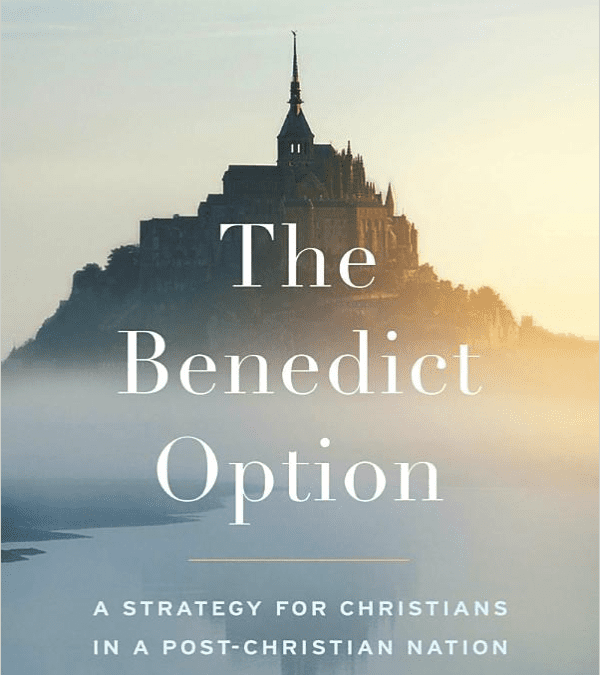 Instead of using terms like quietism let’s look at what Dreher actually says about his Benedict Option. Noticeably, he uses the Rule of Benedict and adjusts it by generalizing some principles for ordinary folks to use as they seek to make their way in post-Christian America. Here are Dreher’s proposals:
We are adrift in liquid modernity, with no direction home.
The forces of dissolution from popular culture are too great for individuals or families to resist on their own. We need to embed ourselves in stable communities of faith.
But that’s not necessarily quietism unless it means total withdrawal, monastery like or Hutterite like. What Dreher means by strategic withdrawal is exiting the culture war, regrouping by becoming more Christian, and turning churches into agents of Christian sanctification. Many of us have said the culture war is either over or not worth fighting for. Even James Davison Hunter leaned in that direction in his widely read To Change the World. Hunter’s proposals struck many of us with anabaptist leanings as quite anabaptist as he urged a kind of “faithful presence,” the title of my colleague, David Fitch’s book*: Faithful Presence.*
So what are the principles one can use from the Rule of Benedict according to Dreher? It begins with the cultural problem Dreher believes is upon us, or close enough to be upon us, or lurking the shadows. His rhetoric on the problems we face strike many as alarmist but his common jeremiads against our day are not held him by him alone. If he trades in hyperbole it serves a purpose to call attention to genuine problems for Christian living in post-Christian America. Here’s the cultural problem:
The Rule is for monastics, obviously, but its teachings are plain enough to be adapted by lay Christians for their own use. It provides a guide to serious and sustained Christian living in a fashion that reorders us interiorly, bringing together what is scattered within our own hearts and orienting it to prayer.
Nor are we trying to save the West. We are only trying to build a Christian way of life that stands as an island of sanctity and stability amid the high tide of liquid modernity. We are not looking to create heaven on earth-; we are simply looking for a way to be strong in faith through a time of great testing.
When I heard of this book and when I opened it I expected to read about Ave Maria University in Ave Maria FL, a community Kris and I wandered around one day. Not a word. Nor does it seem to me Dreher sees Ave Maria as what he’s on about. From my reading he imagines Christians remaining where they are but forming tighter fellowship with other like-minded Christians in their community. Unlike the Essenes of Qumran they are like the Pharisees of Galilee. (I know many see the word “Pharisee” and think “negative.” Forgive me, but I don’t. The Pharisees remained where they were and lived in their community according to their own rule of life, the Torah interpreted.)
His principles, which are an example of (mostly) Catholic virtue ethics, are these:
First, Order. If a defining characteristic of the modern world is disorder, then the most fundamental act of resistance is to establish order. If we don’t have internal order, we will be controlled by our human passions and by the powerful outside forces who are in greater control of directing liquid modernity’s deep currents.
This means the discovery of the order, the logos, that God has written into the nature of Creation and seeking to live in harmony with it. … To order the world rightly as Christians requires regarding all things as pointing to Christ. … In other words, ordering one’s actions is really about training one’s heart to love and to desire the right things, the things that are real, without having to think about it. It is acquiring virtue as a habit.
Second, Prayer. The 1960s media theorist Marshall McLuhan, a practicing Christian, once said that everyone he knew who lost his faith began by ceasing to pray. 60
Third, Work. This is how we must approach our jobs: as opportunities to glorify God. More deeply, Benedictines view their work as an expression of love and stewardship of the community and as a way of reordering the natural world in harmon with God’s will. For the Christian, work has sacramental value. 61
Fourth, Asceticism. I he closure of certain professions to faithful orthodox Christians will be difficult to accept. … . And many of us are not prepared to suffer deprivation for our faith. 63 Asceticism is an antidote to the poison of self-centeredness common in our culture, which teaches us that satisfying our own desires is the key to the good life. 63
Fifth, Stability. The Bible shows us that God calls some people to pick up and move to achieve His purposes, Father Benedict acknowledged. “Still, in a culture like ours, where everyone is always on the move, the Benedictine calling to stay put no matter what can call forth new and important ways of serving God.” 66
Sixth, Community. The rootlessness of contemporary life has frayed community bonds. It is common now to find people who don’t know their neighbors and don’t really want to. To be part of a community is to share in its life. That inevitably makes demands on the individual that limits his freedom. 67 To be a Christian, and to be a vowed member of a religious community, incurs certain obligations to others. … Life in Christian community, whether in monastic or ordinary congregations, is about building the kind of fellowship that every one of us needs to complete our individual pilgrimage. 70
Seventh, Hospitality. According to the Rule, we must never turn away someone who needs our love. A church or other Benedict Option community must be open to the world, to share the bounty of God’s love with those who lack it. 72
Eighth, Balance. Balance, then—or put another way, prudence, mercy, and good judgment — is key to governing the life of a Christian community. 74
Here is virtue ethics: “By methodically and practically ordering our bodies, souls, and minds to a harmonious life centered on the Christ who is everywhere present and filling all things, the Benedictine way offers a spirituality accessible to anyone.” 75
And here is the big theme of this book as I read it: “The way of Saint Benedict is not an escape from the real world but a way to see that world and dwell in it as it truly is. Benedictine spirituality teaches us to bear with the world in love and to transform it as the Holy Spirit transforms us” (77).
To order, click through one of these links:
Previous Post

April 17, 2017
Master of Arts in New Testament at Northern
Next Post
April 18, 2017 On the Resurrection (RJS)
Browse Our Archives
Select a Category Acts of the Apostles Adam Advent Anabaptism Angels Anglican Apologetics Atonement Baptism BCP Prayers Bible Biblical Studies Birds Blogging Bloglossary Bonhoeffer Books Calvinism Christianity Church Church History Coffee Colossians Commentary Recs Conversion Creation Creeds Culture Death Ecclesiastes Economics Education Embracing Grace Emergent Emerging Movement Eschatology Essays Ethics Eucharist Evangelicalism Family Fasting Fathers Fellowship of Differents Footsteps Tour Fun and Whimsical Gospel Grace Happiness Heaven Hell Holy Spirit Irenaeus James Jesus Jesus Creed Job Justification Kingdom of God Law Lectures Lent Liberalism Love and Marriage Mabanteneni Manhood Mary Miracles Missio Alliance MissioLife Missional Missional Jesus Movies and Film New Perspective Northern Seminary OneLife Origins Project Orthodox Parables Pastor's Spouse Pastoring and Leading Pastoring and Preaching Patristics Paul Paul-John Tour Pharisees Pietism Political Theology Prayer and Formation Preaching Problems for Faith Psalm 119 Psalms Public Issues Purgatory Religions Resurrection Revelation Romans Rule of JCreed Science and Faith Sermon on the Mount Sports Ten Commandments Theology Third Way Top Ten Lists Translations Uncategorized Universalism University Ministry Way Out Weekly Meanderings Wisdom Women and Ministry Work Worship Writing & Blogging Youth Ministry
Select a Month July 2021 January 2020 December 2019 November 2019 October 2019 September 2019 August 2019 July 2019 June 2019 May 2019 April 2019 March 2019 February 2019 January 2019 December 2018 November 2018 October 2018 September 2018 August 2018 July 2018 June 2018 May 2018 April 2018 March 2018 February 2018 January 2018 December 2017 November 2017 October 2017 September 2017 August 2017 July 2017 June 2017 May 2017 April 2017 March 2017 February 2017 January 2017 December 2016 November 2016 October 2016 September 2016 August 2016 July 2016 June 2016 May 2016 April 2016 March 2016 February 2016 January 2016 December 2015 November 2015 October 2015 September 2015 August 2015 July 2015 June 2015 May 2015 April 2015 March 2015 February 2015 January 2015 December 2014 November 2014 October 2014 September 2014 August 2014 July 2014 June 2014 May 2014 April 2014 March 2014 February 2014 January 2014 December 2013 November 2013 October 2013 September 2013 August 2013 July 2013 June 2013 May 2013 April 2013 March 2013 February 2013 January 2013 December 2012 November 2012 October 2012 September 2012 August 2012 July 2012 June 2012 May 2012 April 2012 March 2012 February 2012 January 2012 December 2011 November 2011 October 2011 September 2011 August 2011 July 2011 June 2011 May 2011 April 2011 March 2011 February 2011 January 2011 December 2010 November 2010 October 2010 September 2010 August 2010 July 2010 June 2010 May 2010 April 2010 March 2010 February 2010 January 2010 December 2009 November 2009 October 2009 September 2009 August 2009 July 2009 June 2009 May 2009 April 2009 March 2009 February 2009 January 2009 December 2008 November 2008 October 2008 September 2008 August 2008 July 2008 June 2008 May 2008 April 2008 March 2008 February 2008 January 2008 December 2007 November 2007 October 2007 September 2007 August 2007 July 2007 June 2007 May 2007 April 2007 March 2007 February 2007 January 2007 December 2006 November 2006 October 2006 September 2006 August 2006 July 2006 June 2006 May 2006 April 2006 March 2006 February 2006 January 2006 December 2005 November 2005 October 2005 September 2005 August 2005 July 2005 June 2005 May 2005 April 2005 0000
Follow Us!
TAKE THE
Religious Wisdom Quiz
Which Christian group is known for not celebrating holidays or birthdays?
Select your answer to see how you score.
Jehovah's Witnesses Episcopalians Orthodox Methodists
Related posts from Jesus Creed


The Gospel of With Us and Through Us

Northern Seminary Announces: Nijay Gupta Joins Faculty

The Gundrys and Me: Ruth Tucker
TRENDING AT PATHEOS Evangelical

The REST of Your Life: A Creative Wrestles...
This week I had a conversation with a good friend from church....

How the author of the world's best hymn...
I've been working with John Newton for a while now. This makes...

Long before this Lectio Divina, Psalm 130 - the song - started...

What About the Trees? Another Living Parable
After I finished writing the last article about falling leaves as a...

Why Classical Education Is a Conversation, Not a...
Come and Read: Joy in Classical Education When I was a little...

Cornell University has received a great deal of negative publicity and intense...
view all Evangelical blogs
Ad-Free & Subscriber Log-In Subscription Support
- About Us
- 2026 Calendar
- Videos
- Podcasts
- Library of World Religions
- Faith In Media Tracker
- Advertise With Us
- Write for Us
- Privacy Policy
- Terms of Service
- Do Not Sell My Data
- Contact Us
- Radiant Digital
- Manage Newsletter Subscriptions
- Unsubscribe From Notifications
- Sitemap
Copyright 2008-2026, Patheos. All rights reserved.
Subscription Support Ad-Free & Subscriber Log-In
Follow Patheos