
BuddhistCatholicContemplativeEvangelicalGeneral ChristianHinduJewishLatter-day SaintMuslimNew VisionsProgressive Christian
Beliefs
- Buddhist
- Catholic
- Contemplative
- Evangelical
- General Christian
- Hindu
- Jewish
- Latter-day Saint
- More Voices
- Muslim
- New Visions
- Pagan
- Progressive Christian
Topics
- Religion News
- Food and Religion
- Sports and Religion
- Religious Art
- Religious Music and Entertainment
- Religious Events
- History and Religion
- Style and Religion
- Politics and Religion
- Women in Religion
- Recreation Outdoors and Religion
- Business Finance and Religion
- Careers Workplace and Religion
- Education and Religion
- Family Parenting and Religion
- Health Fitness and Religion
- Home and Religion
- Relationships and Religion
- Technology and Religion
- Travel and Religion
Columnists
- Buddhist Columnists
- Business Finance and Religion Columnists
- Careers Workplace and Religion Columnists
- Catholic Columnists
- Contemplative Columnists
- Education and Religion Columnists
- Evangelists Columnists
- Family Parenting and Religion Columnists
- General Christian Columnists
- Health Fitness and Religion Columnists
- Hindu Columnists
- History and Religion Columnists
- Home and Religion Columnists
- Jewish Columnists
- More Voices Columnists
- Latter Day Columnists
- Muslim Columnists
- New Visions Columnists
- Nonreligious Columnists
- Pagan Columnists
- Politics and Religion Columnists
- Progressive Columnists
- Recreation Outdoors and Religion Columnists
- Relationships and Religion Columnists
- Religion News Columnists
- Religious Art Columnists
- Religious Events Columnists
- Religious Music and Entertainment Columnists
- Sports and Religion Columnists
- Style and Religion Columnists
- Technology and Religion Columnists
- Travel and Religion Columnists
- Women in Religion Columnists
Resource Library
- 2026 Calendar
- Library of World Religions
- The 100 Most Holy Places on Earth
- Patheos Answers
- Podcasts
- Videos
- Faith Leaders Database
- Anglican Episcopalian
- Bahai
- Baptist
- Buddhism
- Christianity
- Confucianism
- Eastern Orthodoxy
- Hinduism
- Holiness and Pentecostal
- ISKCON
- Islam
- Judaism
- Lutheran
- Methodist
- The Church of Jesus Christ of Latter-day Saints
- New Age
- Paganism
- Presbytarian and Reformed
- Protestantism
- Religion Behind the Scenes
- Roman Catholic
- Scientology
- Shia Islam
- Sikhism
- Sufism
- Sunni Islam
- Taoism
- Zen
- See all religions
Research Tools
 Ad-Free & Subscriber Log-In Subscription Support
Follow Patheos 

- Trending:
- Advent
- |
- Forgiveness
- |
- Thanksgiving
- |
- Election
- |
- Seasonal Holidays
- |
- Marriage
 Jesus Creed
- Home
- Evangelical
- The Assured Results of Modern Science? (RJS)
The Assured Results of Modern Science? (RJS)
Last updated on: March 16, 2017 at 5:37 am by RJS
The Assured Results of Modern Science? (RJS) 2017-03-15T21:31:47-05:00 RJS
Patheos Explore the world's faith through different perspectives on religion and spirituality! Patheos has the views of the prevalent religions and spiritualities of the world.
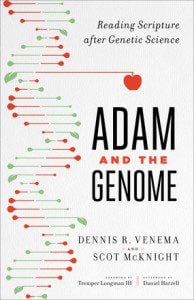 I have begun reading the new book Adam and the Genome by Dennis Venema and Scot McKnight. This book provides an important and novel contribution to the discussion of science and Christian faith. The book joins a number of other excellent books combining scientific and theological expertise. Science, Creation and the Bible: Reconciling Rival Theories of Origins by Richard Carlson and Tremper Longman III combines the expertise of a physicist (Carlson) and an Old Testament scholar (Longman) to address questions of origins. Longman contribution to the book sheds important light on the genre and context of the Old Testament texts on origins. God and the Cosmos: Divine Activity in Space, Time and History by theologian Harry Lee Poe and chemist Jimmy H. Davis looks at God’s interaction with this world, and the influence of science on the ways we think about God’s action. I’ve read, reviewed and recommend both of these books.
For many Christians, however, the question of divine action, important as it is to the theologian, does not impact day-to-day faith. The age of the earth is a non-question, although many books, including Science, Creation and the Bible, provide important new insights. The real sticking point of evolution (and even the age of the earth) comes down to the nature of human kind as the image of God, followed by Adam and the fall. The important scientific questions revolve around evolution and human evolution in particular and on the New Testament importance of Adam as the first man and the original sinner. Adam and the Genome targets these important questions. Dennis is a professor of biology at Trinity Western University. He is an evolutionary biologist and a Christian. Scot McKnight (known, of course, to this audience) is a New Testament scholar and theologian. Together they have given us a thought-provoking book to start a journey through the question. I will be digging into the book and highlighting important points and questions over the next … however long it takes. If interested, pick up a copy, read along, and join the conversation.
Defining Theory. In the first four chapters of the book Dennis tells something of his story and presents an excellent introduction to the genetic evidence for human evolution. Near the beginning of the first chapter he defines the scientific understanding of “theory.” Dennis found biology dreadfully boring in high school and his early college years. Biology, by all appearances, involved memorizing a large number of loosely related facts. This changed as he dug into research and began to understand the underlying themes and principles – the theories.
In science, a theory is and explanatory framework for why the facts are the way they are. Theories are not developed overnight – on the contrary, they are the product of a long process of making observations, forming hypotheses, and testing those hypotheses with experiments. (p. 3)
A scientific theory … starts with a guess of sorts – perhaps an educated guess, based on prior observations. It looks to the available facts and asks why the facts are the way they are. The result is a hypothesis – the technical term for “educated guess.” A scientist can use that hypothesis to form a prediction: if this is why things are the way they are, then such and such should be the case. Then an experiment can be set up to test the hypothesis. If the hypothesis is not supported, a scientist will reject the hypothesis. If the prediction is supported by the experiment, the scientist will fail to reject the hypothesis. (p. 4)
If the hypothesis is supported further experiments will be proposed, designed, and carried out to test and further refine the hypothesis. Eventually the hypothesis (or collection of hypotheses) have stood the test long enough and have enough explanatory power to be labeled a theory.
Good theories, then, are close approximations of how the natural world actually works. Scientists don’t ever fully “accept” them as “true” or “proven,” but many theories in science are so well established that it is highly unlikely that new evidence will substantially modify them. The chromosomal theory of inheritance and the germ theory of disease are examples of such theories: the evidence supporting them is huge, and every new technology that scientists have developed to study either one continues to support them – though they have been revised and improved in the process. (p. 4)
In my area of science, the quantum revolution came about because there were facts that didn’t support the popular theories. Newtonian mechanics and Maxwell’s equations were not enough – sending scientists back to the drawing board looking for the explanations. Few today doubt the reality of atoms and molecules or the laws of quantum mechanics that allow us to explain their structures and properties. When I teach, the goal is not to present students with a litany of facts they regurgitate on the exam (an use in subsequent courses). The goal is to teach them the underlying theoretical framework that makes sense of the facts. It is unimportant to memorize the details of the periodic table – it is far more important (and useful) to understand how to derive it, what the general trends are, and why they exists. Fundamental to chemistry are quantum theory and entropy (statistical mechanics). Evolution is a well attested theory that sits on a supporting framework of chemical and physical theories. Details are being revised constantly, but this is to be expected – it is part of the process.
The fickle finger of science? Many non-scientists have the impression that scientific theories are constantly changing. Several years ago Dr. Mohler noted in a speech at the Ligonier Ministries 2010 National Conference:
The assured results of modern science. There is so much that is packed in that mental category, that intellectual claim. Just remember first of all that science has changed and has gone through many transformations. The assured results of modern science today may very well not be the assured results of modern science tomorrow. And, I can promise you, are not the assured results of science yesterday.
Although there are theories that are incredibly well supported, an honest scientist is always open to the possibility that new evidence with force a revision or rethinking. The “assured results” will be changed as necessary. But this doesn’t mean that science is fickle, rather that it (or more accurately we) are constrained by reality. There are several important points.
(1) Science is accumulative. Changes in “assured results” are not often profound unless one retreats to the pre-scientific era. There is a definite direction to scientific discovery as there is a direction to the passage of time. Science builds and grows on the foundation of those who came before. Changes occur with new realms of observation and experience. Dennis makes reference to “every new technology” for a reason. Revisions to current ideas, hypotheses and theories are generally forced by new capabilities – measurements we could never perform before. Much of my work as an experimental physical chemist involves performing experiments never before possible, with equipment that is new and more powerful than anything that came before, to test hypotheses and uncover new or poorly understood phenomena.
(2) Science is a community exercise and a community conversation leading to community consensus. We attribute theories to individuals like Newton, Einstein, and Darwin, and they had important novel insights that deserve recognition. However, they stood on the shoulders of those who came before, and their theories are and have been refined by contemporaries and by those who followed. Our current understanding of evolution retains important novel insights of Darwin, but is far deeper and more persuasive than anything he ever envisioned. As scientists we are always testing, refining, and questioning our theories and hypotheses. The Large Hadron Collider at Cern was built to test a hypothesis and to look for cracks in the standard model that might point to an even larger reality.
(3) Scientists share some of the blame for public misconceptions. Dennis notes:
We’ve all read headlines about scientific discoveries that “overturn previous theories” and “change everything we thought we knew.” The truth is, these headlines are misleading and often more the result of journalists looking for a catchy headline rather than accurately representing new scientific finding. Often, the scientists themselves are eager to portray their work as novel and exciting, and so aid and abet the journalists. “Incremental advancement to a large body of prior knowledge!” just doesn’t cell papers the same way. (p. 5)
Nor does it gain fame for the scientist. But all the blame does not lay at the feet of the scientists. Unfortunately popular “science” on a wide variety of topics, especially related to diet, exercise, and health, often feed the fire with poorly conducted studies uncritically received. Most peer reviewed science makes a boring read, with caveats, statistics, and qualifications. Dennis provides an interesting example here (get the book and read it.)
We’ll dig further into the book, and perhaps get to evolution, in the next post.
How do you understand the word “theory?”
Is science fickle?
How much trust do you place in scientists and their conclusions?
If you wish to contact me directly you may do so at rjs4mail[at]att.net
If interested you can subscribe to a full text feed of my posts at Musings on Science and Theology.
Previous Post

March 16, 2017
The Job Paradox
Next Post
March 17, 2017 The Gospel of Allegiance
Browse Our Archives
Select a Category Acts of the Apostles Adam Advent Anabaptism Angels Anglican Apologetics Atonement Baptism BCP Prayers Bible Biblical Studies Birds Blogging Bloglossary Bonhoeffer Books Calvinism Christianity Church Church History Coffee Colossians Commentary Recs Conversion Creation Creeds Culture Death Ecclesiastes Economics Education Embracing Grace Emergent Emerging Movement Eschatology Essays Ethics Eucharist Evangelicalism Family Fasting Fathers Fellowship of Differents Footsteps Tour Fun and Whimsical Gospel Grace Happiness Heaven Hell Holy Spirit Irenaeus James Jesus Jesus Creed Job Justification Kingdom of God Law Lectures Lent Liberalism Love and Marriage Mabanteneni Manhood Mary Miracles Missio Alliance MissioLife Missional Missional Jesus Movies and Film New Perspective Northern Seminary OneLife Origins Project Orthodox Parables Pastor's Spouse Pastoring and Leading Pastoring and Preaching Patristics Paul Paul-John Tour Pharisees Pietism Political Theology Prayer and Formation Preaching Problems for Faith Psalm 119 Psalms Public Issues Purgatory Religions Resurrection Revelation Romans Rule of JCreed Science and Faith Sermon on the Mount Sports Ten Commandments Theology Third Way Top Ten Lists Translations Uncategorized Universalism University Ministry Way Out Weekly Meanderings Wisdom Women and Ministry Work Worship Writing & Blogging Youth Ministry
Select a Month July 2021 January 2020 December 2019 November 2019 October 2019 September 2019 August 2019 July 2019 June 2019 May 2019 April 2019 March 2019 February 2019 January 2019 December 2018 November 2018 October 2018 September 2018 August 2018 July 2018 June 2018 May 2018 April 2018 March 2018 February 2018 January 2018 December 2017 November 2017 October 2017 September 2017 August 2017 July 2017 June 2017 May 2017 April 2017 March 2017 February 2017 January 2017 December 2016 November 2016 October 2016 September 2016 August 2016 July 2016 June 2016 May 2016 April 2016 March 2016 February 2016 January 2016 December 2015 November 2015 October 2015 September 2015 August 2015 July 2015 June 2015 May 2015 April 2015 March 2015 February 2015 January 2015 December 2014 November 2014 October 2014 September 2014 August 2014 July 2014 June 2014 May 2014 April 2014 March 2014 February 2014 January 2014 December 2013 November 2013 October 2013 September 2013 August 2013 July 2013 June 2013 May 2013 April 2013 March 2013 February 2013 January 2013 December 2012 November 2012 October 2012 September 2012 August 2012 July 2012 June 2012 May 2012 April 2012 March 2012 February 2012 January 2012 December 2011 November 2011 October 2011 September 2011 August 2011 July 2011 June 2011 May 2011 April 2011 March 2011 February 2011 January 2011 December 2010 November 2010 October 2010 September 2010 August 2010 July 2010 June 2010 May 2010 April 2010 March 2010 February 2010 January 2010 December 2009 November 2009 October 2009 September 2009 August 2009 July 2009 June 2009 May 2009 April 2009 March 2009 February 2009 January 2009 December 2008 November 2008 October 2008 September 2008 August 2008 July 2008 June 2008 May 2008 April 2008 March 2008 February 2008 January 2008 December 2007 November 2007 October 2007 September 2007 August 2007 July 2007 June 2007 May 2007 April 2007 March 2007 February 2007 January 2007 December 2006 November 2006 October 2006 September 2006 August 2006 July 2006 June 2006 May 2006 April 2006 March 2006 February 2006 January 2006 December 2005 November 2005 October 2005 September 2005 August 2005 July 2005 June 2005 May 2005 April 2005 0000
Follow Us!
TAKE THE
Religious Wisdom Quiz
What does "Beersheba" mean?
Select your answer to see how you score.
House of the King Blessed Field Well of the Oath Valley of Water
Related posts from Jesus Creed


The Gospel of With Us and Through Us

Northern Seminary Announces: Nijay Gupta Joins Faculty

The Gundrys and Me: Ruth Tucker
TRENDING AT PATHEOS Evangelical

When you hear the word riches, what comes to mind? For most...

Don’t Miss the Parents: A Creative Christmas Meditation
As we enter the Advent Season, I see many people trying to...

Making Stones Into Bread: Choosing the “Right” Work
I was on my online arts ministry Zoom meeting with the International...

Ukraine’s exhausted Christians face fifth winter of war
By Julian Lukins The full-scale war in Ukraine is taking “a serious...

Russell Brand's Conviction is not anti-Christian Persecution
How do we shed the reputation that the Church is OK with...

Have you ever caught yourself saying, “I’ll do it tomorrow,” or “Now...
view all Evangelical blogs
Ad-Free & Subscriber Log-In Subscription Support
- About Us
- 2026 Calendar
- Videos
- Podcasts
- Library of World Religions
- Faith In Media Tracker
- Advertise With Us
- Write for Us
- Privacy Policy
- Terms of Service
- Do Not Sell My Data
- Contact Us
- Radiant Digital
- Manage Newsletter Subscriptions
- Unsubscribe From Notifications
- Sitemap
Copyright 2008-2026, Patheos, part of the Radiant Digital network of media brands. All rights reserved.
Subscription Support Ad-Free & Subscriber Log-In
Follow Patheos