
BuddhistCatholicContemplativeEvangelicalGeneral ChristianHinduJewishLatter-day SaintMuslimNew VisionsProgressive Christian
Beliefs
- Buddhist
- Catholic
- Contemplative
- Evangelical
- General Christian
- Hindu
- Jewish
- Latter-day Saint
- More Voices
- Muslim
- New Visions
- Pagan
- Progressive Christian
Topics
- Religion News
- Food and Religion
- Sports and Religion
- Religious Art
- Religious Music and Entertainment
- Religious Events
- History and Religion
- Style and Religion
- Politics and Religion
- Women in Religion
- Recreation Outdoors and Religion
- Business Finance and Religion
- Careers Workplace and Religion
- Education and Religion
- Family Parenting and Religion
- Health Fitness and Religion
- Home and Religion
- Relationships and Religion
- Technology and Religion
- Travel and Religion
Columnists
- Buddhist Columnists
- Business Finance and Religion Columnists
- Careers Workplace and Religion Columnists
- Catholic Columnists
- Contemplative Columnists
- Education and Religion Columnists
- Evangelists Columnists
- Family Parenting and Religion Columnists
- General Christian Columnists
- Health Fitness and Religion Columnists
- Hindu Columnists
- History and Religion Columnists
- Home and Religion Columnists
- Jewish Columnists
- More Voices Columnists
- Latter Day Columnists
- Muslim Columnists
- New Visions Columnists
- Nonreligious Columnists
- Pagan Columnists
- Politics and Religion Columnists
- Progressive Columnists
- Recreation Outdoors and Religion Columnists
- Relationships and Religion Columnists
- Religion News Columnists
- Religious Art Columnists
- Religious Events Columnists
- Religious Music and Entertainment Columnists
- Sports and Religion Columnists
- Style and Religion Columnists
- Technology and Religion Columnists
- Travel and Religion Columnists
- Women in Religion Columnists
Resource Library
- 2026 Calendar
- Library of World Religions
- The 100 Most Holy Places on Earth
- Patheos Answers
- Podcasts
- Videos
- Faith Leaders Database
- Anglican Episcopalian
- Bahai
- Baptist
- Buddhism
- Christianity
- Confucianism
- Eastern Orthodoxy
- Hinduism
- Holiness and Pentecostal
- ISKCON
- Islam
- Judaism
- Lutheran
- Methodist
- The Church of Jesus Christ of Latter-day Saints
- New Age
- Paganism
- Presbytarian and Reformed
- Protestantism
- Religion Behind the Scenes
- Roman Catholic
- Scientology
- Shia Islam
- Sikhism
- Sufism
- Sunni Islam
- Taoism
- Zen
- See all religions
Research Tools
 Ad-Free & Subscriber Log-In Subscription Support
Ad-Free & Subscriber Log-In Subscription Support
Follow Patheos 

- Trending:
- Forgiveness
- |
- Marriage
- |
- Consciousness
- |
- Death Penalty
- |
- Election
- |
- Halloween
 Jesus Creed
- Home
- Evangelical
- What’s in a Name? (RJS)
What’s in a Name? (RJS)
Last updated on: March 7, 2017 at 5:51 am by RJS
What’s in a Name? (RJS) 2017-03-05T18:39:16-06:00 RJS
Patheos Explore the world's faith through different perspectives on religion and spirituality! Patheos has the views of the prevalent religions and spiritualities of the world.
 There are many important themes running through the Gospel of Matthew. One of the most significant highlighted by Richard Hays in Reading Backwards: Figural Christology and the Fourfold Gospel Witness and the larger book Echoes of Scripture in the Gospels is the “inclusio” (a literary device which consists of creating a frame by placing similar material at the beginning and end of a section) that defines the entire book. (All quotes below are from Echoes of Scripture in the Gospels.)
The Frame: The frame begins with the naming of Jesus. From 1:20-23
But after he had considered this, an angel of the Lord appeared to him in a dream and said, “Joseph son of David, do not be afraid to take Mary home as your wife, because what is conceived in her is from the Holy Spirit. She will give birth to a son, and you are to give him the name Jesus, because he will save his people from their sins.”
All this took place to fulfill what the Lord had said through the prophet: “The virgin will conceive and give birth to a son, and they will call him Immanuel” (which means “God with us”).
Both names here are significant. The baby is Jesus, Yehoshu’a or Yeshua (Joshua) “God Saves” from the Greek transliteration Ἰησοῦς also used of Joshua in the Septuagint. He is also identified with Immanuel “God with us” a sign of both salvation and judgment in Isaiah 7. “In contrast to Mark’s circumspect indirection in identifying Jesus with the God of Israel, Matthew explicitly presents Jesus as the embodiment of divine presence in the world.” (p. 162-163)
Hays suggests, in fact, that if we have ears to hear we might also identify an echo here with Hosea 11 – God’s Son is called out of Egypt (Mt. 2:15) but in Hosea we also read of “the Holy One among you” who in compassion calls the people home.
Hosea 11:1-11 thus resonates richly with the Matthean Emmanuel theme: the God who called his Son out of Egypt is the same God who is present in their midst. And Matthew has already disclosed that the form of God’s presence is to be found in Jesus.
Literary resonances and echoes are frequently multivocal. Jesus is identified simultaneously with Israel and with the presence of God.
Closing the frame we have 28:16-20
Then the eleven disciples went to Galilee, to the mountain where Jesus had told them to go. When they saw him, they worshiped him; but some doubted. Then Jesus came to them and said, “All authority in heaven and on earth has been given to me. Therefore go and make disciples of all nations, baptizing them in the name of the Father and of the Son and of the Holy Spirit, and teaching them to obey everything I have commanded you. And surely I am with you always, to the very end of the age.”
After the resurrection the one identified in the beginning as Yehoshu’a and Immanuel is now with us, possessing all authority in heaven and on earth, to the very end of the age.
Hays identifies a number of themes between these two passages that identify Jesus as the embodiment of divine presence on earth.
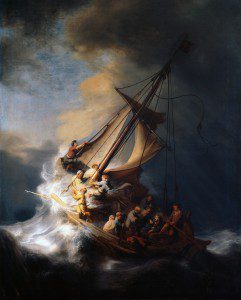 Lord Save us! Jesus Calms the Storm (Matthew 8:23-27)
Then he got into the boat and his disciples followed him. Suddenly a furious storm came up on the lake, so that the waves swept over the boat. But Jesus was sleeping. The disciples went and woke him, saying, “Lord, save us! We’re going to drown!”
He replied, “You of little faith, why are you so afraid?” Then he got up and rebuked the winds and the waves, and it was completely calm.
The men were amazed and asked, “What kind of man is this? Even the winds and the waves obey him!”
Where Mark has ” Rabbi, don’t you care if we drown?” Matthew has the explicit call “Lord, save us!” The disciples call to Jesus in an urgent prayer for deliverance. Jesus is the one who calms the storm and the disciples are amazed. The wind and waves, who obey the Lord in Psalm 107, obey Jesus.
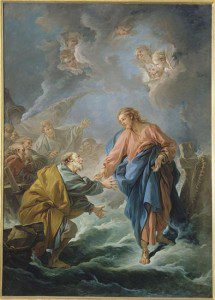 Worship. Even more telling is the later story in Matthew 14:22-33 where Jesus walks across the sea to their boat.
And when they climbed into the boat, the wind died down. Then those who were in the boat worshiped him, saying, “Truly you are the Son of God.” 32-33
In 28:8-9 and 16-17 we also read first of the women at the tomb and then the eleven on the mountain taking a posture of worship toward the risen Jesus. Hays concludes “… in and through these references to worshiping Jesus, Matthew is identifying him as nothing less than the embodied presence of Israel’s God, the one to whom alone worship is due, the one who jealously forbids the worship of any idols, images, or other gods.” (Echoes p. 167) Hays points out the contrast with the concluding temptation where Jesus responds “Away from me, Satan! For it is written: ‘Worship the Lord your God, and serve him only.’” (Mt 4:10) Hays continues: “Once this commandment has been forcefully set forth in the narrative, readers have little choice but to interpret Jesus’ acceptance of worship from other characters as an implicit acknowledgment of his divine identity.” (p. 167)
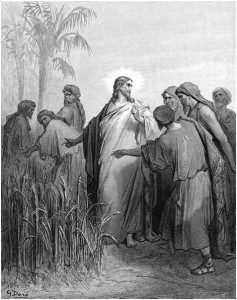 Greater than the Temple. Following a confrontation with the Pharisees over his disciples picking heads of grain and eating them (Mt. 12:1-8), Jesus states “I tell you that something greater than the temple is here.”
We are not told precisely what the “something greater” might be, but the inference lies readily at hand that it must be Jesus himself. What could be greater than the Temple other than the one to whom it is dedicated, the one who is worshiped in it? Matthew’s argument is in effect this: if Jesus is “God with us,” then his presence sanctifies the labor of those who work to serve him, even on the sabbath. Indeed, if Jesus is “God with us,” then his presence now takes the place of the Temple where the presence of God was formerly thought to dwell. (p. 168)
It seems likely that the Pharisees understood the implications. In the next story (12:9-14) Jesus heals a man on the Sabbath and “the Pharisees when out and plotted how they might kill Jesus.“
Where two or three are gathered. Matt. 18:20 “For where two or three gather in my name, there am I with them.”
In this situation, Matthew emphatically locates the divine presence in the figure of Jesus himself, who promises (in a saying that anticipates the resurrection and the ending of the Gospel) to be forever present wherever his followers gather and invoke his name. In short, in Matthew 8:20 Jesus now declares himself, for the first time, to be the Emmanuel promised in the narrator’s opening fulfillment citation in 1:23. (p. 169)
My words will not pass away. Matthew 24:32-35 concludes with Jesus stating “Heaven and earth will pass away, but my words will never pass away.” The only words that can be considered timeless are the very words of God, a theological statement found numerous places in the OT. Hays turns to a familiar passage in Isaiah 40 verse 8 to make the point: “The grass withers, the flowers fall, but the word of our God endures forever.”
Christian interpreters lulled by the familiarity with Matthew’s Gospel may not fully appreciate the theological boldness of the christological assertions made at every turn by Matthew. But there can be no doubt that the word spoken by Jesus in Matthew 24:35 can be true only if it really is “the word of our God,” only if the speaker who says “my words will not pass away” is in fact the God of Israel, God with us. (p. 169-170)
 I am with you always. This brief survey brings us to the end of Matthew’s gospel 28:16-20 where we have the definitive statement that Jesus himself will be with them always. This enduring presence is a clear theme in the Old Testament. Hays runs through a few examples: It is God who stands with Jacob (Gen 28) and with Jeremiah (Jer. 1:5). It is God who is with the people to rebuild the temple (Hag. 1:13, 2:4) The promise to be with them always is an embodiment of the divine role.
Jesus – who even before his birth was identified by Matthew the Evangelist as Emmanuel, God with us – now speaks after his resurrection in fulfillment of precisely that identity. He possesses all authority in heaven and earth, and he promises his sustaining presence throughout all time and in all places, as he sends his followers out to obey him. There is only One who can speak such things truthfully. (p. 174)
To Hays Matthew’s intent is clear. All of these examples illustrate Jesus as an embodiment of Israel’s God, but none more clearly than the worship offered by his followers in 14:33, 28:9, and 28:17.
Matthew highlights the worship of Jesus for one reason: he believes and proclaims that Jesus is the embodied presence of God and that to worship Jesus is to worship YHWH – not merely an agent or a facsimile or an intermediary. If we read the story within the hermeneutical matrix of Israel’s Scripture, we can draw no other conclusion. (p. 175)
Hays makes a strong case that Matthew clearly and intentionally proclaims a high view of Jesus as the incarnate presence of God with his people. The idea that Matthew has a low Christology, with Jesus as a prophet and teacher, is hard to defend.
What do you think of Hays’ argument?
Is Matthew proclaiming Jesus as the embodiment of Israel’s God?
If you wish to contact me directly you may do so at rjs4mail[at]att.net
If interested you can subscribe to a full text feed of my posts at Musings on Science and Theology.
Previous Post

March 7, 2017
Touch Not the Lord's Anointed (Michelle Van Loon)
Next Post
March 7, 2017 What is Concordism in Bible-Science Discussion?
Browse Our Archives
Select a Category Acts of the Apostles Adam Advent Anabaptism Angels Anglican Apologetics Atonement Baptism BCP Prayers Bible Biblical Studies Birds Blogging Bloglossary Bonhoeffer Books Calvinism Christianity Church Church History Coffee Colossians Commentary Recs Conversion Creation Creeds Culture Death Ecclesiastes Economics Education Embracing Grace Emergent Emerging Movement Eschatology Essays Ethics Eucharist Evangelicalism Family Fasting Fathers Fellowship of Differents Footsteps Tour Fun and Whimsical Gospel Grace Happiness Heaven Hell Holy Spirit Irenaeus James Jesus Jesus Creed Job Justification Kingdom of God Law Lectures Lent Liberalism Love and Marriage Mabanteneni Manhood Mary Miracles Missio Alliance MissioLife Missional Missional Jesus Movies and Film New Perspective Northern Seminary OneLife Origins Project Orthodox Parables Pastor's Spouse Pastoring and Leading Pastoring and Preaching Patristics Paul Paul-John Tour Pharisees Pietism Political Theology Prayer and Formation Preaching Problems for Faith Psalm 119 Psalms Public Issues Purgatory Religions Resurrection Revelation Romans Rule of JCreed Science and Faith Sermon on the Mount Sports Ten Commandments Theology Third Way Top Ten Lists Translations Uncategorized Universalism University Ministry Way Out Weekly Meanderings Wisdom Women and Ministry Work Worship Writing & Blogging Youth Ministry
Select a Month July 2021 January 2020 December 2019 November 2019 October 2019 September 2019 August 2019 July 2019 June 2019 May 2019 April 2019 March 2019 February 2019 January 2019 December 2018 November 2018 October 2018 September 2018 August 2018 July 2018 June 2018 May 2018 April 2018 March 2018 February 2018 January 2018 December 2017 November 2017 October 2017 September 2017 August 2017 July 2017 June 2017 May 2017 April 2017 March 2017 February 2017 January 2017 December 2016 November 2016 October 2016 September 2016 August 2016 July 2016 June 2016 May 2016 April 2016 March 2016 February 2016 January 2016 December 2015 November 2015 October 2015 September 2015 August 2015 July 2015 June 2015 May 2015 April 2015 March 2015 February 2015 January 2015 December 2014 November 2014 October 2014 September 2014 August 2014 July 2014 June 2014 May 2014 April 2014 March 2014 February 2014 January 2014 December 2013 November 2013 October 2013 September 2013 August 2013 July 2013 June 2013 May 2013 April 2013 March 2013 February 2013 January 2013 December 2012 November 2012 October 2012 September 2012 August 2012 July 2012 June 2012 May 2012 April 2012 March 2012 February 2012 January 2012 December 2011 November 2011 October 2011 September 2011 August 2011 July 2011 June 2011 May 2011 April 2011 March 2011 February 2011 January 2011 December 2010 November 2010 October 2010 September 2010 August 2010 July 2010 June 2010 May 2010 April 2010 March 2010 February 2010 January 2010 December 2009 November 2009 October 2009 September 2009 August 2009 July 2009 June 2009 May 2009 April 2009 March 2009 February 2009 January 2009 December 2008 November 2008 October 2008 September 2008 August 2008 July 2008 June 2008 May 2008 April 2008 March 2008 February 2008 January 2008 December 2007 November 2007 October 2007 September 2007 August 2007 July 2007 June 2007 May 2007 April 2007 March 2007 February 2007 January 2007 December 2006 November 2006 October 2006 September 2006 August 2006 July 2006 June 2006 May 2006 April 2006 March 2006 February 2006 January 2006 December 2005 November 2005 October 2005 September 2005 August 2005 July 2005 June 2005 May 2005 April 2005 0000
Follow Us!
TAKE THE
Religious Wisdom Quiz
How many books are named after prophets in the Old Testament?
Select your answer to see how you score.
5 17 12 21
Related posts from Jesus Creed


The Gospel of With Us and Through Us

Northern Seminary Announces: Nijay Gupta Joins Faculty

The Gundrys and Me: Ruth Tucker
TRENDING AT PATHEOS Evangelical

How the author of the world's best hymn...
I've been working with John Newton for a while now. This makes...

Long before this Lectio Divina, Psalm 130 - the song - started...

What About the Trees? Another Living Parable
After I finished writing the last article about falling leaves as a...

Why Classical Education Is a Conversation, Not a...
Come and Read: Joy in Classical Education When I was a little...

Falling Leaves: A Living Parable on Letting Go
I’ve spent the vast majority of my life in the southeast corner...

Cornell University has received a great deal of negative publicity and intense...
view all Evangelical blogs
Ad-Free & Subscriber Log-In Subscription Support
- About Us
- 2026 Calendar
- Videos
- Podcasts
- Library of World Religions
- Faith In Media Tracker
- Advertise With Us
- Write for Us
- Privacy Policy
- Terms of Service
- Do Not Sell My Data
- Contact Us
- Radiant Digital
- Manage Newsletter Subscriptions
- Unsubscribe From Notifications
- Sitemap
Copyright 2008-2026, Patheos. All rights reserved.
Subscription Support Ad-Free & Subscriber Log-In
Follow Patheos