
BuddhistCatholicContemplativeEvangelicalGeneral ChristianHinduJewishLatter-day SaintMuslimNew VisionsProgressive Christian
Beliefs
- Buddhist
- Catholic
- Contemplative
- Evangelical
- General Christian
- Hindu
- Jewish
- Latter-day Saint
- More Voices
- Muslim
- New Visions
- Pagan
- Progressive Christian
Topics
- Religion News
- Food and Religion
- Sports and Religion
- Religious Art
- Religious Music and Entertainment
- Religious Events
- History and Religion
- Style and Religion
- Politics and Religion
- Women in Religion
- Recreation Outdoors and Religion
- Business Finance and Religion
- Careers Workplace and Religion
- Education and Religion
- Family Parenting and Religion
- Health Fitness and Religion
- Home and Religion
- Relationships and Religion
- Technology and Religion
- Travel and Religion
Columnists
- Buddhist Columnists
- Business Finance and Religion Columnists
- Careers Workplace and Religion Columnists
- Catholic Columnists
- Contemplative Columnists
- Education and Religion Columnists
- Evangelists Columnists
- Family Parenting and Religion Columnists
- General Christian Columnists
- Health Fitness and Religion Columnists
- Hindu Columnists
- History and Religion Columnists
- Home and Religion Columnists
- Jewish Columnists
- More Voices Columnists
- Latter Day Columnists
- Muslim Columnists
- New Visions Columnists
- Nonreligious Columnists
- Pagan Columnists
- Politics and Religion Columnists
- Progressive Columnists
- Recreation Outdoors and Religion Columnists
- Relationships and Religion Columnists
- Religion News Columnists
- Religious Art Columnists
- Religious Events Columnists
- Religious Music and Entertainment Columnists
- Sports and Religion Columnists
- Style and Religion Columnists
- Technology and Religion Columnists
- Travel and Religion Columnists
- Women in Religion Columnists
Resource Library
- 2026 Calendar
- Library of World Religions
- The 100 Most Holy Places on Earth
- Patheos Answers
- Podcasts
- Videos
- Faith Leaders Database
- Anglican Episcopalian
- Bahai
- Baptist
- Buddhism
- Christianity
- Confucianism
- Eastern Orthodoxy
- Hinduism
- Holiness and Pentecostal
- ISKCON
- Islam
- Judaism
- Lutheran
- Methodist
- The Church of Jesus Christ of Latter-day Saints
- New Age
- Paganism
- Presbytarian and Reformed
- Protestantism
- Religion Behind the Scenes
- Roman Catholic
- Scientology
- Shia Islam
- Sikhism
- Sufism
- Sunni Islam
- Taoism
- Zen
- See all religions
Research Tools
 Ad-Free & Subscriber Log-In Subscription Support
Ad-Free & Subscriber Log-In Subscription Support
Follow Patheos 

- Trending:
- Forgiveness
- |
- Marriage
- |
- Consciousness
- |
- Death Penalty
- |
- Election
- |
- Halloween
 Jesus Creed
- Home
- Evangelical
- Book of the Month: Salvation by Allegiance Alone
Book of the Month: Salvation by Allegiance Alone
Last updated on: March 2, 2017 at 12:06 am by Scot McKnight
Book of the Month: Salvation by Allegiance Alone 2017-02-27T21:13:31-06:00 Scot McKnight
Patheos Explore the world's faith through different perspectives on religion and spirituality! Patheos has the views of the prevalent religions and spiritualities of the world.
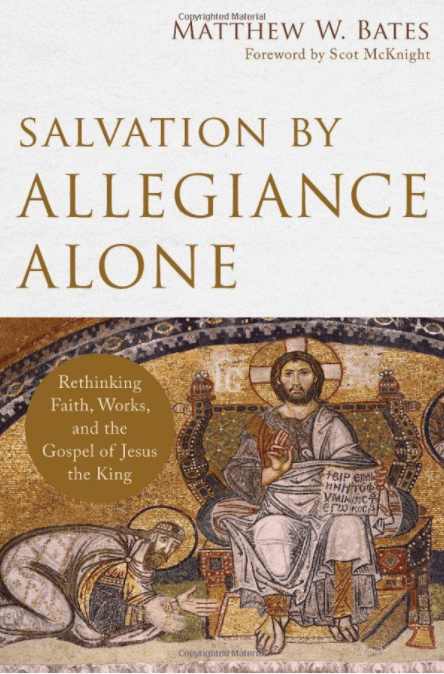
This is the first in a series this month on the new, provocative but powerful book by Matthew Bates. Next week we begin a series on the book.
Salvation by Grace through Faith… But What Is Faith? (A review by Chad Thornhill)
By Chad Thornhill is the Chair of Theological Studies for the Liberty University School of Divinity and the author of The Chosen People (IVP Academic, 2015) and Greek for Everyone (Baker Books, 2016).
There are certain concepts which Christians frequently talk about and yet give surprisingly little critical thought toward how they are actually framed by the Bible. Everyone talks about kingdom, grace, salvation, heaven, etc., but yet often in ways that miss the big picture the Bible paints. Scholars like N. T. Wright (Surprised by Hope), John Barclay (Paul and the Gift), and Scot McKnight (Kingdom Conspiracy) have helped us by returning to the biblical story and framework to sharpen our thoughts on these matters. Surprisingly faith is another one of these topics which every Christian knows is essential, and yet little critical thought and study has gone into articulating what the biblical witnesses actually say about it. Enter Matthew Bates and his new book Salvation by Allegiance Alone (Baker, 2017).
First, on a personal note, as I progressed through my academic journey, some tensions starting piling up. I had come to think of faith as “blind trust” or “belief,” but saw that this was a thin definition based on what is actually happening in the New Testament. Scholars like Murray Harris and Don Garlington were instrumental in sharpening my view. This is precisely where Bates begins. In his first chapter, Bates seeks to deconstruct common Christian definitions of faith, and so faith is not the opposite of examining the evidence, not a blind leap in the dark, not the opposite of works, not wishful thinking, and not intellectual assent. Faith is primarily, according to Bates, allegiance.
Bates settles on this term, in part, by considering the range of meaning which the pist- word group (the Greek words often translated “faith” or “believe”) represents. If you open a standard Greek lexicon, you will find definitions like “faithfulness,” “fidelity,” “commitment,” in addition to “trust” and “belief.” So what does it mean to have “pistis” in Jesus? Bates carefully nuances his framework noting that this doesn’t mean every instance of pist– language means allegiance, but rather ““allegiance” is a better overarching English-language term for what Paul intends with his use of the pistis word group” (78).
Bates the turns to framing the essential narrative of the gospel as portrayed in Paul’s writings and in the Gospels themselves. Bates helpfully summarizes an eight-point outline of the good news story about Jesus.
Jesus:
- preexisted with the Father,
- took on human flesh, fulfilling God’s promises to David,
- died for sins in accordance with the Scriptures,
- was buried,
- was raised on the third day in accordance with the Scriptures,
- appeared to many,
- is seated at the right hand of God as Lord, and
- will come again as judge.
The seventh point is emphasized because, as N. T. Wright and others have pointed out, understanding Jesus as exalted/enthroned is essential to the New Testament gospel. Bates reminds us that the stage of the good news which we currently occupy is this very place of Jesus’ enthronement. So, “the age we find ourselves in now is defined by the Christ’s dynamic rule as he serves as king of heaven and earth at the right hand of God the Father while his enemies are being subdued” (68).
So when we turn to a verse like John 3:16 (“that whoever pisteuon in him will not perish”) or Ephesians 2:8 (“by grace you have been saved through pisteos”), the framework should not be whoever “trusts absent evidence,” or “takes a blind leap,” or “assents to certain facts,” or “is not trusting in human merit,” but rather “swears committed allegiance to Jesus the King.” This recognizes, for example, the thickness of confessing “Jesus is Lord.” This is not merely a cognitive confession (i.e., “I believe certain facts to be true”), but rather recognizing “Jesus is King and I submit to his kingship.” Bates illustrates the strength of his proposal in looking at debated passages like Romans 3:21-28, Romans 5:1, Galatians 2:11-21, Philippians 3:8-11, among many others, and calling on scholars like Wright, Gorman, Barclay, Garlington, and Hays in support of his case. His approach also aids in interpreting Romans 1:3-5 and 16:25-26 (which frame Paul’s letter to the Romans) when Paul speaks about the “obedience of faith.” Or when he speaks of “the law of Christ” (e.g., Gal 5:14, 6:2; Rom 13:9; 1 Cor 9:21; Rom 8:2). Bates rightly asserts that Paul cannot have a “faith v. works” contrast in mind. This would be self-defeating. Rather, Paul affirms “the gospel is purposed toward bringing about the practical obedience characteristic of allegiance to a king” (86). As King, Jesus has a law for his people to follow. Jesus demands loyalty.
Bates is careful to nuance what this entails. This does not “sneak” merit into salvation in some Pelagian or Semi-Pelagian construct. Pistis/allegiance, Bates clarifies, is not “works,” but rather “pistis is the fundamental framework into which works must fit as a part of our salvation” (109).
Intellectual assent is necessary, but not sufficient (cf. 93-96). For Bates, faith entails intellectual assent, confession of loyalty, and embodied fidelity (or what I have sometimes referred to as cognitive, relational, and behavioral dimensions of pistis).
There is much more to this book that defining faith. Bates has in mind setting biblical soteriology straight concerning the future eschatological fate of the people of God, the place of justification in an allegiance-based understanding of faith, a biblical-theological understanding of “election,” rooted in the Bible’s context rather than later theological debates, and the connection between allegiance to Jesus and the Bible’s teaching concerning the image of God in humanity. What Bates has accomplished in such a small book is admirable. His writing is clear and accessible, yet rooted in solid scholarship. This books gets to the heart of the Bible’s vision on salvation, faith, works, and the gospel.
In spite of the many things Bates accomplishes in this book, his core concern is repairing the weak view of faith and the gospel endemic in much of evangelicalism today. The book is as practical as it is theological. Ultimately Bates forces us to ask, when we proclaim the gospel, to what are we calling people? To pray a prayer and avoid hell? Or to recognize the kingship of the risen and exalted Lord and commit themselves to him, and thus find the true goal of human existence, conformity to the image of Christ? There is a difference both in how narrowly we think of the good news and in what kind of disciples we are making. Bates has given much food for thought, and calls the Church to realign its priorities as it relates to the good news of King Jesus.
Previous Post

March 1, 2017
Magdala
Next Post
March 2, 2017 It's Culture, Stupid (RJS)
Browse Our Archives
Select a Category Acts of the Apostles Adam Advent Anabaptism Angels Anglican Apologetics Atonement Baptism BCP Prayers Bible Biblical Studies Birds Blogging Bloglossary Bonhoeffer Books Calvinism Christianity Church Church History Coffee Colossians Commentary Recs Conversion Creation Creeds Culture Death Ecclesiastes Economics Education Embracing Grace Emergent Emerging Movement Eschatology Essays Ethics Eucharist Evangelicalism Family Fasting Fathers Fellowship of Differents Footsteps Tour Fun and Whimsical Gospel Grace Happiness Heaven Hell Holy Spirit Irenaeus James Jesus Jesus Creed Job Justification Kingdom of God Law Lectures Lent Liberalism Love and Marriage Mabanteneni Manhood Mary Miracles Missio Alliance MissioLife Missional Missional Jesus Movies and Film New Perspective Northern Seminary OneLife Origins Project Orthodox Parables Pastor's Spouse Pastoring and Leading Pastoring and Preaching Patristics Paul Paul-John Tour Pharisees Pietism Political Theology Prayer and Formation Preaching Problems for Faith Psalm 119 Psalms Public Issues Purgatory Religions Resurrection Revelation Romans Rule of JCreed Science and Faith Sermon on the Mount Sports Ten Commandments Theology Third Way Top Ten Lists Translations Uncategorized Universalism University Ministry Way Out Weekly Meanderings Wisdom Women and Ministry Work Worship Writing & Blogging Youth Ministry
Select a Month July 2021 January 2020 December 2019 November 2019 October 2019 September 2019 August 2019 July 2019 June 2019 May 2019 April 2019 March 2019 February 2019 January 2019 December 2018 November 2018 October 2018 September 2018 August 2018 July 2018 June 2018 May 2018 April 2018 March 2018 February 2018 January 2018 December 2017 November 2017 October 2017 September 2017 August 2017 July 2017 June 2017 May 2017 April 2017 March 2017 February 2017 January 2017 December 2016 November 2016 October 2016 September 2016 August 2016 July 2016 June 2016 May 2016 April 2016 March 2016 February 2016 January 2016 December 2015 November 2015 October 2015 September 2015 August 2015 July 2015 June 2015 May 2015 April 2015 March 2015 February 2015 January 2015 December 2014 November 2014 October 2014 September 2014 August 2014 July 2014 June 2014 May 2014 April 2014 March 2014 February 2014 January 2014 December 2013 November 2013 October 2013 September 2013 August 2013 July 2013 June 2013 May 2013 April 2013 March 2013 February 2013 January 2013 December 2012 November 2012 October 2012 September 2012 August 2012 July 2012 June 2012 May 2012 April 2012 March 2012 February 2012 January 2012 December 2011 November 2011 October 2011 September 2011 August 2011 July 2011 June 2011 May 2011 April 2011 March 2011 February 2011 January 2011 December 2010 November 2010 October 2010 September 2010 August 2010 July 2010 June 2010 May 2010 April 2010 March 2010 February 2010 January 2010 December 2009 November 2009 October 2009 September 2009 August 2009 July 2009 June 2009 May 2009 April 2009 March 2009 February 2009 January 2009 December 2008 November 2008 October 2008 September 2008 August 2008 July 2008 June 2008 May 2008 April 2008 March 2008 February 2008 January 2008 December 2007 November 2007 October 2007 September 2007 August 2007 July 2007 June 2007 May 2007 April 2007 March 2007 February 2007 January 2007 December 2006 November 2006 October 2006 September 2006 August 2006 July 2006 June 2006 May 2006 April 2006 March 2006 February 2006 January 2006 December 2005 November 2005 October 2005 September 2005 August 2005 July 2005 June 2005 May 2005 April 2005 0000
Follow Us!
TAKE THE
Religious Wisdom Quiz
How many years did Solomon's temple construction take?
Select your answer to see how you score.
6 years 5 years 10 years 7 years
Related posts from Jesus Creed


The Gospel of With Us and Through Us

Northern Seminary Announces: Nijay Gupta Joins Faculty

The Gundrys and Me: Ruth Tucker
TRENDING AT PATHEOS Evangelical

How the author of the world's best hymn...
I've been working with John Newton for a while now. This makes...

Long before this Lectio Divina, Psalm 130 - the song - started...

What About the Trees? Another Living Parable
After I finished writing the last article about falling leaves as a...

Why Classical Education Is a Conversation, Not a...
Come and Read: Joy in Classical Education When I was a little...

Falling Leaves: A Living Parable on Letting Go
I’ve spent the vast majority of my life in the southeast corner...

Cornell University has received a great deal of negative publicity and intense...
view all Evangelical blogs
Ad-Free & Subscriber Log-In Subscription Support
- About Us
- 2026 Calendar
- Videos
- Podcasts
- Library of World Religions
- Faith In Media Tracker
- Advertise With Us
- Write for Us
- Privacy Policy
- Terms of Service
- Do Not Sell My Data
- Contact Us
- Radiant Digital
- Manage Newsletter Subscriptions
- Unsubscribe From Notifications
- Sitemap
Copyright 2008-2026, Patheos. All rights reserved.
Subscription Support Ad-Free & Subscriber Log-In
Follow Patheos