
BuddhistCatholicContemplativeEvangelicalGeneral ChristianHinduJewishLatter-day SaintMuslimNew VisionsProgressive Christian
Beliefs
- Buddhist
- Catholic
- Contemplative
- Evangelical
- General Christian
- Hindu
- Jewish
- Latter-day Saint
- More Voices
- Muslim
- New Visions
- Pagan
- Progressive Christian
Topics
- Religion News
- Food and Religion
- Sports and Religion
- Religious Art
- Religious Music and Entertainment
- Religious Events
- History and Religion
- Style and Religion
- Politics and Religion
- Women in Religion
- Recreation Outdoors and Religion
- Business Finance and Religion
- Careers Workplace and Religion
- Education and Religion
- Family Parenting and Religion
- Health Fitness and Religion
- Home and Religion
- Relationships and Religion
- Technology and Religion
- Travel and Religion
Columnists
- Buddhist Columnists
- Business Finance and Religion Columnists
- Careers Workplace and Religion Columnists
- Catholic Columnists
- Contemplative Columnists
- Education and Religion Columnists
- Evangelists Columnists
- Family Parenting and Religion Columnists
- General Christian Columnists
- Health Fitness and Religion Columnists
- Hindu Columnists
- History and Religion Columnists
- Home and Religion Columnists
- Jewish Columnists
- More Voices Columnists
- Latter Day Columnists
- Muslim Columnists
- New Visions Columnists
- Nonreligious Columnists
- Pagan Columnists
- Politics and Religion Columnists
- Progressive Columnists
- Recreation Outdoors and Religion Columnists
- Relationships and Religion Columnists
- Religion News Columnists
- Religious Art Columnists
- Religious Events Columnists
- Religious Music and Entertainment Columnists
- Sports and Religion Columnists
- Style and Religion Columnists
- Technology and Religion Columnists
- Travel and Religion Columnists
- Women in Religion Columnists
Resource Library
- 2026 Calendar
- Library of World Religions
- The 100 Most Holy Places on Earth
- Patheos Answers
- Podcasts
- Videos
- Faith Leaders Database
- Anglican Episcopalian
- Bahai
- Baptist
- Buddhism
- Christianity
- Confucianism
- Eastern Orthodoxy
- Hinduism
- Holiness and Pentecostal
- ISKCON
- Islam
- Judaism
- Lutheran
- Methodist
- The Church of Jesus Christ of Latter-day Saints
- New Age
- Paganism
- Presbytarian and Reformed
- Protestantism
- Religion Behind the Scenes
- Roman Catholic
- Scientology
- Shia Islam
- Sikhism
- Sufism
- Sunni Islam
- Taoism
- Zen
- See all religions
Research Tools
 Ad-Free & Subscriber Log-In Subscription Support
Follow Patheos 

- Trending:
- Advent
- |
- Forgiveness
- |
- Thanksgiving
- |
- Election
- |
- Seasonal Holidays
- |
- Marriage
 Jesus Creed
- Home
- Evangelical
- The Importance of Israel (RJS)
The Importance of Israel (RJS)
Last updated on: February 21, 2017 at 6:15 am by RJS
The Importance of Israel (RJS) 2017-02-21T06:15:06-06:00 RJS
Patheos Explore the world's faith through different perspectives on religion and spirituality! Patheos has the views of the prevalent religions and spiritualities of the world.
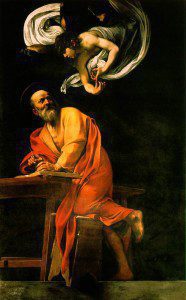 Matthew anchors the story of Jesus in Israel’s history. If we are unfamiliar with the Old Testament Scriptures and this history, we will miss important parts of the message. This is especially true in the prelude to Jesus’ public ministry in chapters 1-4. Richard Hays (Reading Backwards and Echoes of Scripture in the Gospels) explores these connections.
Matthew encourages the reader to see Jesus as the fulfillment of Old Testament precursors, particularly Moses, David, and Isaiah’s Servant figure. … Matthew’s language and imagery are from start to finish soaked in Scripture; He constantly presupposes the social and symbolic world rendered by the stories, songs, prophecies, laws, and wisdom teachings of Israel’s sacred texts. (p. 109)
Jesus is the fulfillment of Israel’s Scripture, he is the Messiah and he enacts Israel’s destiny the way it was intended. In the opening section there are at least seven passages where Matthew makes a direct statement or allusion to Jesus as the fulfillment of Israel’s Scripture.The fulfillment passages sometimes seem a reach, with 2:15 “And so was fulfilled what the Lord had said through the prophet: “Out of Egypt I called my son.” a good example. This quote is found in Hosea 11:1, which is decidedly not a messianic prophecy. This passage, and the rather simplistic assertions sometimes made about it in sermons and Christian literature, has long troubled me. It shouldn’t though. In order to understand Matthew’s point in including this citation, and others as well, we need to dig deeper than some index of prooftexts and look to the context of the passages.
Jesus enacts Israel’s destiny. In this post we will look at four specific passages: the flight to Egypt (2:13-15), Herod’s murder of the innocents (2:16-18), the baptism of Jesus by John (3:13-15), and the temptation (4:1-11). In all of these passages there is, according to Hays, “a typological identification of Jesus with Israel: Jesus becomes the one in whom the fate of Israel is embodied and enacted.” (p. 113)
(1) Out of Egypt I called my Son. 2:13-15 Hosea 11 starts with the identification of Israel as God’s son. This is a tradition that can be traced to Moses and the exodus. God instructs Moses to tell Pharaoh that “Israel is my firstborn son.” (Ex 4:22) But we should see in Matthew’s formula “And so was fulfilled what the Lord had said through the prophet” not simply the bald misappropriation of Hosea 11:1, but a resonance with the context of Hosea 11 and with God’s love for and rescue of his people, Israel.
Matthew transfigures Hosea’s text by seeing how it prefigures an event in the life of Jesus. Matthew now sees the fate of God’s “son” Israel recapitulated in the story of God’s Son, Jesus: In both cases, the son is brought out of exile in Egypt and back into the land.
… Matthew cannot be unaware of the original contextual meaning of Hosea 11:1 as an expression of God’s love for Israel, a love that persists even through Israel’s subsequent unfaithfulness (Hos 11:8-9). Indeed, Matthew’s use of the quotation depends upon the reader’s recognition of its original sense: if Hosea’s words were severed from their reference to the original exodus story, the literary and theological effect of Matthew’s reading would be stifled. The fulfillment of the prophet’s words can be discerned only through an act of imagination that perceives the figural correspondence between the two stories of the exodus and the gospel. … the story of Jesus acquires the resonance of the story of Israel. (p. 113-114)
Matthew’s use of the quotation also names Jesus as God’s Son. This is not independent from, but part and parcel of the figural connection between Jesus and Israel.
(2) Then what was said through the prophet Jeremiah was fulfilled 2:16-18. the words that are fulfilled involve lament – Rachel weeping for her children and refusing to be comforted, because they are no more. Jeremiah 31:15 and context is not a messianic prophecy, but it is another passage where God’s love for Israel, even in their unfaithfulness, becomes evident. Jeremiah continues: This is what the Lord says: “Restrain your voice from weeping and your eyes from tears, for your work will be rewarded,” declares the Lord. “They will return from the land of the enemy. So there is hope for your descendants,” declares the Lord. “Your children will return to their own land.”
Surely it is not merely coincidental that in consecutive formula quotations (Matt 2:15+Matt 2:17-18) Matthew has linked these two very similar passages from Hosea 11:1-11 and Jeremiah 31:15-20. Both prophetic texts speak of the exile and suffering of an unfaithful people, and both declare that God will reach out in mercy and bring the people back from exile. By evoking these two prophetic passages in the infancy narrative, Matthew connects both the history and the future destiny of Israel to the figure of Jesus, and he hints that in Jesus the restoration of Israel is at hand.
Matthew is not merely looking for random Old Testament prooftexts that Jesus might somehow fulfill (as is sometimes suggested); rather, he is thinking about the specific shape of Israel’s story and linking Jesus’ life with key passages that promise God’s unbreakable redemptive love for his people. (pp. 115-116)
(3) It is proper for us to do this to fulfill all righteousness 3:15 The story of the baptism of Jesus by John is well known – a regular in both sermons and Sunday School. But we seldom stop to wonder why Jesus needed to be baptized by John and why it was “to fulfill all righteousness.” After all, John’s baptism was a baptism of repentance and there is certainly little support for the idea that Jesus needed to repent. Hays connects this to Jesus enacting Israel’s destiny.
I would propose that Jesus’ acceptance of a baptism of repentence, performed at the Jordan River, is meant to signify his symbolic identification with sinful Israel (the people whom he will “save from their sins”), and the figurative beginning of that new Israel’s entry into the land of promise. (p. 116)
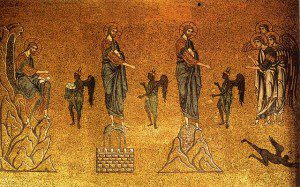 (4) Then Jesus was led by the Spirit into the wilderness to be tempted by the devil. 4:1-11. Jesus fasted for forty days and forty nights. Moses also fasted forty days and nights in the presence of God, first to receive the commandments and then, twice after, to intercede for the sins of the people (Deuteronomy 9). “I lay prostrate before the Lord those forty days and forty nights because the Lord had said he would destroy you. I prayed to the Lord and said, “Sovereign Lord, do not destroy your people, your own inheritance that you redeemed by your great power and brought out of Egypt with a mighty hand.” There is also, of course, a resonance with the forty years that Israel wandered in the wilderness as a result of their unfaithfulness. The three responses that Jesus gives have resonance with Israel’s wandering in the wilderness. (Hays points out that Matthew could have all of this in mind.)
When tempted to turn stones into bread Jesus answered, “It is written: ‘Man shall not live on bread alone, but on every word that comes from the mouth of God.’” quoting Deut. 8:3. In this response we should be aware of the context:
Remember how the Lord your God led you all the way in the wilderness these forty years, to humble and test you in order to know what was in your heart, whether or not you would keep his commands. He humbled you, causing you to hunger and then feeding you with manna, which neither you nor your ancestors had known, to teach you that man does not live on bread alone but on every word that comes from the mouth of the Lord. 8:2-3
Hays notes that in this response “God’s “son” passes the first test by obediently trusting God – just as Israel should have done, when so instructed by Moses.” (p. 118)
When the tempter suggests that Jesus should fling himself down to be rescued by angels Jesus answered him, “It is also written: ‘Do not put the Lord your God to the test.’” a quote from Deut. 6:16*. Again we need to consider the context:*
Do not put the Lord your God to the test as you did at Massah. Be sure to keep the commands of the Lord your God and the stipulations and decrees he has given you. Do what is right and good in the Lord’s sight, so that it may go well with you and you may go in and take over the good land the Lord promised on oath to your ancestors, thrusting out all your enemies before you, as the Lord said. (6:16-19)
Again Jesus passes the test.
Given Matthew’s presentation of Jesus as the Messiah who brings Israel’s exile to an end, this is a highly significant passage: by resisting temptation to aggrandize himself through a spectacular stunt, Jesus again reaffirms obedience and trust in God as the means by which Israel is to be brought at last into the land of promise. And his response as obedient Son exemplifies the role Israel is meant to take in the world: not to seek to force God’s hand through risky self-assertion but waiting faithfully and doing what is right. So God’s Son passes the second test by responding obediently, typologically invoking Moses’ instructions to Israel. (p. 119)
Again the devil tempts Jesus, this time asking for worship in exchange for power and dominion. Jesus said to him, “Away from me, Satan! For it is written: ‘Worship the Lord your God, and serve him only.’” (Deut 6:13) Again we should turn to the context … do not follow other gods … for the Lord your God, who is among you, is a jealous God.
Once again, by allowing this Scripture to answer the devil’s temptation, Jesus identifies himself fully with/as Israel, heeding God’s commandment. With this final decisive rejoinder, Jesus has named the fundamental issue: Who is God, and whom are we to serve? His answer, scripturally voiced, is to declare his own allegiance to the one God of Israel and to reject the worship of any other. With that the tempter is confounded and dismissed from the scene. And so God’s Son passes the third test by responding obediently, just as Moses instructed Israel to do. (pp. 119-120)
Jesus enacts the faithful Israel, son of God through whom salvation comes.
At the end of his time in the wilderness, Jesus has rightly embodied the covenant faithfulness Israel was meant to render to God – and he has done it, in Matthew’s elegant narration, by simply reciting the very Scriptures through which that covenant faithfulness was originally defined and commanded. (p. 120)
We began this survey with Jesus called out of Egypt and identified along with Israel as God’s son. Traced the allusions, through Hosea and Jeremiah to God’s love for Israel, and his promise of redemption and restoration for his people. The first public acts of Jesus in Matthew reinforce this idea of Jesus taking on and restoring the destiny of Israel. Yes, it is for all of us – but through God’s chosen people.
What do you think of this cast of the story of Jesus?
How are we to understand Matthew’s fulfillment quotes – especially when they do not seem particularly relevant?
If you wish to contact me directly you may do so at rjs4mail[at]att.net
If interested you can subscribe to a full text feed of my posts at Musings on Science and Theology.
Previous Post

February 21, 2017
Prophetic without being Obnoxious
Next Post
February 21, 2017 Capernaum and Galilee
Browse Our Archives
Select a Category Acts of the Apostles Adam Advent Anabaptism Angels Anglican Apologetics Atonement Baptism BCP Prayers Bible Biblical Studies Birds Blogging Bloglossary Bonhoeffer Books Calvinism Christianity Church Church History Coffee Colossians Commentary Recs Conversion Creation Creeds Culture Death Ecclesiastes Economics Education Embracing Grace Emergent Emerging Movement Eschatology Essays Ethics Eucharist Evangelicalism Family Fasting Fathers Fellowship of Differents Footsteps Tour Fun and Whimsical Gospel Grace Happiness Heaven Hell Holy Spirit Irenaeus James Jesus Jesus Creed Job Justification Kingdom of God Law Lectures Lent Liberalism Love and Marriage Mabanteneni Manhood Mary Miracles Missio Alliance MissioLife Missional Missional Jesus Movies and Film New Perspective Northern Seminary OneLife Origins Project Orthodox Parables Pastor's Spouse Pastoring and Leading Pastoring and Preaching Patristics Paul Paul-John Tour Pharisees Pietism Political Theology Prayer and Formation Preaching Problems for Faith Psalm 119 Psalms Public Issues Purgatory Religions Resurrection Revelation Romans Rule of JCreed Science and Faith Sermon on the Mount Sports Ten Commandments Theology Third Way Top Ten Lists Translations Uncategorized Universalism University Ministry Way Out Weekly Meanderings Wisdom Women and Ministry Work Worship Writing & Blogging Youth Ministry
Select a Month July 2021 January 2020 December 2019 November 2019 October 2019 September 2019 August 2019 July 2019 June 2019 May 2019 April 2019 March 2019 February 2019 January 2019 December 2018 November 2018 October 2018 September 2018 August 2018 July 2018 June 2018 May 2018 April 2018 March 2018 February 2018 January 2018 December 2017 November 2017 October 2017 September 2017 August 2017 July 2017 June 2017 May 2017 April 2017 March 2017 February 2017 January 2017 December 2016 November 2016 October 2016 September 2016 August 2016 July 2016 June 2016 May 2016 April 2016 March 2016 February 2016 January 2016 December 2015 November 2015 October 2015 September 2015 August 2015 July 2015 June 2015 May 2015 April 2015 March 2015 February 2015 January 2015 December 2014 November 2014 October 2014 September 2014 August 2014 July 2014 June 2014 May 2014 April 2014 March 2014 February 2014 January 2014 December 2013 November 2013 October 2013 September 2013 August 2013 July 2013 June 2013 May 2013 April 2013 March 2013 February 2013 January 2013 December 2012 November 2012 October 2012 September 2012 August 2012 July 2012 June 2012 May 2012 April 2012 March 2012 February 2012 January 2012 December 2011 November 2011 October 2011 September 2011 August 2011 July 2011 June 2011 May 2011 April 2011 March 2011 February 2011 January 2011 December 2010 November 2010 October 2010 September 2010 August 2010 July 2010 June 2010 May 2010 April 2010 March 2010 February 2010 January 2010 December 2009 November 2009 October 2009 September 2009 August 2009 July 2009 June 2009 May 2009 April 2009 March 2009 February 2009 January 2009 December 2008 November 2008 October 2008 September 2008 August 2008 July 2008 June 2008 May 2008 April 2008 March 2008 February 2008 January 2008 December 2007 November 2007 October 2007 September 2007 August 2007 July 2007 June 2007 May 2007 April 2007 March 2007 February 2007 January 2007 December 2006 November 2006 October 2006 September 2006 August 2006 July 2006 June 2006 May 2006 April 2006 March 2006 February 2006 January 2006 December 2005 November 2005 October 2005 September 2005 August 2005 July 2005 June 2005 May 2005 April 2005 0000
Follow Us!
TAKE THE
Religious Wisdom Quiz
True or False: Paul commanded Timothy to rebuke older men harshly.
Select your answer to see how you score.
FALSE TRUE
Related posts from Jesus Creed


The Gospel of With Us and Through Us

Northern Seminary Announces: Nijay Gupta Joins Faculty

The Gundrys and Me: Ruth Tucker
TRENDING AT PATHEOS Evangelical

Don’t Miss the Parents: A Creative Christmas Meditation
As we enter the Advent Season, I see many people trying to...

Making Stones Into Bread: Choosing the “Right” Work
I was on my online arts ministry Zoom meeting with the International...

Ukraine’s exhausted Christians face fifth winter of war
By Julian Lukins The full-scale war in Ukraine is taking “a serious...

Russell Brand's Conviction is not anti-Christian Persecution
How do we shed the reputation that the Church is OK with...

Have you ever caught yourself saying, “I’ll do it tomorrow,” or “Now...

Throughout history, people have pursued pleasure, possessions, relationships, and success in an...
view all Evangelical blogs
Ad-Free & Subscriber Log-In Subscription Support
- About Us
- 2026 Calendar
- Videos
- Podcasts
- Library of World Religions
- Faith In Media Tracker
- Advertise With Us
- Write for Us
- Privacy Policy
- Terms of Service
- Do Not Sell My Data
- Contact Us
- Radiant Digital
- Manage Newsletter Subscriptions
- Unsubscribe From Notifications
- Sitemap
Copyright 2008-2026, Patheos, part of the Radiant Digital network of media brands. All rights reserved.
Subscription Support Ad-Free & Subscriber Log-In
Follow Patheos