
BuddhistCatholicContemplativeEvangelicalGeneral ChristianHinduJewishLatter-day SaintMuslimNew VisionsProgressive Christian
Beliefs
- Buddhist
- Catholic
- Contemplative
- Evangelical
- General Christian
- Hindu
- Jewish
- Latter-day Saint
- More Voices
- Muslim
- New Visions
- Pagan
- Progressive Christian
Topics
- Religion News
- Food and Religion
- Sports and Religion
- Religious Art
- Religious Music and Entertainment
- Religious Events
- History and Religion
- Style and Religion
- Politics and Religion
- Women in Religion
- Recreation Outdoors and Religion
- Business Finance and Religion
- Careers Workplace and Religion
- Education and Religion
- Family Parenting and Religion
- Health Fitness and Religion
- Home and Religion
- Relationships and Religion
- Technology and Religion
- Travel and Religion
Columnists
- Buddhist Columnists
- Business Finance and Religion Columnists
- Careers Workplace and Religion Columnists
- Catholic Columnists
- Contemplative Columnists
- Education and Religion Columnists
- Evangelists Columnists
- Family Parenting and Religion Columnists
- General Christian Columnists
- Health Fitness and Religion Columnists
- Hindu Columnists
- History and Religion Columnists
- Home and Religion Columnists
- Jewish Columnists
- More Voices Columnists
- Latter Day Columnists
- Muslim Columnists
- New Visions Columnists
- Nonreligious Columnists
- Pagan Columnists
- Politics and Religion Columnists
- Progressive Columnists
- Recreation Outdoors and Religion Columnists
- Relationships and Religion Columnists
- Religion News Columnists
- Religious Art Columnists
- Religious Events Columnists
- Religious Music and Entertainment Columnists
- Sports and Religion Columnists
- Style and Religion Columnists
- Technology and Religion Columnists
- Travel and Religion Columnists
- Women in Religion Columnists
Resource Library
- 2026 Calendar
- Library of World Religions
- The 100 Most Holy Places on Earth
- Patheos Answers
- Podcasts
- Videos
- Faith Leaders Database
- Anglican Episcopalian
- Bahai
- Baptist
- Buddhism
- Christianity
- Confucianism
- Eastern Orthodoxy
- Hinduism
- Holiness and Pentecostal
- ISKCON
- Islam
- Judaism
- Lutheran
- Methodist
- The Church of Jesus Christ of Latter-day Saints
- New Age
- Paganism
- Presbytarian and Reformed
- Protestantism
- Religion Behind the Scenes
- Roman Catholic
- Scientology
- Shia Islam
- Sikhism
- Sufism
- Sunni Islam
- Taoism
- Zen
- See all religions
Research Tools
 Ad-Free & Subscriber Log-In Subscription Support
Ad-Free & Subscriber Log-In Subscription Support
Follow Patheos 

- Trending:
- Forgiveness
- |
- Marriage
- |
- Consciousness
- |
- Death Penalty
- |
- Election
- |
- Halloween
 Jesus Creed
- Home
- Evangelical
- Science is Incidental (RJS)
Science is Incidental (RJS)
Last updated on: January 31, 2017 at 5:51 am by RJS
Science is Incidental (RJS) 2017-01-30T21:21:18-06:00 RJS
Patheos Explore the world's faith through different perspectives on religion and spirituality! Patheos has the views of the prevalent religions and spiritualities of the world.
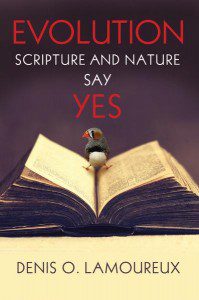 Chapter 5 of Denis Lamoureux’s new book Evolution: Scripture and Nature Say Yes looks at the way that “science” is presented in Scripture. Science is a modern concept, but Scripture certainly speaks about the nature of the cosmos and uses language that assumes a view of astronomy, geography, and biology. But the Bible is not a science book. It doesn’t teach new science, rather it reflects the typical views concerning astronomy, geography, and biology commonly held in the ancient Near East. These views are phenomenological – the result of observation by unaided physical senses. In contrast modern science often goes beyond this using instruments and theories to describe the cosmos. Denis argues that the scientific concepts are incidental to the message of Scripture. He explains this carefully:
The ancient science in Scripture is incidental because God’s central purpose in the Bible is to reveal messages of faith and not scientific facts about his creation. Using the term “incidental” does not mean that ancient science is unimportant. The ancient science in Scripture is essential for transporting spiritual truths. It acts like a cup that holds water. Whether the cup is made of glass, plastic, or metal is incidental. What matters is that a vessel is needed to bring water to a thirsty person. The word “incidental” has the meaning of “happening in connection with something more important.” Thus, the incidental ancient science in Scripture is a necessary vessel that delivers important spiritual messages to our thirsty souls. (p. 90)
It was necessary to use language to describe the shape and form of creation in order to convey the message that God alone is the creator, that his creation is good, and that there is no other deity involved, e.g. the sun, moon, and stars are merely created objects. The language and concepts used are, quite appropriately, those common place to the original ancient Israelite audience or the first century Jewish audience.
Denis runs through a number of examples of ancient science in Scripture. For example, Scripture often depicts a solid firmament stretched out over a flat, circular earth with a sea around the circumference. There is also a general view that stars are small and embedded in the firmament, from which they could be dislodged. Isaiah 34:4 and Matthew 24:29 reflect this view. The vast expanse of space and the immense dimension of most stars, far larger than the earth, is not reflected in Scripture.
The message of faith in Matthew 24 and Isaiah 34 is not a revelation about the structure of the heavens or exactly how God will disassemble the universe. The inerrant spiritual truth in these passages is that the world will come to an end and there will be a day of judgment. (p. 100)
One example of ancient cosmic geography that crops up quite often in the New Testament as well as the Old Testament is the three-tiered view of the universe with the heavens, the earth, and the underworld. Philippians 2:9-11 reflects this view: Therefore God exalted him to the highest place and gave him the name that is above every name, that at the name of Jesus every knee should bow, in heaven and on earth and under the earth, and every tongue acknowledge that Jesus Christ is Lord, to the glory of God the Father. We shouldn’t be dissecting this passage, worried about the physical location of “under the earth” and the identity of the beings that dwell there. The point is that every knee in all of creation should bow and every tongue acknowledge, not the precise structure of the universe.
To reveal inerrant spiritual truths, God accommodated and came down to the level of understanding of these inspired ancient authors. If the Lord had stated in the Bible that he created through the Big Bang and biological evolution, I doubt anyone in ancient times would have understood. Instead, God used incidental ancient sciences as vehicles to transport life-changing messages of faith. I have personally experienced this as well. My life was not changed by the ancient idea of a 3-tier universe, but rather by the spiritual truth that Jesus is Lord over the entire creation (Phil 2:10-11). (p. 110-111)
So what about evolution? The title of the book suggests that scripture says yes to evolution. Does this mean we should expect to find evidence for biological evolution in the pages of scripture? As with astronomy and geography, the Scriptures reflect a phenomenological understanding of biology common to the ancient Near East. There is no evidence of evolution coded into the text. Rather, there is an assumption that every creature and every plant reproduces according to its kind. This immutability of species is assumed to hold all the way back to the very act of creation.
In the eyes of ancient people, living organisms were immutable. In other words, plants and animals never changed and were always the same. Consequently there is no hint of transitional organisms or biological evolution in the Genesis 1 account of creation. (p. 104)
Nor is there any indication of rapid diversification of kinds following the fall or the flood, despite what Ken Ham and the Ark Encounter would like us to believe as they struggle to fit “kinds” into the ark. (See for example, Ark Encounter Common Ancestors: The Increasing Inclusiveness of Biblical Kinds and The Young-Earth Hyper-evolution Hypothesis: A Collection of Critiques along with other posts at Naturalis Historia.) The ancient perspective reflected in Scripture was ignorant of evolution and of the vast diversity of animals scattered around the globe, and for that matter of the globe itself.
 This shouldn’t concern us.
Denis argues that the absence of evolution in Scripture is to be expected as it was completely unknown in the ancient world. The clear assumption that all of today’s species were created as we know them, is incidental to the message of Scripture. “The main message in Genesis 1 and 2 is not to tell us how God created living organisms, but who created plants, animals, and humans – the God of Christianity.” (p. 110)
The scientific assumptions – of a flat earth, a three tiered universe, and immutability of species – is incidental to the message. It is the cup that holds the living water, not the living water itself.
Does this explanation of “incidental” details in Scripture help with understanding?
How can we tell if something is incidental or part of the message itself?
If you wish to contact me directly you may do so at rjs4mail[at]att.net
If interested you can subscribe to a full text feed of my posts at Musings on Science and Theology.
Previous Post

January 31, 2017
Doubting Your Doubts (Jonathan Storment)
Next Post
January 31, 2017 Archbishop Foley Beach and the Refugees
Browse Our Archives
Select a Category Acts of the Apostles Adam Advent Anabaptism Angels Anglican Apologetics Atonement Baptism BCP Prayers Bible Biblical Studies Birds Blogging Bloglossary Bonhoeffer Books Calvinism Christianity Church Church History Coffee Colossians Commentary Recs Conversion Creation Creeds Culture Death Ecclesiastes Economics Education Embracing Grace Emergent Emerging Movement Eschatology Essays Ethics Eucharist Evangelicalism Family Fasting Fathers Fellowship of Differents Footsteps Tour Fun and Whimsical Gospel Grace Happiness Heaven Hell Holy Spirit Irenaeus James Jesus Jesus Creed Job Justification Kingdom of God Law Lectures Lent Liberalism Love and Marriage Mabanteneni Manhood Mary Miracles Missio Alliance MissioLife Missional Missional Jesus Movies and Film New Perspective Northern Seminary OneLife Origins Project Orthodox Parables Pastor's Spouse Pastoring and Leading Pastoring and Preaching Patristics Paul Paul-John Tour Pharisees Pietism Political Theology Prayer and Formation Preaching Problems for Faith Psalm 119 Psalms Public Issues Purgatory Religions Resurrection Revelation Romans Rule of JCreed Science and Faith Sermon on the Mount Sports Ten Commandments Theology Third Way Top Ten Lists Translations Uncategorized Universalism University Ministry Way Out Weekly Meanderings Wisdom Women and Ministry Work Worship Writing & Blogging Youth Ministry
Select a Month July 2021 January 2020 December 2019 November 2019 October 2019 September 2019 August 2019 July 2019 June 2019 May 2019 April 2019 March 2019 February 2019 January 2019 December 2018 November 2018 October 2018 September 2018 August 2018 July 2018 June 2018 May 2018 April 2018 March 2018 February 2018 January 2018 December 2017 November 2017 October 2017 September 2017 August 2017 July 2017 June 2017 May 2017 April 2017 March 2017 February 2017 January 2017 December 2016 November 2016 October 2016 September 2016 August 2016 July 2016 June 2016 May 2016 April 2016 March 2016 February 2016 January 2016 December 2015 November 2015 October 2015 September 2015 August 2015 July 2015 June 2015 May 2015 April 2015 March 2015 February 2015 January 2015 December 2014 November 2014 October 2014 September 2014 August 2014 July 2014 June 2014 May 2014 April 2014 March 2014 February 2014 January 2014 December 2013 November 2013 October 2013 September 2013 August 2013 July 2013 June 2013 May 2013 April 2013 March 2013 February 2013 January 2013 December 2012 November 2012 October 2012 September 2012 August 2012 July 2012 June 2012 May 2012 April 2012 March 2012 February 2012 January 2012 December 2011 November 2011 October 2011 September 2011 August 2011 July 2011 June 2011 May 2011 April 2011 March 2011 February 2011 January 2011 December 2010 November 2010 October 2010 September 2010 August 2010 July 2010 June 2010 May 2010 April 2010 March 2010 February 2010 January 2010 December 2009 November 2009 October 2009 September 2009 August 2009 July 2009 June 2009 May 2009 April 2009 March 2009 February 2009 January 2009 December 2008 November 2008 October 2008 September 2008 August 2008 July 2008 June 2008 May 2008 April 2008 March 2008 February 2008 January 2008 December 2007 November 2007 October 2007 September 2007 August 2007 July 2007 June 2007 May 2007 April 2007 March 2007 February 2007 January 2007 December 2006 November 2006 October 2006 September 2006 August 2006 July 2006 June 2006 May 2006 April 2006 March 2006 February 2006 January 2006 December 2005 November 2005 October 2005 September 2005 August 2005 July 2005 June 2005 May 2005 April 2005 0000
Follow Us!
TAKE THE
Religious Wisdom Quiz
Who said, "Am I not sending you?"
Select your answer to see how you score.
Elijah Jesus God Moses
Related posts from Jesus Creed


The Gospel of With Us and Through Us

Northern Seminary Announces: Nijay Gupta Joins Faculty

The Gundrys and Me: Ruth Tucker
TRENDING AT PATHEOS Evangelical

How the author of the world's best hymn...
I've been working with John Newton for a while now. This makes...

Long before this Lectio Divina, Psalm 130 - the song - started...

What About the Trees? Another Living Parable
After I finished writing the last article about falling leaves as a...

Why Classical Education Is a Conversation, Not a...
Come and Read: Joy in Classical Education When I was a little...

Falling Leaves: A Living Parable on Letting Go
I’ve spent the vast majority of my life in the southeast corner...

Cornell University has received a great deal of negative publicity and intense...
view all Evangelical blogs
Ad-Free & Subscriber Log-In Subscription Support
- About Us
- 2026 Calendar
- Videos
- Podcasts
- Library of World Religions
- Faith In Media Tracker
- Advertise With Us
- Write for Us
- Privacy Policy
- Terms of Service
- Do Not Sell My Data
- Contact Us
- Radiant Digital
- Manage Newsletter Subscriptions
- Unsubscribe From Notifications
- Sitemap
Copyright 2008-2026, Patheos. All rights reserved.
Subscription Support Ad-Free & Subscriber Log-In
Follow Patheos