
BuddhistCatholicContemplativeEvangelicalGeneral ChristianHinduJewishLatter-day SaintMuslimNew VisionsProgressive Christian
Beliefs
- Buddhist
- Catholic
- Contemplative
- Evangelical
- General Christian
- Hindu
- Jewish
- Latter-day Saint
- More Voices
- Muslim
- New Visions
- Pagan
- Progressive Christian
Topics
- Religion News
- Food and Religion
- Sports and Religion
- Religious Art
- Religious Music and Entertainment
- Religious Events
- History and Religion
- Style and Religion
- Politics and Religion
- Women in Religion
- Recreation Outdoors and Religion
- Business Finance and Religion
- Careers Workplace and Religion
- Education and Religion
- Family Parenting and Religion
- Health Fitness and Religion
- Home and Religion
- Relationships and Religion
- Technology and Religion
- Travel and Religion
Columnists
- Buddhist Columnists
- Business Finance and Religion Columnists
- Careers Workplace and Religion Columnists
- Catholic Columnists
- Contemplative Columnists
- Education and Religion Columnists
- Evangelists Columnists
- Family Parenting and Religion Columnists
- General Christian Columnists
- Health Fitness and Religion Columnists
- Hindu Columnists
- History and Religion Columnists
- Home and Religion Columnists
- Jewish Columnists
- More Voices Columnists
- Latter Day Columnists
- Muslim Columnists
- New Visions Columnists
- Nonreligious Columnists
- Pagan Columnists
- Politics and Religion Columnists
- Progressive Columnists
- Recreation Outdoors and Religion Columnists
- Relationships and Religion Columnists
- Religion News Columnists
- Religious Art Columnists
- Religious Events Columnists
- Religious Music and Entertainment Columnists
- Sports and Religion Columnists
- Style and Religion Columnists
- Technology and Religion Columnists
- Travel and Religion Columnists
- Women in Religion Columnists
Resource Library
- 2026 Calendar
- Library of World Religions
- The 100 Most Holy Places on Earth
- Patheos Answers
- Podcasts
- Videos
- Faith Leaders Database
- Anglican Episcopalian
- Bahai
- Baptist
- Buddhism
- Christianity
- Confucianism
- Eastern Orthodoxy
- Hinduism
- Holiness and Pentecostal
- ISKCON
- Islam
- Judaism
- Lutheran
- Methodist
- The Church of Jesus Christ of Latter-day Saints
- New Age
- Paganism
- Presbytarian and Reformed
- Protestantism
- Religion Behind the Scenes
- Roman Catholic
- Scientology
- Shia Islam
- Sikhism
- Sufism
- Sunni Islam
- Taoism
- Zen
- See all religions
Research Tools
 Ad-Free & Subscriber Log-In Subscription Support
Ad-Free & Subscriber Log-In Subscription Support
Follow Patheos 

- Trending:
- Forgiveness
- |
- Marriage
- |
- Consciousness
- |
- Death Penalty
- |
- Election
- |
- Halloween
 Jesus Creed
- Home
- Evangelical
- Rejecting Either/Or (RJS)
Rejecting Either/Or (RJS)
Last updated on: December 29, 2016 at 5:00 am by RJS
Rejecting Either/Or (RJS) 2016-12-28T17:41:38-06:00 RJS
Patheos Explore the world's faith through different perspectives on religion and spirituality! Patheos has the views of the prevalent religions and spiritualities of the world.
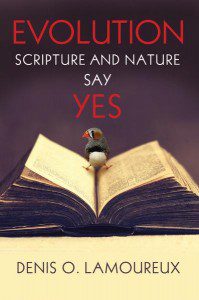 Denis Lamoureux has a new book out: Evolution: Scripture and Nature Say Yes! In this engaging and readable book he builds on his strong background in biology and theology to explore the question of evolutionary creation. The first chapter, Trapped in “Either/Or” Thinking sets the stage. Denis opens with the story of a student in class angry at her parents, Christian school, and pastors for teaching her that “Satan had concocted the so-called theory of evolution,” that she “had to choose between evolution and creation” and that “evolutionists cannot be true Christians.” He moves on to tell his personal story of being raised as a Christian then becoming an atheist in college convinced that evolution was true and that Christianity wasn’t. He returned to faith while in the military stationed on Cyprus, but was still trapped in either/or thinking. He became convinced that evolution was a lie against which Christians should battle and believed that all “real” Christians accepted a young earth and a six day creation.
Denis felt called to engage in the battle between science (evolution) and Christian faith. He began by pursuing a PhD in theology. In this course of study he learned to view the Bible through eyes of faith, but more sophistication; after being shaken to the core by a revered professor: “one day after class I cornered my professor in a hallway and asked him directly, “What do you think about the idea that the world was created in six literal days about six thousand years ago?” He answered bluntly, “It is an error.” I can still remember how the word “error” rattled my soul. … This was the very first time in my life I had met a real Christian who said that creation in six days is wrong.” (p. 28) This was a first step toward understanding.
Willing to accept an old earth, evolution still seemed a worthy foe, synonymous with atheism. A second PhD in biology, focused on the evolution of the jaw, convinced him that the theory of evolution is grounded in solid empirical evidence. Transitional fossils abound when one knows what to look for. Denis outlines some of this evidence in his second chapter Opening God’s Two Books. He started this journey with conviction of a call from the Lord to defeat evolution and defend (young earth) creation. He goes on: “In retrospect, I now see that God did indeed call me to attack atheistic interpretations of evolution and defend the belief that the world is his creation.” (p. 44) The mature call as he now understands it didn’t take the form he had originally imagined, but God spoke to him where he was and prepared him for the task.
The power of language. As Christians we pursue truth, and either/or thinking – the false dichotomy of evolution or creation is not a productive way to pursue truth. To see this it is useful to carefully define some terms. Denis starts here in chapter three.
Creation is a religious belief not a scientific statement. Belief in creation only requires belief in a creator. “The Christian doctrine of creation does not deal with how the world was created, but rather focuses on who created it.” (p. 47) Denis fleshes this out with a discussion of the doctrine of creation.
Evolution is a scientific theory. As such it is neither theist or atheist. “It simply asserts that the cosmos and living organisms, including humans, arose through natural processes over billions of years.” (p. 48) Evolution includes the evolution of the cosmos, the geological evolution of the earth, and biological evolution of the diversity of life. The science itself doesn’t address the question of a creator. It deals only with the physical processes. In chapter two, discussing his work in embryology and jaw development, Denis references Psalm 139:13-14: For you created my inmost being; you knit me together in my mother’s womb. I praise you because I am fearfully and wonderfully made. As Christians we don’t separate natural development from God’s action in our formation as persons in our mother’s womb. “We believe that the Lord creates every person through his ordained and sustained embryological mechanisms.” (p. 42) Likewise we can picture God creating the heavens, the earth and the diversity of life through “natural” evolutionary processes.
Even though these three sciences dealing with evolution do not make any mention of God, I firmly believe that every natural process discovered by evolutionary scientists was ordained by the Creator. I also believe that God sustained these processes during billions of years of cosmological, geological, and biological evolution. (p. 49)
Purpose. The scientific terms for purpose and lack of purpose are teleology and dysteleology. As Christians we believe that there is a purpose to the world – we base our teleology on God not science. The lack of purpose, or dysteleology, is likewise a belief statement not a strictly scientific statement. Denis argues that evolution, despite the claims of some atheists and some Christians, is not inherently dysteleological.
Intelligent design. The next chapter will dig more deeply into the concept of intelligent design. Here Denis makes the point that the bible and most Christians affirm intelligent design in the sense that God intelligently designed the cosmos. However, “Intelligent design is a religious belief, it is not a scientific theory. And, no, design is not scientifically detectable.” (p. 54)
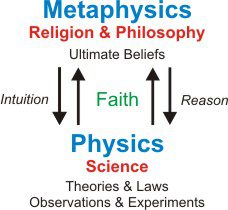 Metaphysics/Physics. Finally Denis introduces the Metaphysics-Physics principle. The figure to the right is based on Figure 3-2 in the book. Denis argues that it is important to realize that metaphysics and physics are complementary. Physics deals with the study of nature. “To employ the Greek word for “nature,” science investigates phusis. The English terms “physics” and “physical” are derived from it. (p. 55) Science, based on observations and experiments, theories and laws, explores the nature of our cosmos. We have learned a great deal, and we continue to learn. Metaphysics moves beyond physics. “The Greek preposition “meta” carries the meanings “after,” behind,” and “beyond.” Therefore, after we have finished our scientific investigations, we inevitably think about metaphysics and ultimate beliefs that are behind or beyond the physical world.” (p. 56) Acts of faith, accompanied by both intuition and reason, connect physics and metaphysics.
Christians make an upward step of faith connecting physics to religious belief in a purposeful and designed world. Atheists make an upward step of faith connecting physics to a random and dysteleological world. We also all make downwards steps of faith connecting our belief in purpose and design or lack of purpose and design to the scientific observations.
Creationists are not those who reject evolution and possibly believe in a young earth. Creationists are those who believe in a creator. Evolutionists are not those who reject creation, but those who accept the scientific theory of evolution. It is possible to be both an evolutionist and a creationist. Denis introduced the term Evolutionary Creation to describe his belief (more on this later).
How would you respond to the argument that creation and evolution are mutually exclusive?
Does the discussion of metaphysics and physics as complementary realms of knowledge make sense?
If you wish to contact me directly you may do so at rjs4mail[at]att.net
If interested you can subscribe to a full text feed of my posts at Musings on Science and Theology.
Previous Post

December 28, 2016
Jesus Creed Books of the Year 2016
Next Post
December 30, 2016 Matthew 2: How Old was Jesus? (John Frye)
Browse Our Archives
Select a Category Acts of the Apostles Adam Advent Anabaptism Angels Anglican Apologetics Atonement Baptism BCP Prayers Bible Biblical Studies Birds Blogging Bloglossary Bonhoeffer Books Calvinism Christianity Church Church History Coffee Colossians Commentary Recs Conversion Creation Creeds Culture Death Ecclesiastes Economics Education Embracing Grace Emergent Emerging Movement Eschatology Essays Ethics Eucharist Evangelicalism Family Fasting Fathers Fellowship of Differents Footsteps Tour Fun and Whimsical Gospel Grace Happiness Heaven Hell Holy Spirit Irenaeus James Jesus Jesus Creed Job Justification Kingdom of God Law Lectures Lent Liberalism Love and Marriage Mabanteneni Manhood Mary Miracles Missio Alliance MissioLife Missional Missional Jesus Movies and Film New Perspective Northern Seminary OneLife Origins Project Orthodox Parables Pastor's Spouse Pastoring and Leading Pastoring and Preaching Patristics Paul Paul-John Tour Pharisees Pietism Political Theology Prayer and Formation Preaching Problems for Faith Psalm 119 Psalms Public Issues Purgatory Religions Resurrection Revelation Romans Rule of JCreed Science and Faith Sermon on the Mount Sports Ten Commandments Theology Third Way Top Ten Lists Translations Uncategorized Universalism University Ministry Way Out Weekly Meanderings Wisdom Women and Ministry Work Worship Writing & Blogging Youth Ministry
Select a Month July 2021 January 2020 December 2019 November 2019 October 2019 September 2019 August 2019 July 2019 June 2019 May 2019 April 2019 March 2019 February 2019 January 2019 December 2018 November 2018 October 2018 September 2018 August 2018 July 2018 June 2018 May 2018 April 2018 March 2018 February 2018 January 2018 December 2017 November 2017 October 2017 September 2017 August 2017 July 2017 June 2017 May 2017 April 2017 March 2017 February 2017 January 2017 December 2016 November 2016 October 2016 September 2016 August 2016 July 2016 June 2016 May 2016 April 2016 March 2016 February 2016 January 2016 December 2015 November 2015 October 2015 September 2015 August 2015 July 2015 June 2015 May 2015 April 2015 March 2015 February 2015 January 2015 December 2014 November 2014 October 2014 September 2014 August 2014 July 2014 June 2014 May 2014 April 2014 March 2014 February 2014 January 2014 December 2013 November 2013 October 2013 September 2013 August 2013 July 2013 June 2013 May 2013 April 2013 March 2013 February 2013 January 2013 December 2012 November 2012 October 2012 September 2012 August 2012 July 2012 June 2012 May 2012 April 2012 March 2012 February 2012 January 2012 December 2011 November 2011 October 2011 September 2011 August 2011 July 2011 June 2011 May 2011 April 2011 March 2011 February 2011 January 2011 December 2010 November 2010 October 2010 September 2010 August 2010 July 2010 June 2010 May 2010 April 2010 March 2010 February 2010 January 2010 December 2009 November 2009 October 2009 September 2009 August 2009 July 2009 June 2009 May 2009 April 2009 March 2009 February 2009 January 2009 December 2008 November 2008 October 2008 September 2008 August 2008 July 2008 June 2008 May 2008 April 2008 March 2008 February 2008 January 2008 December 2007 November 2007 October 2007 September 2007 August 2007 July 2007 June 2007 May 2007 April 2007 March 2007 February 2007 January 2007 December 2006 November 2006 October 2006 September 2006 August 2006 July 2006 June 2006 May 2006 April 2006 March 2006 February 2006 January 2006 December 2005 November 2005 October 2005 September 2005 August 2005 July 2005 June 2005 May 2005 April 2005 0000
Follow Us!
TAKE THE
Religious Wisdom Quiz
What city was Jesus born in?
Select your answer to see how you score.
Jerusalem Bethlehem Capernaum Nazareth
Related posts from Jesus Creed

Evolutionary Creation 10 (RJS)

TRENDING AT PATHEOS Evangelical

The REST of Your Life: A Creative Wrestles...
This week I had a conversation with a good friend from church....

How the author of the world's best hymn...
I've been working with John Newton for a while now. This makes...

Long before this Lectio Divina, Psalm 130 - the song - started...

What About the Trees? Another Living Parable
After I finished writing the last article about falling leaves as a...

Why Classical Education Is a Conversation, Not a...
Come and Read: Joy in Classical Education When I was a little...

Cornell University has received a great deal of negative publicity and intense...
view all Evangelical blogs
Ad-Free & Subscriber Log-In Subscription Support
- About Us
- 2026 Calendar
- Videos
- Podcasts
- Library of World Religions
- Faith In Media Tracker
- Advertise With Us
- Write for Us
- Privacy Policy
- Terms of Service
- Do Not Sell My Data
- Contact Us
- Radiant Digital
- Manage Newsletter Subscriptions
- Unsubscribe From Notifications
- Sitemap
Copyright 2008-2026, Patheos. All rights reserved.
Subscription Support Ad-Free & Subscriber Log-In
Follow Patheos