
BuddhistCatholicContemplativeEvangelicalGeneral ChristianHinduJewishLatter-day SaintMuslimNew VisionsProgressive Christian
Beliefs
- Buddhist
- Catholic
- Contemplative
- Evangelical
- General Christian
- Hindu
- Jewish
- Latter-day Saint
- More Voices
- Muslim
- New Visions
- Pagan
- Progressive Christian
Topics
- Religion News
- Food and Religion
- Sports and Religion
- Religious Art
- Religious Music and Entertainment
- Religious Events
- History and Religion
- Style and Religion
- Politics and Religion
- Women in Religion
- Recreation Outdoors and Religion
- Business Finance and Religion
- Careers Workplace and Religion
- Education and Religion
- Family Parenting and Religion
- Health Fitness and Religion
- Home and Religion
- Relationships and Religion
- Technology and Religion
- Travel and Religion
Columnists
- Buddhist Columnists
- Business Finance and Religion Columnists
- Careers Workplace and Religion Columnists
- Catholic Columnists
- Contemplative Columnists
- Education and Religion Columnists
- Evangelists Columnists
- Family Parenting and Religion Columnists
- General Christian Columnists
- Health Fitness and Religion Columnists
- Hindu Columnists
- History and Religion Columnists
- Home and Religion Columnists
- Jewish Columnists
- More Voices Columnists
- Latter Day Columnists
- Muslim Columnists
- New Visions Columnists
- Nonreligious Columnists
- Pagan Columnists
- Politics and Religion Columnists
- Progressive Columnists
- Recreation Outdoors and Religion Columnists
- Relationships and Religion Columnists
- Religion News Columnists
- Religious Art Columnists
- Religious Events Columnists
- Religious Music and Entertainment Columnists
- Sports and Religion Columnists
- Style and Religion Columnists
- Technology and Religion Columnists
- Travel and Religion Columnists
- Women in Religion Columnists
Resource Library
- 2026 Calendar
- Library of World Religions
- The 100 Most Holy Places on Earth
- Patheos Answers
- Podcasts
- Videos
- Faith Leaders Database
- Anglican Episcopalian
- Bahai
- Baptist
- Buddhism
- Christianity
- Confucianism
- Eastern Orthodoxy
- Hinduism
- Holiness and Pentecostal
- ISKCON
- Islam
- Judaism
- Lutheran
- Methodist
- The Church of Jesus Christ of Latter-day Saints
- New Age
- Paganism
- Presbytarian and Reformed
- Protestantism
- Religion Behind the Scenes
- Roman Catholic
- Scientology
- Shia Islam
- Sikhism
- Sufism
- Sunni Islam
- Taoism
- Zen
- See all religions
Research Tools
 Ad-Free & Subscriber Log-In Subscription Support
Follow Patheos 

- Trending:
- Advent
- |
- Forgiveness
- |
- Thanksgiving
- |
- Election
- |
- Seasonal Holidays
- |
- Marriage
 Jesus Creed
- Home
- Evangelical
- Making Sense of God (RJS)
Making Sense of God (RJS)
Last updated on: October 6, 2016 at 6:07 am by RJS
Making Sense of God (RJS) 2016-10-05T21:19:58-05:00 RJS
Patheos Explore the world's faith through different perspectives on religion and spirituality! Patheos has the views of the prevalent religions and spiritualities of the world.
 I wrote a post last Tuesday None and Fine With It that looked at recent results reported from the Religious Landscape Survey of US beliefs and trends. This post received extensive comment, much of it from people who are not Christians and gave their views why “none” was a preferred choice. Many of these comments shed light on issues that we, as Christians, need to address, My post on Thursday, Cultivate Humility, focused on the topic of intellectual humility – something that should be a virtue both as a scientist and as a Christian. This post received far less comment, but one person coming over from the Tuesday post noted:
So, does intellectual humility let you recognize and cope with scientific answers that contradict your doctrine?
I must admit to being curious about handling the cognitive dissonance situations like that must create.
This is an interesting question and one I’ve thought about a great deal. Intellectual humility is a posture and attitude that allows us to be teachable and to teach with sincerity. I try to take this posture into pretty much everything I do and teach. In Freshman Chemistry, for example, a posture of intellectual humility leads me to explain why things are true – not proclaim that they are true. I bring a confidence that I understand the material and can answer the questions, but this doesn’t mean that truth rests on my say-so. In other situations, research meetings for example, intellectual humility means putting my ideas, arguments, and conclusions on the table and defending them, but being willing to listen to the criticisms as well. This is how we learn.
Intellectual humility as a Christian leads me to realize that I am a finite human who does not have all the answers. When it appears that science contradicts doctrine it is important to examine both the scientific and the doctrinal claims. Sometimes the so-called scientific claims overreach into metaphysics and philosophy and need to be taken with a grain of salt. Sometimes the claims are at the edges of understanding and we need to wait for further developments. Sometimes, as in the age of the earth, or the message we should take from the first 11 chapters of Genesis, or the way in which we should understand biblical authority, our doctrines need refinement. This is nothing new, each generation of Christians has found it necessary to wrestle with scripture in the light of new information. We need the humility to realize that we are at least as capable of error as those who came before us.
When I started to dig more deeply into the foundations of my Christian faith one of the things I did was purchase and begin to read the writings of the Ante-Nicene Church Fathers (available on-line at ccel as well, here). The Protestant translator of the first book I read was quick to point out that the interpretational methods of these early Christians (and the later post-Nicene writers as well) were flawed, but, if careful, we could still learn from them. The impact of his warning on me was somewhat different than his intent. It raised a question: How do we know when our approach is better or worse than those who came before? We can pretty much guarantee that those who come after us will find some of our methods suspect. Intellectual humility is crucial as we dig for the truth, while aware that we will not get all the final answers. We learn from the past, recognizing that some of this was wrong, and teach for the future, realizing that some of what we say will be wrong. Many ideas need to be held with an open hand, not in a clenched fist.
Sometimes we have to live with a tension between ideas that seem, at least temporarily, irreconcilable as we seek truth.
My views on some “doctrines” have changed somewhat over the years, others have been strengthened. Many of the points brought up in the comments on None and Fine With It are significant issues we should wrestle with. How we understand atonement and the appropriate interpretation of some Old Testament passages are high on the list.
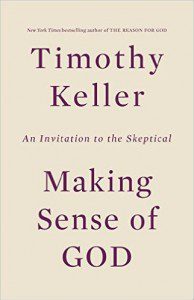 Which brings me to the focus of this post. A couple of weeks ago Dave Moore reviewed Tim Keller’s most recent book Making Sense of God and I knew immediately that I had to get this book and probably blog through it (Dave’s review: Tim Keller’s Newest).
We live in an increasingly secular culture, although not (as Keller points out in his first chapter) and increasingly secular world. Keller, referencing Charles Taylor (A Secular Age), points out that there are at least three uses of the term secular. A person can be secular, a society can be secular, and an age can be secular.
A secular society is one in which there is a separation of religion and the state. No religious faith is privileged by the government and the most powerful cultural institutions. … A secular person is one who does not know if there is a God or any supernatural realm beyond the natural world. Everything in this view has a scientific explanation. … A “secular age” is one in which all the emphasis is on the saeculum, on the here-and-now, without any concept of the eternal. (pp. 2-3)
In a secular society most individuals could be religious – but of a variety of different perspectives. A secular age, in the air we breath and the water we drink, will permeate even those who are religious, and “thin out” faith.
In the Western world (e.g. North America, Europe, Australia, New Zealand and probably some other places as well) we are in the midst of or entering what is probably best designated a secular age. Religion is not dying out, but the general cultural perspective has definitely undergone a massive shift. This is especially true among those with at least a college education. Keller suggests that religion is not on the decline in the US – the apparent decline is among those for whom religion is a choice rather than an inherited community. In one sense this is hard to argue against – but declines (as indicated in the previous post None and Fine With It ) are hitting even denominations that emphasize the importance of personal choice and a personal God. If a secular age “thins out” faith, it will eventually diminish the ranks of the faithful.
 One important question, then, is how to be a witness for the gospel in this secular age. A second, equally important, question is how to give Christians the tools to thrive in this age. It is hard to thrive when on the defensive or in perpetually uncertain. In almost 30 years of ministry in Manhattan, Tim Keller has wrestled with the questions raised by people in the city. New York is not a particularly religious city and Manhattan is the least religious borough. I have found it hard to find good statistics though. Numbers vary dramatically, depending on how one defines religion. The education level is high (59% of adults over 25 with Bachelor’s degree or more compared with 29% for the whole country, data from the 2010 census), although not as high as my community (which rounds to 71% ), and education feeds into the secular feel of our age.
Tim Keller’s invitation to the skeptical is directed toward this educated audience. He has insights worth listening to and bringing up for discussion. Chapter 2: Isn’t Religion Based on Faith and Secularism on Evidence? will allow us to dive into the deep water. The same commenter quoted at the top of this post noted on None and Fine With It:
The evidence is the evidence, and science follows the evidence. Christianity comes to the evidence with a preconceived premise that there is a supernatural creator, which then biases all the conclusions that follow.
And later in response to another commenter:
But as to the supernatural – it is normal to adopt the null hypotheses.
“Bottom line, we are all living by faith.” No – we are not. Faith is an utter failure as an epistemology. You might live accordingly, but I do not – nor do many others.
Let’s see where Keller takes us in response.
Are we living in a secular age?
If so, what impact does this have on the mission and ministry of the church?
If you wish to contact me directly you may do so at rjs4mail[at]att.net
If interested you can subscribe to a full text feed of my posts at Musings on Science and Theology.
Previous Post

October 6, 2016
NT Wright: Forgiveness Re-Framed
Next Post
October 6, 2016 Parents and Children and Time
Browse Our Archives
Select a Category Acts of the Apostles Adam Advent Anabaptism Angels Anglican Apologetics Atonement Baptism BCP Prayers Bible Biblical Studies Birds Blogging Bloglossary Bonhoeffer Books Calvinism Christianity Church Church History Coffee Colossians Commentary Recs Conversion Creation Creeds Culture Death Ecclesiastes Economics Education Embracing Grace Emergent Emerging Movement Eschatology Essays Ethics Eucharist Evangelicalism Family Fasting Fathers Fellowship of Differents Footsteps Tour Fun and Whimsical Gospel Grace Happiness Heaven Hell Holy Spirit Irenaeus James Jesus Jesus Creed Job Justification Kingdom of God Law Lectures Lent Liberalism Love and Marriage Mabanteneni Manhood Mary Miracles Missio Alliance MissioLife Missional Missional Jesus Movies and Film New Perspective Northern Seminary OneLife Origins Project Orthodox Parables Pastor's Spouse Pastoring and Leading Pastoring and Preaching Patristics Paul Paul-John Tour Pharisees Pietism Political Theology Prayer and Formation Preaching Problems for Faith Psalm 119 Psalms Public Issues Purgatory Religions Resurrection Revelation Romans Rule of JCreed Science and Faith Sermon on the Mount Sports Ten Commandments Theology Third Way Top Ten Lists Translations Uncategorized Universalism University Ministry Way Out Weekly Meanderings Wisdom Women and Ministry Work Worship Writing & Blogging Youth Ministry
Select a Month July 2021 January 2020 December 2019 November 2019 October 2019 September 2019 August 2019 July 2019 June 2019 May 2019 April 2019 March 2019 February 2019 January 2019 December 2018 November 2018 October 2018 September 2018 August 2018 July 2018 June 2018 May 2018 April 2018 March 2018 February 2018 January 2018 December 2017 November 2017 October 2017 September 2017 August 2017 July 2017 June 2017 May 2017 April 2017 March 2017 February 2017 January 2017 December 2016 November 2016 October 2016 September 2016 August 2016 July 2016 June 2016 May 2016 April 2016 March 2016 February 2016 January 2016 December 2015 November 2015 October 2015 September 2015 August 2015 July 2015 June 2015 May 2015 April 2015 March 2015 February 2015 January 2015 December 2014 November 2014 October 2014 September 2014 August 2014 July 2014 June 2014 May 2014 April 2014 March 2014 February 2014 January 2014 December 2013 November 2013 October 2013 September 2013 August 2013 July 2013 June 2013 May 2013 April 2013 March 2013 February 2013 January 2013 December 2012 November 2012 October 2012 September 2012 August 2012 July 2012 June 2012 May 2012 April 2012 March 2012 February 2012 January 2012 December 2011 November 2011 October 2011 September 2011 August 2011 July 2011 June 2011 May 2011 April 2011 March 2011 February 2011 January 2011 December 2010 November 2010 October 2010 September 2010 August 2010 July 2010 June 2010 May 2010 April 2010 March 2010 February 2010 January 2010 December 2009 November 2009 October 2009 September 2009 August 2009 July 2009 June 2009 May 2009 April 2009 March 2009 February 2009 January 2009 December 2008 November 2008 October 2008 September 2008 August 2008 July 2008 June 2008 May 2008 April 2008 March 2008 February 2008 January 2008 December 2007 November 2007 October 2007 September 2007 August 2007 July 2007 June 2007 May 2007 April 2007 March 2007 February 2007 January 2007 December 2006 November 2006 October 2006 September 2006 August 2006 July 2006 June 2006 May 2006 April 2006 March 2006 February 2006 January 2006 December 2005 November 2005 October 2005 September 2005 August 2005 July 2005 June 2005 May 2005 April 2005 0000
Follow Us!
TAKE THE
Religious Wisdom Quiz
What does "Beersheba" mean?
Select your answer to see how you score.
House of the King Blessed Field Well of the Oath Valley of Water
Related posts from Jesus Creed

The Gospel of With Us and Through Us

Northern Seminary Announces: Nijay Gupta Joins Faculty

The Gundrys and Me: Ruth Tucker
TRENDING AT PATHEOS Evangelical

When you hear the word riches, what comes to mind? For most...

Don’t Miss the Parents: A Creative Christmas Meditation
As we enter the Advent Season, I see many people trying to...

Making Stones Into Bread: Choosing the “Right” Work
I was on my online arts ministry Zoom meeting with the International...

Ukraine’s exhausted Christians face fifth winter of war
By Julian Lukins The full-scale war in Ukraine is taking “a serious...

Russell Brand's Conviction is not anti-Christian Persecution
How do we shed the reputation that the Church is OK with...

Have you ever caught yourself saying, “I’ll do it tomorrow,” or “Now...
view all Evangelical blogs
Ad-Free & Subscriber Log-In Subscription Support
- About Us
- 2026 Calendar
- Videos
- Podcasts
- Library of World Religions
- Faith In Media Tracker
- Advertise With Us
- Write for Us
- Privacy Policy
- Terms of Service
- Do Not Sell My Data
- Contact Us
- Radiant Digital
- Manage Newsletter Subscriptions
- Unsubscribe From Notifications
- Sitemap
Copyright 2008-2026, Patheos, part of the Radiant Digital network of media brands. All rights reserved.
Subscription Support Ad-Free & Subscriber Log-In
Follow Patheos