
BuddhistCatholicContemplativeEvangelicalGeneral ChristianHinduJewishLatter-day SaintMuslimNew VisionsProgressive Christian
Beliefs
- Buddhist
- Catholic
- Contemplative
- Evangelical
- General Christian
- Hindu
- Jewish
- Latter-day Saint
- More Voices
- Muslim
- New Visions
- Pagan
- Progressive Christian
Topics
- Religion News
- Food and Religion
- Sports and Religion
- Religious Art
- Religious Music and Entertainment
- Religious Events
- History and Religion
- Style and Religion
- Politics and Religion
- Women in Religion
- Recreation Outdoors and Religion
- Business Finance and Religion
- Careers Workplace and Religion
- Education and Religion
- Family Parenting and Religion
- Health Fitness and Religion
- Home and Religion
- Relationships and Religion
- Technology and Religion
- Travel and Religion
Columnists
- Buddhist Columnists
- Business Finance and Religion Columnists
- Careers Workplace and Religion Columnists
- Catholic Columnists
- Contemplative Columnists
- Education and Religion Columnists
- Evangelists Columnists
- Family Parenting and Religion Columnists
- General Christian Columnists
- Health Fitness and Religion Columnists
- Hindu Columnists
- History and Religion Columnists
- Home and Religion Columnists
- Jewish Columnists
- More Voices Columnists
- Latter Day Columnists
- Muslim Columnists
- New Visions Columnists
- Nonreligious Columnists
- Pagan Columnists
- Politics and Religion Columnists
- Progressive Columnists
- Recreation Outdoors and Religion Columnists
- Relationships and Religion Columnists
- Religion News Columnists
- Religious Art Columnists
- Religious Events Columnists
- Religious Music and Entertainment Columnists
- Sports and Religion Columnists
- Style and Religion Columnists
- Technology and Religion Columnists
- Travel and Religion Columnists
- Women in Religion Columnists
Resource Library
- 2026 Calendar
- Library of World Religions
- The 100 Most Holy Places on Earth
- Patheos Answers
- Podcasts
- Videos
- Faith Leaders Database
- Anglican Episcopalian
- Bahai
- Baptist
- Buddhism
- Christianity
- Confucianism
- Eastern Orthodoxy
- Hinduism
- Holiness and Pentecostal
- ISKCON
- Islam
- Judaism
- Lutheran
- Methodist
- The Church of Jesus Christ of Latter-day Saints
- New Age
- Paganism
- Presbytarian and Reformed
- Protestantism
- Religion Behind the Scenes
- Roman Catholic
- Scientology
- Shia Islam
- Sikhism
- Sufism
- Sunni Islam
- Taoism
- Zen
- See all religions
Research Tools
 Ad-Free & Subscriber Log-In Subscription Support
Ad-Free & Subscriber Log-In Subscription Support
Follow Patheos 

- Trending:
- Forgiveness
- |
- Marriage
- |
- Consciousness
- |
- Death Penalty
- |
- Election
- |
- Halloween
 Jesus Creed
- Home
- Evangelical
- Are We Ethically Superior? (RJS)
Are We Ethically Superior? (RJS)
Last updated on: September 22, 2016 at 5:54 am by RJS
Are We Ethically Superior? (RJS) 2016-09-22T05:50:41-05:00 RJS
Patheos Explore the world's faith through different perspectives on religion and spirituality! Patheos has the views of the prevalent religions and spiritualities of the world.
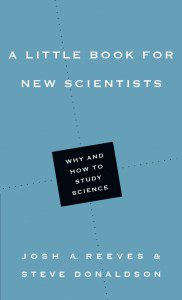 InterVarsity press recently sent me a copy of a new book A Little Book for New Scientists: Why and How to Study Science by Josh Reeves and Steve Donaldson. The book is designed for Christian college, or possibly high school, students contemplating a career in science. It also contains insights in a short readable format that pastors, including youth pastors, may find useful.
Despite the fact that I am no longer a new scientist, I immediately dove in and began to read. Josh Reeves is an assistant professor of Science and Religion at Samford University in Alabama with an undergraduate degree in Psychology, an MDiv, and a Ph.D. in Religious Studies (Science and Religion track) from Boston University. Steve Donaldson is a professor of Computer Science at Samford (BS in Physics, BS in Engineering, MS and Ph.D. in Computer Science). Both Reeves and Donaldson have long-standing interest in the questions at the forefront of science and religion, particularly science and Christianity.
I have to admit that curiosity with a touch of skepticism drove some of my interest in the book. As a scientist with now 20+ years as a professor and 30+ years as a researcher I was curious to see where I would agree or disagree with the views expressed by Reeves and Donaldson. Outside perspectives can be enlightening, but also infuriating on occasion. (Well, Reeves brings an outside perspective – Donaldson has more direct science experience.) Samford, however, has an active program in Science and Religion – and Reeves and Donaldson bring a wealth of experience to this book.
Why study science? Part one of the book addresses this basic question in three chapters. In the first, Reeves and Donaldson point to the two books metaphor “For over 1500 years, Christians have used the metaphor of God’s two books to suggest the complementarity of natural and supernatural knowledge.” (p. 22) God speaks both in the general revelation of his creation and in the special revelation to his people.
Science will not differ for the secular or religious person – not when it comes to empirical observation or mathematics. But there is a difference:
They [secular scientists] just fail to see the true spiritual significance of what they study. In other words, they do not comprehend the spiritual realities to which the physical realm bears witness, with the result that secular scientists are often wrong when they try to construct a worldview based on science. (p. 26)
The two book metaphor has limits however. These limits do not challenge the science – but point to the inability of the investigation of nature alone to bring us to a saving relationship with the Creator. Christianity is a personal and historical religion. God reveals himself through people and actions. This cannot be deduced from any kind of scientific investigation of nature. Reeves and Donaldson quote Francis Bacon who noted that creation and investigation of God’s works in creation “shows the omnipotency and wisdom of the maker, but not his image.” (p. 27) One can be a faithful Christian with no knowledge or understanding of modern science, but one cannot be a faithful Christian without the knowledge or understanding of the personal character of God and historical events transmitted down to us through the church and through Scripture.
Reeves and Donaldson next give a brief overview of the history of apparent conflict between science and the church. While the conflict is quite real on issues of metaphysical and spiritual importance, the conflict on scientific questions is overblown. Scientific materialism is at odds with Christian faith, but science itself is not. Even the famous case of Galileo needs to be understood in context – (1) Galileo was at the cutting edge and the mainstream science community (if we can push such an idea back to the time) did not accept his ideas and (2) much of the reaction was to Galileo’s rather aggressive, even offensive, method of communicating his ideas. This isn’t a simple case of science vs. the church.
 Science and ethics. The final chapter in the first section of the book looks at science and ethics (image Wikipedia). The bottom line is that we need Christians in the sciences to evaluate the claims made in the name of science and to use the knowledge obtained or obtainable through science to live out the Christian calling of love of God and love for one another.

The title of this post comes from this section. Reeves and Donaldson claim that “there is a long history of people claiming that scientists are ethically superior to their fellow citizens.” This statement surprised me because I am not aware of anyone making this claim, nor has it cropped up in anything I’ve read. In fact, I don’t think I had ever heard the claim prior to this. Not in reading of the history of science or in the present day. It also surprised me because I know it isn’t true – all of the foibles and flaws of the general population are at play among scientists as well. Ambition … The allure of money, sex, and power runs deep. The issues are discussed in more depth in the book, but Reeves and Donaldson certainly agree that there is no ground for viewing scientists as ethically superior.
Reeves and Donaldson move from this to talk of science as a community activity. Whereas scientists as individuals are not ethically superior to other humans, could the scientific community as a whole provide an ethically superior outlook?
Our society tends to see scientists in either/or terms. Either they are especially trustworthy, playing the role of priests who can produce sacred truths for a secular society, or they are a corrupt institution because they are beholden to political pressures. A better view, as the sociologist Harry Collins has explained, is to see scientists in a middle-ground category: scientists are merely experts, and as such “should be accorded all the attention and respect we give to other experts in our society like potters, carpenters, real estate agents, and plumbers.” The main reason we trust experts is that they participate in communities that evaluate their actions. (p. 47)
The particular set of examples Collins gives here is telling (quoted approvingly it appears, by Reeves and Donaldson). Scientists are technicians producing a product or middlemen arranging a connection? And where does trust come into the mix with a potter? Potters need licenses? I could go off on a tangent – but perhaps it is better to step back and look at the bigger point. The main reason we trust scientists is that they participate in communities of experts – any new idea, insight, or result must be defended in a community of people capable of evaluating the ideas. The cutting edge should be taken with a grain of salt as the bugs haven’t necessarily been worked out – but well established theories are just that for a reason. The scientific enterprise is intrinsically a community endeavor. Ideas may start with an individual (although the reality is usually more complex than this) but they don’t stay with the individual.
But ethics is a far more embracing idea than simply judging the accuracy of answers to perplexing problems in the natural world. The scientific community places value on certain kinds of pursuits – but society at large should be involved in these discussions. How much time and money should be invested in developing better tools of war? Stand-off detection of biological and chemical threats and explosives? Drugs, imaging methods, materials, solar energy conversion, particle physics, cosmology, evolution, next generation telescopes, and a myriad of other topics? What should be the balance between basic and applied research?
In their conclusion to this section Reeves and Donaldson note that “if Christians abandon science for fear of anti-Christian bias in scientific research, it only ensures that no Christians will be left to evaluate claims made in the name of science.” (p. 54) I think it goes deeper than this – if Christians abandon science for fear of anti-Christian bias it ensures that no Christians will be at the table to challenge metaphysical claims that move beyond science, and it ensures that Christians will be missing from the table when decisions are made to value one avenue of study over another. We will benefit if Christians are active in the communities that make these decisions.
Why should Christians study science?
If you wish to contact me directly you may do so at rjs4mail[at]att.net
If interested you can subscribe to a full text feed of my posts at Musings on Science and Theology.
Previous Post

September 21, 2016
Republican, Conservative, and Supporting Syrian Refugees
Next Post
September 23, 2016 A Pastor Talks about the Pressures to Plagiarize
Browse Our Archives
Select a Category Acts of the Apostles Adam Advent Anabaptism Angels Anglican Apologetics Atonement Baptism BCP Prayers Bible Biblical Studies Birds Blogging Bloglossary Bonhoeffer Books Calvinism Christianity Church Church History Coffee Colossians Commentary Recs Conversion Creation Creeds Culture Death Ecclesiastes Economics Education Embracing Grace Emergent Emerging Movement Eschatology Essays Ethics Eucharist Evangelicalism Family Fasting Fathers Fellowship of Differents Footsteps Tour Fun and Whimsical Gospel Grace Happiness Heaven Hell Holy Spirit Irenaeus James Jesus Jesus Creed Job Justification Kingdom of God Law Lectures Lent Liberalism Love and Marriage Mabanteneni Manhood Mary Miracles Missio Alliance MissioLife Missional Missional Jesus Movies and Film New Perspective Northern Seminary OneLife Origins Project Orthodox Parables Pastor's Spouse Pastoring and Leading Pastoring and Preaching Patristics Paul Paul-John Tour Pharisees Pietism Political Theology Prayer and Formation Preaching Problems for Faith Psalm 119 Psalms Public Issues Purgatory Religions Resurrection Revelation Romans Rule of JCreed Science and Faith Sermon on the Mount Sports Ten Commandments Theology Third Way Top Ten Lists Translations Uncategorized Universalism University Ministry Way Out Weekly Meanderings Wisdom Women and Ministry Work Worship Writing & Blogging Youth Ministry
Select a Month July 2021 January 2020 December 2019 November 2019 October 2019 September 2019 August 2019 July 2019 June 2019 May 2019 April 2019 March 2019 February 2019 January 2019 December 2018 November 2018 October 2018 September 2018 August 2018 July 2018 June 2018 May 2018 April 2018 March 2018 February 2018 January 2018 December 2017 November 2017 October 2017 September 2017 August 2017 July 2017 June 2017 May 2017 April 2017 March 2017 February 2017 January 2017 December 2016 November 2016 October 2016 September 2016 August 2016 July 2016 June 2016 May 2016 April 2016 March 2016 February 2016 January 2016 December 2015 November 2015 October 2015 September 2015 August 2015 July 2015 June 2015 May 2015 April 2015 March 2015 February 2015 January 2015 December 2014 November 2014 October 2014 September 2014 August 2014 July 2014 June 2014 May 2014 April 2014 March 2014 February 2014 January 2014 December 2013 November 2013 October 2013 September 2013 August 2013 July 2013 June 2013 May 2013 April 2013 March 2013 February 2013 January 2013 December 2012 November 2012 October 2012 September 2012 August 2012 July 2012 June 2012 May 2012 April 2012 March 2012 February 2012 January 2012 December 2011 November 2011 October 2011 September 2011 August 2011 July 2011 June 2011 May 2011 April 2011 March 2011 February 2011 January 2011 December 2010 November 2010 October 2010 September 2010 August 2010 July 2010 June 2010 May 2010 April 2010 March 2010 February 2010 January 2010 December 2009 November 2009 October 2009 September 2009 August 2009 July 2009 June 2009 May 2009 April 2009 March 2009 February 2009 January 2009 December 2008 November 2008 October 2008 September 2008 August 2008 July 2008 June 2008 May 2008 April 2008 March 2008 February 2008 January 2008 December 2007 November 2007 October 2007 September 2007 August 2007 July 2007 June 2007 May 2007 April 2007 March 2007 February 2007 January 2007 December 2006 November 2006 October 2006 September 2006 August 2006 July 2006 June 2006 May 2006 April 2006 March 2006 February 2006 January 2006 December 2005 November 2005 October 2005 September 2005 August 2005 July 2005 June 2005 May 2005 April 2005 0000
Follow Us!
TAKE THE
Religious Wisdom Quiz
Which short letter urges forgiveness for a runaway slave named Onesimus?
Select your answer to see how you score.
Philemon Jude Titus 2 Timothy
Related posts from Jesus Creed


The Gospel of With Us and Through Us

Northern Seminary Announces: Nijay Gupta Joins Faculty

The Gundrys and Me: Ruth Tucker
TRENDING AT PATHEOS Evangelical

The REST of Your Life: A Creative Wrestles...
This week I had a conversation with a good friend from church....

How the author of the world's best hymn...
I've been working with John Newton for a while now. This makes...

Long before this Lectio Divina, Psalm 130 - the song - started...

What About the Trees? Another Living Parable
After I finished writing the last article about falling leaves as a...

Why Classical Education Is a Conversation, Not a...
Come and Read: Joy in Classical Education When I was a little...

Cornell University has received a great deal of negative publicity and intense...
view all Evangelical blogs
Ad-Free & Subscriber Log-In Subscription Support
- About Us
- 2026 Calendar
- Videos
- Podcasts
- Library of World Religions
- Faith In Media Tracker
- Advertise With Us
- Write for Us
- Privacy Policy
- Terms of Service
- Do Not Sell My Data
- Contact Us
- Radiant Digital
- Manage Newsletter Subscriptions
- Unsubscribe From Notifications
- Sitemap
Copyright 2008-2026, Patheos. All rights reserved.
Subscription Support Ad-Free & Subscriber Log-In
Follow Patheos