
BuddhistCatholicContemplativeEvangelicalGeneral ChristianHinduJewishLatter-day SaintMuslimNew VisionsProgressive Christian
Beliefs
- Buddhist
- Catholic
- Contemplative
- Evangelical
- General Christian
- Hindu
- Jewish
- Latter-day Saint
- More Voices
- Muslim
- New Visions
- Pagan
- Progressive Christian
Topics
- Religion News
- Food and Religion
- Sports and Religion
- Religious Art
- Religious Music and Entertainment
- Religious Events
- History and Religion
- Style and Religion
- Politics and Religion
- Women in Religion
- Recreation Outdoors and Religion
- Business Finance and Religion
- Careers Workplace and Religion
- Education and Religion
- Family Parenting and Religion
- Health Fitness and Religion
- Home and Religion
- Relationships and Religion
- Technology and Religion
- Travel and Religion
Columnists
- Buddhist Columnists
- Business Finance and Religion Columnists
- Careers Workplace and Religion Columnists
- Catholic Columnists
- Contemplative Columnists
- Education and Religion Columnists
- Evangelists Columnists
- Family Parenting and Religion Columnists
- General Christian Columnists
- Health Fitness and Religion Columnists
- Hindu Columnists
- History and Religion Columnists
- Home and Religion Columnists
- Jewish Columnists
- More Voices Columnists
- Latter Day Columnists
- Muslim Columnists
- New Visions Columnists
- Nonreligious Columnists
- Pagan Columnists
- Politics and Religion Columnists
- Progressive Columnists
- Recreation Outdoors and Religion Columnists
- Relationships and Religion Columnists
- Religion News Columnists
- Religious Art Columnists
- Religious Events Columnists
- Religious Music and Entertainment Columnists
- Sports and Religion Columnists
- Style and Religion Columnists
- Technology and Religion Columnists
- Travel and Religion Columnists
- Women in Religion Columnists
Resource Library
- 2026 Calendar
- Library of World Religions
- The 100 Most Holy Places on Earth
- Patheos Answers
- Podcasts
- Videos
- Faith Leaders Database
- Anglican Episcopalian
- Bahai
- Baptist
- Buddhism
- Christianity
- Confucianism
- Eastern Orthodoxy
- Hinduism
- Holiness and Pentecostal
- ISKCON
- Islam
- Judaism
- Lutheran
- Methodist
- The Church of Jesus Christ of Latter-day Saints
- New Age
- Paganism
- Presbytarian and Reformed
- Protestantism
- Religion Behind the Scenes
- Roman Catholic
- Scientology
- Shia Islam
- Sikhism
- Sufism
- Sunni Islam
- Taoism
- Zen
- See all religions
Research Tools
 Ad-Free & Subscriber Log-In Subscription Support
Follow Patheos 

- Trending:
- Advent
- |
- Forgiveness
- |
- Thanksgiving
- |
- Election
- |
- Seasonal Holidays
- |
- Marriage
 Jesus Creed
- Home
- Evangelical
- Miracles and the “Problem” of Divine Action (RJS)
Miracles and the “Problem” of Divine Action (RJS)
Last updated on: May 19, 2016 at 6:06 am by RJS
Miracles and the “Problem” of Divine Action (RJS) 2016-05-18T20:38:45-05:00 RJS
Patheos Explore the world's faith through different perspectives on religion and spirituality! Patheos has the views of the prevalent religions and spiritualities of the world.
 One of the blogs at BioLogos is run by Jim Stump, formerly a professor of philosophy at Bethel College in Mishawaka, IN, now senior editor at BioLogos. I first “met” Jim virtually when he sent me a copy of the book Blackwell Companion to Science and Christianity, that he co-edited with Alan Padgett. I have since had the privilege of speaking with him in person on several occasions. I wish I had a better picture to post, but to the right Jim is listening intently to a tour guide in Oxford. (I, on the other hand, was taking pictures and only “listening” on the side.)
Introducing his blog Faith and Science Seeking Understanding Jim writes:
“I believe in Christianity as I believe that the sun has risen: not only because I see it, but because by it I see everything else.” -C. S. Lewis
Since the Middle Ages, fides quaerens intellectum (faith seeking understanding) has been the Latin phrase used to indicate a commitment to the Christian faith along with a commitment to working out the implications of faith in light of all we know. This blog extends that commitment to “faith and science” and seeks to understand all we know through the lens of faith.
I introduce Jim’s blog because I think he deals with issues that many who read these posts will find interesting. Philosophical issues that are at the intersection between science and Christian theology. He has begun hosting a series of posts by a number of different authors on the topic of divine action. There are seven posts in the series as I write this with more to come. In the opening post Jim wrote that he’s noticed four particular areas of theological concern that Christians often have when considering evolution in light of their faith:
- What do we do about the Bible’s depictions of Adam and Eve?
- If we share ancestry with other life, what about human uniqueness and the image of God?
- Doesn’t evolution make the problem of evil more difficult?
- If science can explain the development of life, is God’s action consigned to starting things off and then watching from a distance?
We’ve dealt with many of these over the years, working through a number of different writers and Christian thinkers. How are we to understand divine action, whether a miracle or not, in an age of science? My recent walk through Robert Asher’s book Evolution and Belief raised the question on several occasions. Although Asher is a Christian, he finds the idea of miracles at odds with modern science.The view he presented on this particular topic stood at one Christian extreme, almost a deistic position. Many of us take a less extreme view. The God of the bible is a personal God and as such he interacts with his creation. A personal God interacting with creation will, at times, appear “miraculous.” At other times it will be indistinguishable from so-called natural processes. But how do we reconcile an event as both natural and divine?
Jim provides this example as an introduction to the series on divine action:
By way of introduction, let me attempt to frame the discussion affirming the following two claims:
- Evolution is the best scientific description for how human beings developed.
- God intentionally created human beings.
I think both of these claims are true (and they are consistent with the official BioLogos belief statement). But it is one thing to affirm them, and another thing entirely to show how they are consistent with each other. The attempt to do so is one of the ways we are ushered into what philosophers call the problem of divine action. We’re going to feature posts on the topic for a couple of days per week for the next six or seven weeks. Here too, I doubt this will result in the adoption of an official BioLogos position on the topic, but perhaps it will help us to see some things more clearly and understand the range of defensible views.
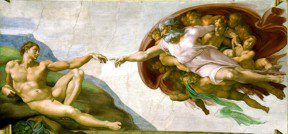 Six posts on the topic have appeared thus far: two by Sarah Lane Ritchie entitled Does the Success of Modern Science Leave God Unemployed?, two by Alvin Plantinga Where is the Problem in the Problem of Divine Action and Why Can’t God Intervene? and two by Robert John Russell entitled Miracles and Science: A Third Way. You can read the posts in their entirety at the links given, and learn more about the authors as well. Today I wish to consider just a few ideas.
In her second post Sarah Lane Ritchie outlines the difference between “general” and “special” divine action:
General divine action, or providence, is taken to indicate God’s initial act of creation ex nihilo, together with the assumption that God is undergirding and preserving the natural laws that God has set in motion, as it were. This is in marked contrast to “special” divine action, which is depicted as the specific actions God undertakes—either in response to human needs and prayers, or to bring about some divinely intended purpose. Miracles would fall into this category as well. The distinction between general and special divine action has become an important one for theologians, and marks a point of departure for those wishing to affirm God’s ongoing activity in the world.
Some Christians, like Asher, don’t think there is much of a place for special divine action (incarnation and resurrection may be exceptions though). Others see divine action best considered in the intrinsic openness of creation. John Polkinghorne’s discussion of quantum uncertainty and chaos provide examples of places where God can act without overturning any “laws of nature.” This is a non-interventionist approach. Sarah continues:
It is worth noting that these non-interventionist approaches are generally not talking about miracles per se, or at least not miracles as defined in the Humean sense as “violations of the laws of nature.” Rather, divine action is to be seen as occurring in and through the natural world, and precisely at the level of inherently under-determined or indeterministic processes.
Of course there are also Christians who take explicitly interventionist position. God intervenes directly in the world in a manner that would be scientifically obvious at the time of the occurrence. This is a genuine miracle by all forms of reckoning. One problem with this approach is that it often assumes a view of a God reaching down into creation, tinkering from time to time. This does not seem consistent with the biblical view of God either.
Against the objection that intervention would indicate a inconsistency in the nature of God Alvin Plantiga counters (Why Can’t God Intervene?):
But is this really true? There would be arbitrariness and inconsistency only if God had no special reason for acting contrary to the usual regularities; but of course he might very well have such reasons. This is obvious for the case of raising Jesus from the dead: God intends to mark the special status accruing to Jesus by this mighty act of raising him from the dead.
Why should any of this be in any way incompatible with his unsurpassable greatness? Well, many seem to think of God as like a classical artist, one who prizes economy, restraint, discipline. Perhaps; but also, perhaps God is more like a romantic artist; perhaps he revels in glorious variety, riotous creativity, overflowing fecundity, uproarious activity. Perhaps he is also very much a hands-on God, constantly active in history, leading, guiding, persuading and redeeming his people. None of this so much as begins to compromise his greatness and majesty, his august and unsurpassable character.
As we consider the nature of God’s divine action in the world it is useful to consider the current state of knowledge. Quantum mechanics and chaos provide an openness that leaves room for divine action. Plantiga considers quantum openness explicitly in the first of his two posts. But if, sometime in the future, this openness is found to be, instead, “closed” and entirely deterministic, nothing changes when it comes to the bottom line for divine action.
What we should think of special divine action, therefore, doesn’t depend on current science. The sensible religious believer is not obliged to trim her sails to the current scientific breeze on this topic, revising her belief on the topic every time science changes its mind. But where Christian or theistic belief and current science can fit nicely together, so much the better. Who knows what the future will bring? But we can say at least the following: at this point, given this evidence, this is how things look. And that’s as much as can be said for any scientific theory.
This is enough to chew on for one post. If the topic is one that interests you, I recommend reading the posts on Jim’s blog and interacting in the comments on the upcoming posts. Jim is always happy to engage with serious questions.
Is divine action a serious problem for science and Christian faith?
How are scientific accounts and divine action compatible?
If you wish to contact me directly you may do so at rjs4mail[at]att.net.
If interested you can subscribe to a full text feed of my posts at Musings on Science and Theology.
Previous Post

May 19, 2016
Bible Tribes
Next Post
May 20, 2016 Re-Thinking Mission with Chris Wright
Browse Our Archives
Select a Category Acts of the Apostles Adam Advent Anabaptism Angels Anglican Apologetics Atonement Baptism BCP Prayers Bible Biblical Studies Birds Blogging Bloglossary Bonhoeffer Books Calvinism Christianity Church Church History Coffee Colossians Commentary Recs Conversion Creation Creeds Culture Death Ecclesiastes Economics Education Embracing Grace Emergent Emerging Movement Eschatology Essays Ethics Eucharist Evangelicalism Family Fasting Fathers Fellowship of Differents Footsteps Tour Fun and Whimsical Gospel Grace Happiness Heaven Hell Holy Spirit Irenaeus James Jesus Jesus Creed Job Justification Kingdom of God Law Lectures Lent Liberalism Love and Marriage Mabanteneni Manhood Mary Miracles Missio Alliance MissioLife Missional Missional Jesus Movies and Film New Perspective Northern Seminary OneLife Origins Project Orthodox Parables Pastor's Spouse Pastoring and Leading Pastoring and Preaching Patristics Paul Paul-John Tour Pharisees Pietism Political Theology Prayer and Formation Preaching Problems for Faith Psalm 119 Psalms Public Issues Purgatory Religions Resurrection Revelation Romans Rule of JCreed Science and Faith Sermon on the Mount Sports Ten Commandments Theology Third Way Top Ten Lists Translations Uncategorized Universalism University Ministry Way Out Weekly Meanderings Wisdom Women and Ministry Work Worship Writing & Blogging Youth Ministry
Select a Month July 2021 January 2020 December 2019 November 2019 October 2019 September 2019 August 2019 July 2019 June 2019 May 2019 April 2019 March 2019 February 2019 January 2019 December 2018 November 2018 October 2018 September 2018 August 2018 July 2018 June 2018 May 2018 April 2018 March 2018 February 2018 January 2018 December 2017 November 2017 October 2017 September 2017 August 2017 July 2017 June 2017 May 2017 April 2017 March 2017 February 2017 January 2017 December 2016 November 2016 October 2016 September 2016 August 2016 July 2016 June 2016 May 2016 April 2016 March 2016 February 2016 January 2016 December 2015 November 2015 October 2015 September 2015 August 2015 July 2015 June 2015 May 2015 April 2015 March 2015 February 2015 January 2015 December 2014 November 2014 October 2014 September 2014 August 2014 July 2014 June 2014 May 2014 April 2014 March 2014 February 2014 January 2014 December 2013 November 2013 October 2013 September 2013 August 2013 July 2013 June 2013 May 2013 April 2013 March 2013 February 2013 January 2013 December 2012 November 2012 October 2012 September 2012 August 2012 July 2012 June 2012 May 2012 April 2012 March 2012 February 2012 January 2012 December 2011 November 2011 October 2011 September 2011 August 2011 July 2011 June 2011 May 2011 April 2011 March 2011 February 2011 January 2011 December 2010 November 2010 October 2010 September 2010 August 2010 July 2010 June 2010 May 2010 April 2010 March 2010 February 2010 January 2010 December 2009 November 2009 October 2009 September 2009 August 2009 July 2009 June 2009 May 2009 April 2009 March 2009 February 2009 January 2009 December 2008 November 2008 October 2008 September 2008 August 2008 July 2008 June 2008 May 2008 April 2008 March 2008 February 2008 January 2008 December 2007 November 2007 October 2007 September 2007 August 2007 July 2007 June 2007 May 2007 April 2007 March 2007 February 2007 January 2007 December 2006 November 2006 October 2006 September 2006 August 2006 July 2006 June 2006 May 2006 April 2006 March 2006 February 2006 January 2006 December 2005 November 2005 October 2005 September 2005 August 2005 July 2005 June 2005 May 2005 April 2005 0000
Follow Us!
TAKE THE
Religious Wisdom Quiz
What does "Beersheba" mean?
Select your answer to see how you score.
House of the King Blessed Field Well of the Oath Valley of Water
Related posts from Jesus Creed


The Gospel of With Us and Through Us

Northern Seminary Announces: Nijay Gupta Joins Faculty

The Gundrys and Me: Ruth Tucker
TRENDING AT PATHEOS Evangelical

When you hear the word riches, what comes to mind? For most...

Don’t Miss the Parents: A Creative Christmas Meditation
As we enter the Advent Season, I see many people trying to...

Making Stones Into Bread: Choosing the “Right” Work
I was on my online arts ministry Zoom meeting with the International...

Ukraine’s exhausted Christians face fifth winter of war
By Julian Lukins The full-scale war in Ukraine is taking “a serious...

Russell Brand's Conviction is not anti-Christian Persecution
How do we shed the reputation that the Church is OK with...

Have you ever caught yourself saying, “I’ll do it tomorrow,” or “Now...
view all Evangelical blogs
Ad-Free & Subscriber Log-In Subscription Support
- About Us
- 2026 Calendar
- Videos
- Podcasts
- Library of World Religions
- Faith In Media Tracker
- Advertise With Us
- Write for Us
- Privacy Policy
- Terms of Service
- Do Not Sell My Data
- Contact Us
- Radiant Digital
- Manage Newsletter Subscriptions
- Unsubscribe From Notifications
- Sitemap
Copyright 2008-2026, Patheos, part of the Radiant Digital network of media brands. All rights reserved.
Subscription Support Ad-Free & Subscriber Log-In
Follow Patheos