
BuddhistCatholicContemplativeEvangelicalGeneral ChristianHinduJewishLatter-day SaintMuslimNew VisionsProgressive Christian
Beliefs
- Buddhist
- Catholic
- Contemplative
- Evangelical
- General Christian
- Hindu
- Jewish
- Latter-day Saint
- More Voices
- Muslim
- New Visions
- Pagan
- Progressive Christian
Topics
- Religion News
- Food and Religion
- Sports and Religion
- Religious Art
- Religious Music and Entertainment
- Religious Events
- History and Religion
- Style and Religion
- Politics and Religion
- Women in Religion
- Recreation Outdoors and Religion
- Business Finance and Religion
- Careers Workplace and Religion
- Education and Religion
- Family Parenting and Religion
- Health Fitness and Religion
- Home and Religion
- Relationships and Religion
- Technology and Religion
- Travel and Religion
Columnists
- Buddhist Columnists
- Business Finance and Religion Columnists
- Careers Workplace and Religion Columnists
- Catholic Columnists
- Contemplative Columnists
- Education and Religion Columnists
- Evangelists Columnists
- Family Parenting and Religion Columnists
- General Christian Columnists
- Health Fitness and Religion Columnists
- Hindu Columnists
- History and Religion Columnists
- Home and Religion Columnists
- Jewish Columnists
- More Voices Columnists
- Latter Day Columnists
- Muslim Columnists
- New Visions Columnists
- Nonreligious Columnists
- Pagan Columnists
- Politics and Religion Columnists
- Progressive Columnists
- Recreation Outdoors and Religion Columnists
- Relationships and Religion Columnists
- Religion News Columnists
- Religious Art Columnists
- Religious Events Columnists
- Religious Music and Entertainment Columnists
- Sports and Religion Columnists
- Style and Religion Columnists
- Technology and Religion Columnists
- Travel and Religion Columnists
- Women in Religion Columnists
Resource Library
- 2026 Calendar
- Library of World Religions
- The 100 Most Holy Places on Earth
- Patheos Answers
- Podcasts
- Videos
- Faith Leaders Database
- Anglican Episcopalian
- Bahai
- Baptist
- Buddhism
- Christianity
- Confucianism
- Eastern Orthodoxy
- Hinduism
- Holiness and Pentecostal
- ISKCON
- Islam
- Judaism
- Lutheran
- Methodist
- The Church of Jesus Christ of Latter-day Saints
- New Age
- Paganism
- Presbytarian and Reformed
- Protestantism
- Religion Behind the Scenes
- Roman Catholic
- Scientology
- Shia Islam
- Sikhism
- Sufism
- Sunni Islam
- Taoism
- Zen
- See all religions
Research Tools
 Ad-Free & Subscriber Log-In Subscription Support
Ad-Free & Subscriber Log-In Subscription Support
Follow Patheos 

- Trending:
- Forgiveness
- |
- Marriage
- |
- Consciousness
- |
- Death Penalty
- |
- Election
- |
- Halloween
 Jesus Creed
- Home
- Evangelical
- The God of Abraham (RJS)
The God of Abraham (RJS)
Last updated on: May 12, 2016 at 7:38 am by RJS
The God of Abraham (RJS) 2016-05-12T07:38:17-05:00 RJS
Patheos Explore the world's faith through different perspectives on religion and spirituality! Patheos has the views of the prevalent religions and spiritualities of the world.
We worship the same God.
 We are in the midst of a series of posts on the book of Genesis, considering a number of different commentaries. In the primeval history of Genesis 1-11, as indeed in much of Genesis, God is the primary actor. Genesis isn’t so much a story of human origins or the origins of Israel as it is a story of God’s mission. The origins of God’s work with his people. Because of this the most important part of Genesis, and the reason the book is worth an extended series, is not found in the primeval history of Genesis 1-11, but in the call of Abraham and of Israel. (The image is a 17th century artist’s depiction of the journey of Abraham from Haran.)

The Christian story begins with the call of Abraham and the election of Israel as God’s people, a light to the nations.
The Lord had said to Abram, “Go from your country, your people and your father’s household to the land I will show you. “I will make you into a great nation, and I will bless you; I will make your name great, and you will be a blessing. I will bless those who bless you, and whoever curses you I will curse; and all peoples on earth will be blessed through you.” So Abram went, as the Lord had told him. … The Lord appeared to Abram and said, “To your offspring I will give this land.” So he built an altar there to the Lord, who had appeared to him. From there he went on toward the hills east of Bethel and pitched his tent, with Bethel on the west and Ai on the east. There he built an altar to the Lord and called on the name of the Lord. Genesis 12:1-8
Later:
Abraham will surely become a great and powerful nation, and all nations on earth will be blessed through him. For I have chosen him, so that he will direct his children and his household after him to keep the way of the Lord by doing what is right and just, so that the Lord will bring about for Abraham what he has promised him.” 18:18-19
A pledge reaffirmed to Jacob as he fled to his mother’s brother Laban.
Jacob left Beersheba and set out for Harran. … He had a dream in which he saw a stairway resting on the earth, with its top reaching to heaven, and the angels of God were ascending and descending on it. There above it stood the Lord, and he said: “I am the Lord, the God of your father Abraham and the God of Isaac. I will give you and your descendants the land on which you are lying. Your descendants will be like the dust of the earth, and you will spread out to the west and to the east, to the north and to the south. All peoples on earth will be blessed through you and your offspring. I am with you and will watch over you wherever you go, and I will bring you back to this land. I will not leave you until I have done what I have promised you.” 28:10-15
A pledge reaffirmed in the exodus of Israel from Egypt. God calls Moses referring back to Abraham, Isaac, and Jacob.
When the Lord saw that he had gone over to look, God called to him from within the bush, “Moses! Moses!” And Moses said, “Here I am.” “Do not come any closer,” God said. “Take off your sandals, for the place where you are standing is holy ground.” Then he said, “I am the God of your father, the God of Abraham, the God of Isaac and the God of Jacob.” At this, Moses hid his face, because he was afraid to look at God. Exodus 3:4-6
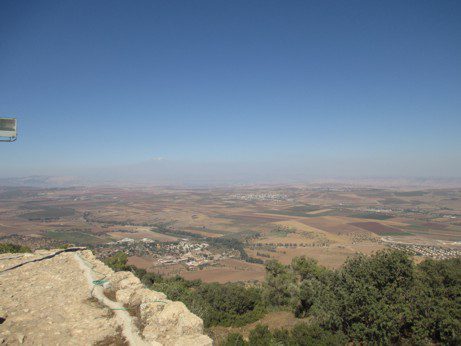 Jesus meets Moses with Elijah on the mount of transfiguration. The same Moses who served the God of Abraham, Isaac, and Jacob.
After six days Jesus took with him Peter, James and John the brother of James, and led them up a high mountain by themselves. There he was transfigured before them. His face shone like the sun, and his clothes became as white as the light. Just then there appeared before them Moses and Elijah, talking with Jesus. Peter said to Jesus, “Lord, it is good for us to be here. If you wish, I will put up three shelters—one for you, one for Moses and one for Elijah.” While he was still speaking, a bright cloud covered them, and a voice from the cloud said, “This is my Son, whom I love; with him I am well pleased. Listen to him!” Matthew 17:1-5
God, the Father of Jesus, is the God of Abraham, Isaac, and Jacob. The God who called Abraham, who formed Israel, who rescued them out of Egypt, who anointed David, who brought them back from exile is the God of the New Testament and the God we worship.
We worship the God of Abraham, Isaac and Jacob. This shouldn’t be a controversial statement … but it is. The same God controversy at Wheaton over the winter made this clear. Many Christians were willing go argue that because we worship the God revealed in Jesus (whoever has seen me has seen the Father Jn 14:9), only those who worship Jesus worship the same God. Therefore neither Muslims nor Jews worship the same God we worship. I have no desire to get into a discussion of Islam – I have no firm position on this. But any argument against the “same God” that leads also to the conclusion that Jews and Christians do not worship the same God strikes me as wrong and borderline heretical. There is a vast difference between seeing in part (certainly as Christians we do believe that the Jewish understanding of God is incomplete) and worshiping a different God. We, like the Jews, worship the God of Abraham, Isaac, Jacob, Moses, David, Elijah, and Isaiah.
Walter Moberly in his book The Theology of the Book of Genesis digs into this as he discusses Genesis 12-50.
From a Jewish perspective, perhaps the central issue in understanding Genesis 12-50 is posed by the normative, indeed definitive, nature of God’s self-revelation to Moses and Israel at Sinai/Horeb, together with the covenant making and gift of torah. If the norm for life with God is here, then how is Israel to understand those whose life with God is in some way of enduring significance – as Abraham and Sarah’s, Isaac and Rebekah’s, and Jacob and his twelve children’s clearly are – and yet who lived without torah, because torah had not yet been given? (p. 121-122)
Turns out that Jewish approaches include arguments that the patriarchs must have known torah. Moberly runs through a few examples, but concludes: “In one way or other, it is clear that the classic Jewish instinct is to handle the problem of the patriarchs’ pre-torah context by assimilating them into a torah context.” (p. 125) From the perspective of Paul, who reads Genesis in the context of the life, death, and resurrection of Jesus, the pre-torah context of Abraham and the other patriarchs highlights the importance of faith over torah observance. Abraham believed God, and it was reckoned to him as righteousness.
The problem that Genesis poses for Jewish thinking is surely closely analogous to the problem posed by the Old Testament as a whole for Christian thinking. For those whose norms of faith and life focus on the knowledge of God in and through Jesus Christ, the Old Testament poses the same issues as does Genesis 12-50 for Mosaic torah: How does one relate continuity and identity to real and major difference? Christians down the ages have made the same kinds of moves in relation to the Old Testament that Jews have made in relation to Genesis. The predominant instinct has been to assimilate – more or less subtly – the unfamiliar to the familiar, the divergent to the normative. (p. 131)
Some have simply dismissed the Old Testament. Marcion, the second century Christian who rejected the Hebrew Scriptures entirely, is the extreme example here, but it is also seen in less extreme forms. Moberly cites both Luther (mild) and Bultmann (more severe) as examples. I recently read an evangelical pastor who argued that the church doesn’t need the Old Testament. We simply need Jesus.
Moberly also points out that a canonical reading of Genesis requires us to reckon with “the fundamental theological issue of revelation – that God is known by Israel (and Jews and Christians, subsequently) because God has revealed himself.” (p. 137) Historical-critical tools, including a religio-historical account of the ancient Near East, can be of use in understanding aspects of the text, but ultimately God’s self-revelation need not fit neatly into that picture. God revealed himself to Abraham in a context that allowed himself to be known, but somewhat differently from the way that he later revealed himself to Moses in the burning bush or on Mount Sinai. Likewise, the coming of Jesus in his life, death, and resurrection involves a deeper and more complete self-revelation of the same God. The God and Father of the Lord Jesus Christ is none other than YHWH, the God of Israel. YHWH the God of Israel is none other than the God who brought Abraham into Canaan from Ur of the Chaldeans.
If we neglect God’s self-revelation to Abraham and Moses, his dealings with Israel from Genesis through the return from exile, and his words through the prophets, we will not fully understand his self-revelation in the Lord Jesus Christ, his life, death, and resurrection.
If you wish to contact me directly you may do so at rjs4mail[at]att.net.
If interested you can subscribe to a full text feed of my posts at Musings on Science and Theology.
Previous Post

May 12, 2016
Mary and Me and Complementarianism (by Ruth Tucker)
Next Post
May 12, 2016 Rio and Zika
Browse Our Archives
Select a Category Acts of the Apostles Adam Advent Anabaptism Angels Anglican Apologetics Atonement Baptism BCP Prayers Bible Biblical Studies Birds Blogging Bloglossary Bonhoeffer Books Calvinism Christianity Church Church History Coffee Colossians Commentary Recs Conversion Creation Creeds Culture Death Ecclesiastes Economics Education Embracing Grace Emergent Emerging Movement Eschatology Essays Ethics Eucharist Evangelicalism Family Fasting Fathers Fellowship of Differents Footsteps Tour Fun and Whimsical Gospel Grace Happiness Heaven Hell Holy Spirit Irenaeus James Jesus Jesus Creed Job Justification Kingdom of God Law Lectures Lent Liberalism Love and Marriage Mabanteneni Manhood Mary Miracles Missio Alliance MissioLife Missional Missional Jesus Movies and Film New Perspective Northern Seminary OneLife Origins Project Orthodox Parables Pastor's Spouse Pastoring and Leading Pastoring and Preaching Patristics Paul Paul-John Tour Pharisees Pietism Political Theology Prayer and Formation Preaching Problems for Faith Psalm 119 Psalms Public Issues Purgatory Religions Resurrection Revelation Romans Rule of JCreed Science and Faith Sermon on the Mount Sports Ten Commandments Theology Third Way Top Ten Lists Translations Uncategorized Universalism University Ministry Way Out Weekly Meanderings Wisdom Women and Ministry Work Worship Writing & Blogging Youth Ministry
Select a Month July 2021 January 2020 December 2019 November 2019 October 2019 September 2019 August 2019 July 2019 June 2019 May 2019 April 2019 March 2019 February 2019 January 2019 December 2018 November 2018 October 2018 September 2018 August 2018 July 2018 June 2018 May 2018 April 2018 March 2018 February 2018 January 2018 December 2017 November 2017 October 2017 September 2017 August 2017 July 2017 June 2017 May 2017 April 2017 March 2017 February 2017 January 2017 December 2016 November 2016 October 2016 September 2016 August 2016 July 2016 June 2016 May 2016 April 2016 March 2016 February 2016 January 2016 December 2015 November 2015 October 2015 September 2015 August 2015 July 2015 June 2015 May 2015 April 2015 March 2015 February 2015 January 2015 December 2014 November 2014 October 2014 September 2014 August 2014 July 2014 June 2014 May 2014 April 2014 March 2014 February 2014 January 2014 December 2013 November 2013 October 2013 September 2013 August 2013 July 2013 June 2013 May 2013 April 2013 March 2013 February 2013 January 2013 December 2012 November 2012 October 2012 September 2012 August 2012 July 2012 June 2012 May 2012 April 2012 March 2012 February 2012 January 2012 December 2011 November 2011 October 2011 September 2011 August 2011 July 2011 June 2011 May 2011 April 2011 March 2011 February 2011 January 2011 December 2010 November 2010 October 2010 September 2010 August 2010 July 2010 June 2010 May 2010 April 2010 March 2010 February 2010 January 2010 December 2009 November 2009 October 2009 September 2009 August 2009 July 2009 June 2009 May 2009 April 2009 March 2009 February 2009 January 2009 December 2008 November 2008 October 2008 September 2008 August 2008 July 2008 June 2008 May 2008 April 2008 March 2008 February 2008 January 2008 December 2007 November 2007 October 2007 September 2007 August 2007 July 2007 June 2007 May 2007 April 2007 March 2007 February 2007 January 2007 December 2006 November 2006 October 2006 September 2006 August 2006 July 2006 June 2006 May 2006 April 2006 March 2006 February 2006 January 2006 December 2005 November 2005 October 2005 September 2005 August 2005 July 2005 June 2005 May 2005 April 2005 0000
Follow Us!
TAKE THE
Religious Wisdom Quiz
Who was the mother of Samuel?
Select your answer to see how you score.
Sarah Rebekah Mary Hannah
Related posts from Jesus Creed


The Gospel of With Us and Through Us

Northern Seminary Announces: Nijay Gupta Joins Faculty

The Gundrys and Me: Ruth Tucker
TRENDING AT PATHEOS Evangelical

The REST of Your Life: A Creative Wrestles...
This week I had a conversation with a good friend from church....

How the author of the world's best hymn...
I've been working with John Newton for a while now. This makes...

Long before this Lectio Divina, Psalm 130 - the song - started...

What About the Trees? Another Living Parable
After I finished writing the last article about falling leaves as a...

Why Classical Education Is a Conversation, Not a...
Come and Read: Joy in Classical Education When I was a little...

Cornell University has received a great deal of negative publicity and intense...
view all Evangelical blogs
Ad-Free & Subscriber Log-In Subscription Support
- About Us
- 2026 Calendar
- Videos
- Podcasts
- Library of World Religions
- Faith In Media Tracker
- Advertise With Us
- Write for Us
- Privacy Policy
- Terms of Service
- Do Not Sell My Data
- Contact Us
- Radiant Digital
- Manage Newsletter Subscriptions
- Unsubscribe From Notifications
- Sitemap
Copyright 2008-2026, Patheos. All rights reserved.
Subscription Support Ad-Free & Subscriber Log-In
Follow Patheos