
BuddhistCatholicContemplativeEvangelicalGeneral ChristianHinduJewishLatter-day SaintMuslimNew VisionsProgressive Christian
Beliefs
- Buddhist
- Catholic
- Contemplative
- Evangelical
- General Christian
- Hindu
- Jewish
- Latter-day Saint
- More Voices
- Muslim
- New Visions
- Pagan
- Progressive Christian
Topics
- Religion News
- Food and Religion
- Sports and Religion
- Religious Art
- Religious Music and Entertainment
- Religious Events
- History and Religion
- Style and Religion
- Politics and Religion
- Women in Religion
- Recreation Outdoors and Religion
- Business Finance and Religion
- Careers Workplace and Religion
- Education and Religion
- Family Parenting and Religion
- Health Fitness and Religion
- Home and Religion
- Relationships and Religion
- Technology and Religion
- Travel and Religion
Columnists
- Buddhist Columnists
- Business Finance and Religion Columnists
- Careers Workplace and Religion Columnists
- Catholic Columnists
- Contemplative Columnists
- Education and Religion Columnists
- Evangelists Columnists
- Family Parenting and Religion Columnists
- General Christian Columnists
- Health Fitness and Religion Columnists
- Hindu Columnists
- History and Religion Columnists
- Home and Religion Columnists
- Jewish Columnists
- More Voices Columnists
- Latter Day Columnists
- Muslim Columnists
- New Visions Columnists
- Nonreligious Columnists
- Pagan Columnists
- Politics and Religion Columnists
- Progressive Columnists
- Recreation Outdoors and Religion Columnists
- Relationships and Religion Columnists
- Religion News Columnists
- Religious Art Columnists
- Religious Events Columnists
- Religious Music and Entertainment Columnists
- Sports and Religion Columnists
- Style and Religion Columnists
- Technology and Religion Columnists
- Travel and Religion Columnists
- Women in Religion Columnists
Resource Library
- 2026 Calendar
- Library of World Religions
- The 100 Most Holy Places on Earth
- Patheos Answers
- Podcasts
- Videos
- Faith Leaders Database
- Anglican Episcopalian
- Bahai
- Baptist
- Buddhism
- Christianity
- Confucianism
- Eastern Orthodoxy
- Hinduism
- Holiness and Pentecostal
- ISKCON
- Islam
- Judaism
- Lutheran
- Methodist
- The Church of Jesus Christ of Latter-day Saints
- New Age
- Paganism
- Presbytarian and Reformed
- Protestantism
- Religion Behind the Scenes
- Roman Catholic
- Scientology
- Shia Islam
- Sikhism
- Sufism
- Sunni Islam
- Taoism
- Zen
- See all religions
Research Tools
 Ad-Free & Subscriber Log-In Subscription Support
Ad-Free & Subscriber Log-In Subscription Support
Follow Patheos 

- Trending:
- Forgiveness
- |
- Marriage
- |
- Consciousness
- |
- Death Penalty
- |
- Election
- |
- Halloween
 Jesus Creed
- Home
- Evangelical
- The Genes Agree – The Answer Is No (RJS)
The Genes Agree – The Answer Is No (RJS)
Last updated on: April 26, 2016 at 6:13 am by RJS
The Genes Agree – The Answer Is No (RJS) 2016-04-26T06:13:36-05:00 RJS
Patheos Explore the world's faith through different perspectives on religion and spirituality! Patheos has the views of the prevalent religions and spiritualities of the world.
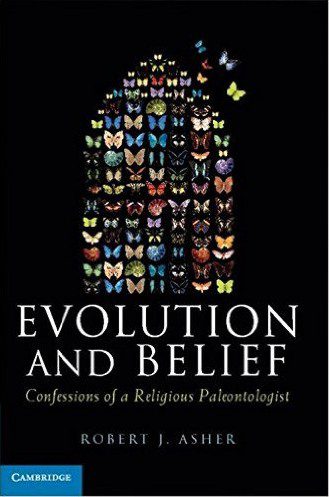 No, evolution isn’t a theory in trouble. There is ample evidence for common descent and evolution by natural selection.
The last posts on Robert Asher’s book Evolution and Belief: Confessions of a Religious Paleontologist considered fossil evidence for evolution. Dr. Asher is a specialist in mammalian evolution as evidenced in the fossil record, Curator of Vertebrates at the Museum of Zoology, Cambridge UK. In previous chapters he ran through the evidence for the evolution of mammals, elephants, and whales. Evidence for transitional forms is abundant. The fossil record contains clear evidence for transitions from the original tetrapods to the separate lines of synapsids leading to mammals and sauropsids leading to dinosaurs, reptiles, and birds (Always in Transition) . Within mammals there is abundant fossil evidence for transitions between elephants and transitions from a land dwelling species to the modern whales (The Fossils Say No!). This is only the tip of the fossil record iceberg … and the fossil record is only one of the lines of evidence for evolution. The DNA evidence is equally abundant and equally convincing. Chapters nine and ten of Asher’s book provide an introduction to the DNA
Common descent implies common ancestors, and this can be traced through DNA.
Having a common ancestor means specifically that different animals alive today – chimp and human, for example – can trace their heritage to a real population of interbreeding animals in the distant past that lived in a specific place at a specific time, and furthermore had a uniform anatomical and genetic make-up. It would be reasonable to conclude that if evolution actually happened, then two animals descended from an immediate common ancestor would show more similarity (anatomical, genetic, paleontological, and geographic) than either would with a more distant relative. (p. 158)
It is important not to be two simplistic in the analysis however.
[D]ifferences may accumulate in one animal or plan lineage more slowly than in another, for example leading to a descendant that is similar to its parent and very different from its sibling. Similarity that has nothing to do with common ancestry may result from adaptations to a similar environment (digging, swimming, foraging at night), or the unpredictability of mutation and fossilization. Changes in sea level and mobile continents enable some animals to disperse together to a certain area whether or not they are closely related. (p. 159)
But the evidence tells us that these events are relatively uncommon. DNA sequences can be used to build up phylogenetic trees illustrating the connections between different species of plants and animals.
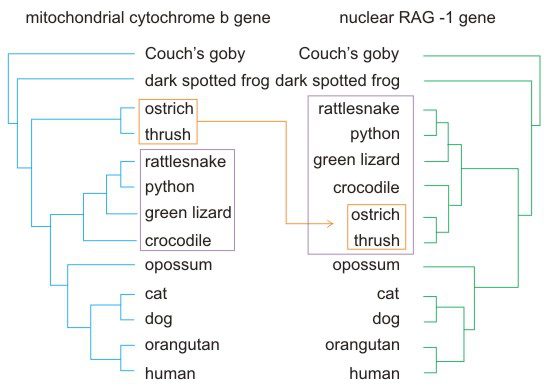 Much of the genetic evidence is readily available to anyone with internet access. Asher provides general instructions as well as a link to the mitochondrial DNA coding for cytochrome b that he used to construct a phylogenetic tree for thirteen vertebrates ranging from a fish (Couch’s goby) to humans. Small data sets (like the cytochrome b gene) can provide a rough tree, while larger genetic data sets may change some of the details. A simple analysis of similarities in cytochrome b usine the criterion of parsimony (the simplest explanation is the best) provides the tree on the left side of this figure. Larger data sets, with the RAG-1 gene as an example, demonstrate the close relationship between the birds (ostrich and thrush) and the crocodile. This is one piece of evidence, corroborated by others, that birds evolved from dinosaurs.
We observed in Chapter 4 how the fossil record is also consistent with the tree depicted {in the figure above} … So now we’ve got anatomy, development, the fossil record, and DNA sequences from the mitochondrial and nuclear genome showing us the same basic pattern. We can establish that this pattern is not due to ecology or physiology, and it is clearly not a chance result from the immense number of possible genealogies among sampled organisms. In the parlance of a prosecuting attorney, the observations are analogous to finding a bloodstain on the victim matching your suspect, in addition to a bogus alibi, fingerprints, eyewitness testimony, and a confession. The ability to predict such correspondence in patterns across very different sources of data doesn’t just happen unless you’ve got a process behind it, and we do: evolution by natural selection. (p. 166)
When investigators make a mistake or speculate outside the strength of the evidence other scientists are quick to jump on it an publish rebuttals, sometimes rubbing it in ruthlessly. (Asher cites an example in an endnote.)
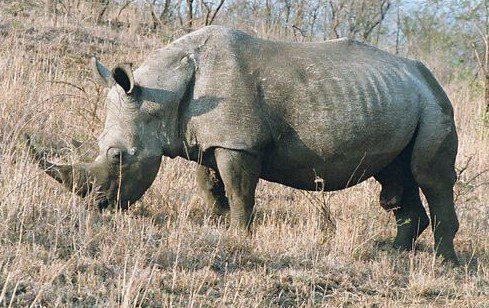 DNA evidence hasn’t only confirmed already suspected trends. Sometimes anatomy alone isn’t an adequate guide. At times the genetic evidence has led to significant rearrangements within broad outlines. Placental mammals provide an example. The distinctions between fish, amphibians, reptiles, and mammals are crystal clear. The distinctions and connections between monotremes, marsupials, and placental mammals are also clear. But it was only after the advent of DNA sequencing that some connections within placental mammals could be determined with any degree of certainty. For example, the bat was thought to be closely related to the colugo and horses (an odd-toed ungulate or perissodactyl) to the elephant – both of which were wrong. Odd-toed ungulates are within a broad group of Laurasiatheria while elephants belong to Afrotheria. (The rhinoceros is also an odd-toed ungulate.) Science is an ongoing process and we are still learning. There will likely be additional tweaks as more evidence is uncovered, both in DNA and in the fossil record.
DNA and new features. Can evolution create information? This has been posed as another challenge to evolutionary theory. In chapter 10 Asher digs into this question. He doesn’t really address the creation of completely new features, but he does provide a fascinating discussion of the myriad ways that differences in phenotype (an organism’s observable characteristics or traits), can be modified through evolutionary means.Although point mutations occur (single amino acid changes) these are not the most important or powerful processes.
The inclusion of viral DNA is one mechanism. If viral DNA is incorporated into germ cells (eggs or sperm) it can be passed on. Not all viruses are detrimental, and the additional genetic material provides room for the development of new capacities without harming already functional systems.
Gene duplication is another mechanism for development of new features and capabilities. Cell division can go awry, often with disastrous consequences (cancer for example), but sometimes innocuous changes occur. Two or more copies of a gene may result. The ability to perceive color is related to the presence of several closely related proteins coded by opsin genes. Slight variations in three different opsin genes cause changes the absorption spectrum of the chromophore in the protein making it sensitive to short, long, or middle wavelengths in the visible spectrum. These changes are exploited for color perception. Some animals (zebra fish for example) have a fourth opsin allowing UV-sensitive vision outside the range of humans.
It has been demonstrated that a gene duplication event of the long-wavelength, X-chromosome opsin gene in the common ancestor of catarrhines, combined with simple point mutations … was the source of our middle-wavelength X-linked opsin gene that enables trichromatic vision in humans, great apes and Afro-Asian monkeys. (p. 190)
Other variations in opsins are found in other animals leading to variations in wavelength discrimination.
How do we know that gene duplication is responsible for two versus three opsins in various species of primates? First, we know because the mechanisms of DNA transcription and replication are good, but their not perfect. Categories of genetic duplication include retroposition, tandem duplication, and polyploidy, and each differs in terms of the amount of genetic material copied. … All these forms of gene duplication are common in the natural world. (p. 190-191)
The DNA sequences and the patterns between species contain clues to the history of these changes.
A third mechanism available is in the presence of gene sequences that control the expression of genes. Small repeat units can modify “downstream activity of other molecules.” Asher provides an example connected to skull shape in dogs and other carnivora. A longer snout is connected with a higher ratio of glutamine to glutamic acid in these microsatellite repeat units. Because these microsatellite regions can have variable length, they provide a “tuning knob” for changes in features.
A final example provided by Asher involves the development of the mammalian ear. There is a control cascade, something of a Rube Goldberg sequence of events, that controls the development of the ear. In one step of the process, differential expression of a couple of genes involved in ear development control the final length of the cochlear coil and the sensitivity of the animal to sound. They “help to control the activity of retinoic acid, which in turn influences the location and extent of coiling in the organ of hearing, the cochlea.” (p, 198) Small changes in gene expression can cause gradual small changes in phenotype – consistent with the fossil record of intermediate forms.
The examples of vision and ear development represent relatively minor changes, but the toolkit that give rise to these can, over geological time scales five rise to far more profound changes as well, in a stepwise relatively slow progression. Macroevolution is nothing more than microevolution when the time available gets large.
If you are interested in more of the details, I’ve only scratched the surface of Asher’s discussion in these chapters. The book goes into much more detail.
The origin of life is a mystery. The toolkit available for genetic modification and evolution by natural selection is becoming clearer. Many unknowns remain, but evolution is not a theory in trouble.
——————————————————————————
If you wish to contact me directly you may do so at rjs4mail[at]att.net.
If interested you can subscribe to a full text feed of my posts at Musings on Science and Theology.
Previous Post

April 26, 2016
Questions about Bible Reading
Next Post
April 27, 2016 Household Liturgies (by Jonathan Storment)
Browse Our Archives
Select a Category Acts of the Apostles Adam Advent Anabaptism Angels Anglican Apologetics Atonement Baptism BCP Prayers Bible Biblical Studies Birds Blogging Bloglossary Bonhoeffer Books Calvinism Christianity Church Church History Coffee Colossians Commentary Recs Conversion Creation Creeds Culture Death Ecclesiastes Economics Education Embracing Grace Emergent Emerging Movement Eschatology Essays Ethics Eucharist Evangelicalism Family Fasting Fathers Fellowship of Differents Footsteps Tour Fun and Whimsical Gospel Grace Happiness Heaven Hell Holy Spirit Irenaeus James Jesus Jesus Creed Job Justification Kingdom of God Law Lectures Lent Liberalism Love and Marriage Mabanteneni Manhood Mary Miracles Missio Alliance MissioLife Missional Missional Jesus Movies and Film New Perspective Northern Seminary OneLife Origins Project Orthodox Parables Pastor's Spouse Pastoring and Leading Pastoring and Preaching Patristics Paul Paul-John Tour Pharisees Pietism Political Theology Prayer and Formation Preaching Problems for Faith Psalm 119 Psalms Public Issues Purgatory Religions Resurrection Revelation Romans Rule of JCreed Science and Faith Sermon on the Mount Sports Ten Commandments Theology Third Way Top Ten Lists Translations Uncategorized Universalism University Ministry Way Out Weekly Meanderings Wisdom Women and Ministry Work Worship Writing & Blogging Youth Ministry
Select a Month July 2021 January 2020 December 2019 November 2019 October 2019 September 2019 August 2019 July 2019 June 2019 May 2019 April 2019 March 2019 February 2019 January 2019 December 2018 November 2018 October 2018 September 2018 August 2018 July 2018 June 2018 May 2018 April 2018 March 2018 February 2018 January 2018 December 2017 November 2017 October 2017 September 2017 August 2017 July 2017 June 2017 May 2017 April 2017 March 2017 February 2017 January 2017 December 2016 November 2016 October 2016 September 2016 August 2016 July 2016 June 2016 May 2016 April 2016 March 2016 February 2016 January 2016 December 2015 November 2015 October 2015 September 2015 August 2015 July 2015 June 2015 May 2015 April 2015 March 2015 February 2015 January 2015 December 2014 November 2014 October 2014 September 2014 August 2014 July 2014 June 2014 May 2014 April 2014 March 2014 February 2014 January 2014 December 2013 November 2013 October 2013 September 2013 August 2013 July 2013 June 2013 May 2013 April 2013 March 2013 February 2013 January 2013 December 2012 November 2012 October 2012 September 2012 August 2012 July 2012 June 2012 May 2012 April 2012 March 2012 February 2012 January 2012 December 2011 November 2011 October 2011 September 2011 August 2011 July 2011 June 2011 May 2011 April 2011 March 2011 February 2011 January 2011 December 2010 November 2010 October 2010 September 2010 August 2010 July 2010 June 2010 May 2010 April 2010 March 2010 February 2010 January 2010 December 2009 November 2009 October 2009 September 2009 August 2009 July 2009 June 2009 May 2009 April 2009 March 2009 February 2009 January 2009 December 2008 November 2008 October 2008 September 2008 August 2008 July 2008 June 2008 May 2008 April 2008 March 2008 February 2008 January 2008 December 2007 November 2007 October 2007 September 2007 August 2007 July 2007 June 2007 May 2007 April 2007 March 2007 February 2007 January 2007 December 2006 November 2006 October 2006 September 2006 August 2006 July 2006 June 2006 May 2006 April 2006 March 2006 February 2006 January 2006 December 2005 November 2005 October 2005 September 2005 August 2005 July 2005 June 2005 May 2005 April 2005 0000
Follow Us!
TAKE THE
Religious Wisdom Quiz
What metaphor does Paul use in Galatians to describe the law's role before Christ came?
Select your answer to see how you score.
A shepherd A judge A father A guardian
Related posts from Jesus Creed


The Gospel of With Us and Through Us

Northern Seminary Announces: Nijay Gupta Joins Faculty

The Gundrys and Me: Ruth Tucker
TRENDING AT PATHEOS Evangelical

The REST of Your Life: A Creative Wrestles...
This week I had a conversation with a good friend from church....

How the author of the world's best hymn...
I've been working with John Newton for a while now. This makes...

Long before this Lectio Divina, Psalm 130 - the song - started...

What About the Trees? Another Living Parable
After I finished writing the last article about falling leaves as a...

Why Classical Education Is a Conversation, Not a...
Come and Read: Joy in Classical Education When I was a little...

Cornell University has received a great deal of negative publicity and intense...
view all Evangelical blogs
Ad-Free & Subscriber Log-In Subscription Support
- About Us
- 2026 Calendar
- Videos
- Podcasts
- Library of World Religions
- Faith In Media Tracker
- Advertise With Us
- Write for Us
- Privacy Policy
- Terms of Service
- Do Not Sell My Data
- Contact Us
- Radiant Digital
- Manage Newsletter Subscriptions
- Unsubscribe From Notifications
- Sitemap
Copyright 2008-2026, Patheos. All rights reserved.
Subscription Support Ad-Free & Subscriber Log-In
Follow Patheos