
BuddhistCatholicContemplativeEvangelicalGeneral ChristianHinduJewishLatter-day SaintMuslimNew VisionsProgressive Christian
Beliefs
- Buddhist
- Catholic
- Contemplative
- Evangelical
- General Christian
- Hindu
- Jewish
- Latter-day Saint
- More Voices
- Muslim
- New Visions
- Pagan
- Progressive Christian
Topics
- Religion News
- Food and Religion
- Sports and Religion
- Religious Art
- Religious Music and Entertainment
- Religious Events
- History and Religion
- Style and Religion
- Politics and Religion
- Women in Religion
- Recreation Outdoors and Religion
- Business Finance and Religion
- Careers Workplace and Religion
- Education and Religion
- Family Parenting and Religion
- Health Fitness and Religion
- Home and Religion
- Relationships and Religion
- Technology and Religion
- Travel and Religion
Columnists
- Buddhist Columnists
- Business Finance and Religion Columnists
- Careers Workplace and Religion Columnists
- Catholic Columnists
- Contemplative Columnists
- Education and Religion Columnists
- Evangelists Columnists
- Family Parenting and Religion Columnists
- General Christian Columnists
- Health Fitness and Religion Columnists
- Hindu Columnists
- History and Religion Columnists
- Home and Religion Columnists
- Jewish Columnists
- More Voices Columnists
- Latter Day Columnists
- Muslim Columnists
- New Visions Columnists
- Nonreligious Columnists
- Pagan Columnists
- Politics and Religion Columnists
- Progressive Columnists
- Recreation Outdoors and Religion Columnists
- Relationships and Religion Columnists
- Religion News Columnists
- Religious Art Columnists
- Religious Events Columnists
- Religious Music and Entertainment Columnists
- Sports and Religion Columnists
- Style and Religion Columnists
- Technology and Religion Columnists
- Travel and Religion Columnists
- Women in Religion Columnists
Resource Library
- 2026 Calendar
- Library of World Religions
- The 100 Most Holy Places on Earth
- Patheos Answers
- Podcasts
- Videos
- Faith Leaders Database
- Anglican Episcopalian
- Bahai
- Baptist
- Buddhism
- Christianity
- Confucianism
- Eastern Orthodoxy
- Hinduism
- Holiness and Pentecostal
- ISKCON
- Islam
- Judaism
- Lutheran
- Methodist
- The Church of Jesus Christ of Latter-day Saints
- New Age
- Paganism
- Presbytarian and Reformed
- Protestantism
- Religion Behind the Scenes
- Roman Catholic
- Scientology
- Shia Islam
- Sikhism
- Sufism
- Sunni Islam
- Taoism
- Zen
- See all religions
Research Tools
 Ad-Free & Subscriber Log-In Subscription Support
Ad-Free & Subscriber Log-In Subscription Support
Follow Patheos 

- Trending:
- Forgiveness
- |
- Marriage
- |
- Consciousness
- |
- Death Penalty
- |
- Election
- |
- Halloween
 Jesus Creed
- Home
- Evangelical
- From Atoms or Adams, We are God’s Creation (RJS)
From Atoms or Adams, We are God’s Creation (RJS)
Last updated on: March 31, 2016 at 6:30 am by RJS
From Atoms or Adams, We are God’s Creation (RJS) 2016-03-31T06:30:31-05:00 RJS
Patheos Explore the world's faith through different perspectives on religion and spirituality! Patheos has the views of the prevalent religions and spiritualities of the world.
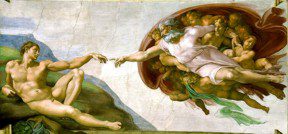 The next chapter of Ron Highfield’s new book The Faithful Creator looks explicitly at divine creation and modern science. Certainly the first image that comes to mind for many is the (supposed) conflict between the conclusions of modern science and biblical faith in God as creator. But is this conflict real and unavoidable, or is it a conflict grounded in misunderstanding? Highfield suggests that “we need clear distinctions between theological, metaphysical, and scientific domains and methods of study.” He believes “much confusion has been created by confusing these domains and methods.” (p. 144)
I don’t want to dig deeply into the philosophy of science and the nature of the knowledge that the practice of science brings to light. Highfield points out that “most working scientists are not philosophically reflective,” with which I agree completely. But most philosophers of science also don’t seem to have a real appreciation for the practice of science. This isn’t surprising. As someone who has been a practicing scientist for 35 years and a professor for 24 years I find that my understanding of both the science and the nature of scientific practice continues to grow. Outsiders can and often do bring important insights – but will still miss aspects of the practice. (I will note that Highfield’s comments on the all too human nature of the scientific community ring true as well. Scientists are subject to all of the usual shortcomings and weakness that come with being fallen human beings. Nor are theologians or any other groups exempt from these.)
Scientific Knowledge. Highfield’s primary point about the nature of scientific knowledge is that it is empirical and relates to the interconnections between empirical observations. This alone sets a limit to scientific knowledge and a limit to the applicability of science to the Christian doctrine of creation.
Modern natural science is not the science of everything or of every dimension of the world. Science cannot adjudicate the question of whether there is more to the world than the empirical. It is blind to all else. If there is something more, other methods of study will be required to investigate it. … The Christian doctrine of creation does not derive from empirical experience of the world or the study of relationships between sets of empirical phenomena within the world. In theology, the God-relation is everything. Innerworldly empirical relations are of no concern. (p. 151)
The theological theses or affirmations of creation are consistent with any scientific perspective because they say nothing in particular about the empirical relationships that science uncovers. (See A Theology of Creation and In The Beginning for more discussion of these.)
- The one God is the absolute origin and sovereign ruler over all that is not God.
- The one God freely established the Creator-creature relation.
- The creation really exists before God and stands before him as good.
- The Creator-creature relation established at the beginning, with its characteristic qualities, endures for all time.
- Human beings possess a unique relationship to the Creator characterized by their image and likeness to God and responsibility to him.
- God acts on and relates to the world from the Father, through the Son and in the Holy Spirit.
A Christian theology of creation is centered on the nature of God and his relationship with his creation. “These theses are consistent with any scientific law or cosmic history or history of life. Indeed, there is absolutely nothing that is discoverable by the empirical methods of natural science that could falsify or verify even one of these affirmations.” (p. 152)
This doesn’t mean that science and theology have no interaction, they should be in dialogue with each other. And there can be conflict at the metaphysical level, but this is conflict of a different sort. Science and theology are independent because “there are no theories or facts that do double duty in both theology and natural science.” (p. 155)
The science of origins, whether the origin of the universe (big bang), the origin of life (a big unknown) or the origin of species (evolution) doesn’t touch on any important aspects of our theology of Creation. The big bang can neither prove or disprove the theology of God as creator. The multiverse (if real) isn’t a threat to our theology of creation. God could have created any number of universes with any number of different characteristics. We have no a priori theological reason for thinking one way or another. Evolution isn’t a problem either. Biological science accounts for reproduction and variation, but that’s it. “At no point does biological science take into account my relationship to God, as a creature or as a person.” But there is an even bigger point:
The doctrine of creation does not merely affirm that the first creatures, whether they were atoms or Adams, were created by God. It affirms that all things throughout all time and space, including you and me, are just as much God’s creation as the first creatures were. Evolutionary biology accounts for changes over time the same way it accounts for our births, that is, through empirical data and empirically based scientific law. I reject the idea that my identity, my relationship to God or my purpose in life can be reduced to biological categories. And I reject the idea that an evolutionary account of the history of life can prove or disprove creation. God’s relationship to his creatures is not an empirical phenomenon and is not subject to investigation by empirical science. It transcends all physical laws; for all physical laws are aspects of the physical world and as such are created. (p. 159)
God’s as Creator isn’t limited to the origin of anything, whether the universe, life, species, or human beings. God is Creator from beginning to end and at all times between.
Highfield also objects to the notion that either the evolution or the big bang should be viewed as God’s means of creation. This limits God to physical processes, but God as creator of all is also the creator of those laws and processes. Thinking about Highfield’s argument, I would say that God doesn’t use the big bang to create, the big bang is his creation. He doesn’t use evolution to create, evolution is his creation. “The eternal God creates all laws and processes and the entire web of relations internal to creation.” (p. 159)
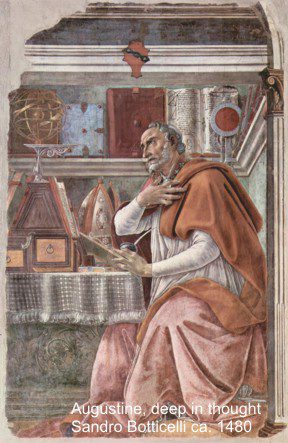 Augustine. Highfield has argued that the theology of creation should be limited to God’s relationship to creation and creation’s relationship to God. This is independent of science, whether ancient, modern, or future. This approach is largely the approach taken by Augustine. Unfounded speculations concerning the cosmos had played a role in turning him from Manichaeism and he didn’t want Christians to fall into this trap.
Augustine applies this lesson to Christians: “When I hear this or that brother Christian, who is ignorant of these matters and thinks one thing is the case when another is correct, with patience I contemplate the man expressing his opinion.” As long as the man does not say something “unworthy” of God, Augustine is willing to let it go. “But it becomes an obstacle if he thinks his view of nature belongs to the very form of orthodox doctrine, and dares obstinately to affirm something he doesn’t understand.” Clearly Augustine did not want Christianity brought into disrepute because of the doubtful interpretations on matters irrelevant to faith. (p. 169)
The quotes are from The Confessions (v.9). Augustine expresses the same caution in his commentaries on Genesis including The Literal Meaning of Genesis. In many cases the meaning and intent isn’t certain and we should be careful not to bring disrepute to the gospel message, that is “the resurrection of the dead, the hope of eternal life, and the kingdom of heaven,” over issues that have no lasting significance. The Galileo episode provides an example here. If Cardinal Bellarmine had taken Augustine’s advice and avoided pronouncements on the heretical nature of a sun-centered cosmology, the mission of the church would have been better served. We do well to take Augustine’s advice today as well. A focus on God’s relationship to creation and creation’s relationship to God helps to avoid unnecessary trouble.
There is more in this chapter, including and interesting discussion of Intelligent Design and its relationship to a theology of Creation, but this will wait for the next post.
Is a Christian theology of creation concerned with material processes?
What is the relationship between creation and science?
If you wish to contact me directly you may do so at rjs4mail[at]att.net.
If interested you can subscribe to a full text feed of my posts at Musings on Science and Theology.
Previous Post

March 30, 2016
You are what you love (Jonathan Storment)
Next Post
April 1, 2016 Us vs. Us: Andrew Marin's Newest Study on LGBT
Browse Our Archives
Select a Category Acts of the Apostles Adam Advent Anabaptism Angels Anglican Apologetics Atonement Baptism BCP Prayers Bible Biblical Studies Birds Blogging Bloglossary Bonhoeffer Books Calvinism Christianity Church Church History Coffee Colossians Commentary Recs Conversion Creation Creeds Culture Death Ecclesiastes Economics Education Embracing Grace Emergent Emerging Movement Eschatology Essays Ethics Eucharist Evangelicalism Family Fasting Fathers Fellowship of Differents Footsteps Tour Fun and Whimsical Gospel Grace Happiness Heaven Hell Holy Spirit Irenaeus James Jesus Jesus Creed Job Justification Kingdom of God Law Lectures Lent Liberalism Love and Marriage Mabanteneni Manhood Mary Miracles Missio Alliance MissioLife Missional Missional Jesus Movies and Film New Perspective Northern Seminary OneLife Origins Project Orthodox Parables Pastor's Spouse Pastoring and Leading Pastoring and Preaching Patristics Paul Paul-John Tour Pharisees Pietism Political Theology Prayer and Formation Preaching Problems for Faith Psalm 119 Psalms Public Issues Purgatory Religions Resurrection Revelation Romans Rule of JCreed Science and Faith Sermon on the Mount Sports Ten Commandments Theology Third Way Top Ten Lists Translations Uncategorized Universalism University Ministry Way Out Weekly Meanderings Wisdom Women and Ministry Work Worship Writing & Blogging Youth Ministry
Select a Month July 2021 January 2020 December 2019 November 2019 October 2019 September 2019 August 2019 July 2019 June 2019 May 2019 April 2019 March 2019 February 2019 January 2019 December 2018 November 2018 October 2018 September 2018 August 2018 July 2018 June 2018 May 2018 April 2018 March 2018 February 2018 January 2018 December 2017 November 2017 October 2017 September 2017 August 2017 July 2017 June 2017 May 2017 April 2017 March 2017 February 2017 January 2017 December 2016 November 2016 October 2016 September 2016 August 2016 July 2016 June 2016 May 2016 April 2016 March 2016 February 2016 January 2016 December 2015 November 2015 October 2015 September 2015 August 2015 July 2015 June 2015 May 2015 April 2015 March 2015 February 2015 January 2015 December 2014 November 2014 October 2014 September 2014 August 2014 July 2014 June 2014 May 2014 April 2014 March 2014 February 2014 January 2014 December 2013 November 2013 October 2013 September 2013 August 2013 July 2013 June 2013 May 2013 April 2013 March 2013 February 2013 January 2013 December 2012 November 2012 October 2012 September 2012 August 2012 July 2012 June 2012 May 2012 April 2012 March 2012 February 2012 January 2012 December 2011 November 2011 October 2011 September 2011 August 2011 July 2011 June 2011 May 2011 April 2011 March 2011 February 2011 January 2011 December 2010 November 2010 October 2010 September 2010 August 2010 July 2010 June 2010 May 2010 April 2010 March 2010 February 2010 January 2010 December 2009 November 2009 October 2009 September 2009 August 2009 July 2009 June 2009 May 2009 April 2009 March 2009 February 2009 January 2009 December 2008 November 2008 October 2008 September 2008 August 2008 July 2008 June 2008 May 2008 April 2008 March 2008 February 2008 January 2008 December 2007 November 2007 October 2007 September 2007 August 2007 July 2007 June 2007 May 2007 April 2007 March 2007 February 2007 January 2007 December 2006 November 2006 October 2006 September 2006 August 2006 July 2006 June 2006 May 2006 April 2006 March 2006 February 2006 January 2006 December 2005 November 2005 October 2005 September 2005 August 2005 July 2005 June 2005 May 2005 April 2005 0000
Follow Us!
TAKE THE
Religious Wisdom Quiz
Where did God tell Moses to remove his shoes because it was holy ground?
Select your answer to see how you score.
Red Sea At the burning bush Egyptian palace Mount Sinai
Related posts from Jesus Creed


The Gospel of With Us and Through Us

Northern Seminary Announces: Nijay Gupta Joins Faculty

The Gundrys and Me: Ruth Tucker
TRENDING AT PATHEOS Evangelical

How the author of the world's best hymn...
I've been working with John Newton for a while now. This makes...

Long before this Lectio Divina, Psalm 130 - the song - started...

What About the Trees? Another Living Parable
After I finished writing the last article about falling leaves as a...

Why Classical Education Is a Conversation, Not a...
Come and Read: Joy in Classical Education When I was a little...

Falling Leaves: A Living Parable on Letting Go
I’ve spent the vast majority of my life in the southeast corner...

Cornell University has received a great deal of negative publicity and intense...
view all Evangelical blogs
Ad-Free & Subscriber Log-In Subscription Support
- About Us
- 2026 Calendar
- Videos
- Podcasts
- Library of World Religions
- Faith In Media Tracker
- Advertise With Us
- Write for Us
- Privacy Policy
- Terms of Service
- Do Not Sell My Data
- Contact Us
- Radiant Digital
- Manage Newsletter Subscriptions
- Unsubscribe From Notifications
- Sitemap
Copyright 2008-2026, Patheos. All rights reserved.
Subscription Support Ad-Free & Subscriber Log-In
Follow Patheos