
BuddhistCatholicContemplativeEvangelicalGeneral ChristianHinduJewishLatter-day SaintMuslimNew VisionsProgressive Christian
Beliefs
- Buddhist
- Catholic
- Contemplative
- Evangelical
- General Christian
- Hindu
- Jewish
- Latter-day Saint
- More Voices
- Muslim
- New Visions
- Pagan
- Progressive Christian
Topics
- Religion News
- Food and Religion
- Sports and Religion
- Religious Art
- Religious Music and Entertainment
- Religious Events
- History and Religion
- Style and Religion
- Politics and Religion
- Women in Religion
- Recreation Outdoors and Religion
- Business Finance and Religion
- Careers Workplace and Religion
- Education and Religion
- Family Parenting and Religion
- Health Fitness and Religion
- Home and Religion
- Relationships and Religion
- Technology and Religion
- Travel and Religion
Columnists
- Buddhist Columnists
- Business Finance and Religion Columnists
- Careers Workplace and Religion Columnists
- Catholic Columnists
- Contemplative Columnists
- Education and Religion Columnists
- Evangelists Columnists
- Family Parenting and Religion Columnists
- General Christian Columnists
- Health Fitness and Religion Columnists
- Hindu Columnists
- History and Religion Columnists
- Home and Religion Columnists
- Jewish Columnists
- More Voices Columnists
- Latter Day Columnists
- Muslim Columnists
- New Visions Columnists
- Nonreligious Columnists
- Pagan Columnists
- Politics and Religion Columnists
- Progressive Columnists
- Recreation Outdoors and Religion Columnists
- Relationships and Religion Columnists
- Religion News Columnists
- Religious Art Columnists
- Religious Events Columnists
- Religious Music and Entertainment Columnists
- Sports and Religion Columnists
- Style and Religion Columnists
- Technology and Religion Columnists
- Travel and Religion Columnists
- Women in Religion Columnists
Resource Library
- 2026 Calendar
- Library of World Religions
- The 100 Most Holy Places on Earth
- Patheos Answers
- Podcasts
- Videos
- Faith Leaders Database
- Anglican Episcopalian
- Bahai
- Baptist
- Buddhism
- Christianity
- Confucianism
- Eastern Orthodoxy
- Hinduism
- Holiness and Pentecostal
- ISKCON
- Islam
- Judaism
- Lutheran
- Methodist
- The Church of Jesus Christ of Latter-day Saints
- New Age
- Paganism
- Presbytarian and Reformed
- Protestantism
- Religion Behind the Scenes
- Roman Catholic
- Scientology
- Shia Islam
- Sikhism
- Sufism
- Sunni Islam
- Taoism
- Zen
- See all religions
Research Tools
 Ad-Free & Subscriber Log-In Subscription Support
Ad-Free & Subscriber Log-In Subscription Support
Follow Patheos 

- Trending:
- Forgiveness
- |
- Marriage
- |
- Consciousness
- |
- Death Penalty
- |
- Election
- |
- Halloween
 Jesus Creed
- Home
- Evangelical
- Always in Transition (RJS)
Always in Transition (RJS)
Last updated on: February 23, 2016 at 6:40 am by RJS
Always in Transition (RJS) 2016-02-23T06:40:15-06:00 RJS
Patheos Explore the world's faith through different perspectives on religion and spirituality! Patheos has the views of the prevalent religions and spiritualities of the world.
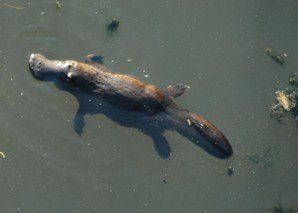 One of the most common complaints about evolutionary biology is the absence of transitional fossils – the so-called missing links. This generally represents a significant misunderstanding of the nature of evolutionary change and a misunderstanding of the available evidence. We classify animals based on the current range of differences observed. Mammals are not reptiles, and there is no half mammal half reptile species alive today. There can’t be, because if such a creature existed, it would help define the forms and classifications we use. For example, mammals are not defined by live birth of young because the platypus, with many other common mammalian features, is an egg laying animal. Like other mammals, the platypus and other monotremes are warm-blooded, hairy, milk producers, with a single bone dentary bone in their lower jaw, and three middle-ear bones. The vast array of features and traits observed in the diversity of lifeforms today present a fascinating puzzle for systematic biology. It is possible to classify and organize, but it is not always easy to define kinds. It appears that life is now, and has always been, in transition.
Despite the claims of some opponents of evolution, the fossil record provides many clear examples of transitional forms. In chapters 5 and 6 of his book Evolution and Belief, Robert Asher runs through some details of this evidence, first for mammals in general and then for the family including elephants in particular (mammalian paleontology is Dr. Asher’s specialty). Although we tend to define mammals as warm-blooded animals that nurse their young, a more traditional scientific definition involves the structure of the jaw and ear. Soft tissue features such as mammary glands and fur are only indirectly preserved in the fossil record. Bones, on the other hand, are plentiful.
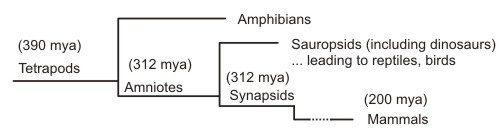
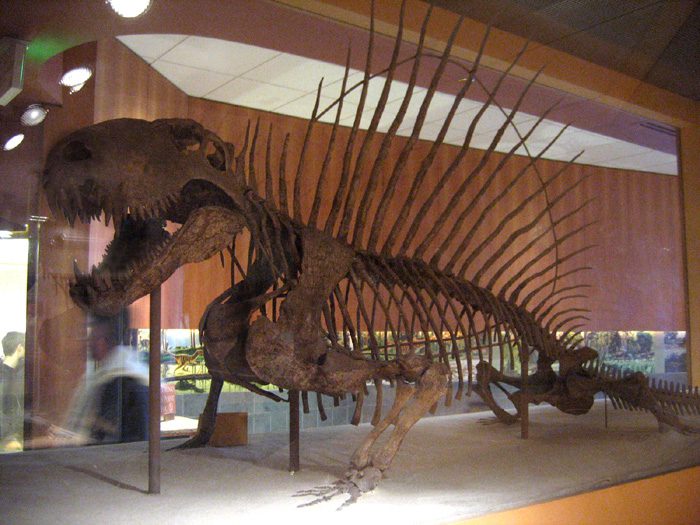 The branch of tetrapods through which mammals developed separated from branch leading to dinosaurs, reptiles and bird something like 312 million years ago, very quickly after amniotes capable of laying eggs on land appeared on the scene. Mammals are synapsids – defined by a specific skull feature. Dinosaurs, reptiles and birds are sauropsids. The Dimetrodon (295-272 million years ago (mya) – skeleton to the right) is a synapsid, not a dinosaur or a mammal, but a branch of the group that led from the earliest amniotes to modern mammals.
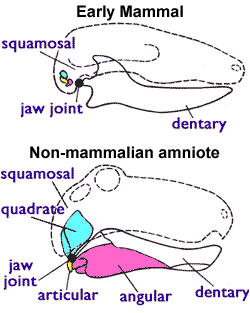 Mammals are distinguished from other synapsids by the development of a dentary–squamosal jaw joint. Non-mammalian amniotes, both synapsids and sauropsids, possess four jaw bones and a complex joint (image from Wikipedia). Mammals posses a simpler joint and one dentary jaw bone. The other three bones form part of the ear. Fossil skulls provide a clear record of the gradual development of the mammalian jaw and ear structures. Asher runs through this evidence in chapter 5. The fossil record illustrates a gradual adaptation of existing structures from one purpose (eating) to another (hearing) over something like 100 million years. The first clear “mammal” appears in the fossil record some 200 mya.
Embryology provides a confirming line of evidence. The four jaw bones of reptiles form from the same location in the early embryo as the ear and dentary bone of mammals, with additional similarities in the nerve connections to the active muscles. One key aspect of the modifications from jaw to ear involves a difference in timing gene expression in embryological development. This isn’t the creation of something from nothing, but a re-purposing of already existing components, combined with some reshaping.
Broadly speaking, Darwin’s theory leads to the understanding that variations during growth, including subtle changes in the timing of development from one generation to the next, forms the basis upon which natural selection can operate. Note how greatly this differs from the false characterization that evolution must “create information” from scratch. A major anatomical novelty, such as the incorporation of small bones into the hearing mechanism of mammals, does indeed seem to present an unbridgeable gap when we ignore development and fossils an compare the hearing mechanisms of modern, adult reptiles and mammals. However, both groups show sufficient anatomical variation during their development so as to make the differences between them derivable from differences in the growth and timing of certain parts of the skeleton. Combined with data from the fossil record, we can connect the processes of development evident to us in the lifetime of any living mammal or reptile with the adult appearance of real animals that existed in the past. (p. 106)
The development of an embryo doesn’t retrace an evolutionary path – but differentiation results from subtle differences in the way in which existing genes are expressed as the embryo develops and this can make it appear as though the past is retraced. In fact … “you yourself had a jaw articulation like that of a crocodile … at an early stage of your development.” (p. 106) The timing of ossification (turning cartilage to bone) makes a big difference.
[O]ne could say that the decrease in size in synapsid postdentary bones was, at least initially, a side effect of the selection for increased power during jaw closure via enlargement of the dentary bone. Only later during synapsid evolution did acoustic sensitivity comprise a major selective force driving the evolution of what would become our very distinctive mammalian ear bones. (p. 107)
There is a great deal more of interest in this chapter (including a discussion of the appearance of evidence for lactation), but I would like to wrap up this post by turning to Asher’s discussion of elephants in chapter 6.
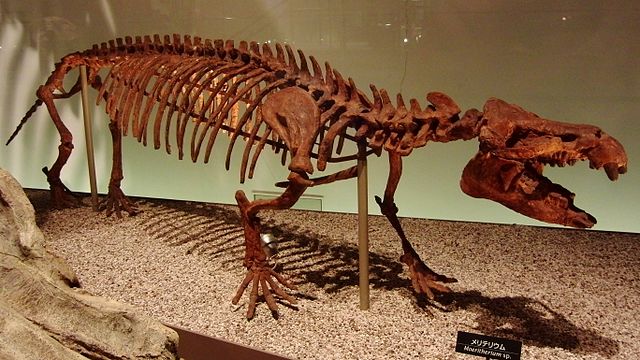 The History of Elephants. The earliest distinct ancestor of the modern elephant is found in a fossil species Phosphatherium existing about 55 mya. This animal possessed an anteriorly (near the front) situated eye orbit similar to the modern elephant. How do we know that this is ancestral to elephants (i.e. Order Proboscidea)?
In the case of the Proboscidea, it is not only because we see certain key anatomical features shared by modern elephants and Phosphatherium (Figure 6.1), but also due to the fact that we have a long string of fossils that show aspects of their bones and teeth intermediate between those of ancient and modern proboscideans. These intermediates document with some precision how features that we know today in elephants have appeared mosaically, or piecemeal, in many extinct animals over the past 60 million years, including fossils of Phosphatherium (Figure 6.2). (p. 113-114)
Other species are found between Phosphatherium and the recognizable elephant-like species. The image above is of a Moeritherium dating 37-35 mya (image from Wikipedia). I haven’t reproduced the figures Asher refers to in the quote, but like the figures of mammalian jaw development in chapter 5, these help to illustrate the evidence for the evolutionary progression to the modern elephant. The figure below outlines the more recent progression, along with some pictures of mastodon, stegodon, and mammoth fossils. (Except the mastodon, all images adapted from available images on Wikipedia.)
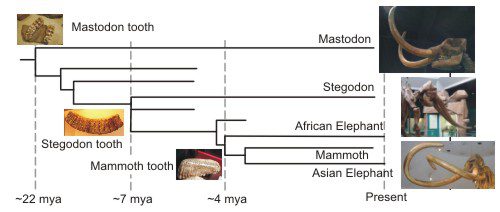
The teeth are particularly interesting. Although the mastodon survived until something like 11000 years ago, its lineage traces back 20 million years. It changed relatively little over this time. Other Proboscidea exhibit more diversity. One key difference between the Mastodon and the stegodon, elephants and mammoth is seen in the teeth. The teeth of stegodons and mammoths, like modern elephants, are composed of plate-like lamellae. The mastodon teeth are quite different with sharp points on the molars.
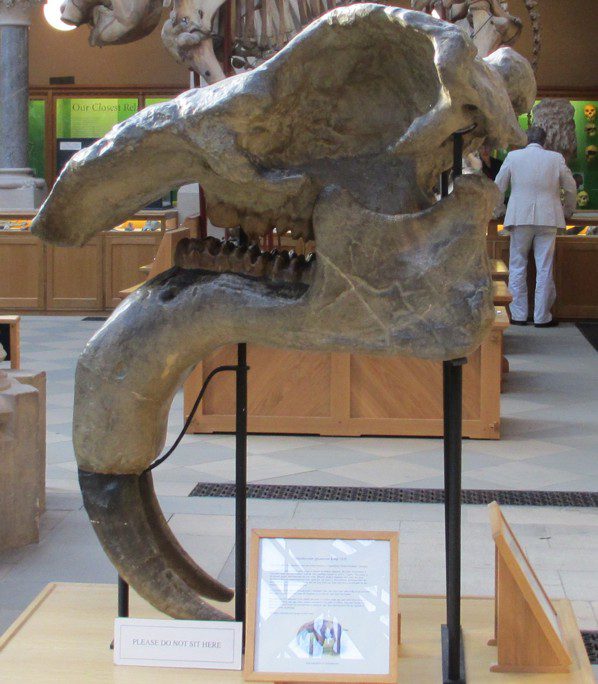 Elephant like animals are amazingly diverse. The deinotherium, skull shown to the right, had lower tusks, and was larger than modern elephants.The teeth are mastodon like. Although it appears in the fossil record about the same time as the mastodon, it most likely derives from a branch that separated much earlier (>35 mya).
Asher points out that the fossil record of Proboscidea and their precursors supports two key predictions of evolutionary biology: “the features we observe in modern elephants occur in varying combinations in many kinds of extinct mammals” and “fossils that most closely resemble modern forms are, by and large, younger.” (p. 118) The progression isn’t perfect (he uses deinotherium as an example). And similar features can arise along different pathways (numidotherium is an example here). Another complication arises from the fact that “it is only once a new species becomes sufficiently widespread and numerous that it is likely to appear in the fossil record, and such conditions may occur much later than the actual speciation event.” (p. 120) Thus small deviations are not troubling. It is also always possible that a new find of a rare fossil will push the timing of some of the branches on this tree back in time somewhat. But the overall picture is clear, and transitional fossils are abundant. Elephant-like fossils are not rare at all.
That these transitions took millions of years, following a wandering path to the modern reptiles, mammals and elephants that surround us is, by far, the most consistent explanation. And this flowering of forms, like all of creation, declares the glory of God. It leaves me in awe of the marvels of creation.
Does the abundance of evidence for the evolutionary history of mammals surprise you?
Does it change your understanding of evolutionary biology?
Is it a challenge to faith?
If you wish to contact me directly you may do so at rjs4mail[at]att.net.
If interested you can subscribe to a full text feed of my posts at Musings on Science and Theology.
Previous Post

February 23, 2016
Amazing Dis-Grace (by Jason Micheli)
Next Post
February 23, 2016 Trump, Pope Francis, Roger Olson: Is Trump a Christian?
Browse Our Archives
Select a Category Acts of the Apostles Adam Advent Anabaptism Angels Anglican Apologetics Atonement Baptism BCP Prayers Bible Biblical Studies Birds Blogging Bloglossary Bonhoeffer Books Calvinism Christianity Church Church History Coffee Colossians Commentary Recs Conversion Creation Creeds Culture Death Ecclesiastes Economics Education Embracing Grace Emergent Emerging Movement Eschatology Essays Ethics Eucharist Evangelicalism Family Fasting Fathers Fellowship of Differents Footsteps Tour Fun and Whimsical Gospel Grace Happiness Heaven Hell Holy Spirit Irenaeus James Jesus Jesus Creed Job Justification Kingdom of God Law Lectures Lent Liberalism Love and Marriage Mabanteneni Manhood Mary Miracles Missio Alliance MissioLife Missional Missional Jesus Movies and Film New Perspective Northern Seminary OneLife Origins Project Orthodox Parables Pastor's Spouse Pastoring and Leading Pastoring and Preaching Patristics Paul Paul-John Tour Pharisees Pietism Political Theology Prayer and Formation Preaching Problems for Faith Psalm 119 Psalms Public Issues Purgatory Religions Resurrection Revelation Romans Rule of JCreed Science and Faith Sermon on the Mount Sports Ten Commandments Theology Third Way Top Ten Lists Translations Uncategorized Universalism University Ministry Way Out Weekly Meanderings Wisdom Women and Ministry Work Worship Writing & Blogging Youth Ministry
Select a Month July 2021 January 2020 December 2019 November 2019 October 2019 September 2019 August 2019 July 2019 June 2019 May 2019 April 2019 March 2019 February 2019 January 2019 December 2018 November 2018 October 2018 September 2018 August 2018 July 2018 June 2018 May 2018 April 2018 March 2018 February 2018 January 2018 December 2017 November 2017 October 2017 September 2017 August 2017 July 2017 June 2017 May 2017 April 2017 March 2017 February 2017 January 2017 December 2016 November 2016 October 2016 September 2016 August 2016 July 2016 June 2016 May 2016 April 2016 March 2016 February 2016 January 2016 December 2015 November 2015 October 2015 September 2015 August 2015 July 2015 June 2015 May 2015 April 2015 March 2015 February 2015 January 2015 December 2014 November 2014 October 2014 September 2014 August 2014 July 2014 June 2014 May 2014 April 2014 March 2014 February 2014 January 2014 December 2013 November 2013 October 2013 September 2013 August 2013 July 2013 June 2013 May 2013 April 2013 March 2013 February 2013 January 2013 December 2012 November 2012 October 2012 September 2012 August 2012 July 2012 June 2012 May 2012 April 2012 March 2012 February 2012 January 2012 December 2011 November 2011 October 2011 September 2011 August 2011 July 2011 June 2011 May 2011 April 2011 March 2011 February 2011 January 2011 December 2010 November 2010 October 2010 September 2010 August 2010 July 2010 June 2010 May 2010 April 2010 March 2010 February 2010 January 2010 December 2009 November 2009 October 2009 September 2009 August 2009 July 2009 June 2009 May 2009 April 2009 March 2009 February 2009 January 2009 December 2008 November 2008 October 2008 September 2008 August 2008 July 2008 June 2008 May 2008 April 2008 March 2008 February 2008 January 2008 December 2007 November 2007 October 2007 September 2007 August 2007 July 2007 June 2007 May 2007 April 2007 March 2007 February 2007 January 2007 December 2006 November 2006 October 2006 September 2006 August 2006 July 2006 June 2006 May 2006 April 2006 March 2006 February 2006 January 2006 December 2005 November 2005 October 2005 September 2005 August 2005 July 2005 June 2005 May 2005 April 2005 0000
Follow Us!
TAKE THE
Religious Wisdom Quiz
Who said, "I do not know how to speak; I am too young"?
Select your answer to see how you score.
Samuel Moses Jeremiah Isaiah
Related posts from Jesus Creed


The Gospel of With Us and Through Us

Northern Seminary Announces: Nijay Gupta Joins Faculty

The Gundrys and Me: Ruth Tucker
TRENDING AT PATHEOS Evangelical

The REST of Your Life: A Creative Wrestles...
This week I had a conversation with a good friend from church....

How the author of the world's best hymn...
I've been working with John Newton for a while now. This makes...

Long before this Lectio Divina, Psalm 130 - the song - started...

What About the Trees? Another Living Parable
After I finished writing the last article about falling leaves as a...

Why Classical Education Is a Conversation, Not a...
Come and Read: Joy in Classical Education When I was a little...

Cornell University has received a great deal of negative publicity and intense...
view all Evangelical blogs
Ad-Free & Subscriber Log-In Subscription Support
- About Us
- 2026 Calendar
- Videos
- Podcasts
- Library of World Religions
- Faith In Media Tracker
- Advertise With Us
- Write for Us
- Privacy Policy
- Terms of Service
- Do Not Sell My Data
- Contact Us
- Radiant Digital
- Manage Newsletter Subscriptions
- Unsubscribe From Notifications
- Sitemap
Copyright 2008-2026, Patheos. All rights reserved.
Subscription Support Ad-Free & Subscriber Log-In
Follow Patheos