
BuddhistCatholicContemplativeEvangelicalGeneral ChristianHinduJewishLatter-day SaintMuslimNew VisionsProgressive Christian
Beliefs
- Buddhist
- Catholic
- Contemplative
- Evangelical
- General Christian
- Hindu
- Jewish
- Latter-day Saint
- More Voices
- Muslim
- New Visions
- Pagan
- Progressive Christian
Topics
- Religion News
- Food and Religion
- Sports and Religion
- Religious Art
- Religious Music and Entertainment
- Religious Events
- History and Religion
- Style and Religion
- Politics and Religion
- Women in Religion
- Recreation Outdoors and Religion
- Business Finance and Religion
- Careers Workplace and Religion
- Education and Religion
- Family Parenting and Religion
- Health Fitness and Religion
- Home and Religion
- Relationships and Religion
- Technology and Religion
- Travel and Religion
Columnists
- Buddhist Columnists
- Business Finance and Religion Columnists
- Careers Workplace and Religion Columnists
- Catholic Columnists
- Contemplative Columnists
- Education and Religion Columnists
- Evangelists Columnists
- Family Parenting and Religion Columnists
- General Christian Columnists
- Health Fitness and Religion Columnists
- Hindu Columnists
- History and Religion Columnists
- Home and Religion Columnists
- Jewish Columnists
- More Voices Columnists
- Latter Day Columnists
- Muslim Columnists
- New Visions Columnists
- Nonreligious Columnists
- Pagan Columnists
- Politics and Religion Columnists
- Progressive Columnists
- Recreation Outdoors and Religion Columnists
- Relationships and Religion Columnists
- Religion News Columnists
- Religious Art Columnists
- Religious Events Columnists
- Religious Music and Entertainment Columnists
- Sports and Religion Columnists
- Style and Religion Columnists
- Technology and Religion Columnists
- Travel and Religion Columnists
- Women in Religion Columnists
Resource Library
- 2026 Calendar
- Library of World Religions
- The 100 Most Holy Places on Earth
- Patheos Answers
- Podcasts
- Videos
- Faith Leaders Database
- Anglican Episcopalian
- Bahai
- Baptist
- Buddhism
- Christianity
- Confucianism
- Eastern Orthodoxy
- Hinduism
- Holiness and Pentecostal
- ISKCON
- Islam
- Judaism
- Lutheran
- Methodist
- The Church of Jesus Christ of Latter-day Saints
- New Age
- Paganism
- Presbytarian and Reformed
- Protestantism
- Religion Behind the Scenes
- Roman Catholic
- Scientology
- Shia Islam
- Sikhism
- Sufism
- Sunni Islam
- Taoism
- Zen
- See all religions
Research Tools
 Ad-Free & Subscriber Log-In Subscription Support
Ad-Free & Subscriber Log-In Subscription Support
Follow Patheos 

- Trending:
- Forgiveness
- |
- Marriage
- |
- Consciousness
- |
- Death Penalty
- |
- Election
- |
- Halloween
 Jesus Creed
- Home
- Evangelical
- Fleming Rutledge and the Atonement (by Jason Micheli)
Fleming Rutledge and the Atonement (by Jason Micheli)
Last updated on: February 12, 2016 at 12:12 am by Scot McKnight
Fleming Rutledge and the Atonement (by Jason Micheli) 2016-02-11T07:43:39-06:00 Scot McKnight
Patheos Explore the world's faith through different perspectives on religion and spirituality! Patheos has the views of the prevalent religions and spiritualities of the world.
 I am beyond delighted that Jason, who has spent the year in cancer treatments and healing, is back on the Jesus Creed blog. I consider Jason a friend and a gifted Methodist pastor.
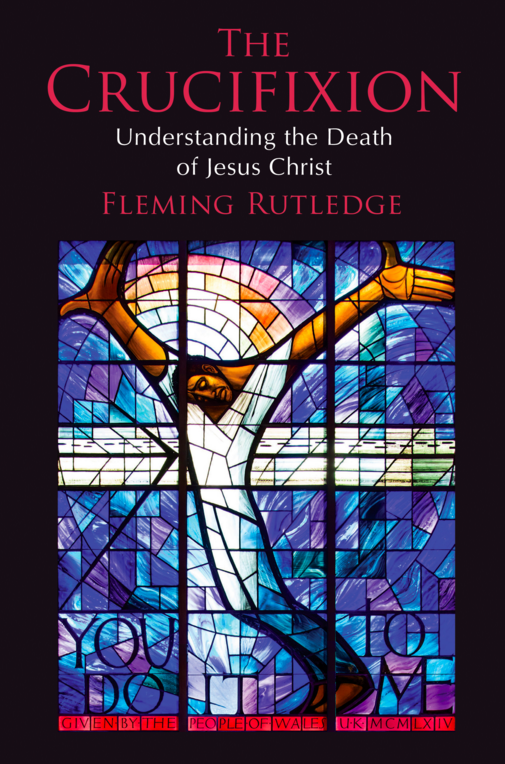
Inside the 16th St Baptist Church in Birmingham, Alabama hangs a stained glass window featuring an arresting depiction of a brown-skinned Christ crucified upon the cross. I say arresting because the image leads the eye in two seemingly dissonant directions. In one direction, Christ’s body appears almost in motion as if he were not truly bound by his captors’ nails. In the other, his anguished visage recalls the Eastern icon called the Utmost Humiliation.
The window was commissioned by the people of Wales in response to the KKK bombing of the church in 1963, which murdered 4 little black girls. The artist, John Petts, expressed his intent that one arm of the crucified Christ appear turned against the demonic powers of the world while the other arm extends out, ready to embrace all of creation.
Accompanying the image is an inscription from Jesus’ parable of the Last Judgment, which I’d argue has grown rote and impotent by its almost exclusive use to admonish Christians to care for the needybut here gets deployed with convicting power: ‘Whenever you’ve done it to one of the least of these, You Did It to Me.’
Like I said, arresting.
More than that, Petts’ art offers a thick, visual summary of the argument Fleming Rutledge mounts in her latest book, The Crucifixion: Understanding the Death of Jesus Christ, for the Wales Window brings to the fore her emphasis on real, flesh and blood history as the arena in which God in Christ acted upon the cross and in which God through the word of the cross acts still today. Where so much debate today on the atonement veers between the individualistic and the esoteric, Rutledge relentlessly fixes her study of the cross within the challenges and questions raised by a suffering, sinful world. In addition to lived history, the Wales Window highlights several other distinct themes that resonant through The Crucifixion:
Sin not as vices requiring sentimental, pious conversion but as Sin, Powers and Principalities that systemically enslave humanity, requiring liberation. The former is, really, a work of human piety while the latter is an invasion only God can work.
The need for God alone to work justice and to remake the world God created by rectifying the world that humanity, in bondage to Sin, has created.
The sufficiency of Christ’s once-for-all sacrifice upon the cross.
The irreligious, counter-cultural imperative of the New Testament that Christ’s death was offered not only in solidarity with the world’s forsaken and oppressed but ‘for’ the forsakers and oppressors as well.
All of these themes are implicit in the Wales Window and are explicit in Fleming Rutledge’s treatment of the cross; in fact, I’d wager that if John Petts had had the opportunity to read The Crucifixion he might have felt led to create another window for whatever church those KKK bombers attended, depicting in some way that’s deeply offensive to us that Christ died just as much for them, the ungodly.
Many months ago, Fleming Rutledge solicited my opinion, along with a group of others, on the cover of her forthcoming book on the cross. The Wales Window was one of three possible cover images. Unwisely, I suggested one of the other two options. Only now, having read her book, do I see how the image of a crucified black Christ in Jim Crow Alabama, whose death is offered for unrighteous klansmen as much as for innocent black children, perfectly captures her interpretation of the apostolic proclamation.
The incongruity of such an oblation, which becomes inescapable when viewing the Wales Window, is often missed by Christians who presume the meaning of Christ’s death on the cross to be self-evident.
Fleming Rutledge begins The Crucifixion by holding out this question:
‘If Christ crucified is the heart of the gospel, what does this signify?’
And another:
‘What does Christian faith say about evil in the world?’
These prove to be the guiding questions that animate her examination of the Jesus’ cross.
Rutledge’s assumptions behind these questions become key to the first part of her work. In insisting that the cross’ meaning is not self-evident, Rutledge forcefully distinguishes the apostolic kerygma from religion, spirituality, and the DIY devotional practices en vogue today. She recovers from both Paul and the Old Testament an awareness of the cross as a symbol of absolute forsakenness, an attribute which makes the cross the very opposite of what most people today take it to be: an inherently unreligious symbol. The cross is not an image projected out of humanity’s spiritual wants and needs; it is literally the crucible where humanity’s spiritual wants and needs are once for all killed. Therefore, Rutledge argues, you can’t reason your way from an agnostic posture to one of kneeling before cross nor will the spiritual intuition of God in your garden ever lead you to submit to a naked, executed Jew. Perhaps more importantly, ‘spirituality’ will never compel you to identify with the world’s forsaken as a necessary implication of your faith. It certainly won’t require you to identify with the world’s forsakers. The only thing obvious about the cross, as Luke’s Emmaus story makes clear, is that the cross was a scandal. It’s this scandal, the peculiarly godlessness of the manner of death God chose in Christ, that will become crucial later in the book as Rutledge seeks to recover traditional substitutionary language for the atonement.
If the cross is so counter-intuitive and its meaning can only be grasped by faith, then how does the Church convert people to the message of Christ crucified?
As a preacher, I found her answer to this question particularly provocative.
There’s a saying (cliche) that’s floated around my own denomination, the United Methodist Church, for as long as I can remember: ‘Preach the Gospel. If necessary use words.’ Despite how often people quote this, it’s facile. It ostensibly excuses a lack of boldness that is the very opposite of the New Testament’s own preaching of the Gospel.
It’s attributed to St. Francis of Assisi but frequency of citation has made it almost a Methodist slogan of sorts. And, like all cliches, there’s some wisdom once you dig to the bottom of it. In this case, our actions and way of life with others should be in concert with what we believe about the God who comes to us in Jesus Christ.
However, it’s a cliche that depends upon bad, unhelpful theology, for it relies upon the misunderstanding that at the core of the Christian faith is the ministry of Jesus.
That is, the cliche implies that Christianity is fundamentally about the things that Jesus did (which we’re called to replicate in our actions) rather than the thing that God did in Jesus Christ (which we could never replicate but only announce with resort to words). It goes against the grain of much of mainline Christianity today, but Rutledge retrieves the belief that Christian faith is created not through the teachings of or stories about Jesus but by Jesus himself. On this, she is adamant, the New Testament is consistent, Jesus is made known and present, by the action of the Spirit, through the preaching of the word of the cross. ‘Jesus Christ and him crucified’ was the message that converted the world.
As Fleming Rutledge puts it:
This proclamation of Jesus as Lord arose not out of Jesus’ ministry, which after all can be compared to the ministry of other holy men, but out of the unique apostolic kerygma (proclamation) of the crucified and risen One…It is essential to remember that it was the preaching (kerygma) of the apostles and early Christians that created the church in the first place. Men and women did not forsake their former ways of life because they were offered spiritual direction or instructed in righteous living: they became converts because of the explosive news that they heard. The apostolic preaching makes up most of the New Testament. The new faith pivoted on the cross/resurrection event. The overwhelming impression given by the apostolic kerygma is that of a revolution in human affairs…This is not the result of Jesus’ teaching in and of itself. The cross, incomparably vindicated by the resurrection, is the world-changing act of God that makes the New Testament proclamation unique in all the world.’
So then, the Gospel requires words even more so than actions because it’s the word (the kerygma) of this apocalyptic event of what God has done in Christ, through cross and resurrection, that makes Jesus present today. And Jesus alone is the author of faith.
What’s more, because this kerygma is so shocking and counter-intuitive, what Paul refers to as ‘foolishness,’ it will always require interpretation, for the word of cross in no way coheres with our natural religious (that is, sentimental) impulses.
Rutledge’s pastoral sensitivity to the question of evil, her second guiding question, motivates her passion for traditional atonement theories which today are wildly and popularly dismissed in progressive and mainline circles. Where critics often see substitutionary atonement as unavoidably individualistic and eternity obsessed, Rutledge fixes such language firmly within the pages of the New York Times. The pages and footnotes of her book are replete with heart-breaking and damning examples of our collective sinfulness. When applied only to the individual’s sin substitutionary language too often creates an image of God as a capricious, malevolent god, yet when such scriptural language is applied to the world’s evil, as Rutledge does, the reader is left wondering how wrath could not be the outworking of God’s Good nature.
Whatever else the cross may mean, Rutledge argues, it’s about justice; that is, the cross is an atonement for humanity’s sin and it’s an apocalyptic invasion where God rectifies the world’s injustice.
It’s her concern for justice in a world still ensnared by the Powers that pulses in her avowal of substitutionary atonement images, but perhaps it’s not what she argues for in the initial section of The Crucifixion that’s as needful as how she argues it. Considering how many Christians today, in both conservative and progressive circles, do what the Church Fathers intentionally did not do and cast aspersions on the legitimacy of various atonement metaphors, singling out their preferred theory as ‘more faithful,’ the charity with which Rutledge treats all of the Church’s language and images for the cross is maybe the best gift her book offers Christians who use the cross to undermine one of the cross’ central claims, that we are one in Jesus Christ.
Stay in touch! Like Jesus Creed on Facebook:
Previous Post

February 11, 2016
Registration Date Extended to March 4
Next Post
February 12, 2016 "Get yer bread heah!"
Browse Our Archives
Select a Category Acts of the Apostles Adam Advent Anabaptism Angels Anglican Apologetics Atonement Baptism BCP Prayers Bible Biblical Studies Birds Blogging Bloglossary Bonhoeffer Books Calvinism Christianity Church Church History Coffee Colossians Commentary Recs Conversion Creation Creeds Culture Death Ecclesiastes Economics Education Embracing Grace Emergent Emerging Movement Eschatology Essays Ethics Eucharist Evangelicalism Family Fasting Fathers Fellowship of Differents Footsteps Tour Fun and Whimsical Gospel Grace Happiness Heaven Hell Holy Spirit Irenaeus James Jesus Jesus Creed Job Justification Kingdom of God Law Lectures Lent Liberalism Love and Marriage Mabanteneni Manhood Mary Miracles Missio Alliance MissioLife Missional Missional Jesus Movies and Film New Perspective Northern Seminary OneLife Origins Project Orthodox Parables Pastor's Spouse Pastoring and Leading Pastoring and Preaching Patristics Paul Paul-John Tour Pharisees Pietism Political Theology Prayer and Formation Preaching Problems for Faith Psalm 119 Psalms Public Issues Purgatory Religions Resurrection Revelation Romans Rule of JCreed Science and Faith Sermon on the Mount Sports Ten Commandments Theology Third Way Top Ten Lists Translations Uncategorized Universalism University Ministry Way Out Weekly Meanderings Wisdom Women and Ministry Work Worship Writing & Blogging Youth Ministry
Select a Month July 2021 January 2020 December 2019 November 2019 October 2019 September 2019 August 2019 July 2019 June 2019 May 2019 April 2019 March 2019 February 2019 January 2019 December 2018 November 2018 October 2018 September 2018 August 2018 July 2018 June 2018 May 2018 April 2018 March 2018 February 2018 January 2018 December 2017 November 2017 October 2017 September 2017 August 2017 July 2017 June 2017 May 2017 April 2017 March 2017 February 2017 January 2017 December 2016 November 2016 October 2016 September 2016 August 2016 July 2016 June 2016 May 2016 April 2016 March 2016 February 2016 January 2016 December 2015 November 2015 October 2015 September 2015 August 2015 July 2015 June 2015 May 2015 April 2015 March 2015 February 2015 January 2015 December 2014 November 2014 October 2014 September 2014 August 2014 July 2014 June 2014 May 2014 April 2014 March 2014 February 2014 January 2014 December 2013 November 2013 October 2013 September 2013 August 2013 July 2013 June 2013 May 2013 April 2013 March 2013 February 2013 January 2013 December 2012 November 2012 October 2012 September 2012 August 2012 July 2012 June 2012 May 2012 April 2012 March 2012 February 2012 January 2012 December 2011 November 2011 October 2011 September 2011 August 2011 July 2011 June 2011 May 2011 April 2011 March 2011 February 2011 January 2011 December 2010 November 2010 October 2010 September 2010 August 2010 July 2010 June 2010 May 2010 April 2010 March 2010 February 2010 January 2010 December 2009 November 2009 October 2009 September 2009 August 2009 July 2009 June 2009 May 2009 April 2009 March 2009 February 2009 January 2009 December 2008 November 2008 October 2008 September 2008 August 2008 July 2008 June 2008 May 2008 April 2008 March 2008 February 2008 January 2008 December 2007 November 2007 October 2007 September 2007 August 2007 July 2007 June 2007 May 2007 April 2007 March 2007 February 2007 January 2007 December 2006 November 2006 October 2006 September 2006 August 2006 July 2006 June 2006 May 2006 April 2006 March 2006 February 2006 January 2006 December 2005 November 2005 October 2005 September 2005 August 2005 July 2005 June 2005 May 2005 April 2005 0000
Follow Us!
TAKE THE
Religious Wisdom Quiz
True or False: James states that the tongue is a fire, a world of iniquity.
Select your answer to see how you score.
TRUE FALSE
Related posts from Jesus Creed

New Birth Transcending Atonement Theories
The Biggest Problem For Atonement Theories?
"God In Labor" in Christian Theology
TRENDING AT PATHEOS Evangelical

How the author of the world's best hymn...
I've been working with John Newton for a while now. This makes...

Long before this Lectio Divina, Psalm 130 - the song - started...

What About the Trees? Another Living Parable
After I finished writing the last article about falling leaves as a...

Why Classical Education Is a Conversation, Not a...
Come and Read: Joy in Classical Education When I was a little...

Falling Leaves: A Living Parable on Letting Go
I’ve spent the vast majority of my life in the southeast corner...

Cornell University has received a great deal of negative publicity and intense...
view all Evangelical blogs
Ad-Free & Subscriber Log-In Subscription Support
- About Us
- 2026 Calendar
- Videos
- Podcasts
- Library of World Religions
- Faith In Media Tracker
- Advertise With Us
- Write for Us
- Privacy Policy
- Terms of Service
- Do Not Sell My Data
- Contact Us
- Radiant Digital
- Manage Newsletter Subscriptions
- Unsubscribe From Notifications
- Sitemap
Copyright 2008-2026, Patheos. All rights reserved.
Subscription Support Ad-Free & Subscriber Log-In
Follow Patheos