
BuddhistCatholicContemplativeEvangelicalGeneral ChristianHinduJewishLatter-day SaintMuslimNew VisionsProgressive Christian
Beliefs
- Buddhist
- Catholic
- Contemplative
- Evangelical
- General Christian
- Hindu
- Jewish
- Latter-day Saint
- More Voices
- Muslim
- New Visions
- Pagan
- Progressive Christian
Topics
- Religion News
- Food and Religion
- Sports and Religion
- Religious Art
- Religious Music and Entertainment
- Religious Events
- History and Religion
- Style and Religion
- Politics and Religion
- Women in Religion
- Recreation Outdoors and Religion
- Business Finance and Religion
- Careers Workplace and Religion
- Education and Religion
- Family Parenting and Religion
- Health Fitness and Religion
- Home and Religion
- Relationships and Religion
- Technology and Religion
- Travel and Religion
Columnists
- Buddhist Columnists
- Business Finance and Religion Columnists
- Careers Workplace and Religion Columnists
- Catholic Columnists
- Contemplative Columnists
- Education and Religion Columnists
- Evangelists Columnists
- Family Parenting and Religion Columnists
- General Christian Columnists
- Health Fitness and Religion Columnists
- Hindu Columnists
- History and Religion Columnists
- Home and Religion Columnists
- Jewish Columnists
- More Voices Columnists
- Latter Day Columnists
- Muslim Columnists
- New Visions Columnists
- Nonreligious Columnists
- Pagan Columnists
- Politics and Religion Columnists
- Progressive Columnists
- Recreation Outdoors and Religion Columnists
- Relationships and Religion Columnists
- Religion News Columnists
- Religious Art Columnists
- Religious Events Columnists
- Religious Music and Entertainment Columnists
- Sports and Religion Columnists
- Style and Religion Columnists
- Technology and Religion Columnists
- Travel and Religion Columnists
- Women in Religion Columnists
Resource Library
- 2026 Calendar
- Library of World Religions
- The 100 Most Holy Places on Earth
- Patheos Answers
- Podcasts
- Videos
- Faith Leaders Database
- Anglican Episcopalian
- Bahai
- Baptist
- Buddhism
- Christianity
- Confucianism
- Eastern Orthodoxy
- Hinduism
- Holiness and Pentecostal
- ISKCON
- Islam
- Judaism
- Lutheran
- Methodist
- The Church of Jesus Christ of Latter-day Saints
- New Age
- Paganism
- Presbytarian and Reformed
- Protestantism
- Religion Behind the Scenes
- Roman Catholic
- Scientology
- Shia Islam
- Sikhism
- Sufism
- Sunni Islam
- Taoism
- Zen
- See all religions
Research Tools
 Ad-Free & Subscriber Log-In Subscription Support
Ad-Free & Subscriber Log-In Subscription Support
Follow Patheos 

- Trending:
- Forgiveness
- |
- Marriage
- |
- Consciousness
- |
- Death Penalty
- |
- Election
- |
- Halloween
 Jesus Creed
- Home
- Evangelical
- The Mystery of Creation (RJS)
The Mystery of Creation (RJS)
Last updated on: February 11, 2016 at 6:33 am by RJS
The Mystery of Creation (RJS) 2016-02-11T06:33:37-06:00 RJS
Patheos Explore the world's faith through different perspectives on religion and spirituality! Patheos has the views of the prevalent religions and spiritualities of the world.
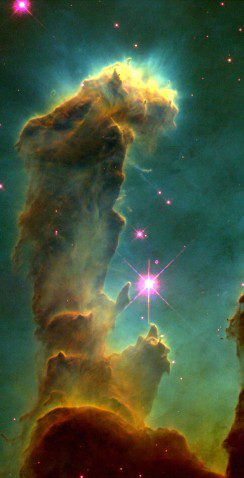 The heavens declare the glory of God;
the skies proclaim the work of his hands.
Day after day they pour forth speech;
night after night they reveal knowledge.
They have no speech, they use no words;
no sound is heard from them.
Yet their voice goes out into all the earth,
their words to the ends of the world. (Ps 9:1-4)
How did God create the heavens and the earth?
This becomes a conundrum in many discussions of science and Christian faith. It is viewed as a problem to be solved. The more that we learn about science, the smaller the available space for the active creative power of God. Either natural processes or God. The next couple of chapters of Ron Highfield’s book The Faithful Creator address the question of how God created. Highfield’s view of the nature of God shapes this discussion (see the previous post A Philosopher’s God? for more details).
When we think about God as creator several competing ideas come to mind. On of the first involves an understanding of God’s act of creation. According to Highfield it is important to discipline our thinking and our language here to be careful not to attribute human characteristics to God. “The differences between the divine act of creating and the human act of making are so profound that we must conclude that they are no merely quantitatively different but qualitatively of a different kind.” (p. 78) The most significant point is that the act of creating cannot come from any idea of anything outside of God and it cannot be dependent on nondivine means. Creation from nothing is important because without God’s act of creating there would be nothing. The act of creating cannot change God and it must produce exactly what God intends and do so perfectly.
It should be clear from the previous post that I am not comfortable with some aspects of this way of talking about God, but it leads Highfield to a significant conclusion, and one I agree with completely. How God creates – the connection between the mind of God and the motions and structures of creation – remains, and must remain a mystery. This is not something that human mind can comprehend. We err when we use human notions of creating and laws of physics constrain God’s act.There is an intrinsic mystery in creation that falls out of our realm of experience and understanding.
This mystery goes beyond the initial act of creation and includes God’s action and interaction with the created world even today. It is a mistake to think of God’s action in terms of ordinary cause and effect.
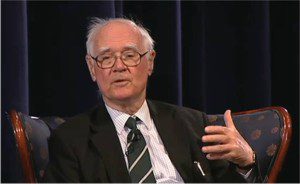 Highfield uses John Polkinghorne as a counter example of someone he believes tied too closely to modern science and human rationality in his explanations. From having read much of Polkinghorne’s work there is no doubt but that Polkinghorne and Highfield disagree rather significantly on many points, particularly on the “openness” of creation and the possibility that God could limit himself to grant freedom to his creation (Highfield digs into this a bit in this section as well). On the issue of the act or how of creation, however, it is not clear to me that the differences are as large as Highfield seems to think.
Polkinghorne often points to chaotic dynamics (nonlinear systems exquisitely sensitive to initial conditions) and quantum uncertainty as places that provide an openness in creation for God’s active presence, in answer to prayer for example, but in other cases as well. He repeats this idea in many of his books – I have Belief in God in an Age of Science, Quarks, Chaos and Christianity, and Theology in the Context of Science on my shelf, all of which touch on it in one fashion or another. Highfield summarizes:
In many essays and books Polkinghorne participates in the search for phases in the world processes, at the quantum level or at the initial conditions of chaotic systems, where God could determine a system with input of information rather than energy. In analogy to human freedom in relation to bodily motion, he argues that God uses (or it is conceivable that God uses) “the inherent incompleteness” and the “resultant flexibilities” in physical processes to act in particular ways in the world. We could conceive of God’s “interaction with creation … purely in the form of active information.” Polkinghorne admits that the term “active information” (mind or form?) is rather vague but argues that it may escape the requirement of true passive information, such as that stored on a computer hard drive or in a DNA molecule, that it requires energy for the process of transference from one medium to another. (p. 90)
And a bit further down:
But does Polkinghorne’s theory of the “how” of divine action really set theology on a better rational foundation than Farrer’s theory of double agency? At best his theory shows the physical world’s receptivity to information at certain levels. But he does not explain how information can be communicated from the divine mind to the physical world, which is the very question that drives the quest. His vague notion of “active information” gets us no closer. Despite the sophistication of the physical theories he invokes and the resulting impression of profound insight, our understanding of the how of divine action never gets beyond the analogy of human action. And we don’t need to know anything about quantum physics or chaos theory to experience our own free action. (p. 91)
Highfield is right that Polkinghorne doesn’t explain the how of divine action. But I don’t believe that that is the question Polkinghorne is addressing. The how of divine action in the world is mysterious. Polkinghornes rumination on “active information” is an indication of this. He agrees with Highfield that the natural analogies in human experience don’t work. Even an analogy to the human mind fails because the human mind is intrinsically embodied. A mind can be destroyed by damaging the brain, memories can be faked, hallucinations occur, and the connection between mind and action can be severed through physical injury. God’s action in the world isn’t through physical means (no energy required). Like Highfield who calls God “pure act,” Polkinghorne invokes “active information” as the form of God’s interaction with the world. For both this is a mystery.
It is also important to realize that the thinking that Polkinghorne responds to isn’t that of the theist who accepts the idea of an active God. Rather it is the scientific mind set that leaves no room for the active involvement of God. Material determinism is far more prevalent, at least in our circles, than Highfield admits. The experience of our own free action is frequently argued to be an illusion. I’ve written about this in the past (see in particular the posts Is Free Will Anti-Science?, Investigating the Unnatural – Is Science the Religion of the 21st Century?, and Free Will is an Illusion?). The scientific approach to knowledge and knowing, the underpinning principles of much of the present academic exercise, is that natural events are explicable by natural processes and by discoverable laws of nature. Alan Lightman, a physicist and novelist refers to this as the Central Doctrine of Science: “All properties and events in the physical universe are governed by laws, and those laws are true at every time and place in the universe.” A corollary is that all events are natural. There is no openness for true freedom. When Polkinghorne points to chaos and quantum uncertainty he is pointing to an intrinsic openness that keeps the scientist from closing the door on divine action and perhaps on human free action as well. The scientist may not need the hypothesis of God, but he can’t eliminate it either.
Finally, it seems to Highfield that “the quest to find an open place where God can act presupposes that God’s ability to act is conditioned by creation’s laws. ” (p. 91) I don’t think Polkinghorne falls into this trap, but there is an important point here. Many do fall for this in one way or another. We must not limit God’s ability to act to gaps in scientific knowledge – whether arising from intrinsic openness or current ignorance. God is not a scientific explanation of creation, and nothing we learn from the scientific investigation of creation – whether cosmology, evolution, embryology, or meteorology – removes God from the picture.
Is there any value in thinking too much about “how” God created the world?
Is God’s action as creator, as well as his current active involvement in the world, a scientific question?
If you wish to contact me directly you may do so at rjs4mail[at]att.net.
If interested you can subscribe to a full text feed of my posts at Musings on Science and Theology.
Stay in touch! Like Jesus Creed on Facebook:
Previous Post

February 11, 2016
Do You Know (this) Mary?
Next Post
February 11, 2016 Commodifying Friendship
Browse Our Archives
Select a Category Acts of the Apostles Adam Advent Anabaptism Angels Anglican Apologetics Atonement Baptism BCP Prayers Bible Biblical Studies Birds Blogging Bloglossary Bonhoeffer Books Calvinism Christianity Church Church History Coffee Colossians Commentary Recs Conversion Creation Creeds Culture Death Ecclesiastes Economics Education Embracing Grace Emergent Emerging Movement Eschatology Essays Ethics Eucharist Evangelicalism Family Fasting Fathers Fellowship of Differents Footsteps Tour Fun and Whimsical Gospel Grace Happiness Heaven Hell Holy Spirit Irenaeus James Jesus Jesus Creed Job Justification Kingdom of God Law Lectures Lent Liberalism Love and Marriage Mabanteneni Manhood Mary Miracles Missio Alliance MissioLife Missional Missional Jesus Movies and Film New Perspective Northern Seminary OneLife Origins Project Orthodox Parables Pastor's Spouse Pastoring and Leading Pastoring and Preaching Patristics Paul Paul-John Tour Pharisees Pietism Political Theology Prayer and Formation Preaching Problems for Faith Psalm 119 Psalms Public Issues Purgatory Religions Resurrection Revelation Romans Rule of JCreed Science and Faith Sermon on the Mount Sports Ten Commandments Theology Third Way Top Ten Lists Translations Uncategorized Universalism University Ministry Way Out Weekly Meanderings Wisdom Women and Ministry Work Worship Writing & Blogging Youth Ministry
Select a Month July 2021 January 2020 December 2019 November 2019 October 2019 September 2019 August 2019 July 2019 June 2019 May 2019 April 2019 March 2019 February 2019 January 2019 December 2018 November 2018 October 2018 September 2018 August 2018 July 2018 June 2018 May 2018 April 2018 March 2018 February 2018 January 2018 December 2017 November 2017 October 2017 September 2017 August 2017 July 2017 June 2017 May 2017 April 2017 March 2017 February 2017 January 2017 December 2016 November 2016 October 2016 September 2016 August 2016 July 2016 June 2016 May 2016 April 2016 March 2016 February 2016 January 2016 December 2015 November 2015 October 2015 September 2015 August 2015 July 2015 June 2015 May 2015 April 2015 March 2015 February 2015 January 2015 December 2014 November 2014 October 2014 September 2014 August 2014 July 2014 June 2014 May 2014 April 2014 March 2014 February 2014 January 2014 December 2013 November 2013 October 2013 September 2013 August 2013 July 2013 June 2013 May 2013 April 2013 March 2013 February 2013 January 2013 December 2012 November 2012 October 2012 September 2012 August 2012 July 2012 June 2012 May 2012 April 2012 March 2012 February 2012 January 2012 December 2011 November 2011 October 2011 September 2011 August 2011 July 2011 June 2011 May 2011 April 2011 March 2011 February 2011 January 2011 December 2010 November 2010 October 2010 September 2010 August 2010 July 2010 June 2010 May 2010 April 2010 March 2010 February 2010 January 2010 December 2009 November 2009 October 2009 September 2009 August 2009 July 2009 June 2009 May 2009 April 2009 March 2009 February 2009 January 2009 December 2008 November 2008 October 2008 September 2008 August 2008 July 2008 June 2008 May 2008 April 2008 March 2008 February 2008 January 2008 December 2007 November 2007 October 2007 September 2007 August 2007 July 2007 June 2007 May 2007 April 2007 March 2007 February 2007 January 2007 December 2006 November 2006 October 2006 September 2006 August 2006 July 2006 June 2006 May 2006 April 2006 March 2006 February 2006 January 2006 December 2005 November 2005 October 2005 September 2005 August 2005 July 2005 June 2005 May 2005 April 2005 0000
Follow Us!
TAKE THE
Religious Wisdom Quiz
Where does the Bible say, "do to others as you would have them do to you"?
Select your answer to see how you score.
Luke Leviticus Revelation Judges
Related posts from Jesus Creed


The Gospel of With Us and Through Us

Northern Seminary Announces: Nijay Gupta Joins Faculty

The Gundrys and Me: Ruth Tucker
TRENDING AT PATHEOS Evangelical

The REST of Your Life: A Creative Wrestles...
This week I had a conversation with a good friend from church....

How the author of the world's best hymn...
I've been working with John Newton for a while now. This makes...

Long before this Lectio Divina, Psalm 130 - the song - started...

What About the Trees? Another Living Parable
After I finished writing the last article about falling leaves as a...

Why Classical Education Is a Conversation, Not a...
Come and Read: Joy in Classical Education When I was a little...

Cornell University has received a great deal of negative publicity and intense...
view all Evangelical blogs
Ad-Free & Subscriber Log-In Subscription Support
- About Us
- 2026 Calendar
- Videos
- Podcasts
- Library of World Religions
- Faith In Media Tracker
- Advertise With Us
- Write for Us
- Privacy Policy
- Terms of Service
- Do Not Sell My Data
- Contact Us
- Radiant Digital
- Manage Newsletter Subscriptions
- Unsubscribe From Notifications
- Sitemap
Copyright 2008-2026, Patheos. All rights reserved.
Subscription Support Ad-Free & Subscriber Log-In
Follow Patheos