
BuddhistCatholicContemplativeEvangelicalGeneral ChristianHinduJewishLatter-day SaintMuslimNew VisionsProgressive Christian
Beliefs
- Buddhist
- Catholic
- Contemplative
- Evangelical
- General Christian
- Hindu
- Jewish
- Latter-day Saint
- More Voices
- Muslim
- New Visions
- Pagan
- Progressive Christian
Topics
- Religion News
- Food and Religion
- Sports and Religion
- Religious Art
- Religious Music and Entertainment
- Religious Events
- History and Religion
- Style and Religion
- Politics and Religion
- Women in Religion
- Recreation Outdoors and Religion
- Business Finance and Religion
- Careers Workplace and Religion
- Education and Religion
- Family Parenting and Religion
- Health Fitness and Religion
- Home and Religion
- Relationships and Religion
- Technology and Religion
- Travel and Religion
Columnists
- Buddhist Columnists
- Business Finance and Religion Columnists
- Careers Workplace and Religion Columnists
- Catholic Columnists
- Contemplative Columnists
- Education and Religion Columnists
- Evangelists Columnists
- Family Parenting and Religion Columnists
- General Christian Columnists
- Health Fitness and Religion Columnists
- Hindu Columnists
- History and Religion Columnists
- Home and Religion Columnists
- Jewish Columnists
- More Voices Columnists
- Latter Day Columnists
- Muslim Columnists
- New Visions Columnists
- Nonreligious Columnists
- Pagan Columnists
- Politics and Religion Columnists
- Progressive Columnists
- Recreation Outdoors and Religion Columnists
- Relationships and Religion Columnists
- Religion News Columnists
- Religious Art Columnists
- Religious Events Columnists
- Religious Music and Entertainment Columnists
- Sports and Religion Columnists
- Style and Religion Columnists
- Technology and Religion Columnists
- Travel and Religion Columnists
- Women in Religion Columnists
Resource Library
- 2026 Calendar
- Library of World Religions
- The 100 Most Holy Places on Earth
- Patheos Answers
- Podcasts
- Videos
- Faith Leaders Database
- Anglican Episcopalian
- Bahai
- Baptist
- Buddhism
- Christianity
- Confucianism
- Eastern Orthodoxy
- Hinduism
- Holiness and Pentecostal
- ISKCON
- Islam
- Judaism
- Lutheran
- Methodist
- The Church of Jesus Christ of Latter-day Saints
- New Age
- Paganism
- Presbytarian and Reformed
- Protestantism
- Religion Behind the Scenes
- Roman Catholic
- Scientology
- Shia Islam
- Sikhism
- Sufism
- Sunni Islam
- Taoism
- Zen
- See all religions
Research Tools
 Ad-Free & Subscriber Log-In Subscription Support
Follow Patheos 

- Trending:
- Advent
- |
- Forgiveness
- |
- Thanksgiving
- |
- Election
- |
- Seasonal Holidays
- |
- Marriage
 Jesus Creed
- Home
- Evangelical
- How the Fossil Record Supports Evolution (RJS)
How the Fossil Record Supports Evolution (RJS)
Last updated on: January 26, 2016 at 8:44 am by RJS
How the Fossil Record Supports Evolution (RJS) 2016-01-26T08:44:19-06:00 RJS
Patheos Explore the world's faith through different perspectives on religion and spirituality! Patheos has the views of the prevalent religions and spiritualities of the world.
 A scientific theory is not a hunch or mere speculation. Rather the term refers to a comprehensive explanation of some aspect of nature that is supported by many congruent lines of data. A further explanation from the NAS web site is helpful.
Many scientific theories are so well-established that no new evidence is likely to alter them substantially. For example, no new evidence will demonstrate that the Earth does not orbit around the sun (heliocentric theory), or that living things are not made of cells (cell theory), that matter is not composed of atoms, or that the surface of the Earth is not divided into solid plates that have moved over geological timescales (the theory of plate tectonics). Like these other foundational scientific theories, the theory of evolution is supported by so many observations and confirming experiments that scientists are confident that the basic components of the theory will not be overturned by new evidence. However, like all scientific theories, the theory of evolution is subject to continuing refinement as new areas of science emerge or as new technologies enable observations and experiments that were not possible previously.
Robert Asher, in Evolution and Belief, runs through some of the evidence for evolution. Early classifications of animals were based on comparative anatomy and embryology. The first attempts to derive a “tree of life,” a broad scale theory of genealogical relationships relied heavily on this data. After 150 years of scientific investigation we now also possess a much more complete fossil record and have access to extensive data from molecular biology and the genome project. All of these lines of evidence (comparative anatomy, embryology, fossil record, and molecular biology) confirm the same basic theory of interrelationships.
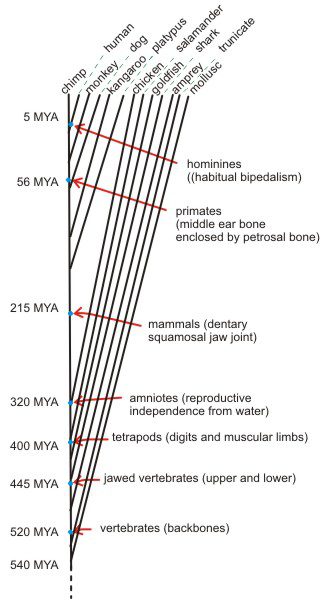 Stratigraphy. The geological column, strata of fossil bearing rocks, provides one strong thread of evidence for evolutionary progression. The layers that contain the fantastic variety of trilobites, as in the image above, fall between ca. 520 and 250 MYA (million years ago). This image is of a section of a large slab from 450 MYA in the Oxford University Museum of Natural history. In contrast the earliest mammals don’t show up until layers that date to 215 MYA or primates until 56 MYA. The timeline to the right highlights part of Fig. 4.1 p. 64 (click on it for a larger version). Much more information is available in the full figure. Finding a variation of trilobite alive today, or a even tyrannosaurus, wouldn’t be a problem for evolutionary theory. Finding a rabbit or a monkey in a Cambrian layer (541-485 MYA) or an Ordovician layer (485-444 MYA) would undermine the entire picture and send us back to the drawing board… on par with discovering something that moves through space faster than the speed of light.
That last is an interesting example. An experiment a few years ago to measure the speed of a neutrino (tiny neutral particles with a mass less than a millionth that of an electron) appeared to give a result faster than the speed of light (here). There was a great deal of skepticism, but the response of the community was to dig deeper, to substantiate the result or determine where the error was made. It was a subtle error in the instrumentation – but dogma didn’t rule the day, data did.
Large scale revolutions are rare, but fine scale refinements are constantly being made, in evolutionary biology and in other sciences. This is normal progress. The timeline picture above presents a good overview, but it is always subject to refinement. The appearance of tetrapods is a good example.
At a finer scale, the story is of course more complex. Paleontologists are generally not under the illusion that we’re out to identify literal distinct ancestors of modern groups. Nor do modern paleontologists claim that geologically older fossils always represent ancestral organisms. In fact, many fierce debates exist about the extent to which the fossil record accurately reports the first appearance of a given group, and paleontologists realize that the first appearance in the rock record is an underestimate of the actual first appearance of a species on our planet.
Indeed, a sure-fire way of making a splash in paleontology is to push back the record of a group by finding the oldest [insert favorite animal here]. Such discoveries happen quite frequently, for example, the recent description of a trackway of a land-walking vertebrate from rocks in southeastern Poland that date to the middle Devonian, about 397 million years ago. These prints show that some animals at that time were capable of propelling themselves with muscular limbs that ended in digits. They predate the oldest skeletal remains of animals with muscular limbs and digits (e.g., Tiktaalik, perhaps better known as “fishapod”) by about 18 million years, and they predate other trackways by about 12 million years, or perhaps even less, given the uncertainty on the age of the other trackway sites. Relative to what had been thought to be a 385 million-year fossil history of tetrapods, the Polish discovery extends the record of this group by about 3%. This is an important find, but does not change at all the fact that as shown in Figure 4.1, the first appearance of major groups correspond quite closely with the genealogical relationships inferred from anatomical and molecular evidence. (p. 70)
I’ve posted on Tiktaalik roseae a couple of time before. The most relevant to this discussion is Tiktaalik roseae revisited.
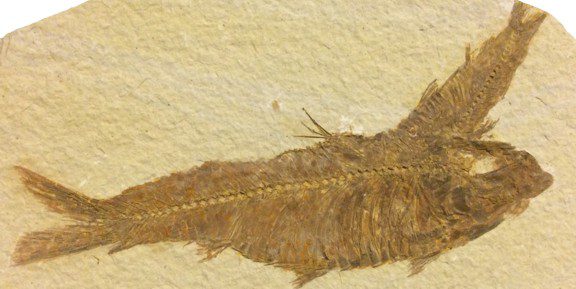 Punctuation. Asher also points out that the fossil record doesn’t show a slow, gradual set of transitions. There are a number of reasons for this. Catastrophic events like meteor strikes can have a major influence on the environment. Another possible reason is the range of biological space accessible. Unicellular organisms can’t do all that much. Multi-cellular organisms can do much more – and once a multi-cellular organism appears populations can differentiate to occupy different spaces (“niches”) consuming, competing, or coexisting. Once a backbone is on the scene various organisms that use a backbone can develop. Features can evolve more than once (convergence) with organisms reaching the similar solutions from different directions, often constrained by basic chemistry and physics, but there are generally telltale signs beneath the surface (e.g. bone structures or DNA sequences) that help establish connections or the lack of connections.
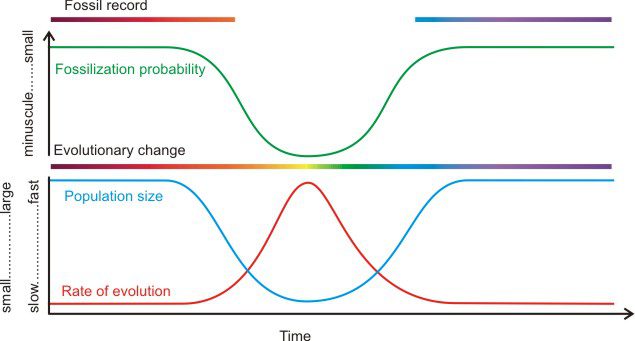 Another reason for “punctuated equilibrium” or the apparently abrupt appearance of new forms is more subtle. Evolutionary change is faster in a small population than in a large population and fossils are not generally left by small populations. This isn’t the only factor at play, but it is a significant one. Oftentimes evolution occurs by isolation of a small population from a larger group. This would cause a drop in the local population and the subpopulation wouldn’t reappear in the fossil record until it was different and had grown large enough to leave an appreciable fossil record.
This is not to say that all speciation events are allopatric, i.e., that they result from the reproductive isolation of small founder populations. Nor does it mean that anything “intermediate” in morphology has no chance of becoming a fossil… However, it does lead to an understanding of how an important model of speciation should typically manifest itself in the fossil record: a given species should typically show stasis, or “equilibrium,” during those times when it is well adapted to its particular environment and sufficiently numerous to leave behind evidence of its existence in the fossil record. An isolated, small daughter population – one in which evolutionary change is prone to become widespread – will be less likely to leave behind fossil representatives simply because it is small. After many generations, and possibly eons of geological time, if and when that population becomes big enough to leave behind fossil representatives, the paleontological “equilibrium” of the parent species will be accompanied (and not necessarily replaced) by the apparently sudden appearance in the fossil record, or “punctuation,” of the daughter species. (p. 76-77)
There is more in this chapter. Asher discusses some of the problems with “quote-mining” in some of the anti-evolution literature (no one likes to be misquoted out of context). He also introduces the fascinating idea that evolution may work at the level of populations as well as individuals. It is often said that all evolution is microevolution acting on individuals, and it is the accumulation of small changes in that results in what we see as macroevolution. However, evolution at the population level may give results counter to those seen if only individuals are considered, a kind of macroevolution. This doesn’t change the general paradigm of evolution by natural selection, but it does impact the outcome of the process. Evolutionary biology is an active field because there much room for new work and future refinement. This is exciting to any scientist.
Do you think the fossil record is a problem for the theory of evolution?
What would you expect from a transitional form?
If you wish to contact me directly you may do so at rjs4mail[at]att.net.
If interested you can subscribe to a full text feed of my posts at Musings on Science and Theology.
Previous Post

January 26, 2016
Yes, Your Pastor Needs a Sabbatical
Next Post
January 26, 2016 Daniel Burke, CNN, and the Evangelical Vote
Browse Our Archives
Select a Category Acts of the Apostles Adam Advent Anabaptism Angels Anglican Apologetics Atonement Baptism BCP Prayers Bible Biblical Studies Birds Blogging Bloglossary Bonhoeffer Books Calvinism Christianity Church Church History Coffee Colossians Commentary Recs Conversion Creation Creeds Culture Death Ecclesiastes Economics Education Embracing Grace Emergent Emerging Movement Eschatology Essays Ethics Eucharist Evangelicalism Family Fasting Fathers Fellowship of Differents Footsteps Tour Fun and Whimsical Gospel Grace Happiness Heaven Hell Holy Spirit Irenaeus James Jesus Jesus Creed Job Justification Kingdom of God Law Lectures Lent Liberalism Love and Marriage Mabanteneni Manhood Mary Miracles Missio Alliance MissioLife Missional Missional Jesus Movies and Film New Perspective Northern Seminary OneLife Origins Project Orthodox Parables Pastor's Spouse Pastoring and Leading Pastoring and Preaching Patristics Paul Paul-John Tour Pharisees Pietism Political Theology Prayer and Formation Preaching Problems for Faith Psalm 119 Psalms Public Issues Purgatory Religions Resurrection Revelation Romans Rule of JCreed Science and Faith Sermon on the Mount Sports Ten Commandments Theology Third Way Top Ten Lists Translations Uncategorized Universalism University Ministry Way Out Weekly Meanderings Wisdom Women and Ministry Work Worship Writing & Blogging Youth Ministry
Select a Month July 2021 January 2020 December 2019 November 2019 October 2019 September 2019 August 2019 July 2019 June 2019 May 2019 April 2019 March 2019 February 2019 January 2019 December 2018 November 2018 October 2018 September 2018 August 2018 July 2018 June 2018 May 2018 April 2018 March 2018 February 2018 January 2018 December 2017 November 2017 October 2017 September 2017 August 2017 July 2017 June 2017 May 2017 April 2017 March 2017 February 2017 January 2017 December 2016 November 2016 October 2016 September 2016 August 2016 July 2016 June 2016 May 2016 April 2016 March 2016 February 2016 January 2016 December 2015 November 2015 October 2015 September 2015 August 2015 July 2015 June 2015 May 2015 April 2015 March 2015 February 2015 January 2015 December 2014 November 2014 October 2014 September 2014 August 2014 July 2014 June 2014 May 2014 April 2014 March 2014 February 2014 January 2014 December 2013 November 2013 October 2013 September 2013 August 2013 July 2013 June 2013 May 2013 April 2013 March 2013 February 2013 January 2013 December 2012 November 2012 October 2012 September 2012 August 2012 July 2012 June 2012 May 2012 April 2012 March 2012 February 2012 January 2012 December 2011 November 2011 October 2011 September 2011 August 2011 July 2011 June 2011 May 2011 April 2011 March 2011 February 2011 January 2011 December 2010 November 2010 October 2010 September 2010 August 2010 July 2010 June 2010 May 2010 April 2010 March 2010 February 2010 January 2010 December 2009 November 2009 October 2009 September 2009 August 2009 July 2009 June 2009 May 2009 April 2009 March 2009 February 2009 January 2009 December 2008 November 2008 October 2008 September 2008 August 2008 July 2008 June 2008 May 2008 April 2008 March 2008 February 2008 January 2008 December 2007 November 2007 October 2007 September 2007 August 2007 July 2007 June 2007 May 2007 April 2007 March 2007 February 2007 January 2007 December 2006 November 2006 October 2006 September 2006 August 2006 July 2006 June 2006 May 2006 April 2006 March 2006 February 2006 January 2006 December 2005 November 2005 October 2005 September 2005 August 2005 July 2005 June 2005 May 2005 April 2005 0000
Follow Us!
TAKE THE
Religious Wisdom Quiz
What does "Shalom" mean in Hebrew?
Select your answer to see how you score.
Joy Peace Love Blessing
Related posts from Jesus Creed


The Gospel of With Us and Through Us

Northern Seminary Announces: Nijay Gupta Joins Faculty

The Gundrys and Me: Ruth Tucker
TRENDING AT PATHEOS Evangelical

When you hear the word riches, what comes to mind? For most...

Don’t Miss the Parents: A Creative Christmas Meditation
As we enter the Advent Season, I see many people trying to...

Making Stones Into Bread: Choosing the “Right” Work
I was on my online arts ministry Zoom meeting with the International...

Ukraine’s exhausted Christians face fifth winter of war
By Julian Lukins The full-scale war in Ukraine is taking “a serious...

Russell Brand's Conviction is not anti-Christian Persecution
How do we shed the reputation that the Church is OK with...

Have you ever caught yourself saying, “I’ll do it tomorrow,” or “Now...
view all Evangelical blogs
Ad-Free & Subscriber Log-In Subscription Support
- About Us
- 2026 Calendar
- Videos
- Podcasts
- Library of World Religions
- Faith In Media Tracker
- Advertise With Us
- Write for Us
- Privacy Policy
- Terms of Service
- Do Not Sell My Data
- Contact Us
- Radiant Digital
- Manage Newsletter Subscriptions
- Unsubscribe From Notifications
- Sitemap
Copyright 2008-2026, Patheos, part of the Radiant Digital network of media brands. All rights reserved.
Subscription Support Ad-Free & Subscriber Log-In
Follow Patheos