
BuddhistCatholicContemplativeEvangelicalGeneral ChristianHinduJewishLatter-day SaintMuslimNew VisionsProgressive Christian
Beliefs
- Buddhist
- Catholic
- Contemplative
- Evangelical
- General Christian
- Hindu
- Jewish
- Latter-day Saint
- More Voices
- Muslim
- New Visions
- Pagan
- Progressive Christian
Topics
- Religion News
- Food and Religion
- Sports and Religion
- Religious Art
- Religious Music and Entertainment
- Religious Events
- History and Religion
- Style and Religion
- Politics and Religion
- Women in Religion
- Recreation Outdoors and Religion
- Business Finance and Religion
- Careers Workplace and Religion
- Education and Religion
- Family Parenting and Religion
- Health Fitness and Religion
- Home and Religion
- Relationships and Religion
- Technology and Religion
- Travel and Religion
Columnists
- Buddhist Columnists
- Business Finance and Religion Columnists
- Careers Workplace and Religion Columnists
- Catholic Columnists
- Contemplative Columnists
- Education and Religion Columnists
- Evangelists Columnists
- Family Parenting and Religion Columnists
- General Christian Columnists
- Health Fitness and Religion Columnists
- Hindu Columnists
- History and Religion Columnists
- Home and Religion Columnists
- Jewish Columnists
- More Voices Columnists
- Latter Day Columnists
- Muslim Columnists
- New Visions Columnists
- Nonreligious Columnists
- Pagan Columnists
- Politics and Religion Columnists
- Progressive Columnists
- Recreation Outdoors and Religion Columnists
- Relationships and Religion Columnists
- Religion News Columnists
- Religious Art Columnists
- Religious Events Columnists
- Religious Music and Entertainment Columnists
- Sports and Religion Columnists
- Style and Religion Columnists
- Technology and Religion Columnists
- Travel and Religion Columnists
- Women in Religion Columnists
Resource Library
- 2026 Calendar
- Library of World Religions
- The 100 Most Holy Places on Earth
- Patheos Answers
- Podcasts
- Videos
- Faith Leaders Database
- Anglican Episcopalian
- Bahai
- Baptist
- Buddhism
- Christianity
- Confucianism
- Eastern Orthodoxy
- Hinduism
- Holiness and Pentecostal
- ISKCON
- Islam
- Judaism
- Lutheran
- Methodist
- The Church of Jesus Christ of Latter-day Saints
- New Age
- Paganism
- Presbytarian and Reformed
- Protestantism
- Religion Behind the Scenes
- Roman Catholic
- Scientology
- Shia Islam
- Sikhism
- Sufism
- Sunni Islam
- Taoism
- Zen
- See all religions
Research Tools
 Ad-Free & Subscriber Log-In Subscription Support
Ad-Free & Subscriber Log-In Subscription Support
Follow Patheos 

- Trending:
- Forgiveness
- |
- Marriage
- |
- Consciousness
- |
- Death Penalty
- |
- Election
- |
- Halloween
 Jesus Creed
- Home
- Evangelical
- John Barclay’s Grace in the Church
John Barclay’s Grace in the Church
Last updated on: January 12, 2016 at 7:13 am by Scot McKnight
John Barclay’s Grace in the Church 2016-01-12T07:13:08-06:00 Scot McKnight
Patheos Explore the world's faith through different perspectives on religion and spirituality! Patheos has the views of the prevalent religions and spiritualities of the world.
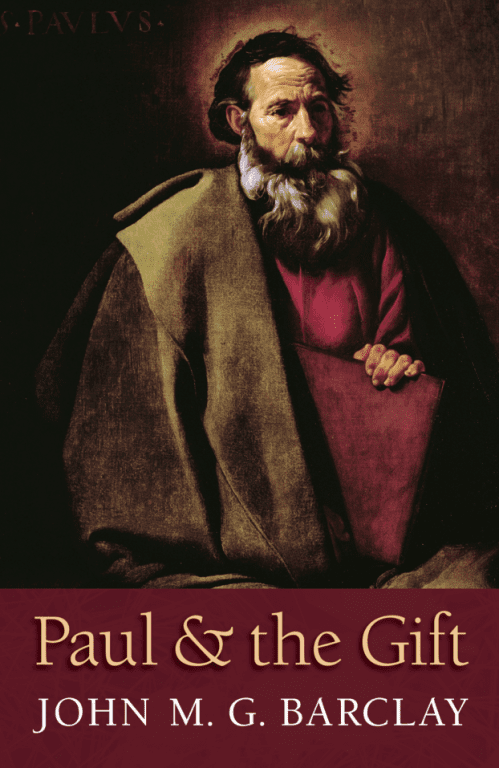 In a recent review in Books and Culture I examined what John Barclay calls a largely unexamined Christian theme — that’s right, grace is largely unexamined. Rather it is assumed we all know what it means. This was my book of the year on the Jesus Creed, so before I get going I want to say that I really, really like this book. While Barclay — in general — fits the apocalyptic school of Paul he does clearly transcend some of the boundaries and in some important ways carves his own path in the thicket.
The singular contribution of this book is to articulate a multi-level and multi-dimensional theory of grace, one that can make each group think they fit and one that, if read carefully, might make each camp think they don’t fit. Barclay is not part of the uber Reformed, he’s not part of the Lutheran in all ways, and he’s not part of the new perspective (though he accepts the basics of Sanders’ original contributions about Judaism), and he does claim some strong apocalyptic themes but he’s not just J. Louis Martyn or Marin de Boer or Douglas Campbell or Bev Gaventa.
Perhaps what I thought was most innovative in Barclay was his observation that prior to Paul grace entailed reciprocation or response. Grace, in other words, wasn’t what many today call “pure gift” or “unconditional gift” or “pure grace.” Those who love the uber Lutheran approach will simply be offended by the ancient evidence.
I will quote a sizable chunk of the review (with some abbreviating), and then proceed to discussing how we can talk about grace in the church:
I shall proceed straight to the central contribution of Paul and the Gift. There are, Barclay contends, six different “perfections” of grace, by which he means six ways grace as gift works itself out toward extremes or its farthest point in meaning and implication. Those six perfections are superabundance, singularity, priority, incongruity, efficacy, and non-circularity. These perfections need his clarifications, for the whole book gains its vision from these terms:
We have noted the tendency to draw the theme of gift/grace to an end-of-the-line extreme, especially for polemical purposes and in relation to God; and we have observed the variety of forms that this “perfecting” tendency can take. Since gift-giving is a complex social relation, it is possible to “perfect” grace (to define its essence in some “pure” or “ultimate” form) in a number of ways. We have identified six possible perfections:
(i) superabundance: the supreme scale, lavishness, or permanence of the gift;
(ii) singularity: the attitude of the giver as marked solely and purely by benevolence;
(iii) priority: the timing of the gift before the recipient’s initiative;
(iv) incongruity: the distribution of the gift without regard to the worth of the recipient;
(v)efficacy: the impact of the gift on the nature or agency of the recipient;
(vi)non-circularity: the escape of the gift from an ongoing cycle of reciprocity.As he will later articulate, Barclay’s perfections of grace operate from different angles: the first is about the gift itself; the second and third about the giver (God), the fourth about the person to whom the gift is given, the fifth about its effect, while the last is about reciprocation. These perfections then illustrate the varied dimensions of a phenomenology of the gift.
Three implications of nuancing grace into these six perfections can be detailed. I begin with a general implication for understanding how to relate the six perfections of grace. Each of the perfections is grace; each can exist without the others; grace, in other words, is not always one or all the others but can be one of them or a mixture of various perfections. Thus, it is simply unfair to the ancient Greco-Roman and Jewish worlds to think it is only grace when it is superabundance and incongruity and non-circularity, and here Barclay has his eye on certain exaggerations—prominent today in church life in the US—in Lutheran and Reformed theology. …
A second implication immediately rises to the surface for those who have learned to think in terms of grace being reducible to superabundance,incongruity, and non-circularity. What about Paul’s theology of grace? Isn’t it as we have learned in the tradition? Barclay’s answer is yes and no. In his opening summary, Barclay lays out his understanding of grace in Galatians and Romans. Here is his thesis for Paul: “Paul s theology of grace characteristically perfects the incongruity of the Christ-gift, given without regard to worth.”
Barclay transcends Augustinian anthropology in the term “worth,” for he is thinking not only of soteriology but also of how honor and worth were established in the Greco-Roman and Jewish worlds, a worth that has now been transcended by equality in Christ. Thus, he continues (all italics that follow are mine):
This theology is articulated within and for Paul’s Gentile mission, and grounds the formation of innovative communities that crossed ethnic and other boundaries. This incongruous gift bypasses and thussubverts pre-constituted systems of worth. It disregards previousforms of symbolic capital and thus enables the creation of new communities whose norms are reset by the Christ-gift itself. Grace took its meaning in and from Paul’s experience and social practice: the nature of the gift was embodied and clarified in novel social experiments.
This social emphasis of Barclay’s, so characteristic of Pauline scholarship today in both the new and apocalyptic perspectives, challenges what Paul’s theology of grace became in the theological tradition of the church, most definitely in the Augustinian line of thinking. The social experiment of an inclusive community turned in theological history toward an individual’s self-reliance (a characteristic, as I said, of the “old” perspective on Paul): “In the subsequent interpretation of Paul, within an established Christian tradition, this motif has played a number of other roles, but has generally shifted from undermining the believers’ previous criteria of worth to undercutting their self-reliance in attaining to Christian norms or their understanding of this effort as necessary for salvation.”…
A third implication then is how grace has been understood in the history of Christian theology, and it would be too much to detail all that Barclay raises to the surface, so a brief sketch and then a fuller statement about Luther, who one might say made grace famous in theology, must suffice here. Barclay’s sketch of that history does not fall short of mastery or compelling prose. He sketches Marcion (singularity, incongruity), Augustine (priority, incongruity in spades, efficacy), Luther (superabundance, singularity, priority, permanent incongruity, and non-circularity but no emphasis on efficacy; and Luther focused on anti-self-reliance and subversion of ecclesiastical authorities), Calvin (priority, incongruity, efficacy, and circularity [not non-circularity, not singularity]; zero-sum game about righteousness, deeply dependent upon Augustine), Barth (incongruity, with wrestling over efficacy), Bultmann (incongruity, priority, and circularity with wrestling about efficacy; no singularity), Käsemann (incongruity into social contexts as well, not singularity or efficacy or non-circularity), J. Louis Martyn (incongruity, priority, efficacy), E. P. Sanders (incongruity, priority), James D. G. Dunn (priority as all-inclusive of grace’s meaning, but also incongruity), N. T. Wright (de-centers grace; more along the line of priority and, I would add, efficacy; I would not say Wright de-centers grace, for his theme of election is nothing other than a theology of grace), and, though Barclay briefly touches on others, we mention only Douglas Campbell—who perfects all six perfections! To which Barclay adds, “Campbell sounds most like Marcion.” Hence, for Campbell grace is only grace if all six perfections are in play.
Now about preaching or teaching this grace:
First, observe that grace is as comprehensive in Barclay as it is in Paul but far more comprehensive than many today think. Grace, in other words, can’t be reduced to God’s unconditional love nor is it wise for the interpreter when coming across “grace” in Paul to go immediately to this incongruity theme. Plumb the context and ask each time you see “grace”: which perfection could be in view?
Second, grace not only finds us where we are but grace takes us to where we need to be, and those who abort that process of God’s transformative redemption are not talking grace in the fullest Pauline fashion. I hear notes of transformative grace in Barclay’s understanding of grace, even if it emphasizes (esp) social incongruity and not just spiritual incongruity. To preach grace, then, is to preach the transformative power of God’s grace at work in us through the Spirit. It is striking to me how often Paul uses “grace” for the spiritual gifts (or graces) in the Christian life, which is not so much an emphasis “you didn’t deserve this” but the present reality of a new life and a new capacity. I see efficacy in this element in Paul.
Third, many in our churches and audiences will have been reared to think grace is reducible to unconditionality on the part of God (his singularity and priority) so to press themes of efficacy or circularity may well sound like “works” (ironically). So the teacher will have to bring folks along by expounding a number of grace texts in Paul’s writings.
Fourth, Barclay exposes the reader in this book to the wide variety of all the major thinkers about grace in the history of the church. This is a great, great service to all of us.
Fifth, Barclay’s book will prevent old perspective scholars from pretending that they can use Judaism as a simplistic foil of non-grace works righteousness vs. grace and non-works righteousness among Christians. Hence, from the review:
Using the sixfold schema of perfections described in chapter 2, we have found that our [Judaism] texts agree at some points, and differ widely at others. All of them perfect the superabundance of divine “grace,” stressing the excess of gifts poured into the world, or the “abundance” of divine mercy and goodness, extended in manifold ways. On the other hand, in another point of agreement, none of them perfect the non-circularity of grace, the notion that God gives without expectation of return … . Beyond these two points of agreement, however, the forms of perfection vary greatly. Some (e.g., Philo) tend toward the singularity of God’s benevolence (God as the cause of good alone); others (e.g., the Hodayot) let God’s mercy shine against the backdrop of his wrath and punishing judgment. Some (e.g., Philo and the Hodayot) suggest the efficacy of grace, attributing to God the human response that God’s grace elicits; others (e.g.,Wisdom of Solomon) show no interest in qualifying human agency in any such way. Some stress the priority of God’s benevolence, whether in a pre-creational determination of human destiny (the Hodayot) or in God’s prior causation of all human acts (Philo). Most strikingly, and most importantly for our study, some (e.g., the Hodayot and LAB; Ezra in 4 Ezra) stress the incongruity of divine mercy, while others (e.g., Philo, Wisdom, Uriel in 4 Ezra) do not. This is not because some have a “higher” or “purer” view of grace than others. This is only one of six possible perfections, and to decide that incongruity is the sine qua non of “grace”—as modern dictionary definitions (and the Christian tradition) tend to do—would be to skew our analysis from the beginning. It is just the case that our texts disagree on how they configure divine goodness in this regard, and it would be equally mistaken to regard the incongruity of grace as ubiquitous in Second Temple Judaism as to consider it absent from its repertoire of perfections.
Finally, grace is sent by God to form a new kind of community in the Roman empire. One no longer marked by social worth but by God’s love and mercy to all, a mercy that creates a new kind of fellowship.
Barclay’s conclusions about the Pauline conception of grace, which was the goal of this book and which could only be answered once one understood what gift-giving was (and is) like and how both the Greco-Roman and Jewish worlds comprehended such grace—and which can’t be understood without patient examination of Paul’s letters to Galatia and Rome in context and narrative flow—are these: grace is christologically focused with a central element of incongruity at the communal level of forming an alternative society in the church. Barclay finds varying emphases on the perfection of superabundance, priority, singularity, and efficacy, but Paul’s theology of grace is not non-circular, that is, the apostle expects those who have experienced God’s grace to respond in love and grace.
Previous Post

January 11, 2016
Economic Equality or Justice? Howard Snyder Speaks
Next Post
January 12, 2016 A Blaze of Glory! (RJS)
Browse Our Archives
Select a Category Acts of the Apostles Adam Advent Anabaptism Angels Anglican Apologetics Atonement Baptism BCP Prayers Bible Biblical Studies Birds Blogging Bloglossary Bonhoeffer Books Calvinism Christianity Church Church History Coffee Colossians Commentary Recs Conversion Creation Creeds Culture Death Ecclesiastes Economics Education Embracing Grace Emergent Emerging Movement Eschatology Essays Ethics Eucharist Evangelicalism Family Fasting Fathers Fellowship of Differents Footsteps Tour Fun and Whimsical Gospel Grace Happiness Heaven Hell Holy Spirit Irenaeus James Jesus Jesus Creed Job Justification Kingdom of God Law Lectures Lent Liberalism Love and Marriage Mabanteneni Manhood Mary Miracles Missio Alliance MissioLife Missional Missional Jesus Movies and Film New Perspective Northern Seminary OneLife Origins Project Orthodox Parables Pastor's Spouse Pastoring and Leading Pastoring and Preaching Patristics Paul Paul-John Tour Pharisees Pietism Political Theology Prayer and Formation Preaching Problems for Faith Psalm 119 Psalms Public Issues Purgatory Religions Resurrection Revelation Romans Rule of JCreed Science and Faith Sermon on the Mount Sports Ten Commandments Theology Third Way Top Ten Lists Translations Uncategorized Universalism University Ministry Way Out Weekly Meanderings Wisdom Women and Ministry Work Worship Writing & Blogging Youth Ministry
Select a Month July 2021 January 2020 December 2019 November 2019 October 2019 September 2019 August 2019 July 2019 June 2019 May 2019 April 2019 March 2019 February 2019 January 2019 December 2018 November 2018 October 2018 September 2018 August 2018 July 2018 June 2018 May 2018 April 2018 March 2018 February 2018 January 2018 December 2017 November 2017 October 2017 September 2017 August 2017 July 2017 June 2017 May 2017 April 2017 March 2017 February 2017 January 2017 December 2016 November 2016 October 2016 September 2016 August 2016 July 2016 June 2016 May 2016 April 2016 March 2016 February 2016 January 2016 December 2015 November 2015 October 2015 September 2015 August 2015 July 2015 June 2015 May 2015 April 2015 March 2015 February 2015 January 2015 December 2014 November 2014 October 2014 September 2014 August 2014 July 2014 June 2014 May 2014 April 2014 March 2014 February 2014 January 2014 December 2013 November 2013 October 2013 September 2013 August 2013 July 2013 June 2013 May 2013 April 2013 March 2013 February 2013 January 2013 December 2012 November 2012 October 2012 September 2012 August 2012 July 2012 June 2012 May 2012 April 2012 March 2012 February 2012 January 2012 December 2011 November 2011 October 2011 September 2011 August 2011 July 2011 June 2011 May 2011 April 2011 March 2011 February 2011 January 2011 December 2010 November 2010 October 2010 September 2010 August 2010 July 2010 June 2010 May 2010 April 2010 March 2010 February 2010 January 2010 December 2009 November 2009 October 2009 September 2009 August 2009 July 2009 June 2009 May 2009 April 2009 March 2009 February 2009 January 2009 December 2008 November 2008 October 2008 September 2008 August 2008 July 2008 June 2008 May 2008 April 2008 March 2008 February 2008 January 2008 December 2007 November 2007 October 2007 September 2007 August 2007 July 2007 June 2007 May 2007 April 2007 March 2007 February 2007 January 2007 December 2006 November 2006 October 2006 September 2006 August 2006 July 2006 June 2006 May 2006 April 2006 March 2006 February 2006 January 2006 December 2005 November 2005 October 2005 September 2005 August 2005 July 2005 June 2005 May 2005 April 2005 0000
Follow Us!
TAKE THE
Religious Wisdom Quiz
A plant grew overnight to shade me, then withered, making me angry enough to die. What lesson did God teach through this?
Select your answer to see how you score.
Trust in God Our need for Humility God's compassion for people God's Patience with us
Related posts from Jesus Creed

Forgiving a Nazi Perpetrator: The Story of Eva...
Grace: Two Misunderstandings Reframed

TRENDING AT PATHEOS Evangelical

The REST of Your Life: A Creative Wrestles...
This week I had a conversation with a good friend from church....

How the author of the world's best hymn...
I've been working with John Newton for a while now. This makes...

Long before this Lectio Divina, Psalm 130 - the song - started...

What About the Trees? Another Living Parable
After I finished writing the last article about falling leaves as a...

Why Classical Education Is a Conversation, Not a...
Come and Read: Joy in Classical Education When I was a little...

Cornell University has received a great deal of negative publicity and intense...
view all Evangelical blogs
Ad-Free & Subscriber Log-In Subscription Support
- About Us
- 2026 Calendar
- Videos
- Podcasts
- Library of World Religions
- Faith In Media Tracker
- Advertise With Us
- Write for Us
- Privacy Policy
- Terms of Service
- Do Not Sell My Data
- Contact Us
- Radiant Digital
- Manage Newsletter Subscriptions
- Unsubscribe From Notifications
- Sitemap
Copyright 2008-2026, Patheos. All rights reserved.
Subscription Support Ad-Free & Subscriber Log-In
Follow Patheos