
BuddhistCatholicContemplativeEvangelicalGeneral ChristianHinduJewishLatter-day SaintMuslimNew VisionsProgressive Christian
Beliefs
- Buddhist
- Catholic
- Contemplative
- Evangelical
- General Christian
- Hindu
- Jewish
- Latter-day Saint
- More Voices
- Muslim
- New Visions
- Pagan
- Progressive Christian
Topics
- Religion News
- Food and Religion
- Sports and Religion
- Religious Art
- Religious Music and Entertainment
- Religious Events
- History and Religion
- Style and Religion
- Politics and Religion
- Women in Religion
- Recreation Outdoors and Religion
- Business Finance and Religion
- Careers Workplace and Religion
- Education and Religion
- Family Parenting and Religion
- Health Fitness and Religion
- Home and Religion
- Relationships and Religion
- Technology and Religion
- Travel and Religion
Columnists
- Buddhist Columnists
- Business Finance and Religion Columnists
- Careers Workplace and Religion Columnists
- Catholic Columnists
- Contemplative Columnists
- Education and Religion Columnists
- Evangelists Columnists
- Family Parenting and Religion Columnists
- General Christian Columnists
- Health Fitness and Religion Columnists
- Hindu Columnists
- History and Religion Columnists
- Home and Religion Columnists
- Jewish Columnists
- More Voices Columnists
- Latter Day Columnists
- Muslim Columnists
- New Visions Columnists
- Nonreligious Columnists
- Pagan Columnists
- Politics and Religion Columnists
- Progressive Columnists
- Recreation Outdoors and Religion Columnists
- Relationships and Religion Columnists
- Religion News Columnists
- Religious Art Columnists
- Religious Events Columnists
- Religious Music and Entertainment Columnists
- Sports and Religion Columnists
- Style and Religion Columnists
- Technology and Religion Columnists
- Travel and Religion Columnists
- Women in Religion Columnists
Resource Library
- 2026 Calendar
- Library of World Religions
- The 100 Most Holy Places on Earth
- Patheos Answers
- Podcasts
- Videos
- Faith Leaders Database
- Anglican Episcopalian
- Bahai
- Baptist
- Buddhism
- Christianity
- Confucianism
- Eastern Orthodoxy
- Hinduism
- Holiness and Pentecostal
- ISKCON
- Islam
- Judaism
- Lutheran
- Methodist
- The Church of Jesus Christ of Latter-day Saints
- New Age
- Paganism
- Presbytarian and Reformed
- Protestantism
- Religion Behind the Scenes
- Roman Catholic
- Scientology
- Shia Islam
- Sikhism
- Sufism
- Sunni Islam
- Taoism
- Zen
- See all religions
Research Tools
 Ad-Free & Subscriber Log-In Subscription Support
Ad-Free & Subscriber Log-In Subscription Support
Follow Patheos 

- Trending:
- Forgiveness
- |
- Marriage
- |
- Consciousness
- |
- Death Penalty
- |
- Election
- |
- Halloween
 Jesus Creed
- Home
- Evangelical
- Temporary Happy By-Products (RJS)
Temporary Happy By-Products (RJS)
Last updated on: December 31, 2015 at 9:41 am by RJS
Temporary Happy By-Products (RJS) 2015-12-31T09:41:12-06:00 RJS
Patheos Explore the world's faith through different perspectives on religion and spirituality! Patheos has the views of the prevalent religions and spiritualities of the world.
It has been a Star Wars season for many. Although I haven’t seen the new movie (or, indeed, any other than the original three – which were fantastic) many friends and family members contributed to the first weekend success of the film. Several have seen it more than once. Anyway, a recent twitter storm and response connected with the film caught my eye (thank you Facebook!…?). Apparently some were critical of the stars of the original movies and the way they have aged, especially Carrie Fisher as Leia. It is her response that has been showing up on Facebook. See here for example; it appears the Facebook version quoted below was edited a bit.
Carrie Fisher on Star Wars trolls: “Youth and beauty are not accomplishments, they’re the temporary happy by-products of time and/or DNA. Don’t hold your breath for either.”
There is an important message here – one that we as Christians above all others ought to understand. Youth and physical beauty are but inconsequential and temporary attributes. But there is no resignation or fatalism with this observation. Our hope is not temporary and age is not the enemy.
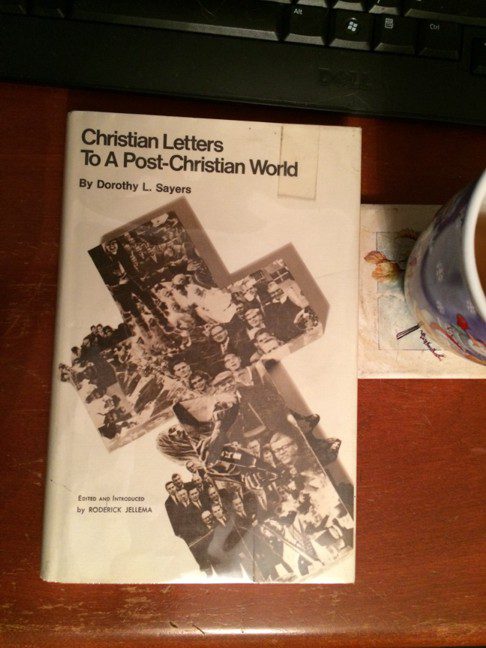 The brouhaha brought to mind once again an important essay by Dorothy Sayers published in Christian letters to a post-Christian world and republished a decade or so later as The Whimsical Christian. (My copy to the right is the earlier edition.) Although both are now out of print, used copies remain available. Sayers deserves a far broader readership than she receives. She was much more than just a writer of detective stories. Her insights (not to mention her incredible power with the pen) still speak today. This post is a lightly edited revision of an earlier post. It provides a fitting reflection as today we end the year, reflect on the past and face the new year.
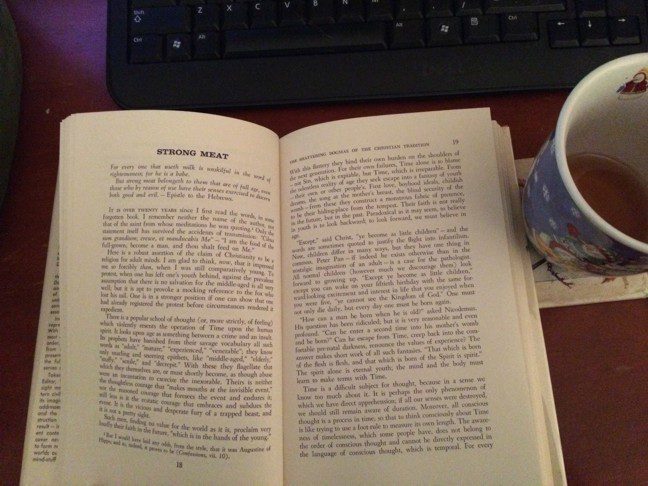
The opening section of this collection includes essays on what Sayers terms The Shattering Dogmas of the Christian Tradition. In an essay Strong Meat Sayers starts with a quote from Hebrews:
Anyone who lives on milk, being still an infant, is not acquainted with the teaching about righteousness. But solid food is for the mature, who by constant use have trained themselves to distinguish good from evil. (Hebrews 5: 13-14)
Sayers goes on to talk about maturity, time, and the church. And my, she had a way with words:
There is a popular school of thought (or, more strictly, of feeling) which violently resents the operation of Time upon the human spirit. It looks upon age as something between a crime and an insult. Its prophets have banished from their savage vocabulary all such words as “adult,” mature,” ” experienced,” “venerable”; they know only snarling and sneering epithets like “middle-aged,” “elderly,” “stuffy,” “senile,” and “decrepit.” With these they flagellate that which they themselves are, or must shortly become, as though abuse were and incantation to exorcise the inexorable. Theirs is neither the thoughtless courage that “makes mouths at the invisible event,” nor the reasoned courage that forsees the event and endures it; still less is it the ecstatic courage that embraces and subdues the event. It is the vicious and desperate furry of a trapped beast; and it is not a pretty sight.
Such men, finding no value for the world as it is, proclaim very loudly their faith in the future, “which is in the hands of the young.” With this flattery they bind their own burden on the shoulders of the next generation. For their own failures, Time alone is to blame – not Sin, which is expiable, but Time, which is irreparable. From the relentless reality of age they seek escape into a fantasy of youth – their own or other people’s. … Their faith is not really in the future, but in the past. Paradoxical as it may seem, to believe in youth is to look backward; to look forward, we must believe in age. (p. 18-19 emphasis added)
 Sayers’ point – developed somewhat more completely in the essay (although she is better at the description than the mundane follow through) – is that Christianity is a religion for adult minds, with a depth and power we need to develop, respect, embody, and preach. This is particularly, Sayers thought, important in an increasingly educated (and sneering) post-Christian world. She also thought that the Christian faith – with the beauty of the creeds and the depth of Christian dogma, and the power of scripture, is easily able to stand up to the challenge. The church, however, fails at times.
This essay, along with the others in this section of the book, provide a great deal of food for thought. The first time I commented on this selection of quotes many reacted to her rhetorical flair, assumed that she was speaking against youth, and didn’t really ponder the point she was making.
Youth and beauty are temporary attributes – all pass through youth, some possess beauty – but neither of these are attributes that provide anyone hope for the future.
Is Sayers right? Must we believe in age to look forward?
If so, what does this mean?
As I have reflected on this a number of thoughts have occurred.
First – “We Must Believe in Age” does not mean devaluing youth and should not be taken as disrespectful of youthful visionaries. It does not mean that the young(er) people have little to offer and should patiently sit back and wait their turn. In fact all people have much to offer and the perspectives of both youth and age make for a much more robust and lively church. Many great new ideas throughout history have come from people in their twenties and thirties, and even younger. In the Bible we have Jeremiah, Peter, Timothy, David, John all becoming leaders in one fashion or another at a relatively young age. … And remaining leaders into old age. And, of course, Moses, who wasn’t ready to lead until he was an old man.
Second – “We Must Believe in Age” is a reflection of the ideal that we should all mature and grow. I’m not in the same place today as I was 20 years ago – and I won’t be in the same place 20 years from now. I rather expect that 20 years from now today’s twenty and thirty somethings will feel that they still have something important to contribute … and it won’t be exactly what they contribute today (after all, they’ll be middle aged). Thus the expression “We must believe in age” isn’t so much a veneration of age, as it is an expectation of a continuing, valued, and respected process of maturation. Because we expect people to grow, we should be willing to listen to those further on in the journey.
Third – “We must believe in age” is an indictment of the sentiment that “the future is in the hands of the young.” It is an indictment of the flattering sense of importance that this sentiment provides. After all, youth is only a temporary attribute we all outgrow. It is an indictment of the abdication of responsibility for the present it represents. It is an indictment of the sentiment that devalues the contributions of the middle-aged and the elderly. We live in the present, looking toward God’s future.
Finally – Sayers really makes the most important point as she concludes the essay:
The story of Passion-Tide and Easter is the story of the winning that freedom and of that victory over the evils of Time. The burden of guilt is accepted (“He was made Sin”), the last agony of alienation from God is passed through (Eloi, lama sabachthani); the temporal Body is broken and remade; and Time and Eternity are reconciled in a Single Person. There is no retreat here to the Paradise of primal ignorance; the new Kingdom of God is built upon the foundations of spiritual experience. Time is not denied; it is fulfilled. “I am the food of the full-grown.” (p. 22)
The future does not rest in the hands of the young. It rests with all of us in the ever moving present and in the age to come. The victory over death is also a victory over the evils of time – for the evil of time lies only in the finality of death. Youth is a temporary attribute. We will all age, hopefully growing in wisdom and strength as we do so.
If we believe the Christian message then we are all part of the future and should be valued as such. We look forward to what the future brings.
A great reflection as we begin a new year. Welcome 2016. May God bless.
What does it mean to believe in age?
If you wish to contact me directly you may do so at rjs4mail[at]att.net
If interested you can subscribe to a full text feed of my posts at Musings on Science and Theology.
Previous Post

December 30, 2015
What's Next?
Next Post
January 1, 2016 Prayer for the New Year
Browse Our Archives
Select a Category Acts of the Apostles Adam Advent Anabaptism Angels Anglican Apologetics Atonement Baptism BCP Prayers Bible Biblical Studies Birds Blogging Bloglossary Bonhoeffer Books Calvinism Christianity Church Church History Coffee Colossians Commentary Recs Conversion Creation Creeds Culture Death Ecclesiastes Economics Education Embracing Grace Emergent Emerging Movement Eschatology Essays Ethics Eucharist Evangelicalism Family Fasting Fathers Fellowship of Differents Footsteps Tour Fun and Whimsical Gospel Grace Happiness Heaven Hell Holy Spirit Irenaeus James Jesus Jesus Creed Job Justification Kingdom of God Law Lectures Lent Liberalism Love and Marriage Mabanteneni Manhood Mary Miracles Missio Alliance MissioLife Missional Missional Jesus Movies and Film New Perspective Northern Seminary OneLife Origins Project Orthodox Parables Pastor's Spouse Pastoring and Leading Pastoring and Preaching Patristics Paul Paul-John Tour Pharisees Pietism Political Theology Prayer and Formation Preaching Problems for Faith Psalm 119 Psalms Public Issues Purgatory Religions Resurrection Revelation Romans Rule of JCreed Science and Faith Sermon on the Mount Sports Ten Commandments Theology Third Way Top Ten Lists Translations Uncategorized Universalism University Ministry Way Out Weekly Meanderings Wisdom Women and Ministry Work Worship Writing & Blogging Youth Ministry
Select a Month July 2021 January 2020 December 2019 November 2019 October 2019 September 2019 August 2019 July 2019 June 2019 May 2019 April 2019 March 2019 February 2019 January 2019 December 2018 November 2018 October 2018 September 2018 August 2018 July 2018 June 2018 May 2018 April 2018 March 2018 February 2018 January 2018 December 2017 November 2017 October 2017 September 2017 August 2017 July 2017 June 2017 May 2017 April 2017 March 2017 February 2017 January 2017 December 2016 November 2016 October 2016 September 2016 August 2016 July 2016 June 2016 May 2016 April 2016 March 2016 February 2016 January 2016 December 2015 November 2015 October 2015 September 2015 August 2015 July 2015 June 2015 May 2015 April 2015 March 2015 February 2015 January 2015 December 2014 November 2014 October 2014 September 2014 August 2014 July 2014 June 2014 May 2014 April 2014 March 2014 February 2014 January 2014 December 2013 November 2013 October 2013 September 2013 August 2013 July 2013 June 2013 May 2013 April 2013 March 2013 February 2013 January 2013 December 2012 November 2012 October 2012 September 2012 August 2012 July 2012 June 2012 May 2012 April 2012 March 2012 February 2012 January 2012 December 2011 November 2011 October 2011 September 2011 August 2011 July 2011 June 2011 May 2011 April 2011 March 2011 February 2011 January 2011 December 2010 November 2010 October 2010 September 2010 August 2010 July 2010 June 2010 May 2010 April 2010 March 2010 February 2010 January 2010 December 2009 November 2009 October 2009 September 2009 August 2009 July 2009 June 2009 May 2009 April 2009 March 2009 February 2009 January 2009 December 2008 November 2008 October 2008 September 2008 August 2008 July 2008 June 2008 May 2008 April 2008 March 2008 February 2008 January 2008 December 2007 November 2007 October 2007 September 2007 August 2007 July 2007 June 2007 May 2007 April 2007 March 2007 February 2007 January 2007 December 2006 November 2006 October 2006 September 2006 August 2006 July 2006 June 2006 May 2006 April 2006 March 2006 February 2006 January 2006 December 2005 November 2005 October 2005 September 2005 August 2005 July 2005 June 2005 May 2005 April 2005 0000
Follow Us!
TAKE THE
Religious Wisdom Quiz
What does "Jordan" (as in Jordan River) mean?
Select your answer to see how you score.
To heal To descend To anoint To open
Related posts from Jesus Creed


The Gospel of With Us and Through Us

Northern Seminary Announces: Nijay Gupta Joins Faculty

The Gundrys and Me: Ruth Tucker
TRENDING AT PATHEOS Evangelical

The REST of Your Life: A Creative Wrestles...
This week I had a conversation with a good friend from church....

How the author of the world's best hymn...
I've been working with John Newton for a while now. This makes...

Long before this Lectio Divina, Psalm 130 - the song - started...

What About the Trees? Another Living Parable
After I finished writing the last article about falling leaves as a...

Why Classical Education Is a Conversation, Not a...
Come and Read: Joy in Classical Education When I was a little...

Cornell University has received a great deal of negative publicity and intense...
view all Evangelical blogs
Ad-Free & Subscriber Log-In Subscription Support
- About Us
- 2026 Calendar
- Videos
- Podcasts
- Library of World Religions
- Faith In Media Tracker
- Advertise With Us
- Write for Us
- Privacy Policy
- Terms of Service
- Do Not Sell My Data
- Contact Us
- Radiant Digital
- Manage Newsletter Subscriptions
- Unsubscribe From Notifications
- Sitemap
Copyright 2008-2026, Patheos. All rights reserved.
Subscription Support Ad-Free & Subscriber Log-In
Follow Patheos