
BuddhistCatholicContemplativeEvangelicalGeneral ChristianHinduJewishLatter-day SaintMuslimNew VisionsProgressive Christian
Beliefs
- Buddhist
- Catholic
- Contemplative
- Evangelical
- General Christian
- Hindu
- Jewish
- Latter-day Saint
- More Voices
- Muslim
- New Visions
- Pagan
- Progressive Christian
Topics
- Religion News
- Food and Religion
- Sports and Religion
- Religious Art
- Religious Music and Entertainment
- Religious Events
- History and Religion
- Style and Religion
- Politics and Religion
- Women in Religion
- Recreation Outdoors and Religion
- Business Finance and Religion
- Careers Workplace and Religion
- Education and Religion
- Family Parenting and Religion
- Health Fitness and Religion
- Home and Religion
- Relationships and Religion
- Technology and Religion
- Travel and Religion
Columnists
- Buddhist Columnists
- Business Finance and Religion Columnists
- Careers Workplace and Religion Columnists
- Catholic Columnists
- Contemplative Columnists
- Education and Religion Columnists
- Evangelists Columnists
- Family Parenting and Religion Columnists
- General Christian Columnists
- Health Fitness and Religion Columnists
- Hindu Columnists
- History and Religion Columnists
- Home and Religion Columnists
- Jewish Columnists
- More Voices Columnists
- Latter Day Columnists
- Muslim Columnists
- New Visions Columnists
- Nonreligious Columnists
- Pagan Columnists
- Politics and Religion Columnists
- Progressive Columnists
- Recreation Outdoors and Religion Columnists
- Relationships and Religion Columnists
- Religion News Columnists
- Religious Art Columnists
- Religious Events Columnists
- Religious Music and Entertainment Columnists
- Sports and Religion Columnists
- Style and Religion Columnists
- Technology and Religion Columnists
- Travel and Religion Columnists
- Women in Religion Columnists
Resource Library
- 2026 Calendar
- Library of World Religions
- The 100 Most Holy Places on Earth
- Patheos Answers
- Podcasts
- Videos
- Faith Leaders Database
- Anglican Episcopalian
- Bahai
- Baptist
- Buddhism
- Christianity
- Confucianism
- Eastern Orthodoxy
- Hinduism
- Holiness and Pentecostal
- ISKCON
- Islam
- Judaism
- Lutheran
- Methodist
- The Church of Jesus Christ of Latter-day Saints
- New Age
- Paganism
- Presbytarian and Reformed
- Protestantism
- Religion Behind the Scenes
- Roman Catholic
- Scientology
- Shia Islam
- Sikhism
- Sufism
- Sunni Islam
- Taoism
- Zen
- See all religions
Research Tools
 Ad-Free & Subscriber Log-In Subscription Support
Ad-Free & Subscriber Log-In Subscription Support
Follow Patheos 

- Trending:
- Forgiveness
- |
- Marriage
- |
- Consciousness
- |
- Death Penalty
- |
- Election
- |
- Halloween
 Jesus Creed
- Home
- Evangelical
- The New Perspective is Now Complete
The New Perspective is Now Complete
Last updated on: December 28, 2015 at 10:54 pm by Scot McKnight
The New Perspective is Now Complete 2015-12-28T22:54:05-06:00 Scot McKnight
Patheos Explore the world's faith through different perspectives on religion and spirituality! Patheos has the views of the prevalent religions and spiritualities of the world.
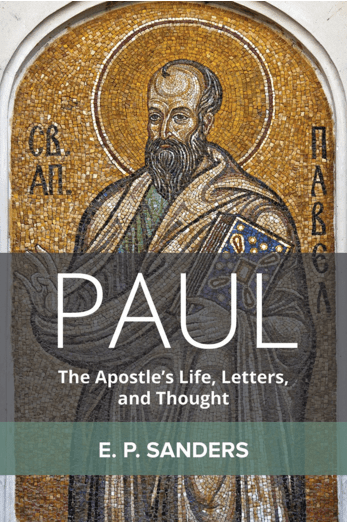 In 1977 E.P. Sanders wrote Paul and Palestinian Judaism and unleashed what, in the expression originally of N.T. Wright and then more forcefully J.D.G. Dunn, is called “the new perspective.” Sanders, however, put far more pressure on how we understand Judaism than how we understand either Jesus (he did write Jesus and Judaism) or Paul (only a small book on Paul, and a long section in P&PJ).
In fact, Sanders’ best book — in my estimation — other than the 1977 juggernaut is his book Judaism: Practice and Belief. There he sketched how Judaism is understood in contemporary to the NT sources, most especially Josephus. I contend this was his most important work of all since he put into print how he understood Judaism more completely than is found in P&PJ.
Dunn and Wright both followed up the work of Sanders on Judaism with strong proposals on how to understand Paul — Dunn completing his work in The Theology of Paul the Apostle (the “pumpkin book”) and NT Wright in Paul and the Faithfulness of God. These two works have formed the core of the new perspective. Those who criticize the new perspective without reading these two works carefully are offering talking points they’ve heard in the academic corridors but are not talking personal knowledge.
What we needed from Sanders was something more than the last sections of P&PJ and more than we got in his little book on Paul in the Past Masters series. I’m happy to announce we have that book now. To use the words of my father in law, it’s a “ming” (his term for something big and heavy). It’s got to be connected to the Ming dynasty but I don’t find this meaning in urban dictionaries. Anyway, E.P. Sanders now has a book called Paul: The Apostle’s Life, Letters, and Thought (Fortress, 2015). The book was pressed between our two front doors on Christmas Eve Day so it is my Christmas present.
It’s 862 pages, but the font is unusually large (nice for this reader’s eyes) and there’s plenty of white space and, even more, Sanders has great prose — he is crystal clear. He doesn’t care about the old perspective, new perspective and apocalyptic Paul debate. He simply lays out what he thinks Paul means in all his (authentic) letters, paragraph by paragraph. Which is, as the title of his post suggests, the completion of the new perspective on Judaism by forging an interpretation of Paul.
After about a 150 page introduction (worth every minute of reading), we get “commentaries” on Paul’s theology in each letter Sanders thinks Paul wrote: 1 Thess, 1-2 Corinthians, Galatians, Philippians and Romans. Plus Philemon.
Classic Sanders, classic new perspective, classic foundation for re-reading Paul:
In addition to the general charge that studying how to obey the commandments of the Hebrew Bible made the Pharisees focus on trivia, the Protestant critics of ancient Judaism have accused ancient Jews in general and Pharisees in particular of holding the view that they could achieve salvation by these trivial acts of obedience to the law and by piling up “good deeds” or “good works.”
This supposed soteriology (doctrine of salvation) is usually termed “self-righteousness,” “works-righteousness,” “legalism,” or simply ‘self-salvation.” The supposed Pharisaic dogma is totally opposed to relying on the grace of God; all depends on each individual’s performance.
I have two preliminary remarks, both of which have to do with the unusual nature of Christianity compared to other religions. The first concerns “dogma.” Over the centuries, Christianity became a religion that required its members to believe (or to say that they believed) a list of propositional truths—dogmas. In religious services they recited creeds, lists of dogmas. This conception of Christianity soon produced the possibility of heresy—believing things that were not on the approved list. Deliberately and publically [sic] disagreeing with items on the list could be fatal.
Many modern scholars of Christianity have come from dogmatic backgrounds, and they have thought it natural for a religion to have numerous dogmas. When they considered Judaism, they looked for dogmas, and many years ago they came up with the soteriological dogma that I described above (self-salvation). …
The second historical peculiarity of Christianity is that it began as a religion of individual salvation; and, although it has now taken on many cultural and social forms, individual salvation—eternal life in a state of bliss—remains a central concern.
The history of the Israelite and Jewish religion is quite different. The Hebrew Bible has very little to say about an afterlife and even less to say about the requirements that individuals must satisfy in order to be saved. Judaism’s main concern has long been the preservation of the people as a group, not individual salvation, and in the main bodies of literature there are no dogmas about what individuals should believe in order to have eternal life. …
It is this: Jews are born in the covenant and are members of the chosen people. In order to gain eternal life (“the world to come,” olam haba), they should obey the commandments as best they could and atone for transgression. That is, they are born into the “in group’ and all they have to do is to remain loyal to the covenant and to the God who gave it. Supererogatory efforts are not required. …
Thus Paul shared the general Jewish view: members of the “in group” will be saved, though God may punish them before or at the time of the judgment.
The difference between Paul and common Judaism on this point is that in Judaism people are born into the covenant and do not need any sort of transformation. They start out in the “in group” and need only to stay in by not rejecting the covenant. In Paul’s view (and that of many other Christians), everyone starts life in need of salvation. They must all do something—convttt, put their faith in Christ—in order to get into the group that will be saved. Once they are in the new covenant, however, the system of rewards and punishments works in the same way as in Judaism. (42-48)
Sanders has a bit of a bug in his bonnet when it comes to denying there is evidence that Paul was an actual Pharisee. The Paul of Acts is one, but Sanders thinks we have to go on the basis of Paul’s letters, and this is how he sums up his discussion:
Paul knew enough about Pharisaism to identify himself as a Pharisee, but I do not see anything in his letters that points toward his knowledge of exclusively Pharisaic views or practices.
Belief in the resurrection might have been enough for Paul to call himself a Pharisee “as to the law,” because it seems to have been a very prominent issue in Palestinian Pharisaism, even though it was not unique to the Pharisees. Acts 23:6 explicitly points in that direction.
Although many people combined fate and freewill, it is possible that Paul regarded this as one of his Pharisaic characteristics.
Similarly, it is conceivable that he regarded his expertise in knowing and interpreting the Bible as Pharisaic. Even though Pharisees were by no means the only experts, they were renowned for their “precision” in understanding the biblical text.
Since there are no traces of uniquely Pharisaic ideas and practices in Paul’s letters, readers may remain agnostic on the question of whether or not Paul received a Pharisaic education. Scholars who find Pharisaic positions in Paul’s letters, or the denial of them, are, in every case that I have noted, making the mistake of assuming that the Pharisees were the only Jews who had legal positions or the only ones who had purity practices.
We noted, however, one point that counts against Paul’s being a Palestinian Pharisee: he seems not to have been highly educated in how to make general principles or vague laws in the Bible apply precisely to everyday life, which was an important point of Pharisaism. (54)
Previous Post

December 27, 2015
Scruton on Classical Music
Next Post
December 28, 2015 Millennials and Investing for Retirement
Browse Our Archives
Select a Category Acts of the Apostles Adam Advent Anabaptism Angels Anglican Apologetics Atonement Baptism BCP Prayers Bible Biblical Studies Birds Blogging Bloglossary Bonhoeffer Books Calvinism Christianity Church Church History Coffee Colossians Commentary Recs Conversion Creation Creeds Culture Death Ecclesiastes Economics Education Embracing Grace Emergent Emerging Movement Eschatology Essays Ethics Eucharist Evangelicalism Family Fasting Fathers Fellowship of Differents Footsteps Tour Fun and Whimsical Gospel Grace Happiness Heaven Hell Holy Spirit Irenaeus James Jesus Jesus Creed Job Justification Kingdom of God Law Lectures Lent Liberalism Love and Marriage Mabanteneni Manhood Mary Miracles Missio Alliance MissioLife Missional Missional Jesus Movies and Film New Perspective Northern Seminary OneLife Origins Project Orthodox Parables Pastor's Spouse Pastoring and Leading Pastoring and Preaching Patristics Paul Paul-John Tour Pharisees Pietism Political Theology Prayer and Formation Preaching Problems for Faith Psalm 119 Psalms Public Issues Purgatory Religions Resurrection Revelation Romans Rule of JCreed Science and Faith Sermon on the Mount Sports Ten Commandments Theology Third Way Top Ten Lists Translations Uncategorized Universalism University Ministry Way Out Weekly Meanderings Wisdom Women and Ministry Work Worship Writing & Blogging Youth Ministry
Select a Month July 2021 January 2020 December 2019 November 2019 October 2019 September 2019 August 2019 July 2019 June 2019 May 2019 April 2019 March 2019 February 2019 January 2019 December 2018 November 2018 October 2018 September 2018 August 2018 July 2018 June 2018 May 2018 April 2018 March 2018 February 2018 January 2018 December 2017 November 2017 October 2017 September 2017 August 2017 July 2017 June 2017 May 2017 April 2017 March 2017 February 2017 January 2017 December 2016 November 2016 October 2016 September 2016 August 2016 July 2016 June 2016 May 2016 April 2016 March 2016 February 2016 January 2016 December 2015 November 2015 October 2015 September 2015 August 2015 July 2015 June 2015 May 2015 April 2015 March 2015 February 2015 January 2015 December 2014 November 2014 October 2014 September 2014 August 2014 July 2014 June 2014 May 2014 April 2014 March 2014 February 2014 January 2014 December 2013 November 2013 October 2013 September 2013 August 2013 July 2013 June 2013 May 2013 April 2013 March 2013 February 2013 January 2013 December 2012 November 2012 October 2012 September 2012 August 2012 July 2012 June 2012 May 2012 April 2012 March 2012 February 2012 January 2012 December 2011 November 2011 October 2011 September 2011 August 2011 July 2011 June 2011 May 2011 April 2011 March 2011 February 2011 January 2011 December 2010 November 2010 October 2010 September 2010 August 2010 July 2010 June 2010 May 2010 April 2010 March 2010 February 2010 January 2010 December 2009 November 2009 October 2009 September 2009 August 2009 July 2009 June 2009 May 2009 April 2009 March 2009 February 2009 January 2009 December 2008 November 2008 October 2008 September 2008 August 2008 July 2008 June 2008 May 2008 April 2008 March 2008 February 2008 January 2008 December 2007 November 2007 October 2007 September 2007 August 2007 July 2007 June 2007 May 2007 April 2007 March 2007 February 2007 January 2007 December 2006 November 2006 October 2006 September 2006 August 2006 July 2006 June 2006 May 2006 April 2006 March 2006 February 2006 January 2006 December 2005 November 2005 October 2005 September 2005 August 2005 July 2005 June 2005 May 2005 April 2005 0000
Follow Us!
TAKE THE
Religious Wisdom Quiz
What did God create on the first day?
Select your answer to see how you score.
Land Animals Plants Light
Related posts from Jesus Creed

Participation-in-Christ: The Major Themes
Justification is about Unification
TRENDING AT PATHEOS Evangelical

The REST of Your Life: A Creative Wrestles...
This week I had a conversation with a good friend from church....

How the author of the world's best hymn...
I've been working with John Newton for a while now. This makes...

Long before this Lectio Divina, Psalm 130 - the song - started...

What About the Trees? Another Living Parable
After I finished writing the last article about falling leaves as a...

Why Classical Education Is a Conversation, Not a...
Come and Read: Joy in Classical Education When I was a little...

Cornell University has received a great deal of negative publicity and intense...
view all Evangelical blogs
Ad-Free & Subscriber Log-In Subscription Support
- About Us
- 2026 Calendar
- Videos
- Podcasts
- Library of World Religions
- Faith In Media Tracker
- Advertise With Us
- Write for Us
- Privacy Policy
- Terms of Service
- Do Not Sell My Data
- Contact Us
- Radiant Digital
- Manage Newsletter Subscriptions
- Unsubscribe From Notifications
- Sitemap
Copyright 2008-2026, Patheos. All rights reserved.
Subscription Support Ad-Free & Subscriber Log-In
Follow Patheos