
BuddhistCatholicContemplativeEvangelicalGeneral ChristianHinduJewishLatter-day SaintMuslimNew VisionsProgressive Christian
Beliefs
- Buddhist
- Catholic
- Contemplative
- Evangelical
- General Christian
- Hindu
- Jewish
- Latter-day Saint
- More Voices
- Muslim
- New Visions
- Pagan
- Progressive Christian
Topics
- Religion News
- Food and Religion
- Sports and Religion
- Religious Art
- Religious Music and Entertainment
- Religious Events
- History and Religion
- Style and Religion
- Politics and Religion
- Women in Religion
- Recreation Outdoors and Religion
- Business Finance and Religion
- Careers Workplace and Religion
- Education and Religion
- Family Parenting and Religion
- Health Fitness and Religion
- Home and Religion
- Relationships and Religion
- Technology and Religion
- Travel and Religion
Columnists
- Buddhist Columnists
- Business Finance and Religion Columnists
- Careers Workplace and Religion Columnists
- Catholic Columnists
- Contemplative Columnists
- Education and Religion Columnists
- Evangelists Columnists
- Family Parenting and Religion Columnists
- General Christian Columnists
- Health Fitness and Religion Columnists
- Hindu Columnists
- History and Religion Columnists
- Home and Religion Columnists
- Jewish Columnists
- More Voices Columnists
- Latter Day Columnists
- Muslim Columnists
- New Visions Columnists
- Nonreligious Columnists
- Pagan Columnists
- Politics and Religion Columnists
- Progressive Columnists
- Recreation Outdoors and Religion Columnists
- Relationships and Religion Columnists
- Religion News Columnists
- Religious Art Columnists
- Religious Events Columnists
- Religious Music and Entertainment Columnists
- Sports and Religion Columnists
- Style and Religion Columnists
- Technology and Religion Columnists
- Travel and Religion Columnists
- Women in Religion Columnists
Resource Library
- 2026 Calendar
- Library of World Religions
- The 100 Most Holy Places on Earth
- Patheos Answers
- Podcasts
- Videos
- Faith Leaders Database
- Anglican Episcopalian
- Bahai
- Baptist
- Buddhism
- Christianity
- Confucianism
- Eastern Orthodoxy
- Hinduism
- Holiness and Pentecostal
- ISKCON
- Islam
- Judaism
- Lutheran
- Methodist
- The Church of Jesus Christ of Latter-day Saints
- New Age
- Paganism
- Presbytarian and Reformed
- Protestantism
- Religion Behind the Scenes
- Roman Catholic
- Scientology
- Shia Islam
- Sikhism
- Sufism
- Sunni Islam
- Taoism
- Zen
- See all religions
Research Tools
 Ad-Free & Subscriber Log-In Subscription Support
Ad-Free & Subscriber Log-In Subscription Support
Follow Patheos 

- Trending:
- Forgiveness
- |
- Marriage
- |
- Consciousness
- |
- Death Penalty
- |
- Election
- |
- Halloween
 Jesus Creed
- Home
- Evangelical
- A Theology of Creation (RJS)
A Theology of Creation (RJS)
Last updated on: December 17, 2015 at 6:31 pm by RJS
A Theology of Creation (RJS) 2015-12-17T18:31:09-06:00 RJS
Patheos Explore the world's faith through different perspectives on religion and spirituality! Patheos has the views of the prevalent religions and spiritualities of the world.
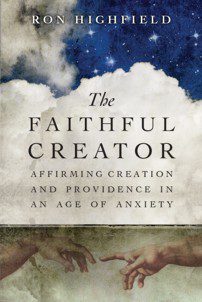 I recently picked up a new book by Ron Highfield The Faithful Creator: Affirming Creation and Providence in an Age of Anxiety. This book explores the concepts of creation, providence and evil and looks like it should lead to some interesting conversation and insight. Ron Highfield is a professor of religion at Pepperdine University (a place I’d love to visit some day), where he teaches courses like Systematic Theology I and Systematic Theology II, among others. Highfield’s approach is that of a theologian, not that of a biblical scholar. His book is described as “both accessible and scholarly” and “an ideal text for classroom use.” This may scare a few off (who really wants to read a textbook?) but shouldn’t. The concepts he addresses are important. Terry Tiessen (Providence Theological Seminary) notes in his blurb on the back of the book:
[Highfield] cogently reaffirms classical theism, and he applies it very helpfully in our present context. Whether or not readers agree with Highfield’s criticism of recent departures from the classical tradition, they will benefit, as I have done, from interacting with his superb restatement of the tradition and his own constructive appropriation of it.
Classical theism, as Highfield describes it, explicitly includes perfect providence and rejects such options as open theism that deny God’s perfect foreknowledge. Part Two of The Faithful Creator deals with the issue of Divine Providence; Part Three turns to The Challenge of Evil. But before tackling these topics Highfield first considers the theology of Creation, looking at the Old and New Testaments, the centrality of Christ, the mechanism of creation and the relationship between divine creation and modern science. There is much here we can chew on.
The Theology of Creation in the Old Testament. Highfield begins by surveying the major creation texts in the Old Testament: Genesis 1-2, Job 38-41, Proverbs 8, a bunch of Psalms, Isaiah 40-45, and Jeremiah 10:12-16; 27:5. We’ve dealt with most of these more than once in the past and I will now be content to summarize Highfield’s conclusions concerning the Old Testament theology of creation.
First an explanation:
For a biblical assertion about creation to qualify as theological it must speak about God as Creator or God’s relationship to the creature. Statements in which the Bible speaks of creatures in ways subject to empirical observation or introspection must be excluded from the theological category. (p. 35)
For example, the statement concerning the ostrich in Job 39 concluding “God did not endow her with wisdom” is observational and provides a moral lesson, but it is not theological because it draws a moral lesson from observation. It doesn’t focus on God and isn’t intended to teach us about God or even about Ostriches.
Highfield puts forth five theses concerning the theology of creation (pp. 36-39). Because these are theological statements they all concern the nature of God or the relationship between God and his creation.
- The one God is the absolute origin and sovereign ruler over all that is not God. “God is there at the beginning and every other thing in existence originated in God’s creative will.”
- The one God freely established the Creator-creature relation, which is characterized by generosity, freedom, and power on the Creator’s side and dependence and debt on the creature’s side. In his explanation of this thesis Highfield explicitly rejects any concept that limits the asymmetry of this relationship. He sees this as a major problem in many recent theologies of creation. God doesn’t reduce himself to make room for creaturely autonomy.
- The creation really exists before God and stands before him as good; that is, as the result of God’s act of creation, the creature is really what God intended it to be and can be used for the purpose God intended. “God treats creation as a genuine other, giving it space and a role to play and making it responsible to God.”
- The Creator-creature relation established at the beginning, with its characteristic qualities, endures for all time. There is no image of a distant deistic creator in the Old Testament. God is Creator in the present just as he was in the past and he will continue to be the Creator in the future. Creation is past action, present action and future action.
- Human beings possess a unique relationship to the Creator characterized by their image and likeness to God and responsibility to him. The Old Testament view of creation is anthropocentric with humans the “crown of creation.” This is in contrast to ancient Near Eastern views where humans were created to serve the gods, doing the menial tasks that the gods did not want to do themselves. According to Highfield, humans have been given power over themselves and thereby also power to rule creation. “The nature that enables human beings to exercise these powers is called the “image and likeness” of God. Herein resides the dignity and the vocation of God’s human creatures.” Highfield’s view of the “image and likeness” of God is somewhat different from that given by Richard Middleton in The Liberating Image, and by other contemporary Old Testament scholars. Middleton argues that the image of God is a vocation, not the nature that enables the vocation. Or put differently – humans as a species are created in the image and likeness of God, it isn’t dependent on the capacity of an individual. This doesn’t doesn’t change the thesis, however. Humans are still unique and characterized by their relationship with and responsibility to God.
Do these theses capture the Old Testament theology of Creation?
Is there anything you would modify or add? If so, why?
If you wish to contact me directly you may do so at rjs4mail[at]att.net.
If interested you can subscribe to a full text feed of my posts at Musings on Science and Theology.
Previous Post

December 17, 2015
Brenda Salter McNeil's Roadmap to Reconciliation
Next Post
December 17, 2015 How about this for a strategy?
Browse Our Archives
Select a Category Acts of the Apostles Adam Advent Anabaptism Angels Anglican Apologetics Atonement Baptism BCP Prayers Bible Biblical Studies Birds Blogging Bloglossary Bonhoeffer Books Calvinism Christianity Church Church History Coffee Colossians Commentary Recs Conversion Creation Creeds Culture Death Ecclesiastes Economics Education Embracing Grace Emergent Emerging Movement Eschatology Essays Ethics Eucharist Evangelicalism Family Fasting Fathers Fellowship of Differents Footsteps Tour Fun and Whimsical Gospel Grace Happiness Heaven Hell Holy Spirit Irenaeus James Jesus Jesus Creed Job Justification Kingdom of God Law Lectures Lent Liberalism Love and Marriage Mabanteneni Manhood Mary Miracles Missio Alliance MissioLife Missional Missional Jesus Movies and Film New Perspective Northern Seminary OneLife Origins Project Orthodox Parables Pastor's Spouse Pastoring and Leading Pastoring and Preaching Patristics Paul Paul-John Tour Pharisees Pietism Political Theology Prayer and Formation Preaching Problems for Faith Psalm 119 Psalms Public Issues Purgatory Religions Resurrection Revelation Romans Rule of JCreed Science and Faith Sermon on the Mount Sports Ten Commandments Theology Third Way Top Ten Lists Translations Uncategorized Universalism University Ministry Way Out Weekly Meanderings Wisdom Women and Ministry Work Worship Writing & Blogging Youth Ministry
Select a Month July 2021 January 2020 December 2019 November 2019 October 2019 September 2019 August 2019 July 2019 June 2019 May 2019 April 2019 March 2019 February 2019 January 2019 December 2018 November 2018 October 2018 September 2018 August 2018 July 2018 June 2018 May 2018 April 2018 March 2018 February 2018 January 2018 December 2017 November 2017 October 2017 September 2017 August 2017 July 2017 June 2017 May 2017 April 2017 March 2017 February 2017 January 2017 December 2016 November 2016 October 2016 September 2016 August 2016 July 2016 June 2016 May 2016 April 2016 March 2016 February 2016 January 2016 December 2015 November 2015 October 2015 September 2015 August 2015 July 2015 June 2015 May 2015 April 2015 March 2015 February 2015 January 2015 December 2014 November 2014 October 2014 September 2014 August 2014 July 2014 June 2014 May 2014 April 2014 March 2014 February 2014 January 2014 December 2013 November 2013 October 2013 September 2013 August 2013 July 2013 June 2013 May 2013 April 2013 March 2013 February 2013 January 2013 December 2012 November 2012 October 2012 September 2012 August 2012 July 2012 June 2012 May 2012 April 2012 March 2012 February 2012 January 2012 December 2011 November 2011 October 2011 September 2011 August 2011 July 2011 June 2011 May 2011 April 2011 March 2011 February 2011 January 2011 December 2010 November 2010 October 2010 September 2010 August 2010 July 2010 June 2010 May 2010 April 2010 March 2010 February 2010 January 2010 December 2009 November 2009 October 2009 September 2009 August 2009 July 2009 June 2009 May 2009 April 2009 March 2009 February 2009 January 2009 December 2008 November 2008 October 2008 September 2008 August 2008 July 2008 June 2008 May 2008 April 2008 March 2008 February 2008 January 2008 December 2007 November 2007 October 2007 September 2007 August 2007 July 2007 June 2007 May 2007 April 2007 March 2007 February 2007 January 2007 December 2006 November 2006 October 2006 September 2006 August 2006 July 2006 June 2006 May 2006 April 2006 March 2006 February 2006 January 2006 December 2005 November 2005 October 2005 September 2005 August 2005 July 2005 June 2005 May 2005 April 2005 0000
Follow Us!
TAKE THE
Religious Wisdom Quiz
Which book of the Bible ends with the word 'Amen'?
Select your answer to see how you score.
Philippians Jude Revelation Romans
Related posts from Jesus Creed


The Gospel of With Us and Through Us

Northern Seminary Announces: Nijay Gupta Joins Faculty

The Gundrys and Me: Ruth Tucker
TRENDING AT PATHEOS Evangelical

The REST of Your Life: A Creative Wrestles...
This week I had a conversation with a good friend from church....

How the author of the world's best hymn...
I've been working with John Newton for a while now. This makes...

Long before this Lectio Divina, Psalm 130 - the song - started...

What About the Trees? Another Living Parable
After I finished writing the last article about falling leaves as a...

Why Classical Education Is a Conversation, Not a...
Come and Read: Joy in Classical Education When I was a little...

Cornell University has received a great deal of negative publicity and intense...
view all Evangelical blogs
Ad-Free & Subscriber Log-In Subscription Support
- About Us
- 2026 Calendar
- Videos
- Podcasts
- Library of World Religions
- Faith In Media Tracker
- Advertise With Us
- Write for Us
- Privacy Policy
- Terms of Service
- Do Not Sell My Data
- Contact Us
- Radiant Digital
- Manage Newsletter Subscriptions
- Unsubscribe From Notifications
- Sitemap
Copyright 2008-2026, Patheos. All rights reserved.
Subscription Support Ad-Free & Subscriber Log-In
Follow Patheos