
BuddhistCatholicContemplativeEvangelicalGeneral ChristianHinduJewishLatter-day SaintMuslimNew VisionsProgressive Christian
Beliefs
- Buddhist
- Catholic
- Contemplative
- Evangelical
- General Christian
- Hindu
- Jewish
- Latter-day Saint
- More Voices
- Muslim
- New Visions
- Pagan
- Progressive Christian
Topics
- Religion News
- Food and Religion
- Sports and Religion
- Religious Art
- Religious Music and Entertainment
- Religious Events
- History and Religion
- Style and Religion
- Politics and Religion
- Women in Religion
- Recreation Outdoors and Religion
- Business Finance and Religion
- Careers Workplace and Religion
- Education and Religion
- Family Parenting and Religion
- Health Fitness and Religion
- Home and Religion
- Relationships and Religion
- Technology and Religion
- Travel and Religion
Columnists
- Buddhist Columnists
- Business Finance and Religion Columnists
- Careers Workplace and Religion Columnists
- Catholic Columnists
- Contemplative Columnists
- Education and Religion Columnists
- Evangelists Columnists
- Family Parenting and Religion Columnists
- General Christian Columnists
- Health Fitness and Religion Columnists
- Hindu Columnists
- History and Religion Columnists
- Home and Religion Columnists
- Jewish Columnists
- More Voices Columnists
- Latter Day Columnists
- Muslim Columnists
- New Visions Columnists
- Nonreligious Columnists
- Pagan Columnists
- Politics and Religion Columnists
- Progressive Columnists
- Recreation Outdoors and Religion Columnists
- Relationships and Religion Columnists
- Religion News Columnists
- Religious Art Columnists
- Religious Events Columnists
- Religious Music and Entertainment Columnists
- Sports and Religion Columnists
- Style and Religion Columnists
- Technology and Religion Columnists
- Travel and Religion Columnists
- Women in Religion Columnists
Resource Library
- 2026 Calendar
- Library of World Religions
- The 100 Most Holy Places on Earth
- Patheos Answers
- Podcasts
- Videos
- Faith Leaders Database
- Anglican Episcopalian
- Bahai
- Baptist
- Buddhism
- Christianity
- Confucianism
- Eastern Orthodoxy
- Hinduism
- Holiness and Pentecostal
- ISKCON
- Islam
- Judaism
- Lutheran
- Methodist
- The Church of Jesus Christ of Latter-day Saints
- New Age
- Paganism
- Presbytarian and Reformed
- Protestantism
- Religion Behind the Scenes
- Roman Catholic
- Scientology
- Shia Islam
- Sikhism
- Sufism
- Sunni Islam
- Taoism
- Zen
- See all religions
Research Tools
 Ad-Free & Subscriber Log-In Subscription Support
Ad-Free & Subscriber Log-In Subscription Support
Follow Patheos 

- Trending:
- Forgiveness
- |
- Marriage
- |
- Consciousness
- |
- Death Penalty
- |
- Election
- |
- Halloween
 Jesus Creed
- Home
- Evangelical
- A Three-Tiered Universe – Earth, Heavens, and Seas (RJS)
A Three-Tiered Universe – Earth, Heavens, and Seas (RJS)
Last updated on: October 6, 2015 at 6:52 pm by RJS
A Three-Tiered Universe – Earth, Heavens, and Seas (RJS) 2015-10-06T18:52:47-05:00 RJS
Patheos Explore the world's faith through different perspectives on religion and spirituality! Patheos has the views of the prevalent religions and spiritualities of the world.
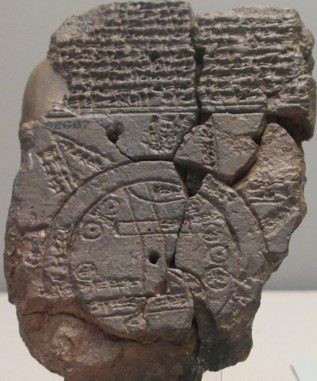 The second and third chapters of Kyle Greenwood’s new book Scripture and Cosmology: Reading the Bible Between the Ancient World and Modern Science deal with ancient Near Eastern cosmologies and the cosmologies found in Scripture. In these chapters Greenwood argues that the ancient Near Eastern view of the world was intrinsically three-tiered and that Scripture reflects this view. (The image to the right is an ancient Babylonian map of the world, ca. 500 to 700 BC, now in the British Museum.)
The view of the world in the ancient Near East was phenomenological – it was based on the common observation of the people. Greenwood summarizes the evidence from the ancient Near East in chapter two.
The Earth was not seen as a globe. It was described and illustrated as a flat body surrounded by water. The earth is either supported on pillars or floats on top of the cosmic seas. Representations in Babylon generally show the earth supported by pillars, while in Egypt the earth was thought to float on the seas, perhaps on a (gigantic) reed mat. There are variations, however, and in one Babylonian text Marduk, the chief deity of Babylon “constructed a raft on the surface of the waters. He made earth and heaped it up on the raft.” In addition to the surface of the earth, where the people lived, the netherworld occupied space in the depths of the earth. This was a land of no return, but it was seen as part of the earth. Similar ideas are at work in Egypt. “Throughout the ancient Near East, the netherworld was a physical abode of the dead in the heart of the earth.” (p. 55)
The Heavens. There are variations in the ancient Near Eastern view of the heavens with some consistent themes. In Mesopotamia the abode of the gods was in the heavens. Egyptians had a somewhat different view. In general the sky was considered a solid structure, either a dome or a flat roof, that served as a barrier to hold back the waters above the earth. Mountains or pillars could hold up the sky, or it could be described as a tent held taught by ropes. The lower heavens contained the stars, planets, sun and moon. The upper heavens was the domain of the deities. “The Mesopotamians thought of the upper heavens as a physical realm above the upper waters. Its floor was solid, enabling residents to stand, sit, or otherwise conduct their affairs.” (p. 61)
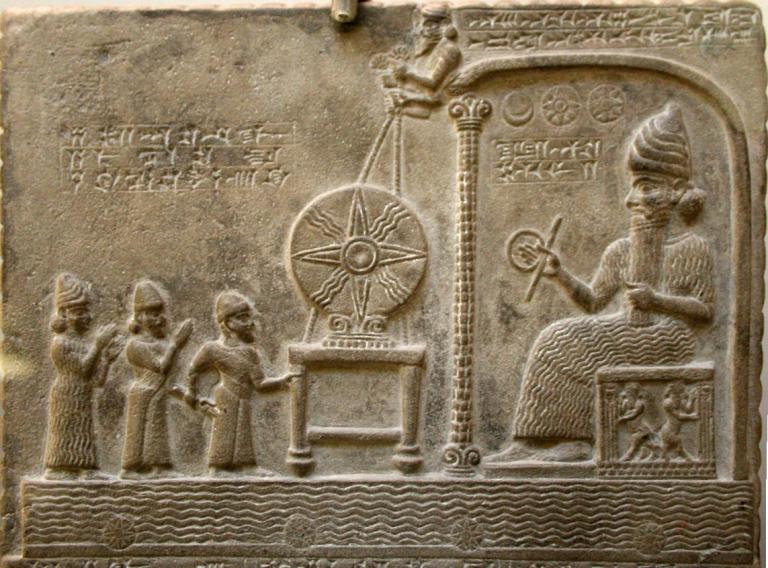 The Sea. In ancient Near Eastern cosmology, the earth is surrounded by cosmic waters: the oceans or seas surround the known world, water springs up from the ground, and falls from the sky – coming from all directions. Canaanite (Ugartic), Mesopotamian, and Egyptian sources portray the seas surrounding the land as chaotic, inhabited by sea serpents of various sorts. The depths of the sea are often associated with the grave. The firm surface of the sky holds back the waters above, although gates or windows let through precipitation when desired. The Sun God Tablet in the British Museum depicts Shamash (the sun god) on his throne, above the cosmic waters, with stars in the surface under the waters above the earth. In Mesopotamia, where the land was watered by rain, the waters above were crucial, providing sustenance. No rain meant drought and famine. In Egypt the annual floods of the Nile were far more important and rain was less significant. In fact the Egyptians didn’t seem to connect the water in the Nile with rain, the river itself was the source of water.
The people “knew” a three-tiered cosmos. “These three tiers, the heavens, the earth and the seas, provided the basic structural models necessary for explaining the entire cosmos.” (p. 69) It wasn’t merely poetic or metaphorical language in ancient eyes. Greenwood explains:
There are several reasons we must reject this notion. First, wherever we find physical descriptions of the cosmos, it is described as three-tiered. Second, wherever we find iconographic images or drawings of the cosmos, they are three-tiered. Third, nowhere in the ancient world do we find the authors explaining their cosmology in any other terms besides the three-tiered system. Finally, we know that the ancients thought of the cosmos in terms of the heavens, earth, and seas because eventually these ideas were challenged by Aristotle and Ptolemy, whose ideas were later challenged by Copernicus, Galileo, and Kepler. … In fact, the ancients very much adhered to the concept of a three-tiered cosmos. (p. 69)
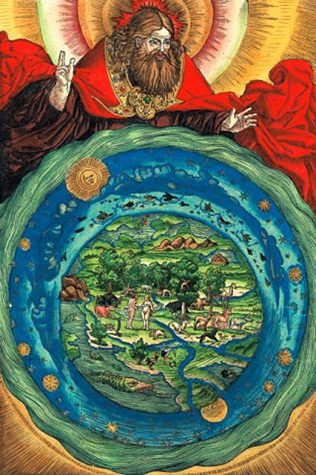 What about Cosmology in Scripture? The same view of a three-tiered cosmos permeates the Old Testament. We see references to windows in the sky (2 Kings 7:2) and repeated mention of the earth, heavens, and sea as comprising all that exists. Greenwood gives a number of examples.
- Exodus 20:11: For in six days the Lord made the heavens and the earth, the sea, and all that is in them, but he rested on the seventh day.
- Nehemiah 9:6: You alone are the Lord. You made the heavens, even the highest heavens, and all their starry host, the earth and all that is on it, the seas and all that is in them. You give life to everything, and the multitudes of heaven worship you.
- Proverbs 3:19-20: By wisdom the Lord laid the earth’s foundations, by understanding he set the heavens in place; by his knowledge the watery depths were divided, and the clouds let drop the dew.
This is the only form of reference found in Scripture. “As we look through the whole of Scripture, we will note that whenever the biblical authors reference the structure of the cosmos, they do so using the same terminology and conceptual framework as their ancient counterparts.” (p. 73) There are definite differences. The sun, moon, and stars are not deities to be worshiped. God alone is sovereign over the whole and He alone is to be worshiped. But the view of the structure of the cosmos is the same.
The earth is depicted as finite and flat with no knowledge of anything but the ancient near East. The disk shaped earth is supported on foundations or pillars (Job 9:6 He shakes the earth from its place and makes its pillars tremble. Isaiah repeatedly describes God as laying the foundations of the earth). The abode of the dead is in the depths of the earth.
The heavens are portrayed as above a solid ceiling or firmament. The stars are in this firmament and either faded in the greater light of the Sun during the day or “retreated into celestial chambers where they retired during daylight hours.” (p. 88) God is in the upper heavens and is portrayed as walking on the dome or firmament. (Job 22:14: Clouds are a hiding place for Him, so that He cannot see; And He walks on the vault of heaven. Exodus 24:10 and Ezekiel 1:26 have a similar vision of God enthroned above the vault of heaven)
The sea defines the extent of the earth. There are waters above, waters below, and waters around. Rain, snow, sleet, and hail are stored above the firmament and released at the appropriate time. The biblical authors reference storehouses and windows of heaven. God is in control of the cosmic sea, providing rain (but not too much) or holding it back. He controls the waters of the deep and subdues the sea serpents that reside in the depths (Leviathan, Rahab, Tannin, and Yam)
The biblical authors “breathed the same cultural air” as the surrounding nations. Their view of the structure of the world was similar, even when their theology was distinctly different. Importantly “while astral worship was prominent in the ancient Near East, it is systematically denounced in the Bible.” (p. 102)
Greenwood concludes:
These similarities, and even the dissimilarities, indicate that the biblical authors were not engaged in a systematic correction of the pagan worldviews. We do not see these authors writing apologetic treatises against the scientifically naive viewpoints of their uninspired neighbors. They do not speak of atmospheric pressure systems affecting the weather. We do not read about the gravitational pull of the planets, the solar orbit of the earth or the earth’s rotation on its axis. The texts do not inform us of faraway galaxies, supernova, comets, or black holes. In short, the biblical authors wrote according to the best scientific evidence of their time, an observational viewpoint that was best expressed through analogy and phenomenological language. (p. 102)
The book goes into far more detail on both the ancient Near Eastern cosmologies and the reflections of these cosmologies found in scripture. There is much food for thought here. The primary point is clear: there is no new science in the bible. The intent of God’s self revelation recorded in scripture was not to teach modern science, but to be in relationship with His people. A scientific view of the structure of the cosmos was not significant to this message or relationship. The cosmology of the bible, especially the Old Testament reflects the cultural air of the time and place in which it was written. This is obvious when we dig into the text (and when it is not obscured by the translators producing our English versions).
Do you see this three-tiered view of the cosmos in Scripture?
What is the significance? Does it change the way you think about science and scripture?
If you wish to contact me directly, you may do so at rjs4mail[at]att.net
If interested you can subscribe to a full text feed of my posts at Musings on Science and Theology.
Previous Post

October 6, 2015
Recovering Baptism, Changing Baptism
Next Post
October 6, 2015 Today is the Day
Browse Our Archives
Select a Category Acts of the Apostles Adam Advent Anabaptism Angels Anglican Apologetics Atonement Baptism BCP Prayers Bible Biblical Studies Birds Blogging Bloglossary Bonhoeffer Books Calvinism Christianity Church Church History Coffee Colossians Commentary Recs Conversion Creation Creeds Culture Death Ecclesiastes Economics Education Embracing Grace Emergent Emerging Movement Eschatology Essays Ethics Eucharist Evangelicalism Family Fasting Fathers Fellowship of Differents Footsteps Tour Fun and Whimsical Gospel Grace Happiness Heaven Hell Holy Spirit Irenaeus James Jesus Jesus Creed Job Justification Kingdom of God Law Lectures Lent Liberalism Love and Marriage Mabanteneni Manhood Mary Miracles Missio Alliance MissioLife Missional Missional Jesus Movies and Film New Perspective Northern Seminary OneLife Origins Project Orthodox Parables Pastor's Spouse Pastoring and Leading Pastoring and Preaching Patristics Paul Paul-John Tour Pharisees Pietism Political Theology Prayer and Formation Preaching Problems for Faith Psalm 119 Psalms Public Issues Purgatory Religions Resurrection Revelation Romans Rule of JCreed Science and Faith Sermon on the Mount Sports Ten Commandments Theology Third Way Top Ten Lists Translations Uncategorized Universalism University Ministry Way Out Weekly Meanderings Wisdom Women and Ministry Work Worship Writing & Blogging Youth Ministry
Select a Month July 2021 January 2020 December 2019 November 2019 October 2019 September 2019 August 2019 July 2019 June 2019 May 2019 April 2019 March 2019 February 2019 January 2019 December 2018 November 2018 October 2018 September 2018 August 2018 July 2018 June 2018 May 2018 April 2018 March 2018 February 2018 January 2018 December 2017 November 2017 October 2017 September 2017 August 2017 July 2017 June 2017 May 2017 April 2017 March 2017 February 2017 January 2017 December 2016 November 2016 October 2016 September 2016 August 2016 July 2016 June 2016 May 2016 April 2016 March 2016 February 2016 January 2016 December 2015 November 2015 October 2015 September 2015 August 2015 July 2015 June 2015 May 2015 April 2015 March 2015 February 2015 January 2015 December 2014 November 2014 October 2014 September 2014 August 2014 July 2014 June 2014 May 2014 April 2014 March 2014 February 2014 January 2014 December 2013 November 2013 October 2013 September 2013 August 2013 July 2013 June 2013 May 2013 April 2013 March 2013 February 2013 January 2013 December 2012 November 2012 October 2012 September 2012 August 2012 July 2012 June 2012 May 2012 April 2012 March 2012 February 2012 January 2012 December 2011 November 2011 October 2011 September 2011 August 2011 July 2011 June 2011 May 2011 April 2011 March 2011 February 2011 January 2011 December 2010 November 2010 October 2010 September 2010 August 2010 July 2010 June 2010 May 2010 April 2010 March 2010 February 2010 January 2010 December 2009 November 2009 October 2009 September 2009 August 2009 July 2009 June 2009 May 2009 April 2009 March 2009 February 2009 January 2009 December 2008 November 2008 October 2008 September 2008 August 2008 July 2008 June 2008 May 2008 April 2008 March 2008 February 2008 January 2008 December 2007 November 2007 October 2007 September 2007 August 2007 July 2007 June 2007 May 2007 April 2007 March 2007 February 2007 January 2007 December 2006 November 2006 October 2006 September 2006 August 2006 July 2006 June 2006 May 2006 April 2006 March 2006 February 2006 January 2006 December 2005 November 2005 October 2005 September 2005 August 2005 July 2005 June 2005 May 2005 April 2005 0000
Follow Us!
TAKE THE
Religious Wisdom Quiz
Who was thrown in a lion's den and survived?
Select your answer to see how you score.
Paul Joshua Daniel Peter
Related posts from Jesus Creed


The Gospel of With Us and Through Us

Northern Seminary Announces: Nijay Gupta Joins Faculty

The Gundrys and Me: Ruth Tucker
TRENDING AT PATHEOS Evangelical

The REST of Your Life: A Creative Wrestles...
This week I had a conversation with a good friend from church....

How the author of the world's best hymn...
I've been working with John Newton for a while now. This makes...

Long before this Lectio Divina, Psalm 130 - the song - started...

What About the Trees? Another Living Parable
After I finished writing the last article about falling leaves as a...

Why Classical Education Is a Conversation, Not a...
Come and Read: Joy in Classical Education When I was a little...

Cornell University has received a great deal of negative publicity and intense...
view all Evangelical blogs
Ad-Free & Subscriber Log-In Subscription Support
- About Us
- 2026 Calendar
- Videos
- Podcasts
- Library of World Religions
- Faith In Media Tracker
- Advertise With Us
- Write for Us
- Privacy Policy
- Terms of Service
- Do Not Sell My Data
- Contact Us
- Radiant Digital
- Manage Newsletter Subscriptions
- Unsubscribe From Notifications
- Sitemap
Copyright 2008-2026, Patheos. All rights reserved.
Subscription Support Ad-Free & Subscriber Log-In
Follow Patheos