
BuddhistCatholicContemplativeEvangelicalGeneral ChristianHinduJewishLatter-day SaintMuslimNew VisionsProgressive Christian
Beliefs
- Buddhist
- Catholic
- Contemplative
- Evangelical
- General Christian
- Hindu
- Jewish
- Latter-day Saint
- More Voices
- Muslim
- New Visions
- Pagan
- Progressive Christian
Topics
- Religion News
- Food and Religion
- Sports and Religion
- Religious Art
- Religious Music and Entertainment
- Religious Events
- History and Religion
- Style and Religion
- Politics and Religion
- Women in Religion
- Recreation Outdoors and Religion
- Business Finance and Religion
- Careers Workplace and Religion
- Education and Religion
- Family Parenting and Religion
- Health Fitness and Religion
- Home and Religion
- Relationships and Religion
- Technology and Religion
- Travel and Religion
Columnists
- Buddhist Columnists
- Business Finance and Religion Columnists
- Careers Workplace and Religion Columnists
- Catholic Columnists
- Contemplative Columnists
- Education and Religion Columnists
- Evangelists Columnists
- Family Parenting and Religion Columnists
- General Christian Columnists
- Health Fitness and Religion Columnists
- Hindu Columnists
- History and Religion Columnists
- Home and Religion Columnists
- Jewish Columnists
- More Voices Columnists
- Latter Day Columnists
- Muslim Columnists
- New Visions Columnists
- Nonreligious Columnists
- Pagan Columnists
- Politics and Religion Columnists
- Progressive Columnists
- Recreation Outdoors and Religion Columnists
- Relationships and Religion Columnists
- Religion News Columnists
- Religious Art Columnists
- Religious Events Columnists
- Religious Music and Entertainment Columnists
- Sports and Religion Columnists
- Style and Religion Columnists
- Technology and Religion Columnists
- Travel and Religion Columnists
- Women in Religion Columnists
Resource Library
- 2026 Calendar
- Library of World Religions
- The 100 Most Holy Places on Earth
- Patheos Answers
- Podcasts
- Videos
- Faith Leaders Database
- Anglican Episcopalian
- Bahai
- Baptist
- Buddhism
- Christianity
- Confucianism
- Eastern Orthodoxy
- Hinduism
- Holiness and Pentecostal
- ISKCON
- Islam
- Judaism
- Lutheran
- Methodist
- The Church of Jesus Christ of Latter-day Saints
- New Age
- Paganism
- Presbytarian and Reformed
- Protestantism
- Religion Behind the Scenes
- Roman Catholic
- Scientology
- Shia Islam
- Sikhism
- Sufism
- Sunni Islam
- Taoism
- Zen
- See all religions
Research Tools
 Ad-Free & Subscriber Log-In Subscription Support
Ad-Free & Subscriber Log-In Subscription Support
Follow Patheos 

- Trending:
- Forgiveness
- |
- Marriage
- |
- Consciousness
- |
- Death Penalty
- |
- Election
- |
- Halloween
 Jesus Creed
- Home
- Evangelical
- Forget the Fish Already! (RJS)
Forget the Fish Already! (RJS)
Last updated on: September 29, 2015 at 6:38 am by RJS
Forget the Fish Already! (RJS) 2015-09-29T06:38:11-05:00 RJS
Patheos Explore the world's faith through different perspectives on religion and spirituality! Patheos has the views of the prevalent religions and spiritualities of the world.
Forget the fish! God can work the miraculous. This is assumed in Jonah, but it isn’t the point of the story. The fish has only a bit swim on part. Focus instead on divine mercy and compassion.
 A while back I wrote a post Satire or History exploring the genre of the book of Jonah. The point isn’t to dismiss the book or to identify “error” in the Bible, but to correctly identify the genre and purpose of the book. In the Zondervan Illustrated Bible Backgrounds Commentary John Walton has some interesting observations on the book of Jonah in its ancient Near Eastern context.
In current trends within critical scholarship, Jonah is commonly labeled as parody or satire. The former typically lampoons a piece of literature, while the latter targets people (specific or stereotyped categories) or events as Jonah does. Satire can be either an enactment or a written composition in which vice, folly, or incompetence is held up for ridicule. The closer to reality a satire can be, the more effective it is. By definition it targets real people and tries to use the mannerisms and words that they use. Satire exaggerates reality, but is based on reality.
Satire and parody are both known in the ancient world and in the Bible. … In similar ways, most would agree that the book of Jonah wants us to laugh at the prophet’s incongruity and senselessness even as we are appalled by his behavior and attitude. (p. 104)
Good satire will be intentionally realistic – and the closer to reality, the more effective. Thus, if the book is a satire we should not find a clear indication of this for that would negate the satire and we should expect to find realistic details placing the story in time and place. Apparent history is not proof that the book should be considered historical.
Satire or A Powerful Parable? But is satire really the appropriate classification for the genre of Jonah? Walter Moberly in Old Testament Theology: Reading the Hebrew Bible as Christian Scripture suggests that a more appropriate classification may be something close to “parable.” The book is short (shorter than most of my posts including this one) and contains memorable elements designed to get those who read or hear the story thinking. It is “an exploration and portrayal of moral and theological issues in memorable narrative rather than abstract form.” (p. 187) The story of Jonah isn’t simple history and was never intended to be read as history. Focusing on the identity of the big fish or the size of Nineveh is a colossal exercise in missing the point. Rather:
My thesis is that the story of Jonah can well be read as probing of this basic perennial problem within Jewish and Christian (and other) faiths: religious language that on one level appears simple and straightforward is in fact harder to understand and appropriate than it initially appears. (p. 182)
Jonah contains elements of satire, but we need to dig down to the message behind the imagery. According to Moberly, the issue in focus is the nature of divine mercy or compassion. The author may want us to laugh at Jonah, but he also wants us to think about Jonah’s problem.
 Jonah receives mercy. The outline of the book is simple. When commanded to go to Nineveh, a true powerhouse, Jonah turns and runs away. After a storm and a sacrifice (Jonah), Jonah prays for mercy from God and it is granted. A big fish swallows up Jonah and vomits him out onto dry land.
While in the fish Jonah prays (chapter 2):
In my distress I called to the Lord,
and he answered me.
From deep in the realm of the dead I called for help,
and you listened to my cry.
…
When my life was ebbing away,
I remembered you, Lord,
and my prayer rose to you,
to your holy temple.
Those who cling to worthless idols
turn away from God’s love for them.
But I, with shouts of grateful praise,
will sacrifice to you.
What I have vowed I will make good.
I will say, ‘Salvation comes from the Lord.
Jonah disobeyed God. He repented and was met by the Lord with divine mercy and compassion.
The Ninevites receive mercy. Jonah then goes to Nineveh and preaches “what is arguably the shortest sermon on record,” five words in the Hebrew translated using eight words in the NIV “Forty more days and Nineveh will be overthrown.” Lo and behold the Ninevites repent and in magnificent style! They all donned sackcloth and fasted, from the king to the lowest in the land, and the fast included even the animals.
Apart from the intriguing inclusion of the livestock, the Ninevite’s repentance looks to be a model in every way, as it consists of fasting, prayer, rejection of sinful behavior, and lack of presumption upon God. In response to all this, God rescinds the threatened judgment upon the Ninevites, who become a paradigmatic example of divine mercy. (p. 186)
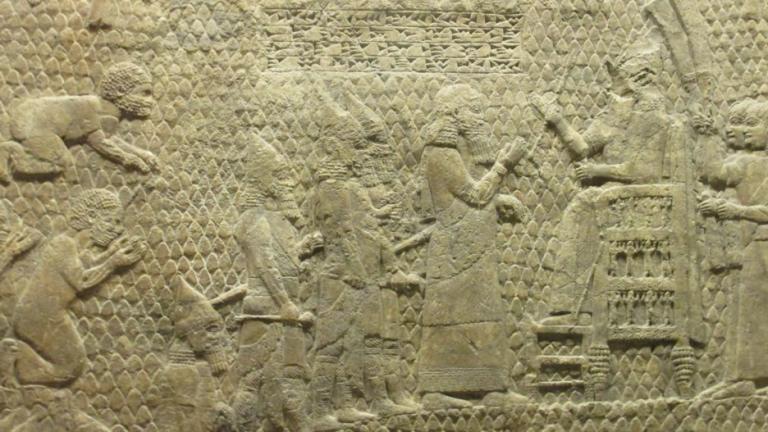
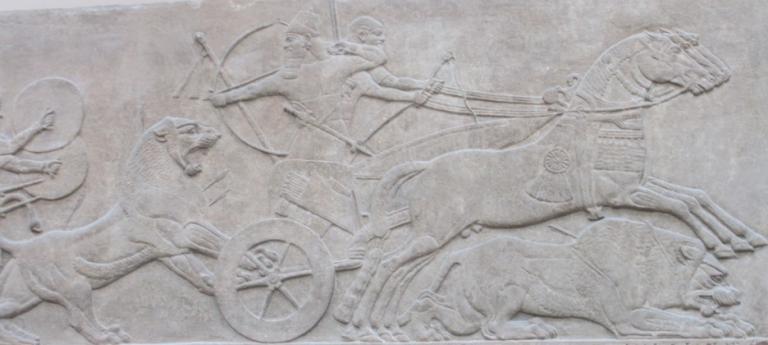
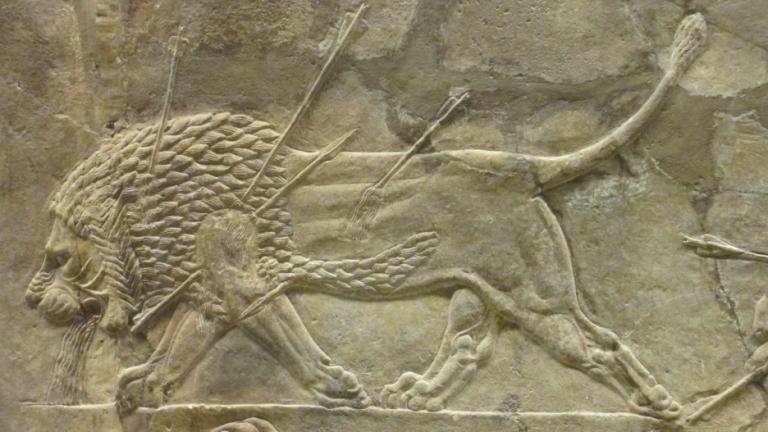
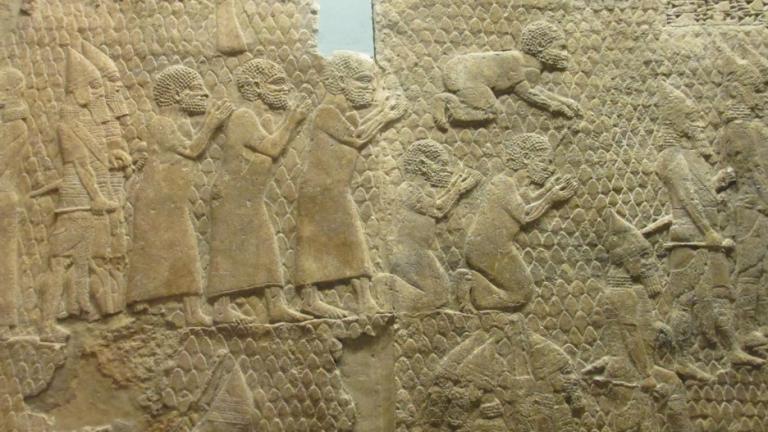 The Ninevites (like Jonah) deserved death. No Israelite would doubt this at all. They were a mighty conquering nation that wreaked destruction on Israel and Judah. We don’t know for sure when the book of Jonah was written. It is set earlier than the Assyrian conquest of Judah, which failed to conquer Jerusalem but stomped over much of the rest of the country in the time of Hezekiah (2 Kings 18-19 and Isaiah 36-37). The image at the top of the post along with the one here are from the relief in the palace of Sennacherib in Nineveh depicting the defeat of Lachish (2 Kings 18, 2 Chron. 32, Isaiah 36-37, Jeremiah 34). This relief is now displayed in the British Museum. The bearded prisoners are Judeans from Lachish. (Another room in the palace contained impressive reliefs of a royal lion hunt, also now in the British Museum.)
The consensus of scholars is that Jonah was written during the exile or later. If so the audience would know of the Assyrian conquest. Yet, the hated Ninevites (like Jonah) received mercy.
Divine Mercy as an Attribute of God. With this setup in Chapters 1-3 we are led to ponder Jonah’s reaction and God’s response in Chapter 4.
Isn’t this what I said, Lord, when I was still at home? That is what I tried to forestall by fleeing to Tarshish. I knew that you are a gracious and compassionate God, slow to anger and abounding in love, a God who relents from sending calamity. Now, Lord, take away my life, for it is better for me to die than to live. (4:2-3)
In this complaint Jonah quotes Exodus 34:6 (The Lord, the Lord, a God merciful and gracious, slow to anger, and abounding in steadfast love and faithfulness) and probably probably refers as well to the sentiment in Jeremiah 18:8 (but if that nation, concerning which I have spoken, turns from its evil, I will change my mind about the disaster that I intended to bring on it).
[Exodus 34:6-7] is an account of the nature of God, from God’s lips, spoken to Moses as privileged recipient. As the fullest statement about the divine nature in the whole Bible, it is located in the context of the aftermath of Israel’s breaking the recently made covenant by sinning with the golden calf (Exod. 32), even while they were still at the mountain of God. (p. 192)
Jonah knows that God is merciful. He is a beneficiary of God’s mercy and compassion – both personally and as an Israelite.
As part of the collection of the 12 minor prophets, the author of Jonah could also have in mind Joel 2:13-14. Joel includes the quote of Exodus 34:6 in a call for Judah to repent and follows it with a response that resembles the response of the king of Nineveh in Jonah 3:9 “who knows whether he will not turn and relent and leave a blessing behind him.” Moberly notes:
When one takes seriously the imaginative world of Jonah 3-4 in the light of Joel 2:13-14, it means that the king of Nineveh is portrayed as having excellent theological insight, trusting and not presuming upon God. It becomes an element in the exemplary nature of Ninevite repentance. It also means that the king of Nineveh is portrayed as having better theological understanding than Jonah. The Ninevite construes divine mercy rightly in both word and action, while Jonah knows only enough to become upset. (p. 195)
Chapter four continues with Jonah sulking. God provides a plant to provide shade, supplementing the shelter Jonah had built. When a worm is sent to destroy the plant, Jonah gets angry. God responds:
You have been concerned about this plant, though you did not tend it or make it grow. It sprang up overnight and died overnight. And should I not have concern for the great city of Nineveh, in which there are more than a hundred and twenty thousand people who cannot tell their right hand from their left—and also many animals?
It isn’t entirely clear why Jonah is angered by divine mercy for the Ninevites. Moberly runs through several possibilities although none of them seem to quite hit the mark. What is clear is that Jonah selfishly cares for himself; “he wants to restrict divine mercy to the elect and does not want to see Israel’s enemies (or gentiles, or sinners …) receive what Israel receives. ” (p. 207)
 There is more. Some who read the text as history take the reference to a hundred and twenty thousand who can’t tell their right hand from their left to indicate that the population is far greater. There are a hundred and twenty thousand children plus adults. But Moberly doesn’t see an obscure indirect census as the intent of the author. Rather the Ninevites are being described as ignorant children. The most powerful nation in the world of the time … as ignorant children.
YHWH’s point is that the insight of wisdom, to which Israel has access in torah, should engender toward those who lack it not arrogance or disdain but rather compassion. The way in which the Gospels overturn conventional assumptions about power and importance, and present knowledge of God’s priorities as a reason for active compassion toward others, stands in strong continuity with this. (p. 208)
Certainly God doesn’t spare Nineveh because of the Assyrian might and wealth. He spares Nineveh because the people, though ignorant as children, turn and repent. God has compassion on them.
In the concluding line God directs Jonah, and succession us, to rethink what divine mercy and compassion mean. A pursuit well worth our time as it is part of the very nature of God.
Does this outline of Jonah emphasizing divine compassion and mercy make sense?
If not, where do you disagree? How would you read the book?
If you wish to contact me directly, you may do so at rjs4mail[at]att.net
If interested you can subscribe to a full text feed of my posts at Musings on Science and Theology.
Previous Post

September 29, 2015
LT Johnson and John Paul II's Theology of the Body
Next Post
September 29, 2015 Millennials and Savings
Browse Our Archives
Select a Category Acts of the Apostles Adam Advent Anabaptism Angels Anglican Apologetics Atonement Baptism BCP Prayers Bible Biblical Studies Birds Blogging Bloglossary Bonhoeffer Books Calvinism Christianity Church Church History Coffee Colossians Commentary Recs Conversion Creation Creeds Culture Death Ecclesiastes Economics Education Embracing Grace Emergent Emerging Movement Eschatology Essays Ethics Eucharist Evangelicalism Family Fasting Fathers Fellowship of Differents Footsteps Tour Fun and Whimsical Gospel Grace Happiness Heaven Hell Holy Spirit Irenaeus James Jesus Jesus Creed Job Justification Kingdom of God Law Lectures Lent Liberalism Love and Marriage Mabanteneni Manhood Mary Miracles Missio Alliance MissioLife Missional Missional Jesus Movies and Film New Perspective Northern Seminary OneLife Origins Project Orthodox Parables Pastor's Spouse Pastoring and Leading Pastoring and Preaching Patristics Paul Paul-John Tour Pharisees Pietism Political Theology Prayer and Formation Preaching Problems for Faith Psalm 119 Psalms Public Issues Purgatory Religions Resurrection Revelation Romans Rule of JCreed Science and Faith Sermon on the Mount Sports Ten Commandments Theology Third Way Top Ten Lists Translations Uncategorized Universalism University Ministry Way Out Weekly Meanderings Wisdom Women and Ministry Work Worship Writing & Blogging Youth Ministry
Select a Month July 2021 January 2020 December 2019 November 2019 October 2019 September 2019 August 2019 July 2019 June 2019 May 2019 April 2019 March 2019 February 2019 January 2019 December 2018 November 2018 October 2018 September 2018 August 2018 July 2018 June 2018 May 2018 April 2018 March 2018 February 2018 January 2018 December 2017 November 2017 October 2017 September 2017 August 2017 July 2017 June 2017 May 2017 April 2017 March 2017 February 2017 January 2017 December 2016 November 2016 October 2016 September 2016 August 2016 July 2016 June 2016 May 2016 April 2016 March 2016 February 2016 January 2016 December 2015 November 2015 October 2015 September 2015 August 2015 July 2015 June 2015 May 2015 April 2015 March 2015 February 2015 January 2015 December 2014 November 2014 October 2014 September 2014 August 2014 July 2014 June 2014 May 2014 April 2014 March 2014 February 2014 January 2014 December 2013 November 2013 October 2013 September 2013 August 2013 July 2013 June 2013 May 2013 April 2013 March 2013 February 2013 January 2013 December 2012 November 2012 October 2012 September 2012 August 2012 July 2012 June 2012 May 2012 April 2012 March 2012 February 2012 January 2012 December 2011 November 2011 October 2011 September 2011 August 2011 July 2011 June 2011 May 2011 April 2011 March 2011 February 2011 January 2011 December 2010 November 2010 October 2010 September 2010 August 2010 July 2010 June 2010 May 2010 April 2010 March 2010 February 2010 January 2010 December 2009 November 2009 October 2009 September 2009 August 2009 July 2009 June 2009 May 2009 April 2009 March 2009 February 2009 January 2009 December 2008 November 2008 October 2008 September 2008 August 2008 July 2008 June 2008 May 2008 April 2008 March 2008 February 2008 January 2008 December 2007 November 2007 October 2007 September 2007 August 2007 July 2007 June 2007 May 2007 April 2007 March 2007 February 2007 January 2007 December 2006 November 2006 October 2006 September 2006 August 2006 July 2006 June 2006 May 2006 April 2006 March 2006 February 2006 January 2006 December 2005 November 2005 October 2005 September 2005 August 2005 July 2005 June 2005 May 2005 April 2005 0000
Follow Us!
TAKE THE
Religious Wisdom Quiz
What is the Christian teaching about humility?
Select your answer to see how you score.
Be proud always Value others above yourself Boast often Demand honor
Related posts from Jesus Creed


The Gospel of With Us and Through Us

Northern Seminary Announces: Nijay Gupta Joins Faculty

The Gundrys and Me: Ruth Tucker
TRENDING AT PATHEOS Evangelical

The REST of Your Life: A Creative Wrestles...
This week I had a conversation with a good friend from church....

How the author of the world's best hymn...
I've been working with John Newton for a while now. This makes...

Long before this Lectio Divina, Psalm 130 - the song - started...

What About the Trees? Another Living Parable
After I finished writing the last article about falling leaves as a...

Why Classical Education Is a Conversation, Not a...
Come and Read: Joy in Classical Education When I was a little...

Cornell University has received a great deal of negative publicity and intense...
view all Evangelical blogs
Ad-Free & Subscriber Log-In Subscription Support
- About Us
- 2026 Calendar
- Videos
- Podcasts
- Library of World Religions
- Faith In Media Tracker
- Advertise With Us
- Write for Us
- Privacy Policy
- Terms of Service
- Do Not Sell My Data
- Contact Us
- Radiant Digital
- Manage Newsletter Subscriptions
- Unsubscribe From Notifications
- Sitemap
Copyright 2008-2026, Patheos. All rights reserved.
Subscription Support Ad-Free & Subscriber Log-In
Follow Patheos