
BuddhistCatholicContemplativeEvangelicalGeneral ChristianHinduJewishLatter-day SaintMuslimNew VisionsProgressive Christian
Beliefs
- Buddhist
- Catholic
- Contemplative
- Evangelical
- General Christian
- Hindu
- Jewish
- Latter-day Saint
- More Voices
- Muslim
- New Visions
- Pagan
- Progressive Christian
Topics
- Religion News
- Food and Religion
- Sports and Religion
- Religious Art
- Religious Music and Entertainment
- Religious Events
- History and Religion
- Style and Religion
- Politics and Religion
- Women in Religion
- Recreation Outdoors and Religion
- Business Finance and Religion
- Careers Workplace and Religion
- Education and Religion
- Family Parenting and Religion
- Health Fitness and Religion
- Home and Religion
- Relationships and Religion
- Technology and Religion
- Travel and Religion
Columnists
- Buddhist Columnists
- Business Finance and Religion Columnists
- Careers Workplace and Religion Columnists
- Catholic Columnists
- Contemplative Columnists
- Education and Religion Columnists
- Evangelists Columnists
- Family Parenting and Religion Columnists
- General Christian Columnists
- Health Fitness and Religion Columnists
- Hindu Columnists
- History and Religion Columnists
- Home and Religion Columnists
- Jewish Columnists
- More Voices Columnists
- Latter Day Columnists
- Muslim Columnists
- New Visions Columnists
- Nonreligious Columnists
- Pagan Columnists
- Politics and Religion Columnists
- Progressive Columnists
- Recreation Outdoors and Religion Columnists
- Relationships and Religion Columnists
- Religion News Columnists
- Religious Art Columnists
- Religious Events Columnists
- Religious Music and Entertainment Columnists
- Sports and Religion Columnists
- Style and Religion Columnists
- Technology and Religion Columnists
- Travel and Religion Columnists
- Women in Religion Columnists
Resource Library
- 2026 Calendar
- Library of World Religions
- The 100 Most Holy Places on Earth
- Patheos Answers
- Podcasts
- Videos
- Faith Leaders Database
- Anglican Episcopalian
- Bahai
- Baptist
- Buddhism
- Christianity
- Confucianism
- Eastern Orthodoxy
- Hinduism
- Holiness and Pentecostal
- ISKCON
- Islam
- Judaism
- Lutheran
- Methodist
- The Church of Jesus Christ of Latter-day Saints
- New Age
- Paganism
- Presbytarian and Reformed
- Protestantism
- Religion Behind the Scenes
- Roman Catholic
- Scientology
- Shia Islam
- Sikhism
- Sufism
- Sunni Islam
- Taoism
- Zen
- See all religions
Research Tools
 Ad-Free & Subscriber Log-In Subscription Support
Ad-Free & Subscriber Log-In Subscription Support
Follow Patheos 

- Trending:
- Forgiveness
- |
- Marriage
- |
- Consciousness
- |
- Death Penalty
- |
- Election
- |
- Halloween
 Jesus Creed
- Home
- Evangelical
- Isaiah and Jesus (RJS)
Isaiah and Jesus (RJS)
Last updated on: September 15, 2015 at 6:10 am by RJS
Isaiah and Jesus (RJS) 2015-09-15T06:10:03-05:00 RJS
Patheos Explore the world's faith through different perspectives on religion and spirituality! Patheos has the views of the prevalent religions and spiritualities of the world.
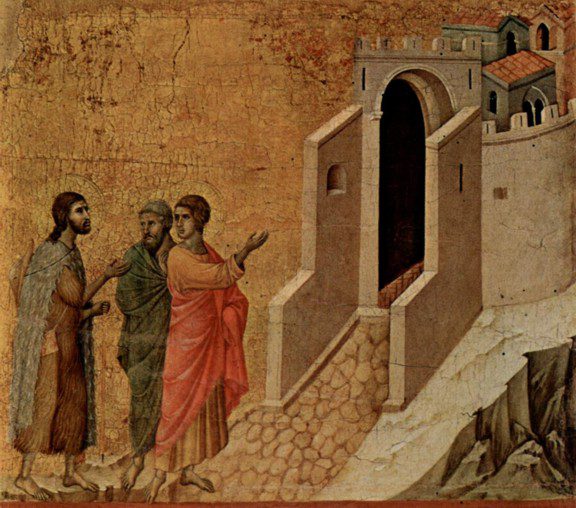 Luke 24 relates a story immediately following the resurrection account (image):

Now that same day two of them were going to a village called Emmaus, about seven miles from Jerusalem. They were talking with each other about everything that had happened. As they talked and discussed these things with each other, Jesus himself came up and walked along with them … He said to them, “How foolish you are, and how slow to believe all that the prophets have spoken! Did not the Messiah have to suffer these things and then enter his glory?” And beginning with Moses and all the Prophets, he explained to them what was said in all the Scriptures concerning himself. (v. 13-15, 25-27)
The Scriptures Jesus explained were in the writings we refer to as the Old Testament. The Old Testament Scriptures provide the context for understanding Jesus as Messiah. The disciples needed to be able to read these Scriptures in a new light. But what does this mean? What did Jesus tell his disciples? Walter Moberly, in Old Testament Theology: Reading the Hebrew Bible as Christian Scripture, digs into this issue focusing on Isaiah, but touching on other prophets as well.
The nature of prophecy. Many (most?) Christians have a rather distorted view of the role of prophecy in the Old Testament. There is no “Bible code” with messages foretelling specific events in the future. Prophetic speech in the Old Testament takes several forms – but this isn’t one.
Classical prophetic speech is a “moral and spiritual challenge that seeks response.” The prophet is focused on the present situation. “Correspondingly, the future is seen to be contingent in relation to the response given: God can take into account people’s responsiveness and not carry out the prophet’s warning or promise if the circumstances have changed.” (p. 147) Although Christians often take Deuteronomy 18:22 and Jeremiah 28:9 as proof texts for the accuracy of prophecy, these do not undercut this contingency. Jeremiah is facing a specific situation: As for the prophet who prophesies peace, when the word of that prophet comes true, then it will be known that the Lord has truly sent the prophet. Moses speaks of the future of Israel, but the curses and blessings of Moses himself were contingent on the responsiveness of the people.
This isn’t to completely deny the affirmation of specific events in the Old Testament, especially in the histories where subsequent events are said to “fulfill the words of the Lord.” Moberly points to Ahijah’s words to Jeroboam as an example (1 Kings 11:29-40, 12:15). “The fulfillment of the divine word within the course of human history is an important motif.” (p. 148) Of course the fulfillment here is not in some far off future, but in the lifetime of at least some of the persons involved.
Apocalyptic literature provides an outgrowth of prophecy. The visions in Daniel provide an example of the apocalyptic. The nature of apocalyptic literature is worth some discussion, but would sidetrack the main point – Isaiah and Jesus.
Isaiah is classical prophecy, a moral and spiritual challenge that seeks a response. As such it is grounded primarily in the contexts in which it was written. The Immanuel prophecy of 7:14 isn’t looking to the distant future but to immediate events. “Within the world of the text, the Jesus of the Gospels is not envisioned.” This is true of other key passages as well. But this doesn’t remove the Christological significance from the passage. There can be layers of meaning drawn from the text beyond the obvious first reading located in the original context. Later knowledge can change our reading of the older text. Moberly quotes David Steinmetz: “But I do not have to believe that Second Isaiah had an explicit knowledge of the crucifixion of Jesus of Nazareth to believe that he was part of a larger narrative that finds its final, though not its sole, meaning in Christ.” (p. 160)
This idea of layers of meaning is consistent with the way that New Testament authors use the Prophets. Matthew can truly claim that the birth of Jesus fulfills Isaiah 7:14 (Mt. 1:22-23) and that the side trip to Egypt fulfilled the words of Hosea in 11:1 “Out of Egypt I called my Son” despite the fact that Hosea is not making a prediction about some future individual. The triumphal entry fulfills Zechariah 9:9 although the prophet was speaking to current conditions not a distant future. Jesus is the center of a larger narrative that fulfills the sweep of Scripture. He is the faithful seed of Abraham, the faithful Israelite, the longed for faithful Davidic king who sets everything to rights – although in a far different manner than ever envisioned.
So what about Jesus and Isaiah? Moberly begins with Mary’s Magnificat. In Mary’s yet unborn son God has scattered the proud, brought down the powerful, exalted the lowly, filled the hungry and sent the rich away empty. The themes of exaltation and abasement run through Isaiah. Isaiah 2 is clear on this point. YHWH alone is exalted. The proud and haughty will be brought low. “The appeal is to “turn away from mortals” to cease to trust in human attempts at exaltation rather than walking in YHWH’s way.” And then: “The elevated mountain of the temple brings justice and peace for all under God. The exalted things that humans esteem and create lead to idolatrous priorities that issue in ultimate fear and debasement.” (p. 168) Among humans, those who are “humble and contrite in spirit” will be sought.
The faithful Davidic King and servant of YHWH continue the theme. The royal king of Isaiah 9:2-7 is “appropriately sharing in YHWH’s exaltation because of his practice of YHWH’s qualities.” (p. 173) He will establish and uphold the kingdom with justice and with righteousness. Justice and righteousness are divine qualities deserving of divine epithets … Wonderful Counselor, Mighty God, Everlasting Father, Prince of Peace. In the servant of YHWH in 52:13-53:12 the theme recurs. Despised and rejected by men and yet “He will be high and lifted up and greatly exalted.”
The servant is a supreme exemplar of motifs associated with exaltation and with what is required for exaltation, motifs in Isaiah as whole. Greatness, as symbolized by exaltation, whether it be for Zion as a whole, or for particular figures, is consistently construed by Isaiah in the moral and spiritual terms of faithfulness to God’s revealed will and the rejection of self-aggrandizement. (p. 175)
These themes resonate with the portrayal of Jesus in the New Testament … and with his words recorded in the Gospels. “Indeed, the idea of inverting usual priorities of exaltation and superiority lies at the very heart of Jesus’s teaching, not least with regard to his own mission and practice.” (p. 175-176) Matthew 23:12, Luke 14:11, 18:14, Mark 8:35, 9:35, 10:43-45, and most importantly the cross as a place of exaltation and glorification in John 12:32-33, 13:31-32. We could easily come up with more examples to flesh this out – John 13:1-17 for example. Paul repeats the theme in what may well be a very early hymn of the church, Philippians 2:5-11. Christ took on the nature of a servant and was exalted to the highest place.
The vision of “the day of YHWH” in Isaiah finds its meaning for Christians in Christ. Moberly concludes the chapter:
For Christians it is the coming of Jesus, supremely in his death and resurrection, which constitutes that which is final – not in the sense that history does not continue, but in the sense that God has definitively revealed and enacted His judgment on the world. This judgment is such that, at any subsequent point in this world or beyond, that which is revealed in the life, death, and resurrection of Jesus remains the ultimate yardstick by which human aspiration and endeavor is measured by God and either affirmed or found wanting. …
It thus becomes appropriate to see the self-revelation of God in Jesus as the supreme realization of Isaiah’s vision of “the day of YHWH.” This is one way of approaching John’s understanding of Jesus as the human face of God, such that Isaiah “saw his glory and spoke about him” (John 12:41). This is not what is envisioned in Isaiah’s own frame of reference. But this is how his subject matter can be understood and appropriated when his words are recontextualized as part of Christian Scripture. (p. 179)
The power of Isaiah in resonance with Jesus is not in a few apologetic proofs. That Isaiah did (or more likely did not) predict the virgin birth is neither here nor there. Although I am sure that there are aspects of Moberly’s view worthy of spirited discussion, the overall theme is important. Jesus is the fulfillment of the overarching themes and sweep of Scripture. This isn’t as easy as some simple check boxes or proof texts, but I find it far more deeply satisfying and convincing.
How do we see Jesus as the fulfillment of the Law and Prophets?
What does it mean to read the Prophets, especially Isaiah, as Christian Scripture?
If you wish to contact me directly, you may do so at rjs4mail[at]att.net
If interested you can subscribe to a full text feed of my posts at Musings on Science and Theology.
Previous Post

September 15, 2015
Top Ten Questions about Heaven
Next Post
September 15, 2015 Talk to the Children
Browse Our Archives
Select a Category Acts of the Apostles Adam Advent Anabaptism Angels Anglican Apologetics Atonement Baptism BCP Prayers Bible Biblical Studies Birds Blogging Bloglossary Bonhoeffer Books Calvinism Christianity Church Church History Coffee Colossians Commentary Recs Conversion Creation Creeds Culture Death Ecclesiastes Economics Education Embracing Grace Emergent Emerging Movement Eschatology Essays Ethics Eucharist Evangelicalism Family Fasting Fathers Fellowship of Differents Footsteps Tour Fun and Whimsical Gospel Grace Happiness Heaven Hell Holy Spirit Irenaeus James Jesus Jesus Creed Job Justification Kingdom of God Law Lectures Lent Liberalism Love and Marriage Mabanteneni Manhood Mary Miracles Missio Alliance MissioLife Missional Missional Jesus Movies and Film New Perspective Northern Seminary OneLife Origins Project Orthodox Parables Pastor's Spouse Pastoring and Leading Pastoring and Preaching Patristics Paul Paul-John Tour Pharisees Pietism Political Theology Prayer and Formation Preaching Problems for Faith Psalm 119 Psalms Public Issues Purgatory Religions Resurrection Revelation Romans Rule of JCreed Science and Faith Sermon on the Mount Sports Ten Commandments Theology Third Way Top Ten Lists Translations Uncategorized Universalism University Ministry Way Out Weekly Meanderings Wisdom Women and Ministry Work Worship Writing & Blogging Youth Ministry
Select a Month July 2021 January 2020 December 2019 November 2019 October 2019 September 2019 August 2019 July 2019 June 2019 May 2019 April 2019 March 2019 February 2019 January 2019 December 2018 November 2018 October 2018 September 2018 August 2018 July 2018 June 2018 May 2018 April 2018 March 2018 February 2018 January 2018 December 2017 November 2017 October 2017 September 2017 August 2017 July 2017 June 2017 May 2017 April 2017 March 2017 February 2017 January 2017 December 2016 November 2016 October 2016 September 2016 August 2016 July 2016 June 2016 May 2016 April 2016 March 2016 February 2016 January 2016 December 2015 November 2015 October 2015 September 2015 August 2015 July 2015 June 2015 May 2015 April 2015 March 2015 February 2015 January 2015 December 2014 November 2014 October 2014 September 2014 August 2014 July 2014 June 2014 May 2014 April 2014 March 2014 February 2014 January 2014 December 2013 November 2013 October 2013 September 2013 August 2013 July 2013 June 2013 May 2013 April 2013 March 2013 February 2013 January 2013 December 2012 November 2012 October 2012 September 2012 August 2012 July 2012 June 2012 May 2012 April 2012 March 2012 February 2012 January 2012 December 2011 November 2011 October 2011 September 2011 August 2011 July 2011 June 2011 May 2011 April 2011 March 2011 February 2011 January 2011 December 2010 November 2010 October 2010 September 2010 August 2010 July 2010 June 2010 May 2010 April 2010 March 2010 February 2010 January 2010 December 2009 November 2009 October 2009 September 2009 August 2009 July 2009 June 2009 May 2009 April 2009 March 2009 February 2009 January 2009 December 2008 November 2008 October 2008 September 2008 August 2008 July 2008 June 2008 May 2008 April 2008 March 2008 February 2008 January 2008 December 2007 November 2007 October 2007 September 2007 August 2007 July 2007 June 2007 May 2007 April 2007 March 2007 February 2007 January 2007 December 2006 November 2006 October 2006 September 2006 August 2006 July 2006 June 2006 May 2006 April 2006 March 2006 February 2006 January 2006 December 2005 November 2005 October 2005 September 2005 August 2005 July 2005 June 2005 May 2005 April 2005 0000
Follow Us!
TAKE THE
Religious Wisdom Quiz
What Christian denomination emphasizes "believer’s baptism"?
Select your answer to see how you score.
Presbyterians Baptists Lutherans Catholics
Related posts from Jesus Creed


The Gospel of With Us and Through Us

Northern Seminary Announces: Nijay Gupta Joins Faculty

The Gundrys and Me: Ruth Tucker
TRENDING AT PATHEOS Evangelical

The REST of Your Life: A Creative Wrestles...
This week I had a conversation with a good friend from church....

How the author of the world's best hymn...
I've been working with John Newton for a while now. This makes...

Long before this Lectio Divina, Psalm 130 - the song - started...

What About the Trees? Another Living Parable
After I finished writing the last article about falling leaves as a...

Why Classical Education Is a Conversation, Not a...
Come and Read: Joy in Classical Education When I was a little...

Cornell University has received a great deal of negative publicity and intense...
view all Evangelical blogs
Ad-Free & Subscriber Log-In Subscription Support
- About Us
- 2026 Calendar
- Videos
- Podcasts
- Library of World Religions
- Faith In Media Tracker
- Advertise With Us
- Write for Us
- Privacy Policy
- Terms of Service
- Do Not Sell My Data
- Contact Us
- Radiant Digital
- Manage Newsletter Subscriptions
- Unsubscribe From Notifications
- Sitemap
Copyright 2008-2026, Patheos. All rights reserved.
Subscription Support Ad-Free & Subscriber Log-In
Follow Patheos