
BuddhistCatholicContemplativeEvangelicalGeneral ChristianHinduJewishLatter-day SaintMuslimNew VisionsProgressive Christian
Beliefs
- Buddhist
- Catholic
- Contemplative
- Evangelical
- General Christian
- Hindu
- Jewish
- Latter-day Saint
- More Voices
- Muslim
- New Visions
- Pagan
- Progressive Christian
Topics
- Religion News
- Food and Religion
- Sports and Religion
- Religious Art
- Religious Music and Entertainment
- Religious Events
- History and Religion
- Style and Religion
- Politics and Religion
- Women in Religion
- Recreation Outdoors and Religion
- Business Finance and Religion
- Careers Workplace and Religion
- Education and Religion
- Family Parenting and Religion
- Health Fitness and Religion
- Home and Religion
- Relationships and Religion
- Technology and Religion
- Travel and Religion
Columnists
- Buddhist Columnists
- Business Finance and Religion Columnists
- Careers Workplace and Religion Columnists
- Catholic Columnists
- Contemplative Columnists
- Education and Religion Columnists
- Evangelists Columnists
- Family Parenting and Religion Columnists
- General Christian Columnists
- Health Fitness and Religion Columnists
- Hindu Columnists
- History and Religion Columnists
- Home and Religion Columnists
- Jewish Columnists
- More Voices Columnists
- Latter Day Columnists
- Muslim Columnists
- New Visions Columnists
- Nonreligious Columnists
- Pagan Columnists
- Politics and Religion Columnists
- Progressive Columnists
- Recreation Outdoors and Religion Columnists
- Relationships and Religion Columnists
- Religion News Columnists
- Religious Art Columnists
- Religious Events Columnists
- Religious Music and Entertainment Columnists
- Sports and Religion Columnists
- Style and Religion Columnists
- Technology and Religion Columnists
- Travel and Religion Columnists
- Women in Religion Columnists
Resource Library
- 2026 Calendar
- Library of World Religions
- The 100 Most Holy Places on Earth
- Patheos Answers
- Podcasts
- Videos
- Faith Leaders Database
- Anglican Episcopalian
- Bahai
- Baptist
- Buddhism
- Christianity
- Confucianism
- Eastern Orthodoxy
- Hinduism
- Holiness and Pentecostal
- ISKCON
- Islam
- Judaism
- Lutheran
- Methodist
- The Church of Jesus Christ of Latter-day Saints
- New Age
- Paganism
- Presbytarian and Reformed
- Protestantism
- Religion Behind the Scenes
- Roman Catholic
- Scientology
- Shia Islam
- Sikhism
- Sufism
- Sunni Islam
- Taoism
- Zen
- See all religions
Research Tools
 Ad-Free & Subscriber Log-In Subscription Support
Ad-Free & Subscriber Log-In Subscription Support
Follow Patheos 

- Trending:
- Forgiveness
- |
- Marriage
- |
- Consciousness
- |
- Death Penalty
- |
- Election
- |
- Halloween
 Jesus Creed
- Home
- Evangelical
- I Dare You to Change! (RJS)
I Dare You to Change! (RJS)
Last updated on: August 6, 2015 at 6:44 am by RJS
I Dare You to Change! (RJS) 2015-08-06T06:44:55-05:00 RJS
Patheos Explore the world's faith through different perspectives on religion and spirituality! Patheos has the views of the prevalent religions and spiritualities of the world.
 Change is hard. Changing a position on any significant issue involves a disruption of social networks. This disruption can be painful. Today I would like to highlight two projects connected to the BioLogos Evolution and Christian Faith program that deal with the issues surrounding change.
Justin Topp, involved with Craig Story in the project Moving Pastors Toward Scientific Literacy, had an interesting post on the BioLogos blog last week: Creation and Evolution “Research Programs” (And Why It’s So Hard to Change Perspectives). In this post he is focused on analyzing the approaches that different groups take to the questions of evolution and Christian faith and the way these approaches control perspective. To lend context to the discussion he tells some of his story moving from a young earth creationist view to an evolutionary creation approach. The post is well worth reading.
Justin includes a table outlining what he sees as the three core positions or “research programs” at play in the discussion of evolution and creation.
To provide a better context to the reader, I have taken the liberty of constructing what I see are the three main research programs that are most relevant to the creation-evolution discussion for Evangelicals (see table). As a reminder, the “core hypothesis” is a thesis that is unchangeable and to which the researcher commits at all costs. Everything else within the research program is designed to connect (or protect) the core hypothesis to data that supports (or refutes) the central theory.
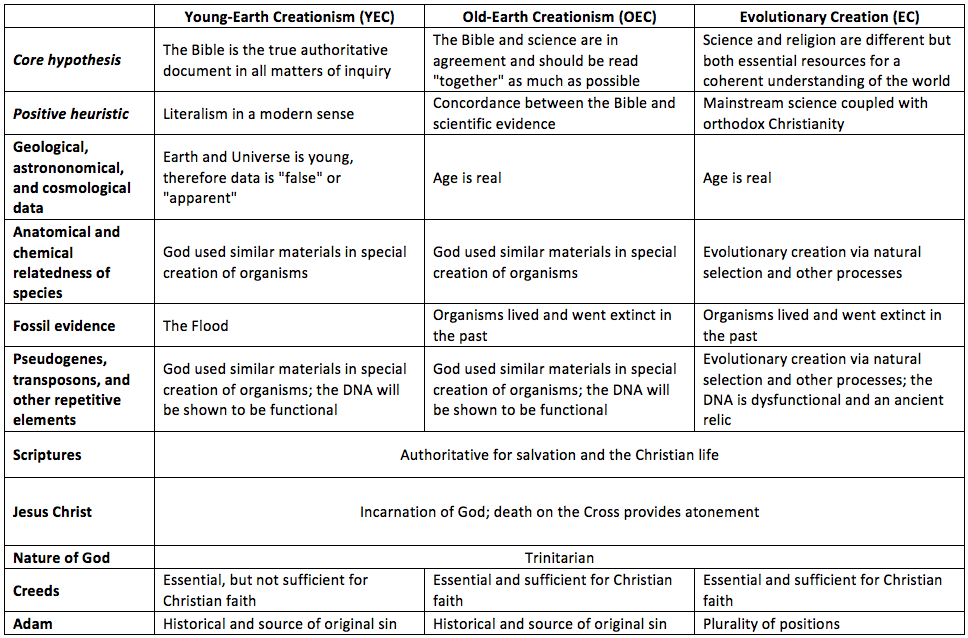 These are broad categories and there are subdivisions within these groups, especially within the evolutionary creation program, but the overall scheme seems accurate. There is substantial agreement on what might seem to be the core issues (Jesus Christ and the nature of God), and even on the authority of scripture, although the hermeneutical approach differs in the three programs. In fact, the approach to an understanding of the Bible and the way it should be interpreted defines the core position of both the young earth and old earth creationist programs. In contrast, the evolutionary creation program is driven less by a specific approach to biblical interpretation and more by a desire (need) to accommodate what are seen as the well supported conclusions of science into a Christian world view. This leads to the frequent charge that those of us who support evolutionary creation are letting science take the drivers seat.
Justin describes a little of his journey from young earth creation to evolutionary creation in his post. My story is different. Although I was raised in a Christian family and in the church I was never a convinced young earth creationist or even a convinced old earth creationist. Our church did not take an official position and the pastor in subtle ways discouraged the young earth position. Still, the underlying approach to scripture was enough to raise issues in my mind. After struggling with the apparent conflicts in college and graduate school I settled into a bracketed approach – science was my vocation and avocation (I am a professor and active in research). Christianity defined my life, but was more-or-less separated from most of my day-to-day life because it seemed impossible to bring the two together. Today I have a much healthier evolutionary creation approach that brings everything together in a much more coherent fashion. My reading and writing, here and elsewhere, is directed toward exploring the issues and figuring out how all this can fit together.
But there are social costs, both in my profession and in the church.
Resistance to Change. Much of what we believe about the interaction between science and Christian faith is driven by social context and ties. This can be driven by positive acceptance and belonging or by negative rhetoric shaping the group, or both. Despite the fundamental agreements, the relationship between those who hold the three positions described above is often less than harmonious. Those who accept the mainstream scientific conclusions often view young earth creationists as ignorant, part of the problem, and a hindrance to faith. Young earth creationists in turn view those who accept evolutionary creation as dangerous, false prophets, and wolves in sheep’s clothing.
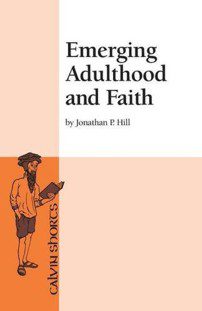 Jonathan Hill, a sociology professor at Calvin College, received funding for his project Support for the National Longitudinal Study of Religion and Human Origins. Jonathan has a new book Emerging Adulthood and Faith derived from his survey research on the faith of young adults. The final chapter of this short book, Blinding Them with Science, focuses on the change (or lack of change) young adults evidence toward questions of evolution and human origins as they move from childhood to adulthood. I may post on more of Jonathan’s conclusions in the future, but for today’s post I want to look only at his conclusions about change.
Most of us don’t make entirely rational data-driven choices about beliefs – whether Christian faith, evolution, global warming, or the need for vaccination. From Jonathan’s book:
When people change their beliefs about human origins, it usually will be found alongside other social changes: Friendship networks, relationships with family members, and participation in certain religious communities are altered as well. It is much more plausible that these social changes are actually the driving force in changing beliefs about the relationship between science and religion. In other words, framing the significant change about beliefs regarding human origins as primarily an intellectual puzzle which individuals deal with in isolation (which is true of both the models that began this chapter) is not the best way to understand the problem. While that model may be true for a select few people who are seriously engaged in the intellectual debates about science and religion, for the vast majority of young people, this is simply not how they arrive at their beliefs.
… People come to accept or reject evolution not as a result of pouring over the details and evidence, but as a symbolic gesture to indicate to others where they belong in the socio-political landscape. This requires understanding that religious beliefs, and beliefs about other contentious public issues, are intertwined with identity and social relationships. Formal science education, for most young people, is unlikely to change this. (p. 56-57)
One take away message from this is that church is incredibly important. It is not simply a place for worship, but a community that shapes people. The structure, priorities, and social environment of a church shapes the way disciples of Christ are formed. This should receive more attention than it often does. More to the point of this post though, any change in the evangelical community on the questions of science and faith will not be driven by logical argument and data alone. It will only come from trust and community.
If you disagree with my evolutionary creation point of view, take comfort in this: if your friendship, family, and fellowship networks are grounded in a more restrictive position, the science that I and my colleagues teach is not likely to have much impact.
Do Justin’s classifications make sense? What might you change?
What drives a change in views on evolution or any other issue? What led you to change your position?
How should the church respond?
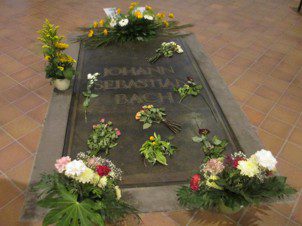 The image at the top of the post was taken in Thomas Kirche in Leipzig, where Johann Sebastian Bach was music director and is now buried.
If you wish to contact me directly, you may do so at rjs4mail[at]att.net
If interested you can subscribe to a full text feed of my posts at Musings on Science and Theology.
Previous Post

August 6, 2015
Harper Lee's Original Novel (or was it?)
Next Post
August 6, 2015 In the Heartland with the Fellowship of Evangelical Churches
Browse Our Archives
Select a Category Acts of the Apostles Adam Advent Anabaptism Angels Anglican Apologetics Atonement Baptism BCP Prayers Bible Biblical Studies Birds Blogging Bloglossary Bonhoeffer Books Calvinism Christianity Church Church History Coffee Colossians Commentary Recs Conversion Creation Creeds Culture Death Ecclesiastes Economics Education Embracing Grace Emergent Emerging Movement Eschatology Essays Ethics Eucharist Evangelicalism Family Fasting Fathers Fellowship of Differents Footsteps Tour Fun and Whimsical Gospel Grace Happiness Heaven Hell Holy Spirit Irenaeus James Jesus Jesus Creed Job Justification Kingdom of God Law Lectures Lent Liberalism Love and Marriage Mabanteneni Manhood Mary Miracles Missio Alliance MissioLife Missional Missional Jesus Movies and Film New Perspective Northern Seminary OneLife Origins Project Orthodox Parables Pastor's Spouse Pastoring and Leading Pastoring and Preaching Patristics Paul Paul-John Tour Pharisees Pietism Political Theology Prayer and Formation Preaching Problems for Faith Psalm 119 Psalms Public Issues Purgatory Religions Resurrection Revelation Romans Rule of JCreed Science and Faith Sermon on the Mount Sports Ten Commandments Theology Third Way Top Ten Lists Translations Uncategorized Universalism University Ministry Way Out Weekly Meanderings Wisdom Women and Ministry Work Worship Writing & Blogging Youth Ministry
Select a Month July 2021 January 2020 December 2019 November 2019 October 2019 September 2019 August 2019 July 2019 June 2019 May 2019 April 2019 March 2019 February 2019 January 2019 December 2018 November 2018 October 2018 September 2018 August 2018 July 2018 June 2018 May 2018 April 2018 March 2018 February 2018 January 2018 December 2017 November 2017 October 2017 September 2017 August 2017 July 2017 June 2017 May 2017 April 2017 March 2017 February 2017 January 2017 December 2016 November 2016 October 2016 September 2016 August 2016 July 2016 June 2016 May 2016 April 2016 March 2016 February 2016 January 2016 December 2015 November 2015 October 2015 September 2015 August 2015 July 2015 June 2015 May 2015 April 2015 March 2015 February 2015 January 2015 December 2014 November 2014 October 2014 September 2014 August 2014 July 2014 June 2014 May 2014 April 2014 March 2014 February 2014 January 2014 December 2013 November 2013 October 2013 September 2013 August 2013 July 2013 June 2013 May 2013 April 2013 March 2013 February 2013 January 2013 December 2012 November 2012 October 2012 September 2012 August 2012 July 2012 June 2012 May 2012 April 2012 March 2012 February 2012 January 2012 December 2011 November 2011 October 2011 September 2011 August 2011 July 2011 June 2011 May 2011 April 2011 March 2011 February 2011 January 2011 December 2010 November 2010 October 2010 September 2010 August 2010 July 2010 June 2010 May 2010 April 2010 March 2010 February 2010 January 2010 December 2009 November 2009 October 2009 September 2009 August 2009 July 2009 June 2009 May 2009 April 2009 March 2009 February 2009 January 2009 December 2008 November 2008 October 2008 September 2008 August 2008 July 2008 June 2008 May 2008 April 2008 March 2008 February 2008 January 2008 December 2007 November 2007 October 2007 September 2007 August 2007 July 2007 June 2007 May 2007 April 2007 March 2007 February 2007 January 2007 December 2006 November 2006 October 2006 September 2006 August 2006 July 2006 June 2006 May 2006 April 2006 March 2006 February 2006 January 2006 December 2005 November 2005 October 2005 September 2005 August 2005 July 2005 June 2005 May 2005 April 2005 0000
Follow Us!
TAKE THE
Religious Wisdom Quiz
Who said, "I am the resurrection and the life"?
Select your answer to see how you score.
Peter Paul Jesus Moses
Related posts from Jesus Creed


The Gospel of With Us and Through Us

Northern Seminary Announces: Nijay Gupta Joins Faculty

The Gundrys and Me: Ruth Tucker
TRENDING AT PATHEOS Evangelical

The REST of Your Life: A Creative Wrestles...
This week I had a conversation with a good friend from church....

How the author of the world's best hymn...
I've been working with John Newton for a while now. This makes...

Long before this Lectio Divina, Psalm 130 - the song - started...

What About the Trees? Another Living Parable
After I finished writing the last article about falling leaves as a...

Why Classical Education Is a Conversation, Not a...
Come and Read: Joy in Classical Education When I was a little...

Cornell University has received a great deal of negative publicity and intense...
view all Evangelical blogs
Ad-Free & Subscriber Log-In Subscription Support
- About Us
- 2026 Calendar
- Videos
- Podcasts
- Library of World Religions
- Faith In Media Tracker
- Advertise With Us
- Write for Us
- Privacy Policy
- Terms of Service
- Do Not Sell My Data
- Contact Us
- Radiant Digital
- Manage Newsletter Subscriptions
- Unsubscribe From Notifications
- Sitemap
Copyright 2008-2026, Patheos. All rights reserved.
Subscription Support Ad-Free & Subscriber Log-In
Follow Patheos