
BuddhistCatholicContemplativeEvangelicalGeneral ChristianHinduJewishLatter-day SaintMuslimNew VisionsProgressive Christian
Beliefs
- Buddhist
- Catholic
- Contemplative
- Evangelical
- General Christian
- Hindu
- Jewish
- Latter-day Saint
- More Voices
- Muslim
- New Visions
- Pagan
- Progressive Christian
Topics
- Religion News
- Food and Religion
- Sports and Religion
- Religious Art
- Religious Music and Entertainment
- Religious Events
- History and Religion
- Style and Religion
- Politics and Religion
- Women in Religion
- Recreation Outdoors and Religion
- Business Finance and Religion
- Careers Workplace and Religion
- Education and Religion
- Family Parenting and Religion
- Health Fitness and Religion
- Home and Religion
- Relationships and Religion
- Technology and Religion
- Travel and Religion
Columnists
- Buddhist Columnists
- Business Finance and Religion Columnists
- Careers Workplace and Religion Columnists
- Catholic Columnists
- Contemplative Columnists
- Education and Religion Columnists
- Evangelists Columnists
- Family Parenting and Religion Columnists
- General Christian Columnists
- Health Fitness and Religion Columnists
- Hindu Columnists
- History and Religion Columnists
- Home and Religion Columnists
- Jewish Columnists
- More Voices Columnists
- Latter Day Columnists
- Muslim Columnists
- New Visions Columnists
- Nonreligious Columnists
- Pagan Columnists
- Politics and Religion Columnists
- Progressive Columnists
- Recreation Outdoors and Religion Columnists
- Relationships and Religion Columnists
- Religion News Columnists
- Religious Art Columnists
- Religious Events Columnists
- Religious Music and Entertainment Columnists
- Sports and Religion Columnists
- Style and Religion Columnists
- Technology and Religion Columnists
- Travel and Religion Columnists
- Women in Religion Columnists
Resource Library
- 2026 Calendar
- Library of World Religions
- The 100 Most Holy Places on Earth
- Patheos Answers
- Podcasts
- Videos
- Faith Leaders Database
- Anglican Episcopalian
- Bahai
- Baptist
- Buddhism
- Christianity
- Confucianism
- Eastern Orthodoxy
- Hinduism
- Holiness and Pentecostal
- ISKCON
- Islam
- Judaism
- Lutheran
- Methodist
- The Church of Jesus Christ of Latter-day Saints
- New Age
- Paganism
- Presbytarian and Reformed
- Protestantism
- Religion Behind the Scenes
- Roman Catholic
- Scientology
- Shia Islam
- Sikhism
- Sufism
- Sunni Islam
- Taoism
- Zen
- See all religions
Research Tools
 Ad-Free & Subscriber Log-In Subscription Support
Ad-Free & Subscriber Log-In Subscription Support
Follow Patheos 

- Trending:
- Forgiveness
- |
- Marriage
- |
- Consciousness
- |
- Death Penalty
- |
- Election
- |
- Halloween
 Jesus Creed
- Home
- Evangelical
- Bread From Heaven in the Desert (RJS)
Bread From Heaven in the Desert (RJS)
Last updated on: June 4, 2015 at 6:56 am by RJS
Bread From Heaven in the Desert (RJS) 2015-06-04T06:56:21-05:00 RJS
Patheos Explore the world's faith through different perspectives on religion and spirituality! Patheos has the views of the prevalent religions and spiritualities of the world.
 The next chapter of Walter Moberly’s book Old Testament Theology: Reading the Hebrew Bible as Christian Scripture looks at Exodus 16 and the provision of manna in the wilderness.
In the desert the whole community grumbled against Moses and Aaron. The Israelites said to them, “If only we had died by the Lord’s hand in Egypt! There we sat around pots of meat and ate all the food we wanted, but you have brought us out into this desert to starve this entire assembly to death.”
Then the Lord said to Moses, “I will rain down bread from heaven for you. The people are to go out each day and gather enough for that day. In this way I will test them and see whether they will follow my instructions. On the sixth day they are to prepare what they bring in, and that is to be twice as much as they gather on the other days.”
The Israelites ate manna forty years, until they came to a land that was settled; they ate manna until they reached the border of Canaan. (Exodus 16:3-5,35)
This is a powerfully important story in the history of God’s interaction with Israel that carries over to his mission among all who call on his name.
It is also a story that raises questions. What was manna and how did God provide it? The modern approach is to look for some “scientific” source of this food with the suggestion that it was the sap of a tamarisk tree defended by some. Here Moberly cites Colin Humphrey’s discussion in The Miracles of Exodus: A Scientist’s Discovery of the Extraordinary Natural Causes of the Biblical Stories. But this really isn’t satisfactory, and answer many of the questions raised by Exodus. If we take the numbers literally there were some 2+ million people in the group, 600,000 men plus women and children, and livestock (c.f. 12:3, 17:3). The sap of tamarisk trees in the desert will not feed a group of this size.
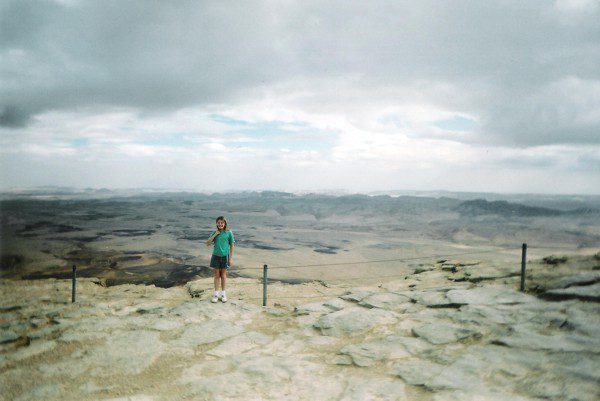
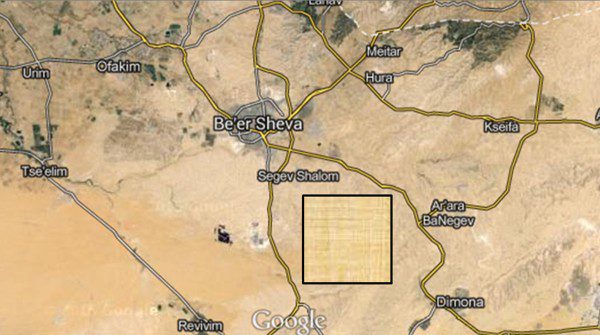 To put this in perspective, at approximately the population density of New York City (8.5 million in 790 km2) two million people require 185 km2. We’ll pack them into 100 km2 – a square 10 km on a side as shown on a screen image map of the Negev. This allows each person (never mind the livestock) a space about 7 m by 7 m. (The present day population of Be’er Sheva is under 200,000.) This is an enormous group wandering in a pretty inhospitable wilderness. The picture at the top of the post is in the Negev. This isn’t exactly the area referred to in Exodus 16. But the whole region is desert, and my impression was that it makes the Arizona desert look quite lush. For the most part it seemed more like the badlands of South Dakota.
In fact though, the enumeration of 600,000 men isn’t consistent with the general tone of the Exodus narrative, which often implies a group of a few thousand. Moberly looks as an example at the last verse of chapter 15 after the Israelites had complained about the supply of water and God provided drinkable water: “Then they came to Elim, where there were twelve springs and seventy palm trees, and they camped there near the water.” The implication is that this was an oasis of plenty – and it is plenty for a more modest sized group, but not for 2 million people, complete with livestock.
Nor could Moses speak simultaneously to a group of this size, although the text portrays him as speaking to the Israelites as a whole on multiple occasions. Imagine Moses and Aaron on the field of Michigan Stadium speaking without the aid of amplifiers and then multiply the size of the stands by 20 (or by a factor of 6 if he only addresses the men).
And despite the people’s constant complaints concerning food and water, they had livestock for feasting and sacrifice when Aaron shaped the golden calf for them (32:6).
These details make us look twice at the text. The numbers might be symbolic, or a mistranslation, or an exaggeration. Or they might be anachronism … numbers from a later time written into the text “presumably through the assumption of a continuity between Israel past and present.” (p. 90) Moberly is inclined toward the later explanation. But this isn’t the point of the text. This is a foundational story of the people of Israel, following God through the wilderness. Most likely it is a story passed along orally before it was written down.
Whatever the origins of the narrative, as the narrative is handed on and retold, it acquires ever greater coloring from the contexts of its retelling. This is because the narrative is seen to be a suitable vehicle for the expression of certain recurrent existential issues and questions of identity that are important to the people who cherish the narrative. Because of such a history of prior use, the narrative in its received form may relate somewhat somewhat loosely to its received literary contextualization. One consequence is that it is usually more or less impossible to separate out, or reconstruct, the different elements that have come to constitute the narrative, though sometimes anachronisms can give some clues. (p. 93)
This is an explanation that won’t sit well with many evangelicals, as it is not consistent with our general expectation of inerrant divine revelation. Is it possible that the problem is our expectation of the text rather than with the received text?
What this means for our reading. In any event, Moberly points out that this suggestion that the narrative has a history of being shaped in retelling, if true, has a number of ramifications on the way that we should approach the text. (p. 94)
- First, the large number of Israel as in the millions should not be introduced into one’s imagination with the manna story.
- Second, livestock should not be presumed to be present within the manna story, for this becomes an example of how a story that has had its own history of use may relate somewhat loosely to its received literary contextualization. … [T]he contemporary theologically engaged reader should resist the temptation to produce an integration of divergent narrative elements
In other words we should read the story for the meaning it contains and not worry about harmonizing all the elements of the narrative with other parts of Exodus or the Pentateuch. Yes we can, and should, synthesize the biblical narrative. There is a theme. But heavy-handed harmonization if a mistake. “If in some places a diamond is polished and in other places it is rough, it still remains a diamond.”
- Third, an instinct to rationalize manna as a natural phenomenon … should be resisted as a category mistake.
We should read the multi-layered manna story canonically, and for its theological significance. This doesn’t deny a historical root to the story, but rather leads us away from fixating on (inconsistent) details to concentrating on the big picture.
Some of the lessons to be learned:
Not by Bread Alone. Deuteronomy 8 gives a lesson to be learned from the provision of manna.
He humbled you, causing you to hunger and then feeding you with manna, which neither you nor your ancestors had known, to teach you that man does not live on bread alone but on every word that comes from the mouth of the Lord.
It is through having their hunger met thus that Israel is opened to learning a fundamental principle about human life; not by bread alone is human life sustained, but by responsiveness to the divine will. Material needs are affirmed, but qualified. … One may not unreasonably see significance in the use of the generic ‘ādām, “humanity.” rather than simply “Israel,” as making the point that what Israel learns in this particular way is in a principle of universal applicability. (p. 97)
Jesus articulates this principle of responsiveness to divine will when he quotes this passage when in the desert, hungry, and tempted. He is the faithful Israelite in a situation when they were not. (Mt 4, Lk 4)
The Bread of Life. In John 6:39-58 the people ask Jesus for a sign and refer to the provision of manna in the wilderness. Jesus turns this around and connects it to himself as the bread of life.
Just as the living Father sent me and I live because of the Father, so the one who feeds on me will live because of me. This is the bread that came down from heaven. Your ancestors ate manna and died, but whoever feeds on this bread will live forever. (v. 57-58)
This takes the interaction with the story of Exodus 16 a bit further. Jesus himself is the bread of life.
Trust God Afresh. Moberly points to the discipline of daily living in Exodus 16. The people are called to trust on God afresh every morning. They are not to store up for themselves, for God will provide. Although the circumstance and means of God’s provision changes once the Israelites enter the promised land, the need to trust God afresh every morning doesn’t change. The seven day pattern with a double portion on the sixth followed by a sabbath rest is also an important part of this discipline of dependence on God.
According to Need. There is also the significance of the fair distribution. In Exodus 16:17-18 we read:
The Israelites did as they were told; some gathered much, some little. And when they measured it by the omer, the one who gathered much did not have too much, and the one who gathered little did not have too little. Everyone had gathered just as much as they needed.
Paul picks up on this in 2 Cor. 8:13-15 and takes seriously the implications of the story. Moberly suggests that Paul sees the ready and willing desire to share from abundance and necessity of provision for all in a “fair balance” or as the NIV puts it with “equality” as “embodying an enduring spiritual principle for God’s people.” (p. 105)
Exodus 16 is a powerful and multidimensional text with a long and powerful interpretative history and many lessons yet for us today. The point isn’t to apply “science” to the story, but to listen and understand.
Do the apparently inconsistent details in the Exodus account raise questions in your mind? If so how can they be resolved?
What promise or problem do you see with Moberly’s suggestion that the received narrative has been shaped by retelling?
What is the theological significance of the text?
If you wish to contact me, you may do so at rjs4mail[at]att.net.
If interested you can subscribe to a full text feed of my posts at Musings on Science and Theology.
Previous Post

June 4, 2015
The Changing Face of Friendship
Next Post
June 5, 2015 Christians Influencing Society
Browse Our Archives
Select a Category Acts of the Apostles Adam Advent Anabaptism Angels Anglican Apologetics Atonement Baptism BCP Prayers Bible Biblical Studies Birds Blogging Bloglossary Bonhoeffer Books Calvinism Christianity Church Church History Coffee Colossians Commentary Recs Conversion Creation Creeds Culture Death Ecclesiastes Economics Education Embracing Grace Emergent Emerging Movement Eschatology Essays Ethics Eucharist Evangelicalism Family Fasting Fathers Fellowship of Differents Footsteps Tour Fun and Whimsical Gospel Grace Happiness Heaven Hell Holy Spirit Irenaeus James Jesus Jesus Creed Job Justification Kingdom of God Law Lectures Lent Liberalism Love and Marriage Mabanteneni Manhood Mary Miracles Missio Alliance MissioLife Missional Missional Jesus Movies and Film New Perspective Northern Seminary OneLife Origins Project Orthodox Parables Pastor's Spouse Pastoring and Leading Pastoring and Preaching Patristics Paul Paul-John Tour Pharisees Pietism Political Theology Prayer and Formation Preaching Problems for Faith Psalm 119 Psalms Public Issues Purgatory Religions Resurrection Revelation Romans Rule of JCreed Science and Faith Sermon on the Mount Sports Ten Commandments Theology Third Way Top Ten Lists Translations Uncategorized Universalism University Ministry Way Out Weekly Meanderings Wisdom Women and Ministry Work Worship Writing & Blogging Youth Ministry
Select a Month July 2021 January 2020 December 2019 November 2019 October 2019 September 2019 August 2019 July 2019 June 2019 May 2019 April 2019 March 2019 February 2019 January 2019 December 2018 November 2018 October 2018 September 2018 August 2018 July 2018 June 2018 May 2018 April 2018 March 2018 February 2018 January 2018 December 2017 November 2017 October 2017 September 2017 August 2017 July 2017 June 2017 May 2017 April 2017 March 2017 February 2017 January 2017 December 2016 November 2016 October 2016 September 2016 August 2016 July 2016 June 2016 May 2016 April 2016 March 2016 February 2016 January 2016 December 2015 November 2015 October 2015 September 2015 August 2015 July 2015 June 2015 May 2015 April 2015 March 2015 February 2015 January 2015 December 2014 November 2014 October 2014 September 2014 August 2014 July 2014 June 2014 May 2014 April 2014 March 2014 February 2014 January 2014 December 2013 November 2013 October 2013 September 2013 August 2013 July 2013 June 2013 May 2013 April 2013 March 2013 February 2013 January 2013 December 2012 November 2012 October 2012 September 2012 August 2012 July 2012 June 2012 May 2012 April 2012 March 2012 February 2012 January 2012 December 2011 November 2011 October 2011 September 2011 August 2011 July 2011 June 2011 May 2011 April 2011 March 2011 February 2011 January 2011 December 2010 November 2010 October 2010 September 2010 August 2010 July 2010 June 2010 May 2010 April 2010 March 2010 February 2010 January 2010 December 2009 November 2009 October 2009 September 2009 August 2009 July 2009 June 2009 May 2009 April 2009 March 2009 February 2009 January 2009 December 2008 November 2008 October 2008 September 2008 August 2008 July 2008 June 2008 May 2008 April 2008 March 2008 February 2008 January 2008 December 2007 November 2007 October 2007 September 2007 August 2007 July 2007 June 2007 May 2007 April 2007 March 2007 February 2007 January 2007 December 2006 November 2006 October 2006 September 2006 August 2006 July 2006 June 2006 May 2006 April 2006 March 2006 February 2006 January 2006 December 2005 November 2005 October 2005 September 2005 August 2005 July 2005 June 2005 May 2005 April 2005 0000
Follow Us!
TAKE THE
Religious Wisdom Quiz
True or False: In Revelation, the New Jerusalem has ten gates, each made of a single pearl.
Select your answer to see how you score.
FALSE TRUE
Related posts from Jesus Creed


The Gospel of With Us and Through Us

Northern Seminary Announces: Nijay Gupta Joins Faculty

The Gundrys and Me: Ruth Tucker
TRENDING AT PATHEOS Evangelical

The REST of Your Life: A Creative Wrestles...
This week I had a conversation with a good friend from church....

How the author of the world's best hymn...
I've been working with John Newton for a while now. This makes...

Long before this Lectio Divina, Psalm 130 - the song - started...

What About the Trees? Another Living Parable
After I finished writing the last article about falling leaves as a...

Why Classical Education Is a Conversation, Not a...
Come and Read: Joy in Classical Education When I was a little...

Cornell University has received a great deal of negative publicity and intense...
view all Evangelical blogs
Ad-Free & Subscriber Log-In Subscription Support
- About Us
- 2026 Calendar
- Videos
- Podcasts
- Library of World Religions
- Faith In Media Tracker
- Advertise With Us
- Write for Us
- Privacy Policy
- Terms of Service
- Do Not Sell My Data
- Contact Us
- Radiant Digital
- Manage Newsletter Subscriptions
- Unsubscribe From Notifications
- Sitemap
Copyright 2008-2026, Patheos. All rights reserved.
Subscription Support Ad-Free & Subscriber Log-In
Follow Patheos