
BuddhistCatholicContemplativeEvangelicalGeneral ChristianHinduJewishLatter-day SaintMuslimNew VisionsProgressive Christian
Beliefs
- Buddhist
- Catholic
- Contemplative
- Evangelical
- General Christian
- Hindu
- Jewish
- Latter-day Saint
- More Voices
- Muslim
- New Visions
- Pagan
- Progressive Christian
Topics
- Religion News
- Food and Religion
- Sports and Religion
- Religious Art
- Religious Music and Entertainment
- Religious Events
- History and Religion
- Style and Religion
- Politics and Religion
- Women in Religion
- Recreation Outdoors and Religion
- Business Finance and Religion
- Careers Workplace and Religion
- Education and Religion
- Family Parenting and Religion
- Health Fitness and Religion
- Home and Religion
- Relationships and Religion
- Technology and Religion
- Travel and Religion
Columnists
- Buddhist Columnists
- Business Finance and Religion Columnists
- Careers Workplace and Religion Columnists
- Catholic Columnists
- Contemplative Columnists
- Education and Religion Columnists
- Evangelists Columnists
- Family Parenting and Religion Columnists
- General Christian Columnists
- Health Fitness and Religion Columnists
- Hindu Columnists
- History and Religion Columnists
- Home and Religion Columnists
- Jewish Columnists
- More Voices Columnists
- Latter Day Columnists
- Muslim Columnists
- New Visions Columnists
- Nonreligious Columnists
- Pagan Columnists
- Politics and Religion Columnists
- Progressive Columnists
- Recreation Outdoors and Religion Columnists
- Relationships and Religion Columnists
- Religion News Columnists
- Religious Art Columnists
- Religious Events Columnists
- Religious Music and Entertainment Columnists
- Sports and Religion Columnists
- Style and Religion Columnists
- Technology and Religion Columnists
- Travel and Religion Columnists
- Women in Religion Columnists
Resource Library
- 2026 Calendar
- Library of World Religions
- The 100 Most Holy Places on Earth
- Patheos Answers
- Podcasts
- Videos
- Faith Leaders Database
- Anglican Episcopalian
- Bahai
- Baptist
- Buddhism
- Christianity
- Confucianism
- Eastern Orthodoxy
- Hinduism
- Holiness and Pentecostal
- ISKCON
- Islam
- Judaism
- Lutheran
- Methodist
- The Church of Jesus Christ of Latter-day Saints
- New Age
- Paganism
- Presbytarian and Reformed
- Protestantism
- Religion Behind the Scenes
- Roman Catholic
- Scientology
- Shia Islam
- Sikhism
- Sufism
- Sunni Islam
- Taoism
- Zen
- See all religions
Research Tools
 Ad-Free & Subscriber Log-In Subscription Support
Ad-Free & Subscriber Log-In Subscription Support
Follow Patheos 

- Trending:
- Forgiveness
- |
- Marriage
- |
- Consciousness
- |
- Death Penalty
- |
- Election
- |
- Halloween
 Jesus Creed
- Home
- Evangelical
- The Significance of the End: Death, Judgement, Heaven and Hell (RJS)
The Significance of the End: Death, Judgement, Heaven and Hell (RJS)
Last updated on: April 28, 2015 at 6:11 am by RJS
The Significance of the End: Death, Judgement, Heaven and Hell (RJS) 2015-04-28T06:11:41-05:00 RJS
Patheos Explore the world's faith through different perspectives on religion and spirituality! Patheos has the views of the prevalent religions and spiritualities of the world.
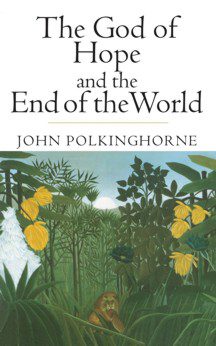 The last couple of chapters in John Polkinghorne’s book The God of Hope and the End of the World deal with the four last things (death, judgment, heaven, and hell) and with their significance. There is something of a divide within the church … between those who preach hell, fire, and brimstone and those who find such ideas part of a barbaric past we’ve out grown. Now this is a caricature of course, but there is a tendency to either overemphasize coming judgment or to dismiss it altogether. John Polkinghorne counters: “Those of us who adopt the more balanced stance of an inaugurated eschatology will not be content with a neglect of the Four Last Things.” (p. 124) His penultimate chapter is structured around these four things.
Death. Death, in Christian thinking, is an evil to be overcome. It is a darkness that is accepted in the light and hope of the resurrection. Polkinghorne points out that even Jesus in the Garden of Gethsemane experienced a reluctance in the face of mortality. Humans were not created immortal, but there is a bitterness to mortality that accompanies a broken connection with God.
As self-consciousness dawned – itself a process as difficult to envision as it is certain that it happened – there would surely also have dawned a form of God-consciousness. The episode that theologians call the Fall can then be understood as a turning away from God into the human self, by which our ancestors became curved in upon themselves and alienated from the divine reality. This was not the cause of physical death but it gave to that experience the spiritual dimension of mortality. Self-conscious beings could anticipate their future death, but at the same time they had become divorced from the God who is the only hope of a destiny beyond that death. (p. 126)
This life lived is significant, and we should make every effort to be “right with God” and to proclaim and teach the gospel. Polkinghorne does not think, however, that an “iron curtain comes down at death” with no subsequent opportunity for repentance. The mercy of a God will surely allow “those who, through circumstances beyond their control, have never truly heard the gospel of Christ, or never had a real opportunity to respond in to its call in this life” a chance to respond. (p. 128)
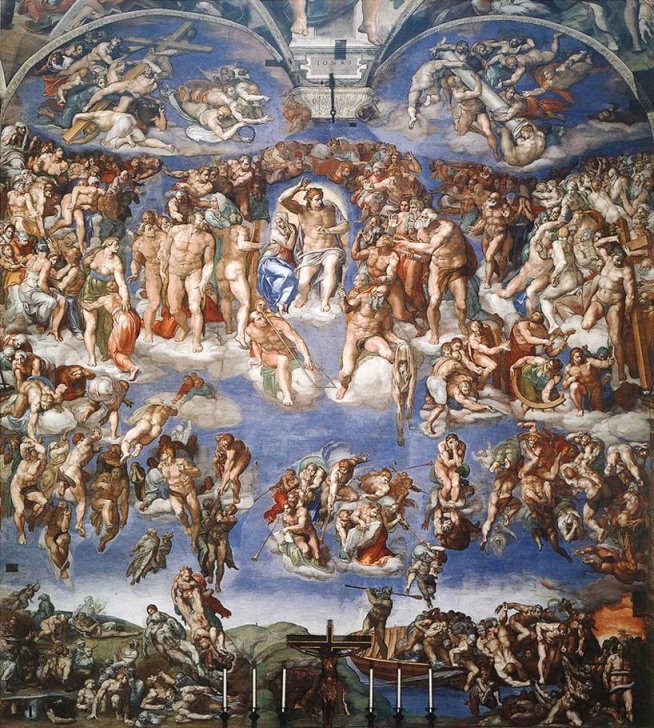 Judgement. Judgement is and will be real, something we should fear and something we all face. (Image: Michelangelo’s interpretation in the Sistine Chapel) Polkinghorne makes three points concerning the judgement to come.

One it that God is a holy God whose kingdom is the realm of moral purity. … The Cross of Christ is the measure of the costliness of divine forgiveness. Sin is no trivial matter, but it is in fact a deadly matter. … [J]udgement is no superficial matter nor one of mere conventionality but the recognition of the nature of reality. (p. 128-129)
The stern images and warnings in Scripture should be taken seriously.
The second point is one with which some may take exception. Polkinghorne suggests that we shouldn’t assign people unambiguously to the company of the blessed or the company of the damned. We are neither wholly sheep nor wholly goat.
Perhaps judgement is a process rather than a verdict. Perhaps its fire is the cleansing fire that burns away the dross of our lives; its suffering the consequence of the knife wielded by the divine Surgeon who wounds to heal. Perhaps judgement builds up the sheep and diminishes the goat in each one of us. (p. 130)
This isn’t “testy rejection by an angry God” but includes exposure and purification of his people.
The concept of judgement as the painful encounter with reality, in which all masks of illusion are swept away, is powerful and convincing. It is also basically a hopeful image, for it is only in the recognition and acknowledgement of reality that there can reside the hope of salvation. It has some resonances with a different image used by Paul:
… If what has been built on the foundation survives, the builder will receive a reward. If the work is burned, the builder will suffer loss; the builder will be saved, but only as through fire. (1 Corinthians 3:11-15)
It is in the purging fire of judgement that there lies our hope for purification and redemption. … Properly conceived, judgement is the divine antidote to human sin, just as resurrection is the divine antidote to human mortality. (p. 131-132)
No cheap grace for Paul, nor should there be for us.
Finally, judgement isn’t simply something between individuals and God.There is a systemic and social dimension to sinfulness and Polkinhorne agrees with Miroslav Volf that judgement will also have a social and corporate dimension. He quotes Volf: “If sin has an inalienable social dimension, and if redemption aims at the establishment of the order of peace … then the divine embrace of both victim and perpetrator must be understood as leading to their mutual embrace.” (p. 132)
Heaven. Heaven will be greater than we can imagine, but Polkinghorne believes (and I agree with him) that it will continue to involve process and time and an unfolding of our being. It is simply impossible to begin to imagine a timeless eternity. The essence of our being, as God has created us, is growth.
The life of heaven will be lived in the presence of the divine reality, but the exploration by finite creatures of the infinite riches of that reality will be unending. (p. 132)
Polkinghorne quotes a similar hope from Gregory of Nyssa (ca. 335-395) and then continues:
The first stages of this eschatological journey will surely involve that encounter with the holy reality of God that we have called judgement, together with the associated cleansing from those many unrealities with which our lives have been laden. This purgative process will be an indispensable preparation for the more profound engagement with the life of the holy God that lie beyond it. If this is right, some revalued and re-expressed concept of purgatory seems to be an essential component in eschatological thinking. (p. 133)
This isn’t purgatory as in some punishment for transgression from which we can buy time off through indulgences. It is more of a training and shaping to be God’s people.
Polkinghorne also emphasizes the ongoing importance of the human individual in God’s sight. Some egoless state or preservation of humans in the memory of God doesn’t do justice to the biblical teachings. And he answers the question “Will I see my loved one again?”
Since human relationships are constitutive of our humanity, and central sources of human good, one can reply unhesitatingly, ‘Yes – nothing of the good will be lost in the Lord’. In fact, what can at best be only a partial good in this world will be redeemed to become a total good in the world to come. Human hope is a community hope; human destiny is a collective destiny. Fulfillment lies in our incorporation into the one body of Christ. (p. 136)
The church is not for this world alone.
Hell. In Michigan we know precisely the distance from Paradise to Hell – 338 miles, traveled in 5 hours and 6 minutes without traffic according to Google maps. More seriously, hell is the hardest of the four last things to deal with. The existence of Hell is hard to stomach. Polkinghorne wanders through a number of ideas … hell, annihilation, and universalism.
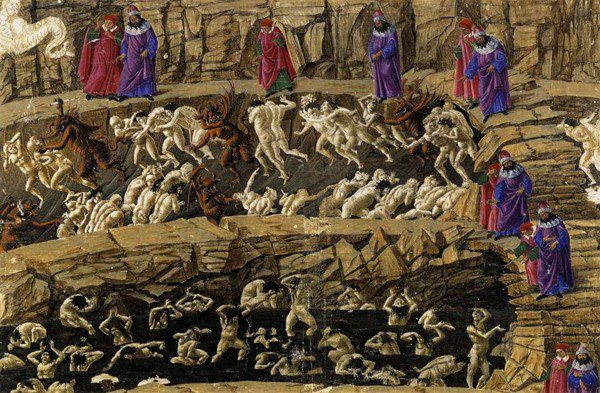 The image in Dante’s Inferno (Image: Botticelli’s 1480’s version) is not one Polkinghorne finds consistent with Scripture or theology. He is convinced that those consigned to hell will be those who have condemned themselves to hell through a “resolute choice to exclude the divine life from their lives.” (p. 136) He sees it as a place of boredom rather than torture and never ending punishment. He also sees some persuasiveness to the notion of annihilation – where those outside of the divine presence fade away into nothingness. He continues: “It is hard to know what to think, just as it is similarly hard to know whether the universalist hope, that in the end and in every life, God’s love will always be victorious, implies though there is, so to speak, a hell, ultimately it will be found to be empty.” (p. 137) Perhaps God’s love for all is the ultimate power in human existence.

Polkinghorne suggests that perhaps it is better that we don’t know much about hell. Certainty of universal salvation encourages a reliance on cheap grace. Certainty of eternal punishment seems beyond comprehension and raises questions of its own, like why did these people exist anyway? Sometimes the appropriate answer is simply that we don’t know for sure.
The significance of the end. Eschatology is not something we should brush off and ignore. We may not have all the answers, but the story is meaningless without an end. “Eschatology is the keystone of the edifice of theological thinking, holding the whole building together.” (p. 140)
Polkinghorne summarizes what he sees as a viable eschatological expectation with four propositions (p. 148-149):
(1) If the universe is a creation, it must make sense everlastingly, and so ultimately it must be redeemed from transience and decay.
(2) If human beings are creatures loved by their Creator they must have a destiny beyond death.
(3) In so far as present human imagination can articulate eschatological expectation, it has to do so within the tension between continuity and discontinuity. (He elaborates a bit – there must be enough continuity that we truly share in the age to come, and enough discontinuity to end suffering and mortality.)
(4) The only ground for such a hope lies in the steadfast love and faithfulness of God that is testified to by the resurrection of Jesus Christ.
Christian belief must not lose its nerve about eschatological hope. A credible theology depends upon it and, in turn, a Trinitarian and incarnational theology can assure us of its credibility.
This is a fine short book on Christian hope. It runs through a number of important ideas and Polkinghorne speculates on a number of these from his perspective as Christian, scientist, Anglican priest, and scholar. Christian eschatology and the significance of the end is too important to be brushed off or given over to speculations of novelists who glory in entertaining tales of destruction.
What importance does your church put on the four last things?
Are these important topics?
If you wish to contact me, you may do so at rjs4mail[at]att.net.
If interested you can subscribe to a full text feed of my posts at Musings on Science and Theology.
Previous Post

April 28, 2015
Males and Their Friends (Alastair Roberts)
Next Post
April 28, 2015 Do We Need Libraries?
Browse Our Archives
Select a Category Acts of the Apostles Adam Advent Anabaptism Angels Anglican Apologetics Atonement Baptism BCP Prayers Bible Biblical Studies Birds Blogging Bloglossary Bonhoeffer Books Calvinism Christianity Church Church History Coffee Colossians Commentary Recs Conversion Creation Creeds Culture Death Ecclesiastes Economics Education Embracing Grace Emergent Emerging Movement Eschatology Essays Ethics Eucharist Evangelicalism Family Fasting Fathers Fellowship of Differents Footsteps Tour Fun and Whimsical Gospel Grace Happiness Heaven Hell Holy Spirit Irenaeus James Jesus Jesus Creed Job Justification Kingdom of God Law Lectures Lent Liberalism Love and Marriage Mabanteneni Manhood Mary Miracles Missio Alliance MissioLife Missional Missional Jesus Movies and Film New Perspective Northern Seminary OneLife Origins Project Orthodox Parables Pastor's Spouse Pastoring and Leading Pastoring and Preaching Patristics Paul Paul-John Tour Pharisees Pietism Political Theology Prayer and Formation Preaching Problems for Faith Psalm 119 Psalms Public Issues Purgatory Religions Resurrection Revelation Romans Rule of JCreed Science and Faith Sermon on the Mount Sports Ten Commandments Theology Third Way Top Ten Lists Translations Uncategorized Universalism University Ministry Way Out Weekly Meanderings Wisdom Women and Ministry Work Worship Writing & Blogging Youth Ministry
Select a Month July 2021 January 2020 December 2019 November 2019 October 2019 September 2019 August 2019 July 2019 June 2019 May 2019 April 2019 March 2019 February 2019 January 2019 December 2018 November 2018 October 2018 September 2018 August 2018 July 2018 June 2018 May 2018 April 2018 March 2018 February 2018 January 2018 December 2017 November 2017 October 2017 September 2017 August 2017 July 2017 June 2017 May 2017 April 2017 March 2017 February 2017 January 2017 December 2016 November 2016 October 2016 September 2016 August 2016 July 2016 June 2016 May 2016 April 2016 March 2016 February 2016 January 2016 December 2015 November 2015 October 2015 September 2015 August 2015 July 2015 June 2015 May 2015 April 2015 March 2015 February 2015 January 2015 December 2014 November 2014 October 2014 September 2014 August 2014 July 2014 June 2014 May 2014 April 2014 March 2014 February 2014 January 2014 December 2013 November 2013 October 2013 September 2013 August 2013 July 2013 June 2013 May 2013 April 2013 March 2013 February 2013 January 2013 December 2012 November 2012 October 2012 September 2012 August 2012 July 2012 June 2012 May 2012 April 2012 March 2012 February 2012 January 2012 December 2011 November 2011 October 2011 September 2011 August 2011 July 2011 June 2011 May 2011 April 2011 March 2011 February 2011 January 2011 December 2010 November 2010 October 2010 September 2010 August 2010 July 2010 June 2010 May 2010 April 2010 March 2010 February 2010 January 2010 December 2009 November 2009 October 2009 September 2009 August 2009 July 2009 June 2009 May 2009 April 2009 March 2009 February 2009 January 2009 December 2008 November 2008 October 2008 September 2008 August 2008 July 2008 June 2008 May 2008 April 2008 March 2008 February 2008 January 2008 December 2007 November 2007 October 2007 September 2007 August 2007 July 2007 June 2007 May 2007 April 2007 March 2007 February 2007 January 2007 December 2006 November 2006 October 2006 September 2006 August 2006 July 2006 June 2006 May 2006 April 2006 March 2006 February 2006 January 2006 December 2005 November 2005 October 2005 September 2005 August 2005 July 2005 June 2005 May 2005 April 2005 0000
Follow Us!
TAKE THE
Religious Wisdom Quiz
If you show me, you will show your faith. Without me, faith is dead. What am I?
Select your answer to see how you score.
Prayer Works Love Obedience
Related posts from Jesus Creed


The Gospel of With Us and Through Us

Northern Seminary Announces: Nijay Gupta Joins Faculty

The Gundrys and Me: Ruth Tucker
TRENDING AT PATHEOS Evangelical

The REST of Your Life: A Creative Wrestles...
This week I had a conversation with a good friend from church....

How the author of the world's best hymn...
I've been working with John Newton for a while now. This makes...

Long before this Lectio Divina, Psalm 130 - the song - started...

What About the Trees? Another Living Parable
After I finished writing the last article about falling leaves as a...

Why Classical Education Is a Conversation, Not a...
Come and Read: Joy in Classical Education When I was a little...

Cornell University has received a great deal of negative publicity and intense...
view all Evangelical blogs
Ad-Free & Subscriber Log-In Subscription Support
- About Us
- 2026 Calendar
- Videos
- Podcasts
- Library of World Religions
- Faith In Media Tracker
- Advertise With Us
- Write for Us
- Privacy Policy
- Terms of Service
- Do Not Sell My Data
- Contact Us
- Radiant Digital
- Manage Newsletter Subscriptions
- Unsubscribe From Notifications
- Sitemap
Copyright 2008-2026, Patheos. All rights reserved.
Subscription Support Ad-Free & Subscriber Log-In
Follow Patheos