
BuddhistCatholicContemplativeEvangelicalGeneral ChristianHinduJewishLatter-day SaintMuslimNew VisionsProgressive Christian
Beliefs
- Buddhist
- Catholic
- Contemplative
- Evangelical
- General Christian
- Hindu
- Jewish
- Latter-day Saint
- More Voices
- Muslim
- New Visions
- Pagan
- Progressive Christian
Topics
- Religion News
- Food and Religion
- Sports and Religion
- Religious Art
- Religious Music and Entertainment
- Religious Events
- History and Religion
- Style and Religion
- Politics and Religion
- Women in Religion
- Recreation Outdoors and Religion
- Business Finance and Religion
- Careers Workplace and Religion
- Education and Religion
- Family Parenting and Religion
- Health Fitness and Religion
- Home and Religion
- Relationships and Religion
- Technology and Religion
- Travel and Religion
Columnists
- Buddhist Columnists
- Business Finance and Religion Columnists
- Careers Workplace and Religion Columnists
- Catholic Columnists
- Contemplative Columnists
- Education and Religion Columnists
- Evangelists Columnists
- Family Parenting and Religion Columnists
- General Christian Columnists
- Health Fitness and Religion Columnists
- Hindu Columnists
- History and Religion Columnists
- Home and Religion Columnists
- Jewish Columnists
- More Voices Columnists
- Latter Day Columnists
- Muslim Columnists
- New Visions Columnists
- Nonreligious Columnists
- Pagan Columnists
- Politics and Religion Columnists
- Progressive Columnists
- Recreation Outdoors and Religion Columnists
- Relationships and Religion Columnists
- Religion News Columnists
- Religious Art Columnists
- Religious Events Columnists
- Religious Music and Entertainment Columnists
- Sports and Religion Columnists
- Style and Religion Columnists
- Technology and Religion Columnists
- Travel and Religion Columnists
- Women in Religion Columnists
Resource Library
- 2026 Calendar
- Library of World Religions
- The 100 Most Holy Places on Earth
- Patheos Answers
- Podcasts
- Videos
- Faith Leaders Database
- Anglican Episcopalian
- Bahai
- Baptist
- Buddhism
- Christianity
- Confucianism
- Eastern Orthodoxy
- Hinduism
- Holiness and Pentecostal
- ISKCON
- Islam
- Judaism
- Lutheran
- Methodist
- The Church of Jesus Christ of Latter-day Saints
- New Age
- Paganism
- Presbytarian and Reformed
- Protestantism
- Religion Behind the Scenes
- Roman Catholic
- Scientology
- Shia Islam
- Sikhism
- Sufism
- Sunni Islam
- Taoism
- Zen
- See all religions
Research Tools
 Ad-Free & Subscriber Log-In Subscription Support
Ad-Free & Subscriber Log-In Subscription Support
Follow Patheos 

- Trending:
- Forgiveness
- |
- Marriage
- |
- Consciousness
- |
- Death Penalty
- |
- Election
- |
- Halloween
 Jesus Creed
- Home
- Evangelical
- A New Perspective Anglican Ponders a Presbyterian’s Luther
A New Perspective Anglican Ponders a Presbyterian’s Luther
Last updated on: April 1, 2015 at 12:08 am by Scot McKnight
A New Perspective Anglican Ponders a Presbyterian’s Luther 2015-03-29T06:45:09-05:00 Scot McKnight
Patheos Explore the world's faith through different perspectives on religion and spirituality! Patheos has the views of the prevalent religions and spiritualities of the world.
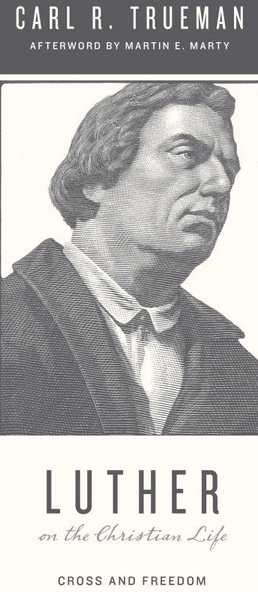 This is not an April Fools day post. It’s a post appreciating the greatness of Martin Luther, with whom I’ve had my own struggles. I, of course, love his accomplishment in the Protestant Reformation, wish more would be made on the part of many in seeing how political that movement actually was, think his posing of law over against gospel is not only a false dichotomy but shatters the biblical narrative, and of course I know what he did to both Anabaptists and Jews. Yet… yet… yet… Luther must be seen for the Titan he was.
So, when I heard that one of my favorite church historians had written a book on Luther and the Christian life, I had to read it… and it is a very good book that I recommend enthusiastically: Carl Trueman, Luther and the Christian Life: Cross and Freedom (Wheaton: Crossway, 2015).
The book is about the Christian life but Trueman keeps a constant eye on the pastoral life and pastoral implications of Luther’s theological understanding of life. A pastor can read this entire book for its pastoral theology with great profit.
Carl’s got a way with words, and this one illustrates his indirection — and wit — for a big sweep of Luther:
*For Luther, as someone not gifted in the matter of understatement, Anabaptists were allies of the Antichrist, another point of undoubted discomfort for modern evangelical appropriations of his theology. Not only was he a militant, unrepentant paedobaptist; he also ascribed rather negative eschatological significance to his opponents on this score (*141).
Trueman loves Luther as a man and learns from him as a theologian and pastor and husband:
Over twenty years ago, I was being interviewed for what would prove to be my first tenured appointment at a university. Halfway through the ordeal, one of the interviewers asked me, “If you were trapped on a desert island, who would you want with you—Luther or Calvin?” My response was reasonably nuanced for a reply to an unexpected question: “Well, I think Calvin would provide the best theological and exegetical discussion, but he always strikes me as somewhat sour and colorless. Luther, however, may not have been as careful a theologian, but he was so obviously human and so clearly loved life. Thus, I’d have to choose Luther.” Later that day, I was offered the position of lecturer in medieval and Reformation theology (195).
In some ways Trueman’s task is to yank Luther from the clutches of some evangelical uses of him and his theology, not to show how Luther differed over and over with Roman Catholicism. Thus, Trueman knows his audience, knows what needs most to be said, and this book does it. But there is no idealizing of Luther in this book:
With a figure like Martin Luther, the tendency will always be to make him a hero or a villain. The stakes are so high in the Reformation debate, and Protestant and Roman Catholic identities so wrapped up in responses to him, that the temptation of a black-and-white, morally and theologically straightforward approach is significant. Yet even this brief overview of his life reveals not only the connections between his biography and his theology but also the human contradictions and failings that were part of who he was and what he did. His stand at Worms is magnificent; his later writings against the Jews are nauseating. What are we to do with him? (54)
Because Trueman has been teaching Luther for so many years he stands above the normal readings and points us all to what is most important to how many read Luther today:
The key texts for the popular evangelical understanding of Luther were all in place by then: The Ninety-Five Theses, The Heidelberg Disputation, The Freedom of the Christian Man, and The Bondage of the Will. One or two great texts were yet to be written (the great commentary on Galatians being the obvious example), but on the whole these four titles cover the working canon through which most Protestant evangelicals approach Luther (160).
Trueman probes other writings to sketch how he views the Christian life but that life is formed in a public context with surges of response, reaction and opposition. In that context Luther’s view of the Christian life comes to the surface:
In a sense, the details are no longer important: the precise issues and practices to which Luther was reacting have long since vanished. What is important is the theology on which the theses were built: the theology of humility and the costliness of grace. Though Luther probably did not realize it at the time, these struck at the heart of the medieval sacramental system and thus at the authority of the church. In criticizing indulgences, Luther also did what is always guaranteed to precipitate a reaction: he hit the church where it hurts most, in her revenue department (38-39).
In his sketch of Luther’s life as the context for his theology and view of the Christian life, Trueman offers this proposal of when the Reformation began — not with the pinning of the 95 theses but… the Leipzig debate where Luther “also added that papal supremacy was a relatively recent innovation” (42). He drove — pounded — a wedge between the gospel and the Catholic Church’s teachings:
Arguably, this is the moment when the Reformation truly began in earnest, for it was then that the implications of Luther’s otherwise piecemeal attacks on indulgences and theological method became clear. If Luther was right, if humility was the key to salvation, then the whole medieval system needed to be rejected, and the papacy was wrong. Leipzig made this clear, along with the fact that there was no middle ground (42).
In the term humility (a theology of the cross and glory) Luther’s central note of the Christian life is heard. As Trueman says it
Luther believed that, outside of Christ, he was dead in trespasses and sins and desperately wicked. His attitude toward the Jews confirms his own opinion of himself (53).
Thus, for Luther at the core of the Christian life is justification by faith and this cannot be emphasized too much and it gets deeper and deeper into the heart of a theological view of life — he digs into the sinful heart to discover what grace means. This is not the Reformed experience so much as it is the Lutheran experience, and I pull here three quotations:
In the medieval understanding, justification was a process of growing righteous via the impartation of Christ’s righteousness connected to the infusion of grace via the sacramental ministry of the church. Thus, justification was simply one part of a much larger structure (67-68).
Thus, a man may appear outwardly righteous (before the world) but in reality be inwardly unrighteous. Likewise, he may appear outwardly unrighteous and indeed despicable but inwardly be perfectly righteous before God. This distinction is absolutely basic to Luther’s understanding of justification, for it is the basis upon which he asserts that no external thing (in terms of works righteousness) can actually affect standing before God (68).
We noted earlier how Luther in 1517, and even on into 1518, was committed to seeing humility as the key that made someone a passive recipient of God’s grace. By 1520, humility had been absorbed into, and transformed by, his broader understanding of faith as trust in God’s Word (68).
Salvation then, justification then, is epistemological and experiential all at once: it is the joyful exchange of Christ’s alien righteousness to us and prompts gratitude in spades. This then creates a new kind of life, a life of cross-shaped and grace-shaped freedom, the kind of freedom that is a theology of the cross and grace and death and resurrection and not one of happiness, victory or abundance:
Freedom for Luther must be understood through the incarnation and the cross: it is freedom to serve others and freedom to die for others. The whole of the Christian faith, and therefore the whole of Christian ministry, needs to be constructed in light of who God is for us as he is revealed in his incarnate Son hanging on the tree at Calvary (75).
The logic of the cross says that weakness and death, painful as they are, have been utterly subverted by God in Christ, that pain and mortality have ironically become the means of strength and power, and that the grave itself has become the gateway to paradise. And that is the lesson of justification by grace through faith too: the outer man may well be fading away, but the inner man goes from strength to strength (77).
Now hear this: Luther’s theory of the Christian life is corporate, ecclesial and centered in the fundamental categories of Word and sacraments.
For all of the post-Bultmannian [read: new perspective?] criticisms of Luther for developing an individualistic theology, in practice his emphases are really rather corporate: Word and sacrament demand a corporate context (79).
OK, fair enough,but I would say it is still quite individualistic for there is precious little interest in the church as community. Church is where a priest/pastor preaches Word and hands out sacraments. That is, go to church, hear the sermon, live out the catechism, take eucharist so you can live a responsible Christian life in the public sector. Perhaps I’m missing something here but I don’t see much community focus in Luther’s view of the Christian life. Having said that, I resume where Trueman was:
If the definition of ministry is set by Word and sacrament, so is the substance of the Christian’s life. Luther’s emphasis on Word, baptism, and the Lord’s Supper should surely point believers toward how they should understand their lives: the church service is fundamental to Christian discipleship. The answer to spiritual weariness, fear, and those dreaded Anfechtungen that afflict the Christian is found not in anything special or extraordinary as the world understands it. That is what the theologian of glory desires. Further, every theologian of glory probably thinks of himself as unique and thus as having special problems that require special solutions. The theologian of the cross, however, while acknowledging that every Christian is unique in that every Christian is a specific individual, also understands that the answer to every unique Christian’s problem is actually very general, and the means are very ordinary. The answer is always Christ crucified for me, and that Christ is found in Word and sacrament (158).
Running this, however, is his theology of law and gospel, a theology that will drive a human to the experience of humility and grace — the cross’s primary impact on the human. Hence, law and gospel run rampant and we find something very similar today in the beliefs of pastors like Tim Keller, Tullian Tchividjian and J.D. Greear, though probably not with the dark themes we see in Luther’s approach to preaching law in order to shatter the confidence of the congregants:
The distinction underlies much of the theology of the disputation but is explicit in thesis 26: “The law says, ‘do this,’ and it is never done. Grace says, ‘believe in this,’ and everything is already done.” Fundamental to Luther’s understanding of salvation, and thus of the Christian life, is the antithesis between doing and believing, between trying to earn salvation and receiving salvation in Christ, between works and faith, between law and gospel (91).
The task of the preacher, therefore, is to take the Bible and to do two things in every sermon: destroy self-righteousness and point hearers toward the alien, external righteousness of Christ (92).
Thus, as the law’s function is to bind and to crush, so the first task of the minister is to preach the law in such a manner that it does this. He must hold before the congregation a vision of the transcendent glory and holiness of God, and force congregants to see just how catastrophically far short of that they all fall. His task is not that of the typical American televangelist: giving people a pep talk and helping them have a good self-image and more confidence in themselves. For Luther, those are the lies of Satan. The preacher’s task is first and foremost to shatter self-confidence in his audience and to drive them to despair.
Once the preaching of the law has driven a person to despair, then the minister is to declare the gospel and point to Christ. That is what the gospel is: an account of the life, work, and significance of the Lord Jesus Christ, as Luther makes clear in his preface to the New Testament: “The gospel, then, is nothing but the preaching about Christ, Son of God and of David, true God and man, who by his death and resurrection has overcome for us the sin, death, and hell of all men who believe in him.” Thus, preaching represents dramatic movement from exposing the folly of self-righteousness and cultivating despair and humility to providing comfort in the Lord Jesus Christ, the promise of whom is grasped by faith (92).
In one of these sermons, he makes a most memorable statement about the power of the Word:
I will preach it, teach it, write it, but I will constrain no man by force, for faith must come freely without compulsion. Take myself as an example. I opposed indulgences and all the papists, but never with force. I simply , preached, and wrote God’s Word; otherwise I did nothing. And while I slept [cf. Mark 4:26-29], or drank Wittenberg beer with my friends Philip and Amsdorf, the Word so greatly weakened the papacy that no prince or emperor ever inflicted such losses upon it. I did nothing; the Word did everything (94-95).
Thus, we are back to the church context for the Christian life:
This points toward one of the striking aspects of Luther’s approach to liturgy: the church’s gathered worship is a catechetical exercise, not in the sense of catechisms that operate by question and answer, but in the broader sense of the school of faith. Gathered worship is intended for the education of the people in sound theology upon which to build their lives (103).
Luther’s vision is comprehensive:
Given Luther’s concern that worship fulfill a pedagogical/catechetical function, it is perhaps not surprising, though certainly impressive, that he sees the whole week as providing an opportunity for structured Christian education through the various liturgies of the church. Monday and Tuesday, the service is to focus on teaching about the Decalogue, the creed, the Lord’s Prayer, baptism, and the Eucharist. These are the established elements of Christian catechesis from the Middle Ages, and Luther clearly assumes them as foundational to the Christian life. Wednesday is to be devoted to teaching from the Gospel of Matthew, as Saturday afternoon is to be devoted to the Gospel of John. Thursday and Friday are to focus on other New Testament writings. Sunday is the big day, with multiple services and three sermons devoted to the Gospels. The overall purpose is “to give the Word of God free course among us” (104).
If anything, Luther values the pastoral life far more than most:
… the minister’s first calling is to be present with those for whom he has oversight. We might even borrow Lutheran terminology from elsewhere: the minister’s presence in his parish is not to be merely symbolic; rather he is to be there as a real presence: in, with, and among his people. This will not only inform his preaching such that it speaks more directly to the particulars of his people’s lives; it will also allow for catechizing, over which the minister has responsibility, and for the one-to-one confession and absolution that some delicate consciences require (108).
And Luther’s honesty comes to the surface in Trueman’s portrait, an honesty that leads to reflections on how to recover one’s fervor:
First, when I feel that I have become cool and joyless in prayer because of other tasks or thoughts (for the flesh and the devil always impede and obstruct prayer), I take my little psalter, hurry to my room, or, if it be the day and hour for it, to the church where a congregation is assembled and, as time permits, I say quietly to myself and word-for-word the Ten Commandments, the Creed, and, if I have time, some words of Christ or of Paul, or some psalms, just as a child might do (119-120).
What then comes to the fore in Luther’s theology of the Christian life?
1. Law and gospel
2. Cross and grace
3. Humility
4. Church receptivity
5. A private/social life shaped by the church’s teachings
6. Joy and fun.
Previous Post

April 1, 2015
Bono on Jesus
Next Post
April 1, 2015 Awkward Holy Saturday (Jonathan Storment)
Browse Our Archives
Select a Category Acts of the Apostles Adam Advent Anabaptism Angels Anglican Apologetics Atonement Baptism BCP Prayers Bible Biblical Studies Birds Blogging Bloglossary Bonhoeffer Books Calvinism Christianity Church Church History Coffee Colossians Commentary Recs Conversion Creation Creeds Culture Death Ecclesiastes Economics Education Embracing Grace Emergent Emerging Movement Eschatology Essays Ethics Eucharist Evangelicalism Family Fasting Fathers Fellowship of Differents Footsteps Tour Fun and Whimsical Gospel Grace Happiness Heaven Hell Holy Spirit Irenaeus James Jesus Jesus Creed Job Justification Kingdom of God Law Lectures Lent Liberalism Love and Marriage Mabanteneni Manhood Mary Miracles Missio Alliance MissioLife Missional Missional Jesus Movies and Film New Perspective Northern Seminary OneLife Origins Project Orthodox Parables Pastor's Spouse Pastoring and Leading Pastoring and Preaching Patristics Paul Paul-John Tour Pharisees Pietism Political Theology Prayer and Formation Preaching Problems for Faith Psalm 119 Psalms Public Issues Purgatory Religions Resurrection Revelation Romans Rule of JCreed Science and Faith Sermon on the Mount Sports Ten Commandments Theology Third Way Top Ten Lists Translations Uncategorized Universalism University Ministry Way Out Weekly Meanderings Wisdom Women and Ministry Work Worship Writing & Blogging Youth Ministry
Select a Month July 2021 January 2020 December 2019 November 2019 October 2019 September 2019 August 2019 July 2019 June 2019 May 2019 April 2019 March 2019 February 2019 January 2019 December 2018 November 2018 October 2018 September 2018 August 2018 July 2018 June 2018 May 2018 April 2018 March 2018 February 2018 January 2018 December 2017 November 2017 October 2017 September 2017 August 2017 July 2017 June 2017 May 2017 April 2017 March 2017 February 2017 January 2017 December 2016 November 2016 October 2016 September 2016 August 2016 July 2016 June 2016 May 2016 April 2016 March 2016 February 2016 January 2016 December 2015 November 2015 October 2015 September 2015 August 2015 July 2015 June 2015 May 2015 April 2015 March 2015 February 2015 January 2015 December 2014 November 2014 October 2014 September 2014 August 2014 July 2014 June 2014 May 2014 April 2014 March 2014 February 2014 January 2014 December 2013 November 2013 October 2013 September 2013 August 2013 July 2013 June 2013 May 2013 April 2013 March 2013 February 2013 January 2013 December 2012 November 2012 October 2012 September 2012 August 2012 July 2012 June 2012 May 2012 April 2012 March 2012 February 2012 January 2012 December 2011 November 2011 October 2011 September 2011 August 2011 July 2011 June 2011 May 2011 April 2011 March 2011 February 2011 January 2011 December 2010 November 2010 October 2010 September 2010 August 2010 July 2010 June 2010 May 2010 April 2010 March 2010 February 2010 January 2010 December 2009 November 2009 October 2009 September 2009 August 2009 July 2009 June 2009 May 2009 April 2009 March 2009 February 2009 January 2009 December 2008 November 2008 October 2008 September 2008 August 2008 July 2008 June 2008 May 2008 April 2008 March 2008 February 2008 January 2008 December 2007 November 2007 October 2007 September 2007 August 2007 July 2007 June 2007 May 2007 April 2007 March 2007 February 2007 January 2007 December 2006 November 2006 October 2006 September 2006 August 2006 July 2006 June 2006 May 2006 April 2006 March 2006 February 2006 January 2006 December 2005 November 2005 October 2005 September 2005 August 2005 July 2005 June 2005 May 2005 April 2005 0000
Follow Us!
TAKE THE
Religious Wisdom Quiz
Who became jealous and tried to kill David several times?
Select your answer to see how you score.
Abiathar Samuel Saul Abner
Related posts from Jesus Creed

Participation-in-Christ: The Major Themes


TRENDING AT PATHEOS Evangelical

The REST of Your Life: A Creative Wrestles...
This week I had a conversation with a good friend from church....

How the author of the world's best hymn...
I've been working with John Newton for a while now. This makes...

Long before this Lectio Divina, Psalm 130 - the song - started...

What About the Trees? Another Living Parable
After I finished writing the last article about falling leaves as a...

Why Classical Education Is a Conversation, Not a...
Come and Read: Joy in Classical Education When I was a little...

Cornell University has received a great deal of negative publicity and intense...
view all Evangelical blogs
Ad-Free & Subscriber Log-In Subscription Support
- About Us
- 2026 Calendar
- Videos
- Podcasts
- Library of World Religions
- Faith In Media Tracker
- Advertise With Us
- Write for Us
- Privacy Policy
- Terms of Service
- Do Not Sell My Data
- Contact Us
- Radiant Digital
- Manage Newsletter Subscriptions
- Unsubscribe From Notifications
- Sitemap
Copyright 2008-2026, Patheos. All rights reserved.
Subscription Support Ad-Free & Subscriber Log-In
Follow Patheos