
BuddhistCatholicContemplativeEvangelicalGeneral ChristianHinduJewishLatter-day SaintMuslimNew VisionsProgressive Christian
Beliefs
- Buddhist
- Catholic
- Contemplative
- Evangelical
- General Christian
- Hindu
- Jewish
- Latter-day Saint
- More Voices
- Muslim
- New Visions
- Pagan
- Progressive Christian
Topics
- Religion News
- Food and Religion
- Sports and Religion
- Religious Art
- Religious Music and Entertainment
- Religious Events
- History and Religion
- Style and Religion
- Politics and Religion
- Women in Religion
- Recreation Outdoors and Religion
- Business Finance and Religion
- Careers Workplace and Religion
- Education and Religion
- Family Parenting and Religion
- Health Fitness and Religion
- Home and Religion
- Relationships and Religion
- Technology and Religion
- Travel and Religion
Columnists
- Buddhist Columnists
- Business Finance and Religion Columnists
- Careers Workplace and Religion Columnists
- Catholic Columnists
- Contemplative Columnists
- Education and Religion Columnists
- Evangelists Columnists
- Family Parenting and Religion Columnists
- General Christian Columnists
- Health Fitness and Religion Columnists
- Hindu Columnists
- History and Religion Columnists
- Home and Religion Columnists
- Jewish Columnists
- More Voices Columnists
- Latter Day Columnists
- Muslim Columnists
- New Visions Columnists
- Nonreligious Columnists
- Pagan Columnists
- Politics and Religion Columnists
- Progressive Columnists
- Recreation Outdoors and Religion Columnists
- Relationships and Religion Columnists
- Religion News Columnists
- Religious Art Columnists
- Religious Events Columnists
- Religious Music and Entertainment Columnists
- Sports and Religion Columnists
- Style and Religion Columnists
- Technology and Religion Columnists
- Travel and Religion Columnists
- Women in Religion Columnists
Resource Library
- 2026 Calendar
- Library of World Religions
- The 100 Most Holy Places on Earth
- Patheos Answers
- Podcasts
- Videos
- Faith Leaders Database
- Anglican Episcopalian
- Bahai
- Baptist
- Buddhism
- Christianity
- Confucianism
- Eastern Orthodoxy
- Hinduism
- Holiness and Pentecostal
- ISKCON
- Islam
- Judaism
- Lutheran
- Methodist
- The Church of Jesus Christ of Latter-day Saints
- New Age
- Paganism
- Presbytarian and Reformed
- Protestantism
- Religion Behind the Scenes
- Roman Catholic
- Scientology
- Shia Islam
- Sikhism
- Sufism
- Sunni Islam
- Taoism
- Zen
- See all religions
Research Tools
 Ad-Free & Subscriber Log-In Subscription Support
Ad-Free & Subscriber Log-In Subscription Support
Follow Patheos 

- Trending:
- Forgiveness
- |
- Marriage
- |
- Consciousness
- |
- Death Penalty
- |
- Election
- |
- Halloween
 Jesus Creed
- Home
- Evangelical
- A Tossed Salad (RJS)
A Tossed Salad (RJS)
Last updated on: April 13, 2015 at 6:09 am by RJS
A Tossed Salad (RJS) 2015-04-13T06:09:32-05:00 RJS
Patheos Explore the world's faith through different perspectives on religion and spirituality! Patheos has the views of the prevalent religions and spiritualities of the world.
 When I was growing up we had tossed salad with dinner quite often, especially during the summer. My dad would make the salad, with tomatoes, lettuce, cucumbers, radishes, and such, cut up small and tossed together, well mixed. When we had company he would also make the salad and the mixed up tossed together nature would get comment. He used no salad dressing, only some celery salt and pepper. The rest of us often added dressing (I’m partial to blue cheese myself). Today I will add bacon bits, croutons, and cheese to the mix as well. In his new book A Fellowship of Differents: Showing the World God’s Design for Life Together Scot uses a metaphor of a salad bowl to describe church – the way it too often is as opposed to the way it should be. He would approve of my dad’s salads, a mixture of flavors unspoiled by a strong and uniform dressing.
I read A Fellowship of Differents over the weekend and heartily recommend the book. It will make a good discussion starter in a wide range of situations, raising important and thought provoking questions.
The point is simple, but not easy. As a good tossed salad, the church should be a mixture of different kinds of people, not a uniform gathering of “likes” – the same age, race, culture, class, education, or even precisely the same theology slathered over with uniform tastes. The church is not called to be a melting pot. Scot adds personal reflection to his book, and I will take the same liberty. I was fortunate to grow up in a church with a broad range of ages, educational levels, and income. The racial mix was rather (but not completely) uniform – however, this matched the surrounding community. We were not fundamentalists, and tolerated discussion and a range of views on many kinds of issues. Not big on “end times” discussions, with something of a range of views in the church. There were also a range of views on the age of the earth. I learned later that our pastor had played a role in keeping the local conference of our denomination from adopting a young earth type position. We were not separatists – but we certainly viewed ourselves as different from the surrounding culture. And this shaped the way I view the local church – even yet today.
Scot comments:
So here’s my claim after that romp through the church of my youth: Everything I learned about the Christian life I learned from my church. I will make this a bigger principle: a local church determines what the Christian life looks like for the people in that church. Now I’ll make it even bigger still: we all learn the Christian life from how our local church shapes us. These three principles are a way of saying that our local churches matter far more than we often know. (p. 15)
The message I learned growing up was that we were different, not on grounds of strict theology, but because we were not “Sunday morning Christians” (like those Methodists, Lutherans, Presbyterians, Congregationalists, and Episcopalians). Today I realize that many of the others were as committed as we, but this was the message I picked up at the time. Church wasn’t something we did for an hour or two each week, but a community we were a part of and were committed to. This certainly shapes my views today – church focused on a short staff run service for one hour a week hardly seems real. Community requires a much larger range of opportunity for participation and interaction. Small groups were not a part of the church I grew up in, and although I’ve had some good experiences in small groups in later years, I remain convinced that they can’t bear the entire load. Small groups are too homogeneous – generally intentional gatherings of peers rather than a fellowship of differents. We need a broader range of interactions.
No local church is perfect, but the local church matters. And the form it takes and teaches shapes the people who attend. The question then becomes “what form should the church take?” Throughout A Fellowship of Differents, Scot looks to Paul’s letters, the various early (imperfect) churches described, and the picture of Christian life Paul envisions. There is far too much in the book for one short post, so I will focus on a few points that stuck out as I was reading.
We is bigger than me. Chapter 10. Christian life and the Christian church isn’t about the individual. Scot suggests that there are two major challenges to the importance of church in America. The first is the myth of the perfect church.
We are given in America the power of choice, and religion has become a smorgasbord to choose your own church based on its ability to live up to your own preferences. This leads to the first thing we need to observe about the actual New Testament pattern, one [Roger] Williams managed to avoid and one many today do not want to acknowledge: we are a messy family.
There never was a golden era when the church “did church” perfectly. Sometimes well-meaning people suggest the first-century was a golden era, but anyone who reads the New Testament knows that there were problems within weeks! In Jerusalem, ethnic rivalries meant Greek-speaking widows were neglected, and at Corinth its members were forming personality cults. (p. 111-112)
There is no perfect church. “The church was and is today the most radical social experiment in history.” (p. 113) We are called to be a part of this experiment.
The second challenge is the myth of self-reliance. Roger Williams epitomized the search for the perfect church. Henry David Thoreau leads us on the path of self reliance. “At the heart of the American psyche is the Self, and Thoreau helped form the American Me so that it is bigger than the American We or the church We.” (p. 113)
But We is bigger than Me. “The Bible’s focus – read it from beginning to end and you will see this – is on what God is doing in this world through the people of God. Page after page, chapter after chapter, book after book – sixty-six of them in all – the Bible tells the story of Israel that morphs into the story of the Kingdom and the story of the Church. … the Me Story is contained within the We story.” (p. 114)
This means that we, as the people of God, share life.
The best word for church in the whole New Testament is not the word church, a word for a gathered assembly. The best word for church is fellowship, which simply means that we share life with one another. That is precisely what happened to the first Christians when the Spirit of God plopped them al together in those house churches across the Roman Empire. Such an odd box of differents. (p. 115)
…
The We of fellowship, then, is spiritual, it is social, and it is financial. But fellowship is not something we create; it is the result of God’s work in us. When God’s people live in fellowship with one another, when they “do life” together, the church embodies the gospel about King Jesus and people respond to the gospel about him, When they live in fellowship, the Me finds its joy in the We. It’s messy, believe me, very messy, but no matter what the mess, the gospel is at work to turn messy people into holy people, even if it takes a lifetime (or more). (p. 116)
It is in the day to day messiness of a local church that me becomes we, not in any individual regime of spiritual formation.
Faithful folks, not heroes. A second point that stuck out for me as I read came in Chapter 15. First a definition. Faith means trust and faithfulness means trust over time of faith over time. Thus faithfulness can only be measured after the passage of time. “What the church needs most is not heroes of faith, but faithful followers of Jesus. ” (p. 164)
A few themes on faithfulness from the chapter: (1) Faithfulness happens when God’s strength is unleashed in us as we look on, to lean on, God. It isn’t a matter of having enough grit and determination. (2) Faithfulness is the result of a lifetime of daily commitments. Prayer, focus, and dozens of small decisions and choices in the forward direction. Faithfulness requires effort, even as it doesn’t depend on grit and determination. (3) Most of us are ordinary Christians, and its okay to be an ordinary Christian. I’d say that all of us are ordinary Christians. Some are called to a more heroic life by circumstance, but most of life, and particularly a life of faithful following involves ordinary life.
Scot concludes:
In the evening of life, I want God to say of me that I was an ordinary person who lived an ordinary Christian life empowered by the extraordinary grace of God my whole life long. … How about you? (p. 169)
Amen.
And this means that the church as a fellowship should be concerned with discipleship and faithfulness.
We need the Spirit of God, and God’s gifts. The final section of A Fellowship of Differents focuses on flourishing. The history of the church is a history of fraction, friction, and separation.
The hope of this book is that that history will be reversed by a renewed commitment to be the church that God designed, a church that flourishes in a salad bowl fellowship of differents.
But there is gospel – resurrection and new creation news here: the Spirit can take our abilities and transcend them, then take our inabilities and transform them into the gracious power of unity. To flourish, then, we need to be Holy Spirit people. The only way the church cam be God’s kind of church is through the power of the Spirit. Only the Spirit empowers us to transcend differences and to transform our preferences into love for others. (p. 195-196)
Scot runs through the importance of the Spirit in Paul’s letters (it comes up all the time). I am going to finish with one point. Each of us (ordinary Christians) has the Spirit and each of us (ordinary Christians) has gifts for the sake of the church. The will flourish as the people of God and a fellowship of differents when all of these gifts are nurtured, encouraged, and used.
The Spirit makes us bigger than a collection of (contentious) individuals.
How does the Spirit make us bigger? By assigning us a gift in the big cosmic mission of God. Through the Spirit’s gifts, we become participants, actors on the divine stage, people gifted by God with an assignment and responsibility in the church of God. We must also see the paradox here that God’s gifts makes us bigger by making us needier! How so? What we learn from the gifts is that God gives to us a gift, but he gives to everyone else a gift too, so that we need one another if the body of Christ is to function well. (p. 208)
There is no all encompassing list of gifts in the letters of Paul, although there are several lists that provide important examples. Scot points out that instead of looking to lists for guidance we should be asking “What is the Spirit gifting me to do in the fellowship?” This will identify gifts and callings. A local church flourishes when it encourages and uses the gifts of all in its body. Individual Christians flourish and grow when they are using their gifts as a part of the people of God.
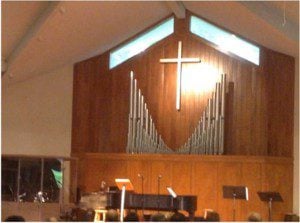 The church I attend today is much like the church of my youth. It has been a church that encourages and uses the different gifts in the congregation. A church is not called to be a business with a business plan for growth and a CEO with a staff for implementation. Nor is it a weekly worship service (with “child care”), relegating fellowship to a small group of people “just like me.” A church is called to be a fellowship of differents and a family that stands together through thick and thin, ups and downs, to be the people of God.
In what way is your church a fellowship of differents?
What is the church called to be?
If you wish to contact me, you may do so at rjs4mail[at]att.net.
If interested you can subscribe to a full text feed of my posts at Musings on Science and Theology.
Previous Post

March 31, 2015
Church-An Alternative Community (by Ray Miller)
Next Post
April 1, 2015 Bono on Jesus
Browse Our Archives
Select a Category Acts of the Apostles Adam Advent Anabaptism Angels Anglican Apologetics Atonement Baptism BCP Prayers Bible Biblical Studies Birds Blogging Bloglossary Bonhoeffer Books Calvinism Christianity Church Church History Coffee Colossians Commentary Recs Conversion Creation Creeds Culture Death Ecclesiastes Economics Education Embracing Grace Emergent Emerging Movement Eschatology Essays Ethics Eucharist Evangelicalism Family Fasting Fathers Fellowship of Differents Footsteps Tour Fun and Whimsical Gospel Grace Happiness Heaven Hell Holy Spirit Irenaeus James Jesus Jesus Creed Job Justification Kingdom of God Law Lectures Lent Liberalism Love and Marriage Mabanteneni Manhood Mary Miracles Missio Alliance MissioLife Missional Missional Jesus Movies and Film New Perspective Northern Seminary OneLife Origins Project Orthodox Parables Pastor's Spouse Pastoring and Leading Pastoring and Preaching Patristics Paul Paul-John Tour Pharisees Pietism Political Theology Prayer and Formation Preaching Problems for Faith Psalm 119 Psalms Public Issues Purgatory Religions Resurrection Revelation Romans Rule of JCreed Science and Faith Sermon on the Mount Sports Ten Commandments Theology Third Way Top Ten Lists Translations Uncategorized Universalism University Ministry Way Out Weekly Meanderings Wisdom Women and Ministry Work Worship Writing & Blogging Youth Ministry
Select a Month July 2021 January 2020 December 2019 November 2019 October 2019 September 2019 August 2019 July 2019 June 2019 May 2019 April 2019 March 2019 February 2019 January 2019 December 2018 November 2018 October 2018 September 2018 August 2018 July 2018 June 2018 May 2018 April 2018 March 2018 February 2018 January 2018 December 2017 November 2017 October 2017 September 2017 August 2017 July 2017 June 2017 May 2017 April 2017 March 2017 February 2017 January 2017 December 2016 November 2016 October 2016 September 2016 August 2016 July 2016 June 2016 May 2016 April 2016 March 2016 February 2016 January 2016 December 2015 November 2015 October 2015 September 2015 August 2015 July 2015 June 2015 May 2015 April 2015 March 2015 February 2015 January 2015 December 2014 November 2014 October 2014 September 2014 August 2014 July 2014 June 2014 May 2014 April 2014 March 2014 February 2014 January 2014 December 2013 November 2013 October 2013 September 2013 August 2013 July 2013 June 2013 May 2013 April 2013 March 2013 February 2013 January 2013 December 2012 November 2012 October 2012 September 2012 August 2012 July 2012 June 2012 May 2012 April 2012 March 2012 February 2012 January 2012 December 2011 November 2011 October 2011 September 2011 August 2011 July 2011 June 2011 May 2011 April 2011 March 2011 February 2011 January 2011 December 2010 November 2010 October 2010 September 2010 August 2010 July 2010 June 2010 May 2010 April 2010 March 2010 February 2010 January 2010 December 2009 November 2009 October 2009 September 2009 August 2009 July 2009 June 2009 May 2009 April 2009 March 2009 February 2009 January 2009 December 2008 November 2008 October 2008 September 2008 August 2008 July 2008 June 2008 May 2008 April 2008 March 2008 February 2008 January 2008 December 2007 November 2007 October 2007 September 2007 August 2007 July 2007 June 2007 May 2007 April 2007 March 2007 February 2007 January 2007 December 2006 November 2006 October 2006 September 2006 August 2006 July 2006 June 2006 May 2006 April 2006 March 2006 February 2006 January 2006 December 2005 November 2005 October 2005 September 2005 August 2005 July 2005 June 2005 May 2005 April 2005 0000
Follow Us!
TAKE THE
Religious Wisdom Quiz
What does "Amen" originally mean?
Select your answer to see how you score.
So be it Let it happen Praise God Be true
Related posts from Jesus Creed

Rethinking Evangelism Through The Reformation

Church: Seven Reasons Not to Go to Church
TRENDING AT PATHEOS Evangelical

How the author of the world's best hymn...
I've been working with John Newton for a while now. This makes...

Long before this Lectio Divina, Psalm 130 - the song - started...

What About the Trees? Another Living Parable
After I finished writing the last article about falling leaves as a...

Why Classical Education Is a Conversation, Not a...
Come and Read: Joy in Classical Education When I was a little...

Falling Leaves: A Living Parable on Letting Go
I’ve spent the vast majority of my life in the southeast corner...

Cornell University has received a great deal of negative publicity and intense...
view all Evangelical blogs
Ad-Free & Subscriber Log-In Subscription Support
- About Us
- 2026 Calendar
- Videos
- Podcasts
- Library of World Religions
- Faith In Media Tracker
- Advertise With Us
- Write for Us
- Privacy Policy
- Terms of Service
- Do Not Sell My Data
- Contact Us
- Radiant Digital
- Manage Newsletter Subscriptions
- Unsubscribe From Notifications
- Sitemap
Copyright 2008-2026, Patheos. All rights reserved.
Subscription Support Ad-Free & Subscriber Log-In
Follow Patheos