
BuddhistCatholicContemplativeEvangelicalGeneral ChristianHinduJewishLatter-day SaintMuslimNew VisionsProgressive Christian
Beliefs
- Buddhist
- Catholic
- Contemplative
- Evangelical
- General Christian
- Hindu
- Jewish
- Latter-day Saint
- More Voices
- Muslim
- New Visions
- Pagan
- Progressive Christian
Topics
- Religion News
- Food and Religion
- Sports and Religion
- Religious Art
- Religious Music and Entertainment
- Religious Events
- History and Religion
- Style and Religion
- Politics and Religion
- Women in Religion
- Recreation Outdoors and Religion
- Business Finance and Religion
- Careers Workplace and Religion
- Education and Religion
- Family Parenting and Religion
- Health Fitness and Religion
- Home and Religion
- Relationships and Religion
- Technology and Religion
- Travel and Religion
Columnists
- Buddhist Columnists
- Business Finance and Religion Columnists
- Careers Workplace and Religion Columnists
- Catholic Columnists
- Contemplative Columnists
- Education and Religion Columnists
- Evangelists Columnists
- Family Parenting and Religion Columnists
- General Christian Columnists
- Health Fitness and Religion Columnists
- Hindu Columnists
- History and Religion Columnists
- Home and Religion Columnists
- Jewish Columnists
- More Voices Columnists
- Latter Day Columnists
- Muslim Columnists
- New Visions Columnists
- Nonreligious Columnists
- Pagan Columnists
- Politics and Religion Columnists
- Progressive Columnists
- Recreation Outdoors and Religion Columnists
- Relationships and Religion Columnists
- Religion News Columnists
- Religious Art Columnists
- Religious Events Columnists
- Religious Music and Entertainment Columnists
- Sports and Religion Columnists
- Style and Religion Columnists
- Technology and Religion Columnists
- Travel and Religion Columnists
- Women in Religion Columnists
Resource Library
- 2026 Calendar
- Library of World Religions
- The 100 Most Holy Places on Earth
- Patheos Answers
- Podcasts
- Videos
- Faith Leaders Database
- Anglican Episcopalian
- Bahai
- Baptist
- Buddhism
- Christianity
- Confucianism
- Eastern Orthodoxy
- Hinduism
- Holiness and Pentecostal
- ISKCON
- Islam
- Judaism
- Lutheran
- Methodist
- The Church of Jesus Christ of Latter-day Saints
- New Age
- Paganism
- Presbytarian and Reformed
- Protestantism
- Religion Behind the Scenes
- Roman Catholic
- Scientology
- Shia Islam
- Sikhism
- Sufism
- Sunni Islam
- Taoism
- Zen
- See all religions
Research Tools
 Ad-Free & Subscriber Log-In Subscription Support
Ad-Free & Subscriber Log-In Subscription Support
Follow Patheos 

- Trending:
- Forgiveness
- |
- Marriage
- |
- Consciousness
- |
- Death Penalty
- |
- Election
- |
- Halloween
 Jesus Creed
- Home
- Evangelical
- The Nature of Creation (RJS)
The Nature of Creation (RJS)
Last updated on: March 17, 2015 at 6:35 am by RJS
The Nature of Creation (RJS) 2015-03-17T06:35:30-05:00 RJS
Patheos Explore the world's faith through different perspectives on religion and spirituality! Patheos has the views of the prevalent religions and spiritualities of the world.
 There are several new books on my desk, The Nature of Creation: Examining the Bible and Science by Mark Harris, The Lost World of Adam and Eve: Genesis 2-3 and the Human Origins Debate by John Walton and Religion and the Sciences of Origins by Kelly James Clark. Each book digs into different aspects of the discussions surrounding science and Christian faith. Over the next several weeks (probably months) I intend to dig into all of them.
Today I will begin with The Nature of Creation. The author, Mark Harris, is a lecturer in Science and Religion at the University of Edinburgh. He began his career as an experimental physicist in condensed matter where he investigated the properties of the so-called spin-ice, solids with an intrinsic spin disorder that persists even to absolute zero. Pure water falls into this class, but is hard to crystallize. Dr. Harris worked on heavy rare earth titanate pyrochlores X2Ti2O7 with X= Gd, Dy, Ho, Er, or Yb. He has a number of influential papers published in Physical Review Letters and other top-notch scientific journals. I bring this up only to emphasize that he has the credentials and background from the sciences. On the religion side, he also trained for the ordained ministry and spent time in university chaplaincy and cathedral ministry before taking his current position at the University of Edinburgh running the Science and Religion program in the School of Divinity.
In the first chapter of The Nature of Creation, Harris outlines some general ideas. It is common to think about the doctrine of creation in terms of a series of propositions. (p. 4)
- God created the world from nothing. He is not dependent upon the world.
- Creation is wholly contingent upon God.
- God is therefore both the initial creator of the world, and also its continuing sustainer.
- God created the world as good.
- Evil came to be present, but does not derive from God.
- Creation will have an end in a “new heaven and a new earth.”
I’d say that we also affirm that God created the world beautiful. The pictures included in this post display some small part of that beauty.
But is this propositional approach an appropriate way to frame the doctrine of creation?
 We need to take scripture seriously right from the start, but taking scripture seriously as foundational and authoritative also requires acknowledging what the text does and does not say. The biblical texts do not provide one simple view of relationship between creation and Creator. Rather the texts provide many different perspectives.
The first few chapters of the Bible (Genesis 1-3) are justifiably memorable, telling the story of the creation of the world in resonant prose, from the beginning of time (“In the beginning”) to the story of the first humans and their shortcomings. When we speak of creation and the Bible it is invariably these chapters which come to mind. However, there is a great wealth of additional creation material spread throughout the Bible, much of which does not show awareness of this initial section. For instance, some of the psalms and prophets speak about creation in terms of a mythological battle between God and the sea, while the book of Proverbs speaks of creation through the personified divine figure of Wisdom. Therefore, one of the first points that should be made in approaching the Bible’s creation texts is that there is no single theological understanding, but a diversity, and it is not clear that this diversity can (or should) be collapsed into a single, harmonized unity. In any case, it is not even as if Genesis 1-3 presents a uniform picture. … Genesis 1-3 contains at least two distinct creation traditions, probably arising from different points in Israel’s history and representing different theological presuppositions. In short the Bible holds several understanding of creation in tension. (p. 9-10)
The creation material contained in the Bible is theological, but it cannot be easily reduced to a series of metaphysical propositions such as those given above. Rather the view of creation is presented in a “diverse variety of narrative and poetic themes.” However, “this diverse body of material … is central to everything the Bible has to say about who God is.” (p. 10) The Bible opens with creation and closes with new creation.
In terms of the Christian Bible’s canonical shape, then creation is the first and last theological statement to be made, and it is theologically foundational; it opens and closes all other statements about God which can be made. It is upon this foundational image of God as Creator that the Bible’s theologies of redemption, ethics, and eschatology are built. Therefore as we look at the creation material in this book, and at the ways in which it has been construed scientifically, we shall see again and again that it is best interpreted in terms of what we learn about God rather than in terms of what we learn about the world. (p. 10)
 A Christian understanding of creation has become contentious as some insist on a literal reading of Genesis 1-3 and a rejection of the conclusions of modern science. Those who take this approach will argue that the text provides a concrete description. It is not “simply” poetic and metaphorical. Harris agrees with this reasoning, although he does not agree with the literal reading of Genesis 1-3. To take the text as metaphorical is to “overlook important points about what the author was trying to achieve.” (p. 11)
For instance, Genesis 1 appears to describe something like a developmental picture of beginnings, which has been compared with modern evolutionary ideas, yet the text is concerned with illustrating how creation is ordered by God in moral and aesthetic terms. … And if we look at the creation imagery more widely in the Bible, we find that it points repeatedly to moral, aesthetic and spiritual values over anything we might construe as “scientific.” We find that it demonstrates God’s fruitfulness, constancy, and faithfulness to the world. (p. 11-12)
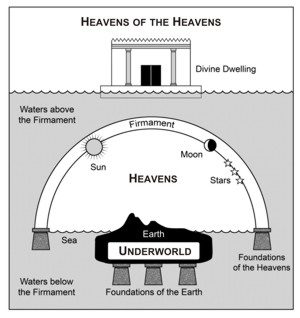 Denis Lamoureux introduced the idea that ancient “science” is present in the Bible, but it is incidental to the message of the Bible – a topic I’ve posted on in the past. (The image to the right comes from his book Evolutionary Creation.) The ancient author used his understanding of cosmology to relate a concrete message about God. We shouldn’t interpret the text metaphorically or as a scientific treatise, rather we should look for the theological message. Harris agrees, pointing out that the Bible does relate a concrete message about creation, but this message is not scientific. It is moral, aesthetic, spiritual, and theological. The creation texts in the Bible use diverse ideas and imagery to describe creation. There is less diversity when it comes to the moral, aesthetic, spiritual and theological message.
So far I’ve only scratched the surface, but it looks like Harris will take us in some interesting directions as he explores creation according to science, creation according to the Bible, suffering, evil, and new creation. Join us as we dig in to the book.
Is a Christian doctrine of creation appropriately framed as a series of propositions?
How else could we frame the question?
To what extent should we interpret the biblical texts as about God rather than about the world?
If you wish to contact me, you may do so at rjs4mail[at]att.net.
If interested you can subscribe to a full text feed of my posts at Musings on Science and Theology.
Previous Post

March 17, 2015
The Apocalyptic Paul -- His Biography
Next Post
March 17, 2015 Mimi Haddad on International Women's Day
Browse Our Archives
Select a Category Acts of the Apostles Adam Advent Anabaptism Angels Anglican Apologetics Atonement Baptism BCP Prayers Bible Biblical Studies Birds Blogging Bloglossary Bonhoeffer Books Calvinism Christianity Church Church History Coffee Colossians Commentary Recs Conversion Creation Creeds Culture Death Ecclesiastes Economics Education Embracing Grace Emergent Emerging Movement Eschatology Essays Ethics Eucharist Evangelicalism Family Fasting Fathers Fellowship of Differents Footsteps Tour Fun and Whimsical Gospel Grace Happiness Heaven Hell Holy Spirit Irenaeus James Jesus Jesus Creed Job Justification Kingdom of God Law Lectures Lent Liberalism Love and Marriage Mabanteneni Manhood Mary Miracles Missio Alliance MissioLife Missional Missional Jesus Movies and Film New Perspective Northern Seminary OneLife Origins Project Orthodox Parables Pastor's Spouse Pastoring and Leading Pastoring and Preaching Patristics Paul Paul-John Tour Pharisees Pietism Political Theology Prayer and Formation Preaching Problems for Faith Psalm 119 Psalms Public Issues Purgatory Religions Resurrection Revelation Romans Rule of JCreed Science and Faith Sermon on the Mount Sports Ten Commandments Theology Third Way Top Ten Lists Translations Uncategorized Universalism University Ministry Way Out Weekly Meanderings Wisdom Women and Ministry Work Worship Writing & Blogging Youth Ministry
Select a Month July 2021 January 2020 December 2019 November 2019 October 2019 September 2019 August 2019 July 2019 June 2019 May 2019 April 2019 March 2019 February 2019 January 2019 December 2018 November 2018 October 2018 September 2018 August 2018 July 2018 June 2018 May 2018 April 2018 March 2018 February 2018 January 2018 December 2017 November 2017 October 2017 September 2017 August 2017 July 2017 June 2017 May 2017 April 2017 March 2017 February 2017 January 2017 December 2016 November 2016 October 2016 September 2016 August 2016 July 2016 June 2016 May 2016 April 2016 March 2016 February 2016 January 2016 December 2015 November 2015 October 2015 September 2015 August 2015 July 2015 June 2015 May 2015 April 2015 March 2015 February 2015 January 2015 December 2014 November 2014 October 2014 September 2014 August 2014 July 2014 June 2014 May 2014 April 2014 March 2014 February 2014 January 2014 December 2013 November 2013 October 2013 September 2013 August 2013 July 2013 June 2013 May 2013 April 2013 March 2013 February 2013 January 2013 December 2012 November 2012 October 2012 September 2012 August 2012 July 2012 June 2012 May 2012 April 2012 March 2012 February 2012 January 2012 December 2011 November 2011 October 2011 September 2011 August 2011 July 2011 June 2011 May 2011 April 2011 March 2011 February 2011 January 2011 December 2010 November 2010 October 2010 September 2010 August 2010 July 2010 June 2010 May 2010 April 2010 March 2010 February 2010 January 2010 December 2009 November 2009 October 2009 September 2009 August 2009 July 2009 June 2009 May 2009 April 2009 March 2009 February 2009 January 2009 December 2008 November 2008 October 2008 September 2008 August 2008 July 2008 June 2008 May 2008 April 2008 March 2008 February 2008 January 2008 December 2007 November 2007 October 2007 September 2007 August 2007 July 2007 June 2007 May 2007 April 2007 March 2007 February 2007 January 2007 December 2006 November 2006 October 2006 September 2006 August 2006 July 2006 June 2006 May 2006 April 2006 March 2006 February 2006 January 2006 December 2005 November 2005 October 2005 September 2005 August 2005 July 2005 June 2005 May 2005 April 2005 0000
Follow Us!
TAKE THE
Religious Wisdom Quiz
True or False: Eve was created from Adam's rib.
Select your answer to see how you score.
FALSE TRUE
Related posts from Jesus Creed


The Thrust of the Biblical Plot (RJS)


Not Of This World, But For This World...
TRENDING AT PATHEOS Evangelical

The REST of Your Life: A Creative Wrestles...
This week I had a conversation with a good friend from church....

How the author of the world's best hymn...
I've been working with John Newton for a while now. This makes...

Long before this Lectio Divina, Psalm 130 - the song - started...

What About the Trees? Another Living Parable
After I finished writing the last article about falling leaves as a...

Why Classical Education Is a Conversation, Not a...
Come and Read: Joy in Classical Education When I was a little...

Cornell University has received a great deal of negative publicity and intense...
view all Evangelical blogs
Ad-Free & Subscriber Log-In Subscription Support
- About Us
- 2026 Calendar
- Videos
- Podcasts
- Library of World Religions
- Faith In Media Tracker
- Advertise With Us
- Write for Us
- Privacy Policy
- Terms of Service
- Do Not Sell My Data
- Contact Us
- Radiant Digital
- Manage Newsletter Subscriptions
- Unsubscribe From Notifications
- Sitemap
Copyright 2008-2026, Patheos. All rights reserved.
Subscription Support Ad-Free & Subscriber Log-In
Follow Patheos