
BuddhistCatholicContemplativeEvangelicalGeneral ChristianHinduJewishLatter-day SaintMuslimNew VisionsProgressive Christian
Beliefs
- Buddhist
- Catholic
- Contemplative
- Evangelical
- General Christian
- Hindu
- Jewish
- Latter-day Saint
- More Voices
- Muslim
- New Visions
- Pagan
- Progressive Christian
Topics
- Religion News
- Food and Religion
- Sports and Religion
- Religious Art
- Religious Music and Entertainment
- Religious Events
- History and Religion
- Style and Religion
- Politics and Religion
- Women in Religion
- Recreation Outdoors and Religion
- Business Finance and Religion
- Careers Workplace and Religion
- Education and Religion
- Family Parenting and Religion
- Health Fitness and Religion
- Home and Religion
- Relationships and Religion
- Technology and Religion
- Travel and Religion
Columnists
- Buddhist Columnists
- Business Finance and Religion Columnists
- Careers Workplace and Religion Columnists
- Catholic Columnists
- Contemplative Columnists
- Education and Religion Columnists
- Evangelists Columnists
- Family Parenting and Religion Columnists
- General Christian Columnists
- Health Fitness and Religion Columnists
- Hindu Columnists
- History and Religion Columnists
- Home and Religion Columnists
- Jewish Columnists
- More Voices Columnists
- Latter Day Columnists
- Muslim Columnists
- New Visions Columnists
- Nonreligious Columnists
- Pagan Columnists
- Politics and Religion Columnists
- Progressive Columnists
- Recreation Outdoors and Religion Columnists
- Relationships and Religion Columnists
- Religion News Columnists
- Religious Art Columnists
- Religious Events Columnists
- Religious Music and Entertainment Columnists
- Sports and Religion Columnists
- Style and Religion Columnists
- Technology and Religion Columnists
- Travel and Religion Columnists
- Women in Religion Columnists
Resource Library
- 2026 Calendar
- Library of World Religions
- The 100 Most Holy Places on Earth
- Patheos Answers
- Podcasts
- Videos
- Faith Leaders Database
- Anglican Episcopalian
- Bahai
- Baptist
- Buddhism
- Christianity
- Confucianism
- Eastern Orthodoxy
- Hinduism
- Holiness and Pentecostal
- ISKCON
- Islam
- Judaism
- Lutheran
- Methodist
- The Church of Jesus Christ of Latter-day Saints
- New Age
- Paganism
- Presbytarian and Reformed
- Protestantism
- Religion Behind the Scenes
- Roman Catholic
- Scientology
- Shia Islam
- Sikhism
- Sufism
- Sunni Islam
- Taoism
- Zen
- See all religions
Research Tools
 Ad-Free & Subscriber Log-In Subscription Support
Follow Patheos 

- Trending:
- Advent
- |
- Forgiveness
- |
- Thanksgiving
- |
- Election
- |
- Seasonal Holidays
- |
- Marriage
 Jesus Creed
- Home
- Evangelical
- Christ Centered Creation! (RJS)
Christ Centered Creation! (RJS)
Last updated on: April 29, 2014 at 6:12 am by RJS
Christ Centered Creation! (RJS) 2014-04-29T06:12:48-05:00 RJS
Patheos Explore the world's faith through different perspectives on religion and spirituality! Patheos has the views of the prevalent religions and spiritualities of the world.
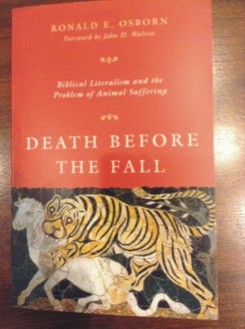 In the previous two posts (here and here) we looked with Ronald Osborn (Death Before the Fall) at the cosmic theodicy of C.S. Lewis and the creation narrative in the book of Job (a passage we too often overlook to our own detriment). Today we turn to the perspective that I see as the central issue in this entire discussion – Christ centered creation.
But Christianity – the faith whose central event is the brutal execution of the God-forsaken God on a Roman cross – greatly complicates and deepens our understanding of the divine response to suffering, whether of humans or animals. It also denies us any stoical pact with the cruelties of death as divinely fated necessity of life. Death is the final enemy. (p. 158)
This central focus has (or should have) a profound influence on the perspective we take of creation and the nature of creation. There is, quite frankly, nothing christological in the typical literalist reading of Genesis. Christ is the subsequent solution to a problem … a problem of our making although many will also point to God’s foreknowledge and/or predestination in the discussion. But this is not the universal Christian view. Turning to the ancient church fathers Osborn puts on the table the view that God’s purpose in creation always included the incarnation as a necessary part of bringing humans into union with God.
The creation was never a static golden age but always an unfolding story with an eschatalogical horizon. And the divine love has always willed that the journey of creation and the pilgrimage of humanity should end in our final adoption as coheirs of God’s kingdom and “partakers of the divine nature.” The destiny of humankind is not simply a recapitulation or recurrence, paradise lost, paradise restored. Rather, the end is greater than the beginning – and was always meant to be so through the mystery of the incarnation. (p. 159)
This view causes consternation for some Christians. The linear creation, fall, redemption story line is deeply connected with a popular view of atonement. After a bit of discussion of atonement theory, Osborn suggests that perhaps the weakness lies with the monotone view of atonement as penal substitution. We need a bigger and broader picture including the ancient understanding of ransom and Christus Victor in the mix (Scot’s A Community Called Atonement is a good resource here).
 The importance of kenosis. Beyond the mere statement of atonement, though, there is the power and the significance of kenosis, κενόω, – the self-emptying of Christ. Paul tells the Philippians … probably quoting an even older christological hymn of the church:
Have this attitude in yourselves which was also in Christ Jesus, who, although He existed in the form of God, did not regard equality with God a thing to be grasped, but emptied Himself, taking the form of a bond-servant, and being made in the likeness of men. Being found in appearance as a man, He humbled Himself by becoming obedient to the point of death, even death on a cross. (Phil. 2, NASB)
The character and governance of God is revealed in Jesus as the crucified savior, God’s Messiah. This isn’t part of the machinations of meticulous manipulation, but the response and plan of a God who is in relationship with his creation, a creation prepared for his purposes with a freedom of will the result of divine will.
Whatever its difficulties, the only position that makes any moral, religious, or rational sense of human moral evil to my mind is the one that declares that the divine will wills human free will, and is both powerful enough and self-giving enough to create beings with the capacity to make meaningful, self-defining choices that are morally and spiritually significant. (p. 161)
This position is also, to my mind, the only one that makes any sense at all of the biblical narrative from Genesis to revelation. The text we have is characterized by the response of God to faithfulness and faithlessness of his people. He is in relationship with people who have the freedom to follow or to turn away. We can cherry pick selected verses that support meticulous sovereignty, but can maintain that position only by rationalizing away the vast (vast!) majority of the text. God’s control is an open-handed control.
This God willed freedom extends (and here Osborn quotes John Polkinghorne) to freedom in the very nature of creation, a freedom that includes quantum uncertainty, plate tectonics, weather, and evolution. Osborn brings in a study by Dietrich Bonhoeffer (Creation and Fall Temptation: Two Biblical Studies) “The Creator wills that his creation itself should affirm and continue his work, he wills that created things should live and create further life.” This God-willed freedom is in harmony with the nature of God and with the person of Christ in the Gospels.
[A] kenotic picture of the Creator insists that God’s creative might and sovereign rule are always expressed in harmony with his character as revealed in the historical person of Jesus, whose way was one of cosuffering humility, nonviolent self-limitation and liberal self-donation. (p. 162)
And Adam? There is more to a Christ-centered view of creation than the fall of Adam and Eve. It is Christ, not Adam who is the first true human.
Some have insisted that without a historical Adam the life, death, and resurrection of the historical Jesus would be devoid of meaning. But this claim amounts to a denial (even if unintentionally so) of the centrality of Christ; for it gives the fallen Adam of Genesis an interpretative primacy over the Jesus of history that Paul and the Gospel writers do not allow. For disciples of Christ, it is only in Christ that the ancient story of human origins and destiny can be rightly understood – not the other way around. We do not read the story of Christ “Adamically.” We reread the story of Adam christologically in the light of the second Adam who is also the first Adam, the first fully human being of whom the ancient story is only a type, a dim shadow and longing, a “figure of him that was to come” (Rom 5:14). (p. 164)
Whether or not Adam existed as a unique historical individual is really quite secondary to the biblical narrative. Adam was not the culmination of some perfect creation. Rather, Osborn suggests that we should look to Christ in his life, self-emptying death as the culmination of creation. The cry “it is finished” carries a profoundly deep meaning … only with this is the creation of the world finally complete. The rest in the tomb is the sabbath rest, in many respects the first sabbath, followed with resurrection by new creation. We shouldn’t take this too far as we still live in anticipation of the age to come, where death is fully and completely vanquished.
But the point remains. Christ isn’t the solution to a problem of our (or Adam’s) making. Before the beginning of the world he was – the firstborn of all creation. We need a Christ centered view of creation.
I agree with most of what Osborn has to say in this chapter, and consider it one of the most important points we can make in the entire discussion. But perhaps you disagree.
What does it mean to have a Christ centered view of creation?
Does this a necessary feature of a Christian view of creation?
If you wish to contact me directly you may do so at rjs4mail [at] att.net.
If interested you can subscribe to a full text feed of my posts at Musings on Science and Theology.
Previous Post

April 29, 2014
For Your Bookshelf
Next Post
April 30, 2014 The Place in the Soul for Doubt (Josh Graves)
Browse Our Archives
Select a Category Acts of the Apostles Adam Advent Anabaptism Angels Anglican Apologetics Atonement Baptism BCP Prayers Bible Biblical Studies Birds Blogging Bloglossary Bonhoeffer Books Calvinism Christianity Church Church History Coffee Colossians Commentary Recs Conversion Creation Creeds Culture Death Ecclesiastes Economics Education Embracing Grace Emergent Emerging Movement Eschatology Essays Ethics Eucharist Evangelicalism Family Fasting Fathers Fellowship of Differents Footsteps Tour Fun and Whimsical Gospel Grace Happiness Heaven Hell Holy Spirit Irenaeus James Jesus Jesus Creed Job Justification Kingdom of God Law Lectures Lent Liberalism Love and Marriage Mabanteneni Manhood Mary Miracles Missio Alliance MissioLife Missional Missional Jesus Movies and Film New Perspective Northern Seminary OneLife Origins Project Orthodox Parables Pastor's Spouse Pastoring and Leading Pastoring and Preaching Patristics Paul Paul-John Tour Pharisees Pietism Political Theology Prayer and Formation Preaching Problems for Faith Psalm 119 Psalms Public Issues Purgatory Religions Resurrection Revelation Romans Rule of JCreed Science and Faith Sermon on the Mount Sports Ten Commandments Theology Third Way Top Ten Lists Translations Uncategorized Universalism University Ministry Way Out Weekly Meanderings Wisdom Women and Ministry Work Worship Writing & Blogging Youth Ministry
Select a Month July 2021 January 2020 December 2019 November 2019 October 2019 September 2019 August 2019 July 2019 June 2019 May 2019 April 2019 March 2019 February 2019 January 2019 December 2018 November 2018 October 2018 September 2018 August 2018 July 2018 June 2018 May 2018 April 2018 March 2018 February 2018 January 2018 December 2017 November 2017 October 2017 September 2017 August 2017 July 2017 June 2017 May 2017 April 2017 March 2017 February 2017 January 2017 December 2016 November 2016 October 2016 September 2016 August 2016 July 2016 June 2016 May 2016 April 2016 March 2016 February 2016 January 2016 December 2015 November 2015 October 2015 September 2015 August 2015 July 2015 June 2015 May 2015 April 2015 March 2015 February 2015 January 2015 December 2014 November 2014 October 2014 September 2014 August 2014 July 2014 June 2014 May 2014 April 2014 March 2014 February 2014 January 2014 December 2013 November 2013 October 2013 September 2013 August 2013 July 2013 June 2013 May 2013 April 2013 March 2013 February 2013 January 2013 December 2012 November 2012 October 2012 September 2012 August 2012 July 2012 June 2012 May 2012 April 2012 March 2012 February 2012 January 2012 December 2011 November 2011 October 2011 September 2011 August 2011 July 2011 June 2011 May 2011 April 2011 March 2011 February 2011 January 2011 December 2010 November 2010 October 2010 September 2010 August 2010 July 2010 June 2010 May 2010 April 2010 March 2010 February 2010 January 2010 December 2009 November 2009 October 2009 September 2009 August 2009 July 2009 June 2009 May 2009 April 2009 March 2009 February 2009 January 2009 December 2008 November 2008 October 2008 September 2008 August 2008 July 2008 June 2008 May 2008 April 2008 March 2008 February 2008 January 2008 December 2007 November 2007 October 2007 September 2007 August 2007 July 2007 June 2007 May 2007 April 2007 March 2007 February 2007 January 2007 December 2006 November 2006 October 2006 September 2006 August 2006 July 2006 June 2006 May 2006 April 2006 March 2006 February 2006 January 2006 December 2005 November 2005 October 2005 September 2005 August 2005 July 2005 June 2005 May 2005 April 2005 0000
Follow Us!
TAKE THE
Religious Wisdom Quiz
In 1 Peter, what does Peter say Sarah called Abraham?
Select your answer to see how you score.
My beloved Father Master Lord
Related posts from Jesus Creed
From Jesus Traditions to the Gospels themselves

The Thrust of the Biblical Plot (RJS)
The New Testament's Most Undervalued Theologian
TRENDING AT PATHEOS Evangelical

Don’t Miss the Parents: A Creative Christmas Meditation
As we enter the Advent Season, I see a lot of people...

Making Stones Into Bread: Choosing the “Right” Work
I was on my online arts ministry Zoom meeting with the International...

Ukraine’s exhausted Christians face fifth winter of war
By Julian Lukins The full-scale war in Ukraine is taking “a serious...

Russell Brand's Conviction is not anti-Christian Persecution
How do we shed the reputation that the Church is OK with...

Have you ever caught yourself saying, “I’ll do it tomorrow,” or “Now...

Throughout history, people have pursued pleasure, possessions, relationships, and success in an...
view all Evangelical blogs
Ad-Free & Subscriber Log-In Subscription Support
- About Us
- 2026 Calendar
- Videos
- Podcasts
- Library of World Religions
- Faith In Media Tracker
- Advertise With Us
- Write for Us
- Privacy Policy
- Terms of Service
- Do Not Sell My Data
- Contact Us
- Radiant Digital
- Manage Newsletter Subscriptions
- Unsubscribe From Notifications
- Sitemap
Copyright 2008-2026, Patheos, part of the Radiant Digital network of media brands. All rights reserved.
Subscription Support Ad-Free & Subscriber Log-In
Follow Patheos