
BuddhistCatholicContemplativeEvangelicalGeneral ChristianHinduJewishLatter-day SaintMuslimNew VisionsProgressive Christian
Beliefs
- Buddhist
- Catholic
- Contemplative
- Evangelical
- General Christian
- Hindu
- Jewish
- Latter-day Saint
- More Voices
- Muslim
- New Visions
- Pagan
- Progressive Christian
Topics
- Religion News
- Food and Religion
- Sports and Religion
- Religious Art
- Religious Music and Entertainment
- Religious Events
- History and Religion
- Style and Religion
- Politics and Religion
- Women in Religion
- Recreation Outdoors and Religion
- Business Finance and Religion
- Careers Workplace and Religion
- Education and Religion
- Family Parenting and Religion
- Health Fitness and Religion
- Home and Religion
- Relationships and Religion
- Technology and Religion
- Travel and Religion
Columnists
- Buddhist Columnists
- Business Finance and Religion Columnists
- Careers Workplace and Religion Columnists
- Catholic Columnists
- Contemplative Columnists
- Education and Religion Columnists
- Evangelists Columnists
- Family Parenting and Religion Columnists
- General Christian Columnists
- Health Fitness and Religion Columnists
- Hindu Columnists
- History and Religion Columnists
- Home and Religion Columnists
- Jewish Columnists
- More Voices Columnists
- Latter Day Columnists
- Muslim Columnists
- New Visions Columnists
- Nonreligious Columnists
- Pagan Columnists
- Politics and Religion Columnists
- Progressive Columnists
- Recreation Outdoors and Religion Columnists
- Relationships and Religion Columnists
- Religion News Columnists
- Religious Art Columnists
- Religious Events Columnists
- Religious Music and Entertainment Columnists
- Sports and Religion Columnists
- Style and Religion Columnists
- Technology and Religion Columnists
- Travel and Religion Columnists
- Women in Religion Columnists
Resource Library
- 2026 Calendar
- Library of World Religions
- The 100 Most Holy Places on Earth
- Patheos Answers
- Podcasts
- Videos
- Faith Leaders Database
- Anglican Episcopalian
- Bahai
- Baptist
- Buddhism
- Christianity
- Confucianism
- Eastern Orthodoxy
- Hinduism
- Holiness and Pentecostal
- ISKCON
- Islam
- Judaism
- Lutheran
- Methodist
- The Church of Jesus Christ of Latter-day Saints
- New Age
- Paganism
- Presbytarian and Reformed
- Protestantism
- Religion Behind the Scenes
- Roman Catholic
- Scientology
- Shia Islam
- Sikhism
- Sufism
- Sunni Islam
- Taoism
- Zen
- See all religions
Research Tools
 Ad-Free & Subscriber Log-In Subscription Support
Ad-Free & Subscriber Log-In Subscription Support
Follow Patheos 

- Trending:
- Forgiveness
- |
- Marriage
- |
- Consciousness
- |
- Death Penalty
- |
- Election
- |
- Halloween
 Jesus Creed
- Home
- Evangelical
- From Tower Building to Net Mending (RJS)
From Tower Building to Net Mending (RJS)
Last updated on: April 2, 2014 at 5:42 am by RJS
From Tower Building to Net Mending (RJS) 2014-04-02T05:42:25-05:00 RJS
Patheos Explore the world's faith through different perspectives on religion and spirituality! Patheos has the views of the prevalent religions and spiritualities of the world.
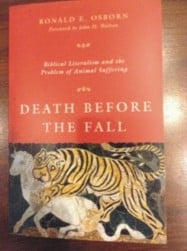 Ronald E. Osborn wraps up part one of his new book Death Before the Fall: Biblical Literalism and the Problem of Animal Suffering with a sketch of a new approach to hard questions of the Christian faith. He uses three different images to cast this vision.
First, he suggests that the Supreme Court provides an approach we should consider. Every decision (or almost every decision) has a majority opinion and a dissenting opinion. The dissenting justices are not disloyal, they simply disagree about the application of constitutional law in this instance. Dissenting opinions sometimes (but not always) point to future directions in consensus. Osborn poses the question:
What if Christian colleges and universities – even those affiliated with traditions with highly literalistic doctrines of creation – embraced a picture of unity in the body of Christ that included the concept of necessary loyal dissent within a framework of basic respect, transparency, and honest searching for truth? (p. 114-115)
Of course, the idea of loyal dissent is deeply troubling to many Christians. Open dialogue carries with it the possibility that we have not yet arrived at the whole truth and that change is possible. After all, the foundation may begin to crack, and who knows what will happen next. Religion, at least “fundamentalist” religion is addicted to certainty. Rather than viewing statements of faith or other such documents as consensus subject to ongoing dialogue they are unquestionable dogmas separating the insider from the outsider.
 Earlier in the book Osborn introduced an analogy comparing the foundationalist approach common in many conservative evangelical or fundamentalists groups to a stacked brick tower. This is, he says, “another image that must be challenged with better pictures of the life of the mind.” (p. 115) The tower is, intrinsically and irreparably, a faulty tower. (The image to the right is from Wikipedia)

Loyal dissent only makes sense if we move from the image of a tower with indubitable facts on which all rests to more helpful distributed images of our understanding of Christian faith. Osborn begins with a discussion of critical realism. He quotes N. T. Wright from The New Testament and the People of God, and reflects on the quote:
“Every human community shares and cherishes certain assumptions, traditions, expectations, and anxieties, and so forth, which encourage its members to construe reality in particular ways, and which create contexts within which certain kinds of statements are perceived as making sense.” What all this means is that we must abandon any pretensions to absolute certainty about our interpretations and confess that we always see “through a glass darkly” (1 Cor. 13:12). This is certainly true in scientific matters, but is perhaps especially true in theological ones (it was, after all, theology and not science that Paul was speaking of when he used the “through a glass darkly” metaphor. (p. 119)
There is both a reality we strive to understand and a realization that do not have a complete and unbiased perspective.
 Nets and Boats not Towers. Osborn offers two images to counter the image of knowledge and Christian faith as a brick tower liable to fall if the wrong brick is removed. The first is the image of a net or web.
The strength or stability of a net does not depend upon any one of its nodes, but upon the entire field as a unified whole. We can alter or mend different cross-points in the net using a wide variety of “knots” (methods) without fear that doing so will cause the entire net to become unraveled. Net menders will not be overly troubled by the different readings of Genesis or other parts of Scripture as long as these readings preserve the overall coherence of the Christian narrative. … The nodes in the net of Christian truth – which include knowledge gleaned from tradition, reason, observation and Scripture – are mutually supportive and mutually defining, never standing alone the way foundation of a brick tower does. (p. 120)
The second image Osborn considers is that of a boat on a long voyage where repairs are continually made to keep the boat afloat. A plank here, a plank there, and paradoxically the boat is made anew in the process. The boat itself is what counts, not the individual planks that make up the boat.
[T]he ship is strong enough to continue sailing while some of its planks are being restored. Dynamic change requires the continuity and stability of the total system, while the stability of the total system requires constant dynamic change at the level of its constituent parts. (p.121)
No analogy is perfect, and all of these will breakdown at some point, but openness to loyal dissent, an image of knowledge and faith as a net rather than a tower, and the interplay of dynamic change and continuity as a normal process can all contribute to deep and lasting Christian faith and a stronger church.
What do you think of the images that Osborne introduces?
Is loyal dissent a positive rather than a negative?
Is the image of a net better than the image of a tower?
Is it possible to view Christian faith as something akin to a ship undergoing a constant dynamic change? What are the constraints on this change?
Osborn concludes this chapter setting up part two where he will explore the question of death before the fall and animal suffering:
I assume the overall coherence as well as the compatibility of scientific and theological frameworks, the postfoundationalist character of all knowledge, the need for intellectual openness to new insights from diverse sources, and the necessity of developing an understanding of animal suffering consistent with God’s character of love as revealed in the historical person of Christ. I believe that Christians can boldly pursue the doctrinal “net mending” or “ship building” in the light of challenging scientific evidence, since all truth is ultimately one. (p.121)
I think he is on to something important with this approach. Other approaches, where each plank of the ship is foundational as in the tower can leave people “clinging to a single board as their vessels break apart into so much driftwood on the high seas.”
If you wish to contact me directly you may do so at rjs4mail[at]att.net
If interested you can subscribe to a full text feed of my posts at Musings on Science and Theology.
Previous Post

April 1, 2014
The Apostle Paul and Women
Next Post

April 1, 2014 This is not an April Fools Post but Should Be
Browse Our Archives
Select a Category Acts of the Apostles Adam Advent Anabaptism Angels Anglican Apologetics Atonement Baptism BCP Prayers Bible Biblical Studies Birds Blogging Bloglossary Bonhoeffer Books Calvinism Christianity Church Church History Coffee Colossians Commentary Recs Conversion Creation Creeds Culture Death Ecclesiastes Economics Education Embracing Grace Emergent Emerging Movement Eschatology Essays Ethics Eucharist Evangelicalism Family Fasting Fathers Fellowship of Differents Footsteps Tour Fun and Whimsical Gospel Grace Happiness Heaven Hell Holy Spirit Irenaeus James Jesus Jesus Creed Job Justification Kingdom of God Law Lectures Lent Liberalism Love and Marriage Mabanteneni Manhood Mary Miracles Missio Alliance MissioLife Missional Missional Jesus Movies and Film New Perspective Northern Seminary OneLife Origins Project Orthodox Parables Pastor's Spouse Pastoring and Leading Pastoring and Preaching Patristics Paul Paul-John Tour Pharisees Pietism Political Theology Prayer and Formation Preaching Problems for Faith Psalm 119 Psalms Public Issues Purgatory Religions Resurrection Revelation Romans Rule of JCreed Science and Faith Sermon on the Mount Sports Ten Commandments Theology Third Way Top Ten Lists Translations Uncategorized Universalism University Ministry Way Out Weekly Meanderings Wisdom Women and Ministry Work Worship Writing & Blogging Youth Ministry
Select a Month July 2021 January 2020 December 2019 November 2019 October 2019 September 2019 August 2019 July 2019 June 2019 May 2019 April 2019 March 2019 February 2019 January 2019 December 2018 November 2018 October 2018 September 2018 August 2018 July 2018 June 2018 May 2018 April 2018 March 2018 February 2018 January 2018 December 2017 November 2017 October 2017 September 2017 August 2017 July 2017 June 2017 May 2017 April 2017 March 2017 February 2017 January 2017 December 2016 November 2016 October 2016 September 2016 August 2016 July 2016 June 2016 May 2016 April 2016 March 2016 February 2016 January 2016 December 2015 November 2015 October 2015 September 2015 August 2015 July 2015 June 2015 May 2015 April 2015 March 2015 February 2015 January 2015 December 2014 November 2014 October 2014 September 2014 August 2014 July 2014 June 2014 May 2014 April 2014 March 2014 February 2014 January 2014 December 2013 November 2013 October 2013 September 2013 August 2013 July 2013 June 2013 May 2013 April 2013 March 2013 February 2013 January 2013 December 2012 November 2012 October 2012 September 2012 August 2012 July 2012 June 2012 May 2012 April 2012 March 2012 February 2012 January 2012 December 2011 November 2011 October 2011 September 2011 August 2011 July 2011 June 2011 May 2011 April 2011 March 2011 February 2011 January 2011 December 2010 November 2010 October 2010 September 2010 August 2010 July 2010 June 2010 May 2010 April 2010 March 2010 February 2010 January 2010 December 2009 November 2009 October 2009 September 2009 August 2009 July 2009 June 2009 May 2009 April 2009 March 2009 February 2009 January 2009 December 2008 November 2008 October 2008 September 2008 August 2008 July 2008 June 2008 May 2008 April 2008 March 2008 February 2008 January 2008 December 2007 November 2007 October 2007 September 2007 August 2007 July 2007 June 2007 May 2007 April 2007 March 2007 February 2007 January 2007 December 2006 November 2006 October 2006 September 2006 August 2006 July 2006 June 2006 May 2006 April 2006 March 2006 February 2006 January 2006 December 2005 November 2005 October 2005 September 2005 August 2005 July 2005 June 2005 May 2005 April 2005 0000
Follow Us!
TAKE THE
Religious Wisdom Quiz
Who was sent by the Jerusalem church to witness revival in Samaria?
Select your answer to see how you score.
Silas and Timothy Paul and Barnabas Peter and John James and John
Related posts from Jesus Creed

It's American for our Politicians to Reference the...



The Thrust of the Biblical Plot (RJS)
TRENDING AT PATHEOS Evangelical

The REST of Your Life: A Creative Wrestles...
This week I had a conversation with a good friend from church....

How the author of the world's best hymn...
I've been working with John Newton for a while now. This makes...

Long before this Lectio Divina, Psalm 130 - the song - started...

What About the Trees? Another Living Parable
After I finished writing the last article about falling leaves as a...

Why Classical Education Is a Conversation, Not a...
Come and Read: Joy in Classical Education When I was a little...

Cornell University has received a great deal of negative publicity and intense...
view all Evangelical blogs
Ad-Free & Subscriber Log-In Subscription Support
- About Us
- 2026 Calendar
- Videos
- Podcasts
- Library of World Religions
- Faith In Media Tracker
- Advertise With Us
- Write for Us
- Privacy Policy
- Terms of Service
- Do Not Sell My Data
- Contact Us
- Radiant Digital
- Manage Newsletter Subscriptions
- Unsubscribe From Notifications
- Sitemap
Copyright 2008-2026, Patheos. All rights reserved.
Subscription Support Ad-Free & Subscriber Log-In
Follow Patheos