
BuddhistCatholicContemplativeEvangelicalGeneral ChristianHinduJewishLatter-day SaintMuslimNew VisionsProgressive Christian
Beliefs
- Buddhist
- Catholic
- Contemplative
- Evangelical
- General Christian
- Hindu
- Jewish
- Latter-day Saint
- More Voices
- Muslim
- New Visions
- Pagan
- Progressive Christian
Topics
- Religion News
- Food and Religion
- Sports and Religion
- Religious Art
- Religious Music and Entertainment
- Religious Events
- History and Religion
- Style and Religion
- Politics and Religion
- Women in Religion
- Recreation Outdoors and Religion
- Business Finance and Religion
- Careers Workplace and Religion
- Education and Religion
- Family Parenting and Religion
- Health Fitness and Religion
- Home and Religion
- Relationships and Religion
- Technology and Religion
- Travel and Religion
Columnists
- Buddhist Columnists
- Business Finance and Religion Columnists
- Careers Workplace and Religion Columnists
- Catholic Columnists
- Contemplative Columnists
- Education and Religion Columnists
- Evangelists Columnists
- Family Parenting and Religion Columnists
- General Christian Columnists
- Health Fitness and Religion Columnists
- Hindu Columnists
- History and Religion Columnists
- Home and Religion Columnists
- Jewish Columnists
- More Voices Columnists
- Latter Day Columnists
- Muslim Columnists
- New Visions Columnists
- Nonreligious Columnists
- Pagan Columnists
- Politics and Religion Columnists
- Progressive Columnists
- Recreation Outdoors and Religion Columnists
- Relationships and Religion Columnists
- Religion News Columnists
- Religious Art Columnists
- Religious Events Columnists
- Religious Music and Entertainment Columnists
- Sports and Religion Columnists
- Style and Religion Columnists
- Technology and Religion Columnists
- Travel and Religion Columnists
- Women in Religion Columnists
Resource Library
- 2026 Calendar
- Library of World Religions
- The 100 Most Holy Places on Earth
- Patheos Answers
- Podcasts
- Videos
- Faith Leaders Database
- Anglican Episcopalian
- Bahai
- Baptist
- Buddhism
- Christianity
- Confucianism
- Eastern Orthodoxy
- Hinduism
- Holiness and Pentecostal
- ISKCON
- Islam
- Judaism
- Lutheran
- Methodist
- The Church of Jesus Christ of Latter-day Saints
- New Age
- Paganism
- Presbytarian and Reformed
- Protestantism
- Religion Behind the Scenes
- Roman Catholic
- Scientology
- Shia Islam
- Sikhism
- Sufism
- Sunni Islam
- Taoism
- Zen
- See all religions
Research Tools
 Ad-Free & Subscriber Log-In Subscription Support
Ad-Free & Subscriber Log-In Subscription Support
Follow Patheos 

- Trending:
- Forgiveness
- |
- Marriage
- |
- Consciousness
- |
- Death Penalty
- |
- Election
- |
- Halloween
 Jesus Creed
- Home
- Evangelical
- Walking from the Faith
Walking from the Faith
Last updated on: June 5, 2012 at 10:58 am by Scot McKnight
Walking from the Faith 2012-06-05T10:58:35-05:00 Scot McKnight
Patheos Explore the world's faith through different perspectives on religion and spirituality! Patheos has the views of the prevalent religions and spiritualities of the world.
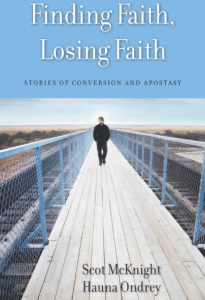
This article, from Alternet.com, is by Valerie Tarico, a psychologist and writer in Seattle, Washington and the founder of Wisdom Commons. She is the author of “Trusting Doubt: A Former Evangelical Looks at Old Beliefs in a New Light” and “Deas and Other Imaginings.” Her articles can be found at Awaypoint.Wordpress.com. Her study overlaps with the reasons for leaving the faith I published in Finding Faith, Losing Faith. (HT: JM)
If the Catholic bishops, their conservative Protestant allies**,** and other right-wing fundamentalists had the sole objective of decimating religious belief, they couldn’t be doing a better job of it.
Testimonials at sites like ExChristian.net show that people leave religion for a number of reasons, many of which religious leaders have very little control over. Sometimes, for example, people take one too many science classes. Sometimes they find their faith shattered by the suffering in the world – either because of a devastating injury or loss in their own lives or because they experience the realities of another person’s pain in a new way. Sometimes a believer gets intrigued by archaeology or symbology or the study of religion itself. Sometimes a believer simply picks up a copy of the Bible or the Koran and discovers faith-shaking contradictions or immoralities there.
But if you read ExChristian testimonials you will notice that quite often church leaders or members do things that either trigger the deconversion process or help it along. They may turn a doubter into a skeptic or a quiet skeptic into an outspoken anti-theist, or as one former Christian calls himself, a “devangelist.”
Here are some top ways Christians push people out the church door or shove secret skeptics out of the closet. Looking at the list, you can’t help but wonder if the Catholic bishops, Rick Santorum, Michele Bachmann and their fundamentalist allies are working for the devil.
1. Gay Baiting. Because of sheer demographics, many gay people are born into religious families. The condemnation (and self-condemnation) they face if their families see homosexuality as an abomination can be excruciating, as we all know from the suicide rate. Some emotionally battered gays spend their lives fighting or denying who they are, but many eventually find their way to open and affirming congregations or non-religious communities.
Ignorant and mean-spirited attitudes about homosexuality don’t drive just gays out of the church, they are a huge deconversion issue for straight friends and family members. When Christians indulge in slurs, devout moms and dads who also love their gay kids find themselves less comfortable in their church home. Young people, many of whom think of the gay rights issue as a no-brainer, put anti-gay churches in the “archaic” category. Since most people Gen X and younger recognize equal rights for gays as a matter of common humanity, gay baiting is a wedge issue that wedges young people right out of the church. That makes Fred Phelps a far better evangelist for atheism than for his own gay-hating Westborough Baptist Church.
2. Prooftexting. People who think of the Bible as the literally perfect word of God love to quote excerpts to argue their points. They often start with a verse in 1 Timothy: All scripture is given by inspiration of God (as if this circular argument would convince anyone but a true believer). They proceed to quote whatever authoritarian, anti-gay or anti-woman verse makes their point, like, Whoever spares the rod hates their children…Blows and wounds cleanse away evil, and beatings purge the inmost being or Thou shalt not lie with mankind, as with womankind: it is abomination. In doing so, they call into question biblical authority, because the Bible writers so obviously got these issues wrong. Literalists who prooftext are a tremendous asset to those who would like to see Bible worship fade away – because prooftexting on one side of an argument invites the same in return, and it is easy to find quotes from the Bible that are either scientifically absurd or morally repugnant.
Many liberal or modernist Christians see the Bible as a human document, an attempt by our spiritual ancestors to articulate their best understanding of God through the lens of imperfect human cultures and minds. Suppose such a Christian is confronted with a verse that says, for example, Now kill all the boys. And kill every woman who has slept with a man, but save for yourselves every girl who has never slept with a man (Numbers 31:17-18), or No man who has any defect may come near [to God in the temple]: no man who is blind or lame, disfigured or deformed; no man with a crippled foot or hand, or who is a hunchback or a dwarf, or who has any eye defect,…(Leviticus 21:17-23). He or she can simply shrug and say, “Yeah, that’s ugly.” A couple of years ago a group of liberal Christians even kicked off an Internet competition to vote on the worst verse in the Bible. Their faith doesn’t stand or fall with the perfection of the Bible. Biblical literalists, on the other hand, give someone like me an excuse to talk about sexual slavery or bias against handicapped people in the Bible – in front of an audience who have been taught that the good book is uniformly good. For a wavering believer, the dissonance can be too much.
3. Misogyny. For psychological and social reasons females are more inclined toward religious belief than males. They are more likely to attend church services and to insist on raising their children in a faith community. They also appear more indifferent than males to rational critique of religion, like debates about theology or evolutionary biology. I was interested to notice recently that my YouTube channel, Life After Christianity, which focuses on the psychology of religion gets about 80 percent male viewers. Women are the church’s base constituency, but fortunately for atheists, this fact hasn’t caused conservative Christians to back off of sexism that is justified by – you got it – prooftexting from the Old and New Testaments.
Evangelical minister Jim Henderson recently published a book, The Resignation of Eve, in which he urges his fellow Christians to take a hard look at the consequences of sexism in the church. According to Henderson, old-school sexism has driven some women out of Christianity permanently, but that’s just the tip of the iceberg. For those who stay, it means that many are less enthusiastic and engaged than they would be. Churches rely on women to volunteer in roles that range from secretary to director of children’s programs to missionaries. That takes a high level of confidence in church doctrines and also a strong sense of belonging. Biblical sexism cultivates neither. Between 1991 and 2011 the percent of women attending church in a typical week dropped by 11 points, from 55 to 44 percent.
4. Hypocrisy. Christians are taught – and many believe—that thanks to the indwelling presence of the Holy Spirit they are a moral beacon for society. The writer of Matthew told his audience, “You are the light of the world.” That’s a high bar, and yet decent believers (along with many other decent people) try earnestly to meet it. But the added pressure on those who call themselves the “righteous” means that believers also are prone to hiding, pretending, posing, and turning a blind eye to their own very human, very normal faults and flaws.
People who desperately want to be sanctified and righteous, “cleansed by the blood of the lamb” – who need to believe that they now merit heaven but that other people’s smallest transgressions merit eternal torture—have a lot of motivation to engage in self-deception and hypocrisy. High-profile hypocrites like Ted Haggard or Rush Limbaugh may be loved by their acolytes, but for people who are teetering, they help to build a gut aversion to whatever they espouse. But often as not, the hypocrisies that pose a threat to faith are small and internal to a single Bible-study or youth group. Backbiting and social shunning are part of the church-lady stereotype for a reason. They also leave a bitter taste that makes some church members stop drinking the Kool-aid.
5. Disgusting and Immoral Behavior. The priest abuse scandal did more for the New Atheist movement than outspoken anti-theists like Christopher Hitchens (God is Not Great), Richard Dawkins (The God Delusion), Sam Harris (The End of Faith) or Bill Maher (Religulous) ever could. To make matters worse (or better, depending on your point of view) Bill Donohue of the Catholic League seems to be doing everything possible to fan those flames: On top of the abuse itself, followed by cover-ups, he is now insisting that the best defense of church property is a good offense against the victims, and has vowed to fight them “one by one.”
The Freedom from Religion Foundation publishes a bi-monthly newspaper that includes a regular feature: The Black Collar Crime Blotter. It features fraud, drug abuse, sex crimes and more by Protestant as well as Catholic clergy. The obvious purpose is to move readers from religion isn’t true to religion isn’t benign to religion is abhorrent and needs fighting. Moral outrage is a powerful emotion.
6. Science Denial. One of my former youth group friends had his faith done in by a conversation with a Bible study leader who explained that dinosaur skeletons actually are the bones of the giants described in early books of the Bible. Uh huh. Christians have come up with dozens of squishier, less falsifiable ways to explain the geological record: The “days” in Genesis 1 were really “ages.” Or God created the world with the fossils already in place to test our faith. Or the biblical creation story is really sacred metaphor. But young-earth creationists who believe the world appeared in its present form 6,000-10,000 years ago are stuck. And since almost half of the American public believes some version of this young-earth story, there are ample opportunities for inquiring minds to trip across proto-scientific nonsense.
Like other factors I’ve mentioned, science denial doesn’t just move believers to nonbelief; it also rallies opposition ranging from cantankerous bloggers to legal advocates. It provides fodder for comedians and critics: “If the world was created 6,000 years ago, what’s fueling your car?” It may produce some of the most far-reaching opposition to religious belief, because science advocates argue that faith, even socially benign faith, is a fundamentally flawed way of knowing. The Catholic church, perhaps still licking wounds about Galileo (it apologized finally in the 20th century), has managed to avoid embarrassing and easily disproven positions on evolutionary biology. But one could argue that its atheism-fostering positions on conception and contraception similarly rely on ignorance about or denial of biological science — in this case embryology and the basic fact that most embryos never become persons.
7. Political Meddling. If you look at religion-bashing quote-quip-photo-clip-links that circulate Facebook and Twitter, most of them are prompted by church incursions into the political sphere. A spat between two atheists erupted on my home page yesterday. “Why can’t ex-Christians just shut up about religion and get on with building a better world?” asked one. “Why can’t we shut up?!” screeched the other. “Because of shit like this!” He posted a link about Kansas giving doctors permission to deny contraception and accurate medical information to patients.
I myself give George W. Bush credit for transforming me from a politically indifferent, digging-in-the-garden agnostic into a culture warrior. He casually implied that, when going to war, he didn’t need to consult with his own father because he had consulted the big guy in the sky, and my evangelical relatives backed him up on that, and I thought, oh my God, the beliefs I was raised on are killing people. The Religious Right, and now the Catholic bishops, have brought religion into politics in the ugliest possible way short of holy war, and people who care about the greater good have taken notice. Lists of ugly Bible verses, articles about the psychology of religion, investigative exposes about Christian machinations in D.C. or rampant proselytizing in the military and public schools –all of these are popular among political progressives because it is impossible to drive progressive change without confronting religious fundamentalism.
8. Intrusion. Australian comedian and atheist John Safran flew to Salt Lake City for a round of door-to-door devangelism after Mormons rang his doorbell one too many times on Saturday morning. More serious intrusions, in deeply personal beginning- and end-of-life decisions, for example, generate reactive anti-theism in people who mostly just want to live and let live.
Catholic and evangelical conservatives have made a high-stakes gamble that they can regain authoritarian control over their flocks and hold onto the next generation of believers (and tithers) by asserting orthodox dogmas, making Christian belief an all-or-nothing proposition. Their goal is a level of theological purity that will produce another Great Awakening based largely on the same dogmas as the last one. They hope to cleanse their membership of theological diversity, and assert top-down control of conscience questions, replenishing their membership with anti-feminist, pro-natalist policies and proselytizing in the Southern hemisphere. But the more they resort to strict authoritarianism, insularity and strict interpretation of Iron Age texts, the more people are wounded in the name of God and the more people are outraged. By making Christian belief an all-or-nothing proposition, they force at least some would-be believers to choose “nothing.” Anti-theists are all too glad to help.
Valerie Tarico is a psychologist and writer in Seattle, Washington and the founder of Wisdom Commons. She is the author of “Trusting Doubt: A Former Evangelical Looks at Old Beliefs in a New Light” and “Deas and Other Imaginings.” Her articles can be found at Awaypoint.Wordpress.com.
Previous Post

June 5, 2012
Evolution and the Creativity of God (RJS)
Next Post
June 5, 2012 Zettabtyes are Coming
Browse Our Archives
Select a Category Acts of the Apostles Adam Advent Anabaptism Angels Anglican Apologetics Atonement Baptism BCP Prayers Bible Biblical Studies Birds Blogging Bloglossary Bonhoeffer Books Calvinism Christianity Church Church History Coffee Colossians Commentary Recs Conversion Creation Creeds Culture Death Ecclesiastes Economics Education Embracing Grace Emergent Emerging Movement Eschatology Essays Ethics Eucharist Evangelicalism Family Fasting Fathers Fellowship of Differents Footsteps Tour Fun and Whimsical Gospel Grace Happiness Heaven Hell Holy Spirit Irenaeus James Jesus Jesus Creed Job Justification Kingdom of God Law Lectures Lent Liberalism Love and Marriage Mabanteneni Manhood Mary Miracles Missio Alliance MissioLife Missional Missional Jesus Movies and Film New Perspective Northern Seminary OneLife Origins Project Orthodox Parables Pastor's Spouse Pastoring and Leading Pastoring and Preaching Patristics Paul Paul-John Tour Pharisees Pietism Political Theology Prayer and Formation Preaching Problems for Faith Psalm 119 Psalms Public Issues Purgatory Religions Resurrection Revelation Romans Rule of JCreed Science and Faith Sermon on the Mount Sports Ten Commandments Theology Third Way Top Ten Lists Translations Uncategorized Universalism University Ministry Way Out Weekly Meanderings Wisdom Women and Ministry Work Worship Writing & Blogging Youth Ministry
Select a Month July 2021 January 2020 December 2019 November 2019 October 2019 September 2019 August 2019 July 2019 June 2019 May 2019 April 2019 March 2019 February 2019 January 2019 December 2018 November 2018 October 2018 September 2018 August 2018 July 2018 June 2018 May 2018 April 2018 March 2018 February 2018 January 2018 December 2017 November 2017 October 2017 September 2017 August 2017 July 2017 June 2017 May 2017 April 2017 March 2017 February 2017 January 2017 December 2016 November 2016 October 2016 September 2016 August 2016 July 2016 June 2016 May 2016 April 2016 March 2016 February 2016 January 2016 December 2015 November 2015 October 2015 September 2015 August 2015 July 2015 June 2015 May 2015 April 2015 March 2015 February 2015 January 2015 December 2014 November 2014 October 2014 September 2014 August 2014 July 2014 June 2014 May 2014 April 2014 March 2014 February 2014 January 2014 December 2013 November 2013 October 2013 September 2013 August 2013 July 2013 June 2013 May 2013 April 2013 March 2013 February 2013 January 2013 December 2012 November 2012 October 2012 September 2012 August 2012 July 2012 June 2012 May 2012 April 2012 March 2012 February 2012 January 2012 December 2011 November 2011 October 2011 September 2011 August 2011 July 2011 June 2011 May 2011 April 2011 March 2011 February 2011 January 2011 December 2010 November 2010 October 2010 September 2010 August 2010 July 2010 June 2010 May 2010 April 2010 March 2010 February 2010 January 2010 December 2009 November 2009 October 2009 September 2009 August 2009 July 2009 June 2009 May 2009 April 2009 March 2009 February 2009 January 2009 December 2008 November 2008 October 2008 September 2008 August 2008 July 2008 June 2008 May 2008 April 2008 March 2008 February 2008 January 2008 December 2007 November 2007 October 2007 September 2007 August 2007 July 2007 June 2007 May 2007 April 2007 March 2007 February 2007 January 2007 December 2006 November 2006 October 2006 September 2006 August 2006 July 2006 June 2006 May 2006 April 2006 March 2006 February 2006 January 2006 December 2005 November 2005 October 2005 September 2005 August 2005 July 2005 June 2005 May 2005 April 2005 0000
Follow Us!
TAKE THE
Religious Wisdom Quiz
What river did John baptize Jesus in?
Select your answer to see how you score.
Red Sea Tigris River Jordan River Nile River
Related posts from Jesus Creed


Weekly Meanderings, 16 March 2019
TRENDING AT PATHEOS Evangelical

The REST of Your Life: A Creative Wrestles...
This week I had a conversation with a good friend from church....

How the author of the world's best hymn...
I've been working with John Newton for a while now. This makes...

Long before this Lectio Divina, Psalm 130 - the song - started...

What About the Trees? Another Living Parable
After I finished writing the last article about falling leaves as a...

Why Classical Education Is a Conversation, Not a...
Come and Read: Joy in Classical Education When I was a little...

Cornell University has received a great deal of negative publicity and intense...
view all Evangelical blogs
Ad-Free & Subscriber Log-In Subscription Support
- About Us
- 2026 Calendar
- Videos
- Podcasts
- Library of World Religions
- Faith In Media Tracker
- Advertise With Us
- Write for Us
- Privacy Policy
- Terms of Service
- Do Not Sell My Data
- Contact Us
- Radiant Digital
- Manage Newsletter Subscriptions
- Unsubscribe From Notifications
- Sitemap
Copyright 2008-2026, Patheos. All rights reserved.
Subscription Support Ad-Free & Subscriber Log-In
Follow Patheos