
BuddhistCatholicContemplativeEvangelicalGeneral ChristianHinduJewishLatter-day SaintMuslimNew VisionsProgressive Christian
Beliefs
- Buddhist
- Catholic
- Contemplative
- Evangelical
- General Christian
- Hindu
- Jewish
- Latter-day Saint
- More Voices
- Muslim
- New Visions
- Pagan
- Progressive Christian
Topics
- Religion News
- Food and Religion
- Sports and Religion
- Religious Art
- Religious Music and Entertainment
- Religious Events
- History and Religion
- Style and Religion
- Politics and Religion
- Women in Religion
- Recreation Outdoors and Religion
- Business Finance and Religion
- Careers Workplace and Religion
- Education and Religion
- Family Parenting and Religion
- Health Fitness and Religion
- Home and Religion
- Relationships and Religion
- Technology and Religion
- Travel and Religion
Columnists
- Buddhist Columnists
- Business Finance and Religion Columnists
- Careers Workplace and Religion Columnists
- Catholic Columnists
- Contemplative Columnists
- Education and Religion Columnists
- Evangelists Columnists
- Family Parenting and Religion Columnists
- General Christian Columnists
- Health Fitness and Religion Columnists
- Hindu Columnists
- History and Religion Columnists
- Home and Religion Columnists
- Jewish Columnists
- More Voices Columnists
- Latter Day Columnists
- Muslim Columnists
- New Visions Columnists
- Nonreligious Columnists
- Pagan Columnists
- Politics and Religion Columnists
- Progressive Columnists
- Recreation Outdoors and Religion Columnists
- Relationships and Religion Columnists
- Religion News Columnists
- Religious Art Columnists
- Religious Events Columnists
- Religious Music and Entertainment Columnists
- Sports and Religion Columnists
- Style and Religion Columnists
- Technology and Religion Columnists
- Travel and Religion Columnists
- Women in Religion Columnists
Resource Library
- 2026 Calendar
- Library of World Religions
- The 100 Most Holy Places on Earth
- Patheos Answers
- Podcasts
- Videos
- Faith Leaders Database
- Anglican Episcopalian
- Bahai
- Baptist
- Buddhism
- Christianity
- Confucianism
- Eastern Orthodoxy
- Hinduism
- Holiness and Pentecostal
- ISKCON
- Islam
- Judaism
- Lutheran
- Methodist
- The Church of Jesus Christ of Latter-day Saints
- New Age
- Paganism
- Presbytarian and Reformed
- Protestantism
- Religion Behind the Scenes
- Roman Catholic
- Scientology
- Shia Islam
- Sikhism
- Sufism
- Sunni Islam
- Taoism
- Zen
- See all religions
Research Tools
 Ad-Free & Subscriber Log-In Subscription Support
Ad-Free & Subscriber Log-In Subscription Support
Follow Patheos 

- Trending:
- Forgiveness
- |
- Marriage
- |
- Consciousness
- |
- Death Penalty
- |
- Election
- |
- Halloween
 Jesus Creed
- Home
- Evangelical
- Evolution, Entropy, and Human Beings 2 (RJS)
Evolution, Entropy, and Human Beings 2 (RJS)
Last updated on: June 3, 2013 at 8:50 pm by RJS
Evolution, Entropy, and Human Beings 2 (RJS) 2013-06-03T20:50:41-05:00 RJS
Patheos Explore the world's faith through different perspectives on religion and spirituality! Patheos has the views of the prevalent religions and spiritualities of the world.
This is the last post on the recent book by Karl Giberson and Francis Collins, The Language of Science and Faith: Straight Answers to Genuine Questions. This book has its origins in the avalanche of questions unleashed on Collins following the publication of his earlier book The Language of God. But this new book is not an encyclopedia of frequently asked questions – it is a readable book walking through many of the frequently asked questions and the important issues in a narrative form. It is written for the non-scientist and will make a good resource for those with questions, for discussion groups, and for church leaders.
 Chapter eight of The Language of Science and Faith addresses the always controversial issue of evolution and human beings. Here we hit on what I find to be the center of conflict between evolution and Christian belief. Yes, the issues of the interpretation of Genesis one, the reliability of scripture, and the place for God in creation are important. But the significance of humans in creation, nature of what it means to be human, and the centrality of human sin to Christian doctrine provoke serious theological conundrums in the context of evolution and common descent.
In this chapter several questions are posed and discussed. Did evolution have to result in human beings? Is human evolution an accident? So how did God create humans? What about Adam and Eve?
It is popular among some who describe evolution for a lay audience (or a scientific audience) to describe the appearance of humans as a “glorious accident.” Yet from a Christian perspective mankind is a significant part of creation, perhaps the most significant part of creation. We are created in the image of God (Gen 1) a little lower than the angels, crowned with glory and honor (Psalm 8). God sent the son so that whoever believes in him may have eternal life (John 3). This is not the interaction of a creator with a glorious or ignoble accident.
There are both theological and scientific responses to the assertion of purposeless creation and accidental humans.
What do you find most troubling in the idea of evolutionary creation of humans?
First the theological approaches to evolutionary creation. Here Giberson and Collins provide three possible scenarios. We’ve suggested all of these in posts and comments over the years.
1. God outside of time.
For starters, a sovereign God can certainly create humans through an inevitable process that appears entirely random from within the system, so to speak. While we cannot know how God relates to time, it may be that God’s purposes are largely invisible from our vantage point. … There may be trajectories of purpose within the universe that we can only dimly perceive or not perceive at all. (p. 199)
2. God active in creation within time.
Another way to think about God’s relationship to evolution is to view God guiding the evolutionary process, working within the randomness. In this view, God is within time, working through the laws of nature in ways that only become apparent much later when we see how things turned out. … What appear to be genuinely random events might actually be the subtle influence of God working within the system of natural law. (pp. 199-200)
3. God uses freedom within creation to create, but the playing field, the “fitness landscape” ensures the intended result.
Finally, we might also imagine, as a third possibility, that God intentionally integrated freedom in the evolutionary process and chose not to predetermine the detailed trajectories of its many winding pathways. But perhaps there are favored directions within the system that tilt the playing field, so that things tend toward certain results. (p. 200)
In each case the evolution of human beings is an intentional and necessary part of God’s grand plan in creation. The first two scenarios do not speak to the scientific issue of evolution – evolution may appear random with patterns, deviations from randomness that are impossible to discern from the inside. We take the evidence as given and develop our scientific conclusions. But God is at work, either transcending time or directly active within the temporal progress of creation. These are plausible scenarios.
The third possibility requires some scientific evidence in conjunction with the theological assumption. If the playing field is tilted there should be scientific evidence for the inevitability of life, and once life is established for the inevitability of humans as a product of the process. I find this scenario particularly attractive and believe that there is, in fact, evidence for or reason to believe in the inevitability of humans given the constraints of the physical universe within which we live and breathe. Simon Conway Morris describes this in his book Life’s Solution: Inevitable Humans in a Lonely Universe. Here he works through an approach to evolution that sees humans as inevitable and evolutionary convergence as scientific evidence for this position. I have had scientific conversations with non-Christian colleagues who take a similar view at least in part. Giberson and Collins summarize the arguments in their book (pp. 201-205). (I posted on the book about a year and a half ago, you can find the links in the Science and Faith Archive on the sidebar.)
Unless we assert that such details as five fingers and one central protruding nose are essential features of what it means to be human the scientific evidence is fully compatible with the intentional and purposeful creation of humans in the image of God.
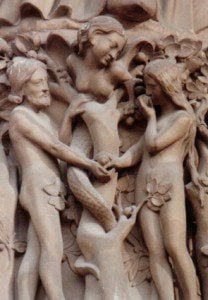
What about Adam and Eve?
Here we run into a number of issues. Literalist historical readings of Genesis 1-11 are not textually consistent, historically consistent, or scientifically consistent with the evidence available including archaeological evidence, geological evidence and genetic evidence. Here we can list several points starting with the text of scripture itself. Genesis 1 and 2 are distinct creation accounts, Cain clearly had a wife, feared the people, and built a city. Scientific evidence indicates a substantially larger population, with persons spread around the globe 10,000 years ago. Genetic data demonstrate descent from a population of several thousand, not two. The similarities with creation stories in other Ancient Near East sources and the clear inclusion of ancient cosmologies also inform our understanding of Genesis.
Genesis 1-11 is true, but must be read for the text it is looking for the intended theological message. There are several possible directions to take regarding Adam and Eve, but these must be both theologically and scientifically sound.
1. Non literalist readings with Adam and the fall as an “everyman” story. The story reflects the dark side present within all of us. We all rebel against God and we need God’s grace. This interpretation runs into problems with Romans 5 and our understanding of the atoning work of Jesus. It is not so much that Paul thought Adam was an individual as that he thought the Fall was real and cast his understanding of Jesus in this context.
2. Rather than an “everyman” story, some suggest that the story of Adam is the beginning of Israel not the beginning of humanity. Pete Enns has suggested this “Adam is Israel” approach as an angle on the text and put it out for discussion. (See Adam is Israel).
There are two ways of looking at this parallel. You could say that the Adam story came first and then the Israelites just followed that pattern. But there is another way. Maybe Israel’s history happened first, and the Adam story was written to reflect that history. In other words, the Adam story is really an Israel story placed in primeval time. It is not a story of human origins but of Israel’s origins.
3. Finally, there are also historical views that work with the evidence.
A common synthetic view integrating the biblical and scientific accounts sees human-like creatures evolving as the scientific evidence indicates, steadily becoming more capable of relating to God. At a certain point in history, God entered into a special relationship with those who had developed the necessary characteristics, endowing them with the gift of his image. With this spiritual gift came the ability to know and experience evil – an opportunity grasped with tragic consequences that have carried through the history of our species. (p.212)
Personally I lean to the third option here. This is similar to the view suggested by CS Lewis in The Problem of Pain, CH 5 The Fall of Man:
For long centuries, God perfected the animal form which was to become the vehicle of humanity and the image of Himself. … Then in fullness of time, God caused to descend upon this organism, both on its psychology and physiology, a new kind of consciousness which could say “I” and “me,” which could look upon itself as an object, which knew God, which could make judgments of truth, beauty, and goodness, and which was so far above time that is could perceive time flowing past. … We do not know how many of these creatures God made, nor how long they continued in the Paradisal state. But sooner or later they fell.
Christ is the point. The central point of Christianity is Christ – God’s relationship with his people and the incarnation of God becoming human, entering time and creation. If salvation through Christ requires only that humans are sinful and accountable before God any of these three scenarios are possible. If we conclude that the entrance of sin is a key piece of the theology of atonement, then a historical scenario of some sort becomes the preferred route. Much more conversation and prayer is required to think through all of the details.
What do you think? Which of these scenarios for understanding evolutionary creation in general and Adam in particular seem reasonable?
Are there other scenarios making sense of all the data, from both scripture and nature, that you would suggest?
If you wish to contact me directly you may do so at rjs4mail[at]att.net
If interested you can subscribe to a full text feed of my posts at Musings on Science and Theology.
Previous Post

March 31, 2011
The Same God 10
Next Post
March 31, 2011 What's Spit got to do with it?
Browse Our Archives
Select a Category Acts of the Apostles Adam Advent Anabaptism Angels Anglican Apologetics Atonement Baptism BCP Prayers Bible Biblical Studies Birds Blogging Bloglossary Bonhoeffer Books Calvinism Christianity Church Church History Coffee Colossians Commentary Recs Conversion Creation Creeds Culture Death Ecclesiastes Economics Education Embracing Grace Emergent Emerging Movement Eschatology Essays Ethics Eucharist Evangelicalism Family Fasting Fathers Fellowship of Differents Footsteps Tour Fun and Whimsical Gospel Grace Happiness Heaven Hell Holy Spirit Irenaeus James Jesus Jesus Creed Job Justification Kingdom of God Law Lectures Lent Liberalism Love and Marriage Mabanteneni Manhood Mary Miracles Missio Alliance MissioLife Missional Missional Jesus Movies and Film New Perspective Northern Seminary OneLife Origins Project Orthodox Parables Pastor's Spouse Pastoring and Leading Pastoring and Preaching Patristics Paul Paul-John Tour Pharisees Pietism Political Theology Prayer and Formation Preaching Problems for Faith Psalm 119 Psalms Public Issues Purgatory Religions Resurrection Revelation Romans Rule of JCreed Science and Faith Sermon on the Mount Sports Ten Commandments Theology Third Way Top Ten Lists Translations Uncategorized Universalism University Ministry Way Out Weekly Meanderings Wisdom Women and Ministry Work Worship Writing & Blogging Youth Ministry
Select a Month July 2021 January 2020 December 2019 November 2019 October 2019 September 2019 August 2019 July 2019 June 2019 May 2019 April 2019 March 2019 February 2019 January 2019 December 2018 November 2018 October 2018 September 2018 August 2018 July 2018 June 2018 May 2018 April 2018 March 2018 February 2018 January 2018 December 2017 November 2017 October 2017 September 2017 August 2017 July 2017 June 2017 May 2017 April 2017 March 2017 February 2017 January 2017 December 2016 November 2016 October 2016 September 2016 August 2016 July 2016 June 2016 May 2016 April 2016 March 2016 February 2016 January 2016 December 2015 November 2015 October 2015 September 2015 August 2015 July 2015 June 2015 May 2015 April 2015 March 2015 February 2015 January 2015 December 2014 November 2014 October 2014 September 2014 August 2014 July 2014 June 2014 May 2014 April 2014 March 2014 February 2014 January 2014 December 2013 November 2013 October 2013 September 2013 August 2013 July 2013 June 2013 May 2013 April 2013 March 2013 February 2013 January 2013 December 2012 November 2012 October 2012 September 2012 August 2012 July 2012 June 2012 May 2012 April 2012 March 2012 February 2012 January 2012 December 2011 November 2011 October 2011 September 2011 August 2011 July 2011 June 2011 May 2011 April 2011 March 2011 February 2011 January 2011 December 2010 November 2010 October 2010 September 2010 August 2010 July 2010 June 2010 May 2010 April 2010 March 2010 February 2010 January 2010 December 2009 November 2009 October 2009 September 2009 August 2009 July 2009 June 2009 May 2009 April 2009 March 2009 February 2009 January 2009 December 2008 November 2008 October 2008 September 2008 August 2008 July 2008 June 2008 May 2008 April 2008 March 2008 February 2008 January 2008 December 2007 November 2007 October 2007 September 2007 August 2007 July 2007 June 2007 May 2007 April 2007 March 2007 February 2007 January 2007 December 2006 November 2006 October 2006 September 2006 August 2006 July 2006 June 2006 May 2006 April 2006 March 2006 February 2006 January 2006 December 2005 November 2005 October 2005 September 2005 August 2005 July 2005 June 2005 May 2005 April 2005 0000
Follow Us!
TAKE THE
Religious Wisdom Quiz
Which Christian holiday starts the new liturgical year in Western churches?
Select your answer to see how you score.
Epiphany Advent Easter Lent
Related posts from Jesus Creed

Wise Words (from a long time ago)

Heaven Promise Livestream Event

Bethel College Tightens Creation Statement
TRENDING AT PATHEOS Evangelical

The REST of Your Life: A Creative Wrestles...
This week I had a conversation with a good friend from church....

How the author of the world's best hymn...
I've been working with John Newton for a while now. This makes...

Long before this Lectio Divina, Psalm 130 - the song - started...

What About the Trees? Another Living Parable
After I finished writing the last article about falling leaves as a...

Why Classical Education Is a Conversation, Not a...
Come and Read: Joy in Classical Education When I was a little...

Cornell University has received a great deal of negative publicity and intense...
view all Evangelical blogs
Ad-Free & Subscriber Log-In Subscription Support
- About Us
- 2026 Calendar
- Videos
- Podcasts
- Library of World Religions
- Faith In Media Tracker
- Advertise With Us
- Write for Us
- Privacy Policy
- Terms of Service
- Do Not Sell My Data
- Contact Us
- Radiant Digital
- Manage Newsletter Subscriptions
- Unsubscribe From Notifications
- Sitemap
Copyright 2008-2026, Patheos. All rights reserved.
Subscription Support Ad-Free & Subscriber Log-In
Follow Patheos