
BuddhistCatholicContemplativeEvangelicalGeneral ChristianHinduJewishLatter-day SaintMuslimNew VisionsProgressive Christian
Beliefs
- Buddhist
- Catholic
- Contemplative
- Evangelical
- General Christian
- Hindu
- Jewish
- Latter-day Saint
- More Voices
- Muslim
- New Visions
- Pagan
- Progressive Christian
Topics
- Religion News
- Food and Religion
- Sports and Religion
- Religious Art
- Religious Music and Entertainment
- Religious Events
- History and Religion
- Style and Religion
- Politics and Religion
- Women in Religion
- Recreation Outdoors and Religion
- Business Finance and Religion
- Careers Workplace and Religion
- Education and Religion
- Family Parenting and Religion
- Health Fitness and Religion
- Home and Religion
- Relationships and Religion
- Technology and Religion
- Travel and Religion
Columnists
- Buddhist Columnists
- Business Finance and Religion Columnists
- Careers Workplace and Religion Columnists
- Catholic Columnists
- Contemplative Columnists
- Education and Religion Columnists
- Evangelists Columnists
- Family Parenting and Religion Columnists
- General Christian Columnists
- Health Fitness and Religion Columnists
- Hindu Columnists
- History and Religion Columnists
- Home and Religion Columnists
- Jewish Columnists
- More Voices Columnists
- Latter Day Columnists
- Muslim Columnists
- New Visions Columnists
- Nonreligious Columnists
- Pagan Columnists
- Politics and Religion Columnists
- Progressive Columnists
- Recreation Outdoors and Religion Columnists
- Relationships and Religion Columnists
- Religion News Columnists
- Religious Art Columnists
- Religious Events Columnists
- Religious Music and Entertainment Columnists
- Sports and Religion Columnists
- Style and Religion Columnists
- Technology and Religion Columnists
- Travel and Religion Columnists
- Women in Religion Columnists
Resource Library
- 2026 Calendar
- Library of World Religions
- The 100 Most Holy Places on Earth
- Patheos Answers
- Podcasts
- Videos
- Faith Leaders Database
- Anglican Episcopalian
- Bahai
- Baptist
- Buddhism
- Christianity
- Confucianism
- Eastern Orthodoxy
- Hinduism
- Holiness and Pentecostal
- ISKCON
- Islam
- Judaism
- Lutheran
- Methodist
- The Church of Jesus Christ of Latter-day Saints
- New Age
- Paganism
- Presbytarian and Reformed
- Protestantism
- Religion Behind the Scenes
- Roman Catholic
- Scientology
- Shia Islam
- Sikhism
- Sufism
- Sunni Islam
- Taoism
- Zen
- See all religions
Research Tools
 Ad-Free & Subscriber Log-In Subscription Support
Ad-Free & Subscriber Log-In Subscription Support
Follow Patheos 

- Trending:
- Forgiveness
- |
- Marriage
- |
- Consciousness
- |
- Death Penalty
- |
- Election
- |
- Halloween
 Jesus Creed
- Home
- Evangelical
- A Statement on Science, Faith, and Human Origins (RJS)
A Statement on Science, Faith, and Human Origins (RJS)
Last updated on: January 13, 2011 at 12:39 pm by RJS
A Statement on Science, Faith, and Human Origins (RJS) 2011-01-13T12:39:53-06:00 RJS
Patheos Explore the world's faith through different perspectives on religion and spirituality! Patheos has the views of the prevalent religions and spiritualities of the world.
BioLogos published a summary statement from the 2010 Workshop Theology of Celebration II held Nov. 9-11 (link to statement and post). Today I would like to put this statement up for consideration and discussion. There are two segments to the statement. The first part deals with the general atmosphere of debate and an affirmation that both the nature of the world we observe, study, and model and Scripture reveal the same God the source of all.
Science and Faith
We affirm historic Christianity as articulated in the classic ecumenical creeds. Beyond the original creation, God continues to act in the natural world by sustaining it and by providentially guiding it toward the goal of a restored and consummated creation. In contrast to Deism, BioLogos affirms God’s direct involvement in human history, including singular acts such as the incarnation and resurrection of Christ, as well as ongoing acts such as answers to prayer and acts of salvation and personal transformation.
We also affirm the value of science, which eloquently describes the glory of God’s creation. We stand with a long tradition of Christians for whom faith and science are mutually hospitable, and we see no necessary conflict between the Bible and the findings of science. We reject, however, the unspoken philosophical presuppositions of scientism, the belief that science is the sole source of all knowledge.
In recent years voices have emerged who seek to undermine religious faith as intellectually disreputable, in part because of its alleged dissonance with science. Some go further, characterizing religion as a “mind virus” or a cultural evil. While many of their ideas are not new, these voices are often identified as the New Atheists, and scientism undergirds their thinking.
In contrast to scientism, we deny that the material world constitutes the whole of reality and that science is our only path to truth. For all its fruitfulness, science is not an all-inclusive source of knowledge; scientism fails to recognize its limitations in fully understanding reality, including such matters as beauty, history, love, justice, friendship, and indeed science itself.
We agree that the methods of the natural sciences provide the most reliable guide to understanding the material world, and the current evidence from science indicates that the diversity of life is best explained as a result of an evolutionary process. Thus BioLogos affirms that evolution is a means by which God providentially achieves God’s purposes.
This is a key part of the statement, an affirmation that God acts in his creation, that science is not the all-inclusive source of knowledge, that there is more than life that facts and material existence. Evolutionary creation is not an a priori assumption, but a conclusion from observation. The conclusion is consistent with Christian faith, evolution is a means by which God acts. He acted and continues to act in evolutionary processes as he acted and continues to act in the weather and the production of each new person in his or her mother’s womb.
What do you think of this part of the statement – does it say what needs to be said?
Is there something else that could or should have been said? (Bear in mind that this is a short statement not a 700 page treatise).
The second part of the summary statement deals more specifically with the question of human origins. The issue here is not the origin of the material biological animals, but the origin of fully human beings created in the image of God. It is generally accepted in the context of this statement that the material biological human animal evolved in common descent with other life on earth.
Accounts of Origins
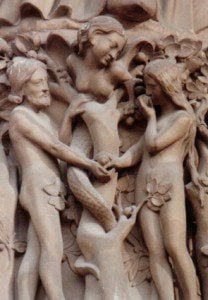
We affirm without reservation both the authority of the Bible and the integrity of science, accepting each of the “Two Books” (the Word and Works of God) as God’s revelations to humankind. Specifically, we affirm the central truth of the biblical accounts of Adam and Eve in revealing the character of God, the character of human beings, and the inherent goodness of the material creation.
We acknowledge the challenge of providing an account of origins that does full justice both to science and to the biblical record. Based on our discussions, we affirm that there are several options that can achieve this synthesis, including some which involve a historical couple, Adam and Eve, and that embrace the compelling conclusions that the earth is more than four billion years old and that all species on this planet are historically related through the process of evolution. We commit ourselves to spreading the word about such harmonious accounts of truth that God has revealed in the Bible and through science.
Is this position on human origins reasonable?
Should we be looking for more agreement on specifics or is it wise to leave the door open for multiple possibilities?
The general sentiment is that the precise model is not worth division. There is a difference of opinion as to the appropriate interpretation of Gen 2-3 and of the teachings of Paul, particularly those in Romans 5 and 1 Corinthians 15. There are a number of different approaches to resolve these questions that have accord with the scientific evidence and take different positions on the question of Adam.
Dr. Lamoureux gives one such model in his book, Evolutionary Creation. The use by Paul of Adam is incidental to the message of scripture. Paul assumed the historicity of Adam and of the fall because it was simply common knowledge of his day. The revealed message is Christ centered and looks forward, this is what Paul experienced and and what Paul expounds.
Dr. Alexander (Creation or Evolution: Do We Have to Choose?) puts forth for consideration a model which he terms homo divinus, a model that also accepts all of the scientific evidence for common descent and the dispersion of mankind around the globe, but finds the OT evidence for a specific Adam, or of adam as representative of a small community, and a fall persuasive. Adam is the federal head of humankind. When Adam falls, all humankind falls with him. John Stott suggests the possibility of such a model in his commentary on Romans as well.
Dr. Alexander also introduces a retelling model, where “the early chapters of Genesis represent a re-telling of this early episode, or series of episodes, in our human history in a form that could be understood within the Middle Eastern culture of the Jewish people of that time. The model therefore presents the Genesis account of Adam and Eve as a myth in the technical sense of that word – a story or parable having the main purpose of teaching eternal truths – albeit one that refers to real putative events that took place over a prolonged period of time during the early history of humanity in Africa.”
We can look to other writers and thinkers for other possible models or approaches. CS Lewis suggests a scenario in The Problem of Pain, Chapter 5, that takes the story of Gen 3 and the importance ascribed to this fall by Paul seriously, but doesn’t look to Genesis as an historical account of origins.The truth is in the story.
For long centuries, God perfected the animal form which was to become the vehicle of humanity and the image of Himself. … But it was only an animal because all its physical and psychical processes where directed to purely material and natural ends. Then in fullness of time, God caused to descend upon this organism, both on its psychology and physiology, a new kind of consciousness which could say “I” and “me,” which could look upon itself as an object, which knew God, which could make judgments of truth, beauty, and goodness, … We do not know how many of these creatures God made, nor how long they continued in the Paradisal state. But sooner or later they fell. Someone or something whispered that they could become as gods. … They wanted some corner in the universe in which they could say to God, “This is our business, not yours.” But there is no such corner. They wanted to be nouns, but they were and must eternally be, mere adjectives. We have no idea what particular act, or series of acts, the self-contradictory, impossible wish found expression.
The thrust in the second part of the BioLogos statement is that it is not wise to take a firm stand on any one of these models or approaches as necessary or as eliminated. They can be considered better, or worse, but it will take time, and a great deal of thinking in community, to reach any kind of consensus opinion. Let’s make it a conversation rather than a battle. Personally I find Dr. Alexander’s models unnecessary and a bit too convoluted. Dr. Lamoureux’s approach, while on the right track, seems to go to far in dismissing important parts of the theological message in scripture as incidental ancient views of origins. CS Lewis takes the message of Gen 3 and retains this message in integration with scientific understanding of the origin of the human animal – such an approach appeals to me.
What do you think?
It you wish to contact me directly you may do so at rjs4mail[at]att.net
If interested you can subscribe to a full text feed of my posts at Musings on Science and Theology.
Previous Post

January 13, 2011
Should Teachers Befriend Students? 1 (Sam Lamerson)
Next Post
January 13, 2011 Shauna Niequist: Enough
Browse Our Archives
Select a Category Acts of the Apostles Adam Advent Anabaptism Angels Anglican Apologetics Atonement Baptism BCP Prayers Bible Biblical Studies Birds Blogging Bloglossary Bonhoeffer Books Calvinism Christianity Church Church History Coffee Colossians Commentary Recs Conversion Creation Creeds Culture Death Ecclesiastes Economics Education Embracing Grace Emergent Emerging Movement Eschatology Essays Ethics Eucharist Evangelicalism Family Fasting Fathers Fellowship of Differents Footsteps Tour Fun and Whimsical Gospel Grace Happiness Heaven Hell Holy Spirit Irenaeus James Jesus Jesus Creed Job Justification Kingdom of God Law Lectures Lent Liberalism Love and Marriage Mabanteneni Manhood Mary Miracles Missio Alliance MissioLife Missional Missional Jesus Movies and Film New Perspective Northern Seminary OneLife Origins Project Orthodox Parables Pastor's Spouse Pastoring and Leading Pastoring and Preaching Patristics Paul Paul-John Tour Pharisees Pietism Political Theology Prayer and Formation Preaching Problems for Faith Psalm 119 Psalms Public Issues Purgatory Religions Resurrection Revelation Romans Rule of JCreed Science and Faith Sermon on the Mount Sports Ten Commandments Theology Third Way Top Ten Lists Translations Uncategorized Universalism University Ministry Way Out Weekly Meanderings Wisdom Women and Ministry Work Worship Writing & Blogging Youth Ministry
Select a Month July 2021 January 2020 December 2019 November 2019 October 2019 September 2019 August 2019 July 2019 June 2019 May 2019 April 2019 March 2019 February 2019 January 2019 December 2018 November 2018 October 2018 September 2018 August 2018 July 2018 June 2018 May 2018 April 2018 March 2018 February 2018 January 2018 December 2017 November 2017 October 2017 September 2017 August 2017 July 2017 June 2017 May 2017 April 2017 March 2017 February 2017 January 2017 December 2016 November 2016 October 2016 September 2016 August 2016 July 2016 June 2016 May 2016 April 2016 March 2016 February 2016 January 2016 December 2015 November 2015 October 2015 September 2015 August 2015 July 2015 June 2015 May 2015 April 2015 March 2015 February 2015 January 2015 December 2014 November 2014 October 2014 September 2014 August 2014 July 2014 June 2014 May 2014 April 2014 March 2014 February 2014 January 2014 December 2013 November 2013 October 2013 September 2013 August 2013 July 2013 June 2013 May 2013 April 2013 March 2013 February 2013 January 2013 December 2012 November 2012 October 2012 September 2012 August 2012 July 2012 June 2012 May 2012 April 2012 March 2012 February 2012 January 2012 December 2011 November 2011 October 2011 September 2011 August 2011 July 2011 June 2011 May 2011 April 2011 March 2011 February 2011 January 2011 December 2010 November 2010 October 2010 September 2010 August 2010 July 2010 June 2010 May 2010 April 2010 March 2010 February 2010 January 2010 December 2009 November 2009 October 2009 September 2009 August 2009 July 2009 June 2009 May 2009 April 2009 March 2009 February 2009 January 2009 December 2008 November 2008 October 2008 September 2008 August 2008 July 2008 June 2008 May 2008 April 2008 March 2008 February 2008 January 2008 December 2007 November 2007 October 2007 September 2007 August 2007 July 2007 June 2007 May 2007 April 2007 March 2007 February 2007 January 2007 December 2006 November 2006 October 2006 September 2006 August 2006 July 2006 June 2006 May 2006 April 2006 March 2006 February 2006 January 2006 December 2005 November 2005 October 2005 September 2005 August 2005 July 2005 June 2005 May 2005 April 2005 0000
Follow Us!
TAKE THE
Religious Wisdom Quiz
How many books does the Old Testament have?
Select your answer to see how you score.
51 39 50 41
Related posts from Jesus Creed

Wise Words (from a long time ago)

Heaven Promise Livestream Event

Bethel College Tightens Creation Statement
TRENDING AT PATHEOS Evangelical

The REST of Your Life: A Creative Wrestles...
This week I had a conversation with a good friend from church....

How the author of the world's best hymn...
I've been working with John Newton for a while now. This makes...

Long before this Lectio Divina, Psalm 130 - the song - started...

What About the Trees? Another Living Parable
After I finished writing the last article about falling leaves as a...

Why Classical Education Is a Conversation, Not a...
Come and Read: Joy in Classical Education When I was a little...

Cornell University has received a great deal of negative publicity and intense...
view all Evangelical blogs
Ad-Free & Subscriber Log-In Subscription Support
- About Us
- 2026 Calendar
- Videos
- Podcasts
- Library of World Religions
- Faith In Media Tracker
- Advertise With Us
- Write for Us
- Privacy Policy
- Terms of Service
- Do Not Sell My Data
- Contact Us
- Radiant Digital
- Manage Newsletter Subscriptions
- Unsubscribe From Notifications
- Sitemap
Copyright 2008-2026, Patheos. All rights reserved.
Subscription Support Ad-Free & Subscriber Log-In
Follow Patheos