
BuddhistCatholicContemplativeEvangelicalGeneral ChristianHinduJewishLatter-day SaintMuslimNew VisionsProgressive Christian
Beliefs
- Buddhist
- Catholic
- Contemplative
- Evangelical
- General Christian
- Hindu
- Jewish
- Latter-day Saint
- More Voices
- Muslim
- New Visions
- Pagan
- Progressive Christian
Topics
- Religion News
- Food and Religion
- Sports and Religion
- Religious Art
- Religious Music and Entertainment
- Religious Events
- History and Religion
- Style and Religion
- Politics and Religion
- Women in Religion
- Recreation Outdoors and Religion
- Business Finance and Religion
- Careers Workplace and Religion
- Education and Religion
- Family Parenting and Religion
- Health Fitness and Religion
- Home and Religion
- Relationships and Religion
- Technology and Religion
- Travel and Religion
Columnists
- Buddhist Columnists
- Business Finance and Religion Columnists
- Careers Workplace and Religion Columnists
- Catholic Columnists
- Contemplative Columnists
- Education and Religion Columnists
- Evangelists Columnists
- Family Parenting and Religion Columnists
- General Christian Columnists
- Health Fitness and Religion Columnists
- Hindu Columnists
- History and Religion Columnists
- Home and Religion Columnists
- Jewish Columnists
- More Voices Columnists
- Latter Day Columnists
- Muslim Columnists
- New Visions Columnists
- Nonreligious Columnists
- Pagan Columnists
- Politics and Religion Columnists
- Progressive Columnists
- Recreation Outdoors and Religion Columnists
- Relationships and Religion Columnists
- Religion News Columnists
- Religious Art Columnists
- Religious Events Columnists
- Religious Music and Entertainment Columnists
- Sports and Religion Columnists
- Style and Religion Columnists
- Technology and Religion Columnists
- Travel and Religion Columnists
- Women in Religion Columnists
Resource Library
- 2026 Calendar
- Library of World Religions
- The 100 Most Holy Places on Earth
- Patheos Answers
- Podcasts
- Videos
- Faith Leaders Database
- Anglican Episcopalian
- Bahai
- Baptist
- Buddhism
- Christianity
- Confucianism
- Eastern Orthodoxy
- Hinduism
- Holiness and Pentecostal
- ISKCON
- Islam
- Judaism
- Lutheran
- Methodist
- The Church of Jesus Christ of Latter-day Saints
- New Age
- Paganism
- Presbytarian and Reformed
- Protestantism
- Religion Behind the Scenes
- Roman Catholic
- Scientology
- Shia Islam
- Sikhism
- Sufism
- Sunni Islam
- Taoism
- Zen
- See all religions
Research Tools
 Ad-Free & Subscriber Log-In Subscription Support
Ad-Free & Subscriber Log-In Subscription Support
Follow Patheos 

- Trending:
- Forgiveness
- |
- Marriage
- |
- Consciousness
- |
- Death Penalty
- |
- Election
- |
- Halloween
 Jesus Creed
- Home
- Evangelical
- Evolutionary Creation 10 (RJS)
Evolutionary Creation 10 (RJS)
Last updated on: January 11, 2011 at 11:03 am by RJS
Evolutionary Creation 10 (RJS) 2011-01-11T11:03:46-06:00 RJS
Patheos Explore the world's faith through different perspectives on religion and spirituality! Patheos has the views of the prevalent religions and spiritualities of the world.
We’ve been working through Denis O. Lamoureux’s book Evolutionary Creation: A Christian Approach to Evolution – a book that describes a way to move beyond the creation and evolutions debates. In Chapter 8 Dr. Lamoureux’s describes a Christian approach to human evolution proposing a way to reconcile scripture, Christian faith and doctrine, and what is known from science. The debates on science and faith hinge on issues that can be divided up into three basic categories (1) Sin and Death, (2) Sin and Accountability and (3) Atonement.
 Mixed into the whole discussion is a view of scripture and the appropriate interpretation of scripture as the inspired word of God. The understanding of scripture is a serious issue, and I don’t want to minimize it, but I think it has become such a serious issue because of the impact a view of scripture can have on the more important theological questions. The inerrancy and infallibility of scripture has become a rallying cry because the alternative appears to be apostasy, denial of God, denial of the redeeming act of God in Jesus, reduction of Christian faith to demythologized universal moral platitudes and ‘social justice.’
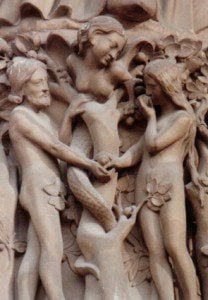
The question for today then is a Christian approach to human evolution in the context of the message of faith contained in Gen 3, Rom 5-8 and 1 Cor 15 . Dr. Lamoureux proposes that the question of Adam and of the fall is incidental to the message of scripture in general and to the message of Paul in particular. It is incidental because it is part of an ancient understanding of origins. The true impact of Paul’s message is Christ looking forward, not his use of Adam or understanding of human origins.
Is it possible that Adam is incidental to the Christian story?
More importantly perhaps, is it possible that the fall is incidental to the Christian story?
What are the theological consequences?
Dr. Lamoureux frames his entire discussion in chapter 8 around the connection between sin and death. He argues for a baldly literal interpretation of Genesis implicit in Paul’s arguments in Romans 5. He argues for a completely literal intent in Genesis 2-3 by the original authors and editors. The incidental message of scripture is that sin and death entered through the sin of Adam. This incidental message is simply wrong – an ancient misconception of creation and the nature of the world. Perhaps the best way to look at Dr. Lamoureux’s approach is to quote the most significant passages.
A key to interpreting Paul’s sin-death passages is found in his theodicy. Stated precisely, he seamlessly interweaves the first revelatory stage of theodicy in Gen 3 with the New Testament fulfillment of theodicy by Jesus. To justify suffering and death in the world, he looks backward into the past sin of Adam. He has no choice but to accept the historicity of the events of Gen 3 since these were the historical facts-of-the-day for first century Jews. But more importantly, Paul focuses forward and views the harsh realities of life in the fulfilling light of Jesus. He introduces an eternal perspective on theodicy and justifies that “we may share in His [Christ’s] sufferings in order that we may also share in His glory.” (Rom 8:17; cf. 8:18; 2 Cor 4:16-17), and adds that “we rejoice in our sufferings, because suffering produces perseverance; perseverance, character; and character, hope” (Rom 5:3, italics added; cf. 8:24-25; see next subsection). Despite our struggles and pain, Paul concludes: “we know that in all things God works for the good of those who love Him, who have been called according to His purpose” (Rom 8:28). In other words, his view of theodicy is a combination of (1) the ancient history of Gen 3 and (2) the radical theological development in the New Testament that our afflictions have eternal meaning. (p. 325)
In the next paragraph:
The origin of suffering and death is cast in an ancient understanding of history with no correspondence to reality, while the fulfillment of these afflictions occurs in real history. Since this ancient history and theological development are tightly woven, it is quite natural for modern readers to link them and to view both as actual historical events. However, this conflates the ancient motif of a lost idyllic age with the most imporant event of history – the Incarnation. Christians today must separate the fulfillment of the biblical revelation on theodicy through Jesus from Paul’s ancient understanding of the origin of suffering and death through Adam. Failure to do so collapses incidental ancient categories with revealed eternal truths. (pp. 325-326).
This can be summed up:
To conclude, there is no sin-death problem. Adam never existed, and therefore suffering and death did not enter the world in divine judgment for his transgression. The origin of physical death presented in Gen 3 is rooted in ancient history and ancient science. Consequently, sin is not causally connected to death and no conflict exists between Gen 3 and the fossil record. To be sure, the solution proposed in this section is quite complex. But the divine revelation in Gen 3, Rom 5-8 and 1 Cor 15 is very simple: humans are sinners, God judges sin, and Jesus dies for sinful men and women. The sin-death problem is ultimately the product of a conceptual distance in the categories between inspired writers of Scripture and its modern readers. Christians today must identify the incidental ancient view of origins and separate it from the inerrant Message of Faith. Indeed sin entered the world, but not with Adam. (p. 329)
Dr. Lamoureux’s approach to the sin-death problem is summarized in the figure below:

And in conclusion Dr. Lamoureux recasts the famous statement of Galileo:
The Bible does not teach us how God made humans or how suffering and death entered the world, but that we were created in the Image of the Father, Son, and Holy Spirit, that He judges our sins, and that Jesus died on the Cross in order to forgive us. (p. 331)
Where does this leave us? I agree with Dr. Lamoureux that Adam, Eve, the snake, and ancient views of origins are incidental in the meaning of the text – the message of faith. But I have never found the connection between sin and death, especially all biological death to be persuasive. The idea of a cosmic fall and a change in the material nature of the world on account of such a fall is either incidental to the message – or a view resulting from a misreading of the text. It is not clear to me that Dr. Lamoureux’s insistence on a literal intent for the text of Genesis is quite right. Nor does this literalistic understanding of an idyllic age and a catastrophic fall seem quite fair to the range of ancient thought or to the range of thought in the first century. In particular it does not seem consistent with the book of Job, also a part of the Hebrew scriptures.
The Sin-death connection is a problem to be discussed, but I don’t see it as the central problem in a discussion of evolutionary human origins. Sin and Accountability and consequently Atonement are the key theological issues. Dr. Lamoureux’s proposal for a Christian approach to human evolution does not answer these. We simply have sinfulness as a fact of life, presumably a part of the way we were created. It seems to me that part of the message of faith is that God created humans for relationship with him, for relationship with each other, that humans willfully rebelled, and that rebellion has consequences. I don’t see where this fits in Dr. Lamoureux’s approach to Genesis or his approach to Paul.
The sin-accountability connection has consequences for the view of atonement. In Dr. Lamoureux’s approach we have the incarnation, crucifixion, and resurrection as facts – but it is not clear what was accomplished and why it was necessary.
This is an interesting book, a good step in thinking through the issues of scripture, theology, and human origins. In particular, the message-incident principle is a useful guide in thinking through the relationship between cultural assumptions and views of cosmology implicit in the text and scripture as inspired of God.
What do you think?
Is the fall – human culpability in rebellion – a part of the message of faith in Genesis and Romans?
Or is Dr. Lamoureux right, that scripture does not teach how sin and suffering entered the human experience?
It you wish to contact me directly you may do so at rjs4mail[at]att.net
If interested you can subscribe to a full text feed of my posts at Musings on Science and Theology.
For those who find the full book (400+ pages) somewhat daunting Dr. Lamoureux has condensed the book into a more accessible version, I Love Jesus & I Accept Evolution. He also provides audio and slide summaries of each chapter of Evolutionary Creation online.
Previous Post

January 11, 2011
The Lord Alone 1
Next Post
January 11, 2011 Repeal the Death Penalty
Browse Our Archives
Select a Category Acts of the Apostles Adam Advent Anabaptism Angels Anglican Apologetics Atonement Baptism BCP Prayers Bible Biblical Studies Birds Blogging Bloglossary Bonhoeffer Books Calvinism Christianity Church Church History Coffee Colossians Commentary Recs Conversion Creation Creeds Culture Death Ecclesiastes Economics Education Embracing Grace Emergent Emerging Movement Eschatology Essays Ethics Eucharist Evangelicalism Family Fasting Fathers Fellowship of Differents Footsteps Tour Fun and Whimsical Gospel Grace Happiness Heaven Hell Holy Spirit Irenaeus James Jesus Jesus Creed Job Justification Kingdom of God Law Lectures Lent Liberalism Love and Marriage Mabanteneni Manhood Mary Miracles Missio Alliance MissioLife Missional Missional Jesus Movies and Film New Perspective Northern Seminary OneLife Origins Project Orthodox Parables Pastor's Spouse Pastoring and Leading Pastoring and Preaching Patristics Paul Paul-John Tour Pharisees Pietism Political Theology Prayer and Formation Preaching Problems for Faith Psalm 119 Psalms Public Issues Purgatory Religions Resurrection Revelation Romans Rule of JCreed Science and Faith Sermon on the Mount Sports Ten Commandments Theology Third Way Top Ten Lists Translations Uncategorized Universalism University Ministry Way Out Weekly Meanderings Wisdom Women and Ministry Work Worship Writing & Blogging Youth Ministry
Select a Month July 2021 January 2020 December 2019 November 2019 October 2019 September 2019 August 2019 July 2019 June 2019 May 2019 April 2019 March 2019 February 2019 January 2019 December 2018 November 2018 October 2018 September 2018 August 2018 July 2018 June 2018 May 2018 April 2018 March 2018 February 2018 January 2018 December 2017 November 2017 October 2017 September 2017 August 2017 July 2017 June 2017 May 2017 April 2017 March 2017 February 2017 January 2017 December 2016 November 2016 October 2016 September 2016 August 2016 July 2016 June 2016 May 2016 April 2016 March 2016 February 2016 January 2016 December 2015 November 2015 October 2015 September 2015 August 2015 July 2015 June 2015 May 2015 April 2015 March 2015 February 2015 January 2015 December 2014 November 2014 October 2014 September 2014 August 2014 July 2014 June 2014 May 2014 April 2014 March 2014 February 2014 January 2014 December 2013 November 2013 October 2013 September 2013 August 2013 July 2013 June 2013 May 2013 April 2013 March 2013 February 2013 January 2013 December 2012 November 2012 October 2012 September 2012 August 2012 July 2012 June 2012 May 2012 April 2012 March 2012 February 2012 January 2012 December 2011 November 2011 October 2011 September 2011 August 2011 July 2011 June 2011 May 2011 April 2011 March 2011 February 2011 January 2011 December 2010 November 2010 October 2010 September 2010 August 2010 July 2010 June 2010 May 2010 April 2010 March 2010 February 2010 January 2010 December 2009 November 2009 October 2009 September 2009 August 2009 July 2009 June 2009 May 2009 April 2009 March 2009 February 2009 January 2009 December 2008 November 2008 October 2008 September 2008 August 2008 July 2008 June 2008 May 2008 April 2008 March 2008 February 2008 January 2008 December 2007 November 2007 October 2007 September 2007 August 2007 July 2007 June 2007 May 2007 April 2007 March 2007 February 2007 January 2007 December 2006 November 2006 October 2006 September 2006 August 2006 July 2006 June 2006 May 2006 April 2006 March 2006 February 2006 January 2006 December 2005 November 2005 October 2005 September 2005 August 2005 July 2005 June 2005 May 2005 April 2005 0000
Follow Us!
TAKE THE
Religious Wisdom Quiz
What does "Shema" mean in Hebrew?
Select your answer to see how you score.
Wait Pray Hear Obey
Related posts from Jesus Creed


Wise Words (from a long time ago)

Heaven Promise Livestream Event
TRENDING AT PATHEOS Evangelical

The REST of Your Life: A Creative Wrestles...
This week I had a conversation with a good friend from church....

How the author of the world's best hymn...
I've been working with John Newton for a while now. This makes...

Long before this Lectio Divina, Psalm 130 - the song - started...

What About the Trees? Another Living Parable
After I finished writing the last article about falling leaves as a...

Why Classical Education Is a Conversation, Not a...
Come and Read: Joy in Classical Education When I was a little...

Cornell University has received a great deal of negative publicity and intense...
view all Evangelical blogs
Ad-Free & Subscriber Log-In Subscription Support
- About Us
- 2026 Calendar
- Videos
- Podcasts
- Library of World Religions
- Faith In Media Tracker
- Advertise With Us
- Write for Us
- Privacy Policy
- Terms of Service
- Do Not Sell My Data
- Contact Us
- Radiant Digital
- Manage Newsletter Subscriptions
- Unsubscribe From Notifications
- Sitemap
Copyright 2008-2026, Patheos. All rights reserved.
Subscription Support Ad-Free & Subscriber Log-In
Follow Patheos